Language


Views: 255 Author: Yinda Powder Coating Publish Time: 2026-10-06 Origin: Site


Content Menu
● What Hot and Cold Powder Coating Application Actually Mean
>> Hot Application: Powder Deposition onto Pre-Heated Steel
>> Cold Application: Ambient-Temperature Spraying Followed by Heat Curing
>> Pre-Baking Is Not the Same as Hot Application
● Hot Application vs. Cold Application: Comparison Table
● Why Thick Steel Structural Beams Need Different Process Planning
>> Thermal Mass Changes the Oven Schedule
>> Beam Geometry Creates Uneven Conditions
>> Structural Use Adds Specification Constraints
● Film Thickness, Appearance, and Difficult-Area Coverage
>> Hot Application Can Increase Build but Reduce Forgiveness
>> Cold Application Usually Offers Better Deposition Control
>> Hot Flocking Does Not Automatically Solve Recess Coverage
● Corrosion Resistance Depends on the Coating System
>> Surface Preparation Comes Before Application Temperature
>> Select Primer and Topcoat for the Actual Environment
>> Treat Outgassing as a Substrate-Specific Problem
● A Practical Qualification Plan for Heavy Steel Beams
>> Step 1: Define Acceptance Criteria Before Spraying
>> Step 2: Establish a Cold-Application Baseline
>> Step 3: Profile the Beam's Temperature
>> Step 4: Trial Hot Application as a Controlled Alternative
>> Step 5: Compare Accepted Output
● Energy and Production Cost: Measure the Complete Route
● Safety Requirements for Pre-Heated Beam Coating
● Choosing the Right Process with Yinda Technology
>> Is Hot Application Better for Thick Steel Structural Beams?
>> Does Cold Application Mean the Coating Needs No Oven?
>> Can Preheating Replace Final Curing?
>> Should Every Heavy Beam Be Pre-Baked?
>> Which Method Provides Better Corrosion Resistance?
>> How Should Cure Be Checked on Thick Beams?
Hot application (pre-heated metal) vs. cold application powder coating for thick steel structural beams is a process-control decision—not simply a choice between two spraying temperatures. Heavy beams store substantial heat, warm unevenly, and present difficult coating areas around flanges, welds, and stiffeners. The right application method must deliver consistent coverage without compromising cure, appearance, safety, or production efficiency.
Cold application is generally the better starting point for controlled electrostatic deposition. Hot application can be useful when a qualified coating system requires heated-substrate deposition or when trials demonstrate a specific advantage. However, preheating does not automatically improve corrosion resistance or eliminate the need for a validated cure cycle.
For Yinda Technology, a powder coating and environmental materials manufacturer with subsidiaries in China, Indonesia, and Saudi Arabia, the practical priority is matching powder chemistry, beam geometry, exposure conditions, and available equipment.
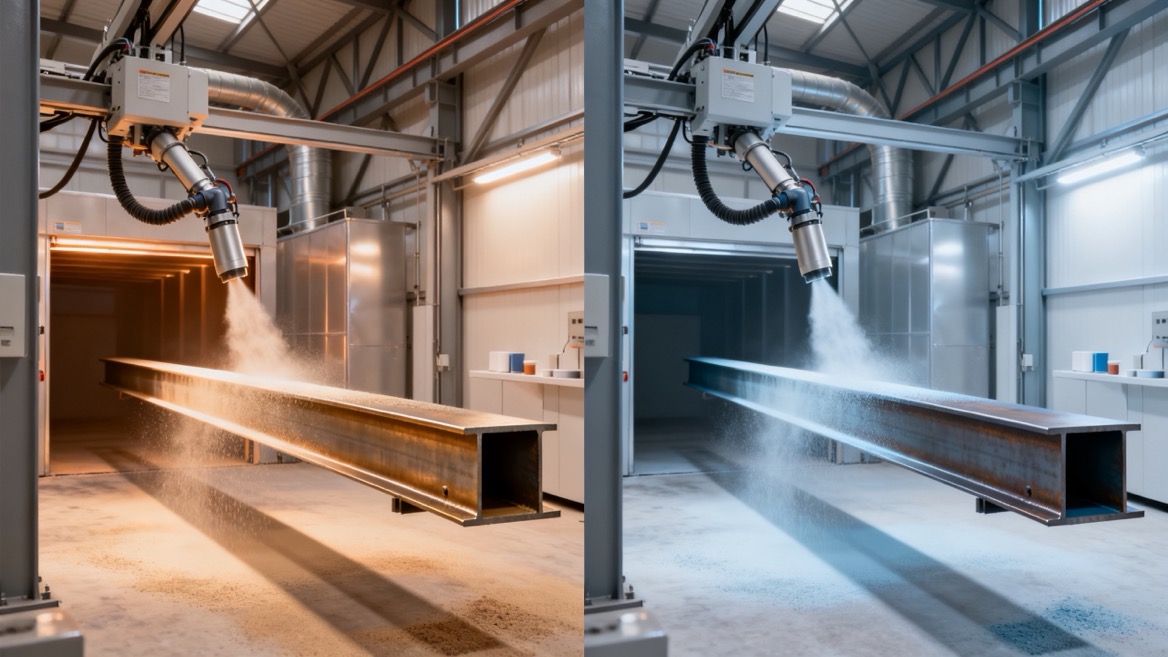
Hot application involves spraying powder onto steel that has been deliberately heated before deposition. When the surface is sufficiently hot for the selected powder, particles can soften or melt on contact. This technique is commonly called hot flocking.
Electrostatic equipment may still be used. However, heat changes how the powder deposits and builds, so the operator cannot assume that conventional room-temperature settings will produce the same film.
This article compares electrostatic spray application onto heated and ambient-temperature beams. It does not cover fluidized-bed coating, which uses a different deposition process.
Cold application means applying powder to prepared steel at approximately ambient temperature. Charged particles are attracted to the grounded beam, creating an uncured powder layer.
The beam then enters an oven, where the coating melts, flows, and—for the thermoset powders discussed here—crosslinks.
"Cold" describes the application stage, not the complete process. Cold-applied thermoset powder still requires the specified thermal cure.
Pre-baking heats an uncoated component to help release trapped moisture or gases before coating.
A beam can be pre-baked, cooled, and then cold-coated. Alternatively, an approved process may apply powder while the component remains warm.
Keep these decisions separate:
- Does the substrate need a degassing treatment?
- At what temperature should powder be applied?
- What final cure schedule does the formulation require?
Combining them into one generic "preheat" instruction creates avoidable uncertainty.
| Process factor | Hot application on pre-heated steel | Cold application on ambient-temperature steel |
|---|---|---|
| Deposition behavior | Heat can soften or melt powder on contact | Primarily controlled by electrostatic attraction |
| Film thickness | Can build quickly; requires careful control | Generally easier to adjust through spray settings and passes |
| Appearance | Sensitive to surface temperature and spraying sequence | More predictable starting point for decorative consistency |
| Recess coverage | May help selected applications, but requires trials | Requires effective grounding and recess-focused gun settings |
| Cure management | Preheat history and cooling during spraying must be considered | Heat-up time and cure hold must be measured |
| Handling | Adds hot-component transfer and burn risks | Avoids hot handling during initial spraying |
| Energy use | Adds a heating stage unless integrated into production | Avoids deliberate application preheating |
| Best starting use | Specially qualified deposition requirements | General structural-beam production |
Neither method compensates for inadequate cleaning, unsuitable chemistry, poor grounding, or insufficient cure.
Heavy beams can take considerably longer than thin components to reach the required part metal temperature.
Oven air temperature is not proof that the steel has reached cure temperature. The Powder Coating Institute distinguishes the time needed to heat the component from the dwell time required for curing.
Consider a hypothetical powder requiring 10 minutes at 180°C metal temperature. If a monitored beam location needs 35 minutes to reach 180°C, a 10-minute total oven cycle is insufficient.
This example illustrates timing—not a recommended cure schedule. Always follow the selected product's technical data sheet and validated temperature profile.
Flanges, webs, welded plates, and stiffeners can experience different heating and deposition conditions.
During hot application, exposed areas may cool while an operator works around the beam. During cold application, electrostatic attraction may favor accessible edges over recessed intersections.
I would therefore assess the complete beam rather than judge the process from one attractive, easily sprayed face.
A coating decision should also address installation requirements.
Identify connection surfaces, masked areas, repair procedures, and any project restrictions before production. Where a connection requires defined friction or contact behavior, obtain approval for the coating arrangement from the responsible engineer.
A visually satisfactory finish is not automatically suitable for every structural connection.
Powder that melts on contact may accumulate rapidly. This can be useful when the formulation and specification support greater film build.
The same behavior creates risks:
- Local over-thickness.
- Uneven texture.
- Different appearance between early and late spray passes.
- Difficulty correcting a partially formed film.
Do not treat extra thickness as free protection. Establish minimum and maximum dry film thickness for the complete system, including individual layers where applicable.
Ambient-temperature application lets the operator adjust powder output, gun distance, electrical settings, and pass sequence before curing.
This makes it a practical baseline for beams requiring repeatable color, gloss, and thickness.
However, it still needs a disciplined process. Increasing voltage or powder output indiscriminately can worsen deposition around difficult geometry rather than solve it.
Internal corners and flange-to-web intersections can experience electrostatic shielding, commonly described as the Faraday cage effect.
For either application route, prioritize:
1. Clean, reliable grounding.
2. Suitable gun settings for recessed areas.
3. Controlled powder delivery.
4. A spray sequence that addresses difficult areas first.
5. Thickness checks at accessible and recessed locations.
Use hot application only if representative trials show that it improves coverage without creating unacceptable build elsewhere.
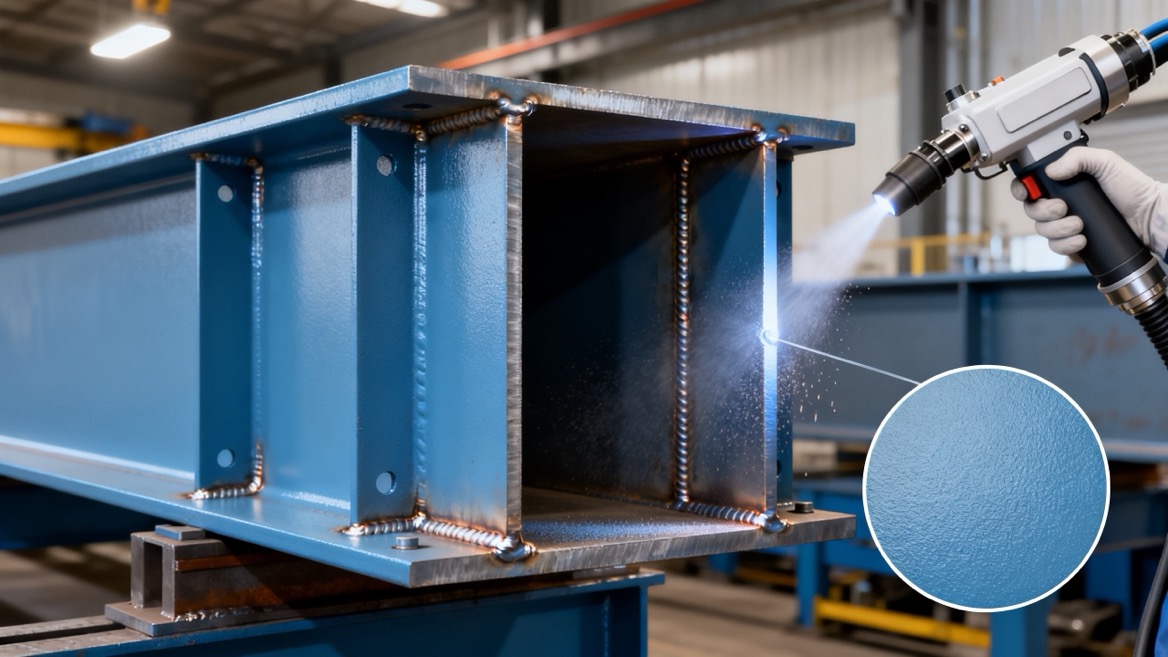
Mill scale, corrosion, oil, welding residues, and other contaminants can compromise coating performance.
Preparation should follow the selected system specification. Depending on the substrate and exposure, this may involve cleaning, abrasive blasting, chemical pretreatment, or a qualified combination.
Specify the required surface condition and profile. "Blast cleaned" alone is not a complete acceptance criterion.
Heating contaminated steel does not make it properly prepared.
Neither hot nor cold application is inherently a corrosion-protection system.
For demanding exposure, evaluate a compatible primer and topcoat rather than assuming one thicker decorative layer will suffice. Manufacturer documentation illustrates this system-based approach: Jotun's steel primers are designed for specified prepared substrates and compatible coating arrangements.
For exterior beams, assess weathering requirements alongside corrosion resistance. Do not select chemistry solely because it deposits successfully on hot steel.
Outgassing is especially relevant to porous or galvanized substrates. A thick fabricated steel beam does not automatically require degassing simply because it is heavy.
If trials reveal pinholes or related defects, investigate substrate condition, contamination, preparation, and the powder's degassing capability.
Any pre-bake temperature must respect the substrate, pretreatment, and powder supplier's instructions. A published recommendation for one system is not a universal beam-coating recipe.
Record:
- Beam dimensions and representative geometry.
- Substrate condition.
- Exposure environment.
- Approved powder system.
- Film thickness limits.
- Appearance requirements.
- Adhesion and other specified performance tests.
- Masking and repair requirements.
This creates a fair comparison between hot and cold application.
Start with the prepared beam at ambient temperature.
Document gun settings, spray sequence, powder consumption, and difficult-area coverage. This baseline helps determine whether preheating delivers a real improvement.
Without it, a successful hot-coated sample proves only that one sample was coat-able.
Use attached thermocouples and a suitable data logger to monitor representative locations.
Include heavy intersections and locations expected to heat slowly. An infrared thermometer may assist with surface checks, but it should not replace a properly planned cure profile for qualification.
Verify the required temperature-and-time conditions at the monitored coating locations, while checking that faster-heating areas remain within the permitted bake window.

If hot application addresses an identified problem, define:
- Permitted application-temperature range.
- Transfer time from oven to booth.
- Spray sequence.
- Maximum application duration.
- Final curing requirements.
Do not assign one preheat temperature to every powder formulation.
Repeat trials across representative beams. A process that works only when one experienced operator moves unusually quickly is difficult to scale.
Measure thickness distribution, appearance, specified performance, cycle time, energy use, powder use, and rework.
The preferred method is the one that repeatedly produces compliant beams—not the one that looks fastest during spraying.
Preheated beams retain useful thermal energy, but preheating itself consumes energy. Transfer losses, oven loading, extra handling, and final curing determine whether the overall route is efficient.
Likewise, cold application avoids deliberate application preheating but still needs enough oven capacity to cure heavy steel correctly.
A useful comparison is:
Energy per accepted beam=Total energy used for the production batch/Number of accepted beams
Track rework separately. A shorter nominal cycle may cost more if it creates thickness defects or undercured coating.
My recommended trial scorecard includes:
| Metric | Why it matters |
|---|---|
| Energy per accepted beam | Captures heating and yield together |
| Powder per accepted beam | Reveals excess build and process losses |
| First-pass acceptance rate | Measures repeatability |
| Total production time | Includes heating, transfer, spraying, and curing |
| Rework hours | Exposes hidden labor costs |
Powder coating requires effective ventilation, grounding, housekeeping, and control of ignition hazards.
Hot application adds heated-component handling and introduces a hot surface into the application workflow. Confirm that the booth, equipment, powder safety data, and operating procedure permit the proposed conditions.
Use an engineered handling arrangement for heavy beams. Address lifting, operator access, exclusion zones, and burn protection.
OSHA spray-finishing requirements provide a useful reference for ventilation and electrical grounding. Facilities in China, Indonesia, and Saudi Arabia must also evaluate their applicable local requirements rather than treat a United States regulation as the complete compliance framework.
Yinda Technology's work in powder coatings, environmental materials, and energy-saving technology makes the full production route the relevant discussion—not simply the powder's application temperature.
For a project review, provide beam drawings, substrate details, exposure conditions, oven capabilities, target thickness, and required acceptance tests.
Ask Yinda Technology to evaluate a suitable coating formulation and application route using representative trials. Request technical data, safety information, and a qualification plan before committing to production.
The objective should be a documented process window that delivers consistent protection with measurable material, energy, and handling requirements.
Not automatically. Cold application is generally the better-controlled starting point. Hot application needs a demonstrated benefit for the selected powder, geometry, and specification.
No. It means the powder is sprayed onto approximately ambient-temperature steel. Conventional thermoset powder still requires its specified heat-curing process.
Do not assume so. Melting on contact is not proof of complete crosslinking. Verify the manufacturer's required temperature-and-time conditions using the qualified process.
No. Thermal mass alone does not establish a degassing need. Investigate substrate condition and trial results before adding a pre-bake stage.
Neither inherently. Preparation, coating chemistry, system design, thickness, coverage, and cure determine protection more directly than application temperature alone.
Profile representative metal locations with attached thermocouples and a data logger. Confirm the specified cure conditions and complete the required coating acceptance tests.
1. Powder Coating Institute. "Frequently Asked Questions." Technical guidance on pretreatment, metal temperature, heat-up time, cure dwell, and oven profiling. [powdercoating]
2. Powder-X. "Should I Preheat the Part Before Spraying Powder?" July 17, 2025. Industry guidance on ambient-temperature application and limitations of hot flocking. [blog.powderx]
3. Eastwood. "What Is 'Hot Flocking' and When Do I Do It?" March 23, 2016. Practical description of powder application onto pre-heated components; not used here as a universal temperature specification. [eastwood]
4. TIGER Coatings. "Outgassing in Powder Coatings and How to Prevent It." December 21, 2022. Guidance on substrate outgassing and pre-treatment heating considerations. [tiger-coatings]
5. Jotun. "Primax Protect." Manufacturer information on powder primer use for prepared steel, including edge coverage, degassing, and intercoat adhesion. [jotun]
6. Occupational Safety and Health Administration. "29 CFR 1910.107—Spray Finishing Using Flammable and Combustible Materials." Regulatory guidance covering powder spraying, ventilation, and electrical grounding. [osha]


