Language


Views: 287 Author: Yinda Powder Coating Publish Time: 2026-08-08 Origin: Site


Content Menu
● Side-by-Side Material Comparison
● Why Cold Storage Shelving Fails Earlier
>> Condensation Is the Main Surface Challenge
>> Freeze-Thaw Cycling Tests Adhesion
>> Cleaning Chemicals Can Change the Result
● Hygiene Performance: What Antimicrobial Polyester Can—and Cannot—Do
>> The Responsible Way to Specify Antimicrobial Shelving
● Corrosion Protection: Barrier Coating vs. Sacrificial Zinc
>> Expert View: Focus on the Failure Point
● Application Recommendations by Facility Type
>> Chilled Food Storage and Distribution
>> Pharmaceutical, Medical, and Laboratory Refrigeration
>> General Industrial Refrigeration
● A Practical Selection Checklist
● Design Details That Improve Shelf Service Life
● The Long-Term Cost Perspective
● FAQs
>> 1. Is antimicrobial polyester better than zinc-plated steel for every cold room?
>> 2. Does antimicrobial polyester eliminate the need to clean shelves?
>> 3. Can zinc-plated shelving rust in a refrigerator room?
>> 4. What test report should buyers request for antimicrobial shelving?
>> 5. Is powder-coated shelving suitable for freezer rooms?
>> 6. Which shelf finish is easier to inspect visually?
>> 7. What matters most when choosing a powder coating supplier?
Cold storage shelving operates in a difficult environment: low temperatures, repeated washdowns, condensation, food-contact risk, forklift traffic, and high demands for uptime. When comparing antimicrobial polyester vs. zinc-plated steel for cold storage and refrigeration room metal shelving, the right choice depends on hygiene priorities, corrosion exposure, loading conditions, cleaning methods, and the facility's long-term maintenance plan.
For many refrigerated warehouses, zinc-plated steel remains a practical, cost-effective shelving material. However, an antimicrobial polyester powder-coated steel system can offer a more complete surface solution where operators need enhanced cleanability, colour consistency, corrosion protection, and a surface designed to limit bacterial survival. The key is to evaluate the complete shelving system—not simply the coating name.

Zinc-plated steel shelving consists of a steel substrate covered with a zinc layer. Zinc acts as a sacrificial protective layer: when moisture reaches the surface, zinc corrodes before the underlying steel. This makes zinc plating a familiar option for dry storage, commercial racking, utility shelving, and moderately humid industrial areas.
Antimicrobial polyester shelving normally uses a steel substrate coated with a cured polyester powder coating containing an antimicrobial additive. The polyester coating forms a continuous protective film over the metal. Its antimicrobial function is intended to inhibit or reduce bacterial activity on the treated surface under defined test conditions.
The comparison is therefore not simply "polyester versus zinc." It is more accurately:
- A zinc metallic coating designed mainly for corrosion protection.
- A polyester powder coating system designed for appearance, barrier protection, cleanability, and—when properly formulated and tested—antimicrobial surface performance.
For refrigerated storage, this distinction matters because condensation, condensation-freeze cycles, cleaning chemistry, and residue accumulation can all affect shelf performance.
| Evaluation Factor | Antimicrobial Polyester Powder-Coated Steel | Zinc-Plated Steel |
|---|---|---|
| Primary protection mechanism | Organic barrier film over steel; antimicrobial additive may reduce bacterial activity on the surface | Zinc sacrificial protection of steel |
| Surface appearance | Smooth, uniform, available in custom colours and finishes | Metallic silver-grey appearance; may dull or develop white corrosion products |
| Hygienic positioning | Can support hygiene-focused designs when independently tested | No inherent antimicrobial claim |
| Corrosion performance | Depends on pretreatment, film thickness, edge coverage, cure quality, and service environment | Depends on zinc coating weight, passivation, drainage, humidity, and chemical exposure |
| Resistance to fingerprints and visual staining | Usually better, especially in light-coloured or textured finishes | Can show water marks, oxidation, and handling marks |
| Cleaning experience | Smooth powder-coated surfaces can be easier to inspect and wipe clean | Durable but may become harder to clean if corrosion products or surface roughness develop |
| Abrasion risk | Deep scratches can expose the steel beneath the coating | Scratches retain some nearby sacrificial zinc protection, depending on damage size and environment |
| Best fit | Food-related storage, medical equipment zones, clean commercial refrigeration, premium retail displays | Budget-focused storage, dry or lower-hygiene utility areas, heavy industrial racking |
| Important limitation | Not a replacement for cleaning, sanitation, drainage, or temperature control | Not a hygiene-control surface and may corrode under persistent moisture or aggressive cleaners |
Neither material is universally superior. A freezer room holding sealed cartons may prioritize structural loading and cost. A chilled food preparation area with frequent human contact, open-product handling, and strict cleaning documentation may place greater value on a continuous antimicrobial polyester finish.
Cold rooms are not simply "cool warehouses." Refrigerated environments create a combination of risks that accelerate coating breakdown and complicate cleaning.
When warm, humid air enters a cold room, water can condense on metal shelving. This commonly occurs around doors, evaporator discharge zones, loading bays, and areas with frequent traffic. Moisture trapped beneath cartons, plastic totes, shelf joints, or welded corners can remain in place for long periods.
Zinc-plated steel can perform well when shelves drain properly and remain relatively dry. But persistent wetness may lead to white rust, a powdery zinc corrosion product that can affect appearance and may create a rougher surface. Once the zinc layer becomes depleted, red rust from the steel substrate can follow.
A well-designed polyester powder coating acts as a barrier between moisture and steel. Its performance depends heavily on surface preparation, coating continuity, film thickness, curing discipline, and protection at edges and welds. In practice, coating quality often matters more than the generic label "polyester."
Cold storage equipment may experience temperature changes during defrost cycles, door openings, cleaning shutdowns, or maintenance. Different materials expand and contract at different rates. If pretreatment is weak or the powder coating is under-cured, repeated cycling can contribute to cracking, loss of adhesion, or edge lifting.
For this reason, buyers should request samples tested under conditions that resemble the planned operating range. A coating that looks excellent at room temperature may not perform the same way in a high-humidity chill room or a sub-zero freezer.
Cold storage shelving is often exposed to detergents, alkaline cleaners, sanitizers, and disinfectants. Some chemical combinations can attack zinc surfaces, especially when they remain wet for extended periods. Strong chemicals can also dull, soften, or damage an unsuitable powder-coated surface.
Before specifying either option, confirm:
1. The routine cleaning chemicals and concentrations.
2. The expected contact time before rinsing.
3. The water temperature and washdown pressure.
4. Whether shelves will be air-dried or manually dried.
5. The coating supplier's chemical-resistance guidance.
This simple review prevents a common procurement mistake: selecting a shelf based only on its initial corrosion rating rather than its actual cleaning environment.
Antimicrobial polyester powder coating is most valuable as an additional surface-control measure. It can help reduce bacterial survival or growth on the treated surface when the coating formulation, additive loading, and test conditions support that claim.
ISO 22196 is widely used to measure antibacterial activity on treated, non-porous surfaces. The method compares bacterial recovery from a treated sample and an untreated control after a defined exposure period. It is useful for comparing surface formulations, but it does not replicate every condition inside an operating refrigeration room. Standard laboratory conditions, contamination levels, organisms, moisture, abrasion, food residues, and cleaning intervals may differ from real use.
In one commercial refrigerator shelving study using an antimicrobial powder-coated steel finish, treated samples demonstrated more than 99.7% reduction of *Listeria monocytogenes* after 24 hours at 4°C compared with untreated coated controls. This is relevant evidence for cold environments, but buyers should treat it as formulation-specific—not as a universal result for every antimicrobial polyester product.
A credible product specification should include:
- The exact coating chemistry and antimicrobial technology.
- The steel grade, pretreatment process, and coating thickness.
- Test organism names and test standard.
- Test temperature, exposure time, and measured reduction result.
- Results before and after abrasion, cleaning, or ageing where available.
- Clear wording that the coating supplements, rather than replaces, sanitation procedures.
An antimicrobial surface is not self-cleaning. It cannot remove dirt, food residues, grease, packaging debris, or biofilm already established in damaged joints. It also does not eliminate the need for scheduled cleaning, proper ventilation, staff hygiene, pest management, and temperature monitoring.
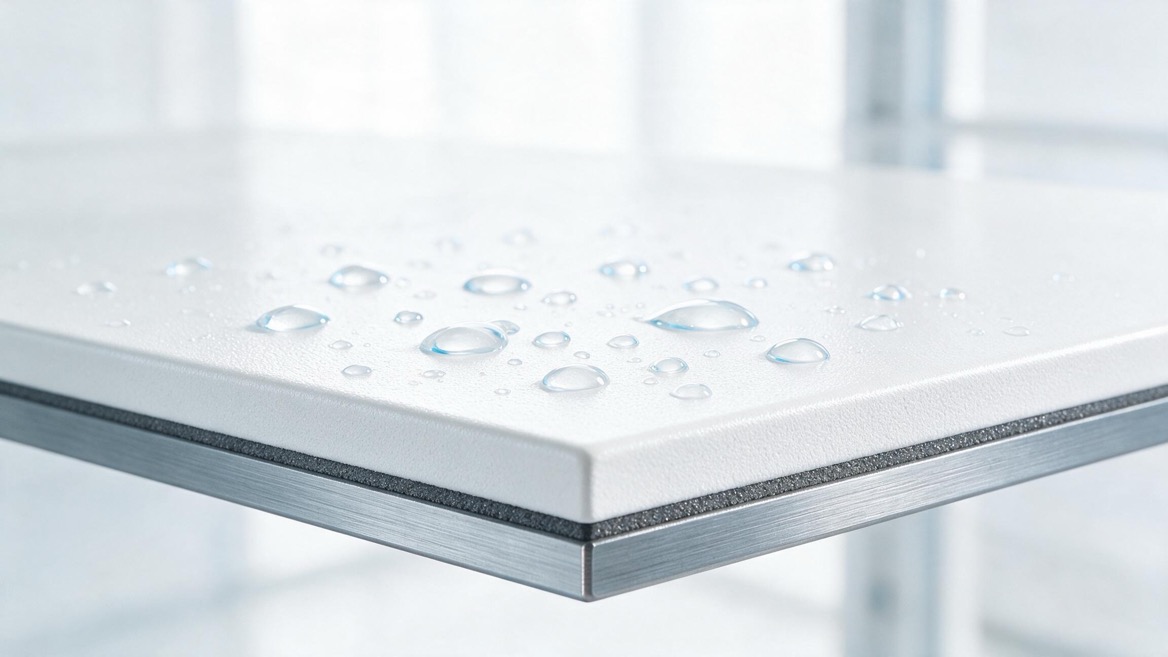
The key engineering difference is how each system responds when the surface is damaged.
Zinc plating offers sacrificial protection. Zinc is more reactive than steel, so it can help protect small exposed areas near scratches. This is a meaningful advantage for shelving that experiences frequent impacts from metal trays, wire baskets, or heavy containers.
Polyester powder coating provides a physical barrier. When the film remains intact, it can isolate the steel from water, oxygen, and many contaminants. However, a deep impact that breaks through the coating can expose the steel. In poorly protected locations—especially sharp edges, bolt holes, welds, and feet—corrosion may begin beneath the coating.
For this reason, the best antimicrobial polyester shelving systems use more than a good topcoat. They combine:
- Careful degreasing and conversion pretreatment.
- Controlled powder application and curing.
- Adequate film build across flat areas and edges.
- Rounded shelf edges rather than sharp corners.
- Weld finishing that removes crevices and traps.
- Replaceable feet, guards, or bump protection in high-impact zones.
From an industrial coating perspective, the "best coating" is not always the one with the highest laboratory rating. The best solution is the one that protects the most vulnerable point in the actual installation.
For zinc-plated shelving, that may be areas where alkaline wash chemicals remain trapped. For powder-coated shelving, it may be the front edge struck repeatedly by loading equipment. A site inspection should identify these zones before material selection.
For chilled facilities handling dairy, produce, meat packaging, seafood, ready-to-eat products, or meal ingredients, antimicrobial polyester powder-coated shelving is often the stronger choice when hygiene, visibility, and frequent cleaning are priorities.
A light-coloured finish can make spills, corrosion, and residues easier to identify during inspection. A smooth, continuous coating can also improve the visual standard of customer-facing or audit-sensitive storage areas.
Specify a tested system and verify its performance at the facility's normal temperature range. Do not rely solely on an ambient-temperature test report.
In frozen storage, moisture may be lower in stable areas, but frost, defrost events, ice build-up, and door-zone condensation can still occur. Zinc-plated shelving can be appropriate for budget-sensitive, sealed-product storage where direct food exposure is not expected and cleaning frequency is limited.
For freezer rooms with regular washdowns, visible shelving, or strict hygiene requirements, a robust polyester powder coating may offer better appearance retention and easier inspection. The coating must be selected for low-temperature adhesion and impact resistance.
These spaces often prioritize documented cleaning procedures, orderly appearance, surface integrity, and material traceability. Antimicrobial polyester-coated steel can be a practical option, particularly where shelving must align with a controlled and professional environment.
However, medical or pharmaceutical use may require specific material, cleaning-agent, particle-shedding, and regulatory validation beyond an antimicrobial claim. Buyers should confirm the final product specification with the facility's quality team.
For spare parts, sealed components, machinery items, and non-food inventory, zinc-plated steel is often sufficient. It provides familiar durability and a competitive purchase cost.
If the area is humid, highly visible, frequently cleaned, or close to food-processing operations, upgrading to a powder-coated system can reduce maintenance work and improve the facility's presentation over time.
Use the following process before ordering cold storage metal shelving:
1. Map the environment. Record operating temperature, humidity, condensation zones, washdown frequency, door traffic, and possible chemical exposure.
2. Define the stored product. Identify whether items are sealed, open, food-related, medical, or sensitive to corrosion particles.
3. Set hygiene expectations. Determine whether the facility needs a conventional cleanable surface or independently supported antimicrobial surface performance.
4. Review mechanical risk. Consider shelf loads, impact points, pallet or cart contact, and whether wire shelving may damage coatings.
5. Request technical documents. Ask for coating thickness, pretreatment details, cross-hatch adhesion data, corrosion-test information, chemical-resistance guidance, and antibacterial test reports.
6. Inspect sample panels. Test cleaning, scratching, wet exposure, and visual appearance before approving large orders.
7. Plan maintenance. Include cleaning procedures, damage inspection, touch-up rules, and replacement parts in the operating plan.
This evaluation method helps procurement teams avoid choosing solely by price. A lower-cost shelf can become the more expensive option if it requires frequent replacement, creates cleaning difficulties, or weakens the visual standard of a facility.
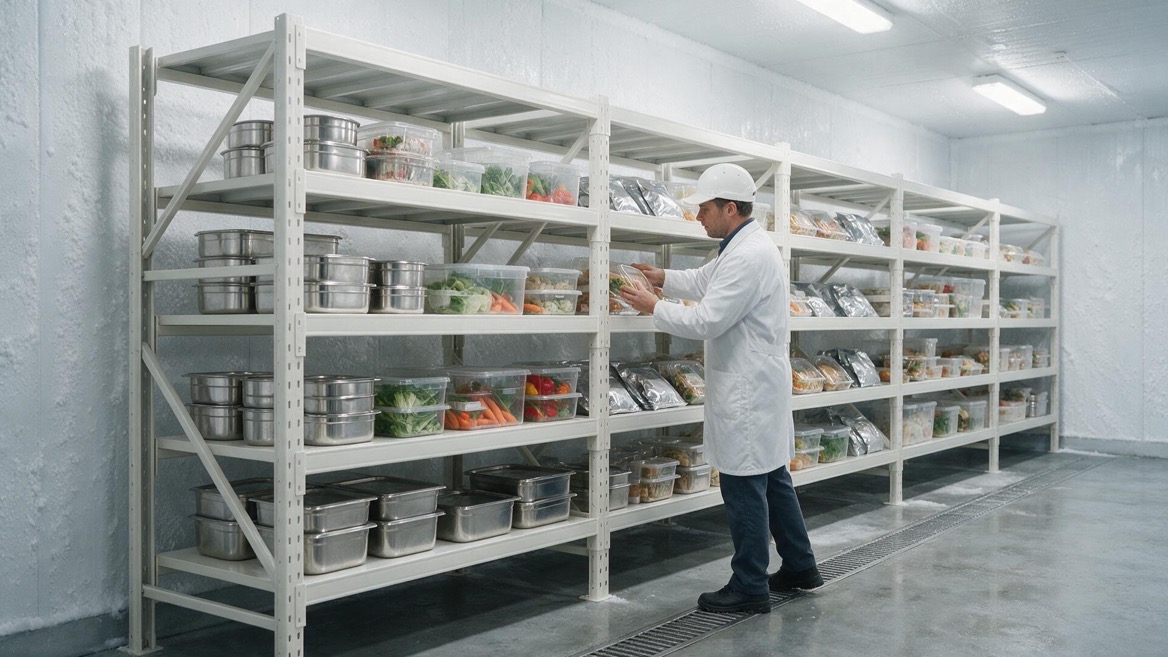
Material selection is only one part of a reliable cold-storage shelving system. The following design features often have an outsized impact on performance:
- Rounded edges reduce coating thinning and are easier to wipe.
- Closed or sealed tube ends prevent moisture from entering hollow sections.
- Drainage-friendly geometry avoids standing water on shelf surfaces.
- Fewer crevices reduce residue accumulation around joints and fasteners.
- Protected feet and lower frames resist wet-floor corrosion and cleaning damage.
- Modular replacement components reduce downtime after impact damage.
- Clear load labels help prevent bending, scratching, and unsafe overloading.
For high-hygiene installations, shelf layout should also allow access for cleaning tools and visual inspection. A perfect coating performs poorly if workers cannot reach the back corners, uprights, or underside of the shelf.
Zinc-plated steel generally has a lower initial cost and can deliver strong value in appropriate conditions. It is a sensible solution for many dry or moderately humid industrial storage applications.
Antimicrobial polyester powder-coated shelving may involve higher material and process costs, especially when it includes validated antimicrobial technology, high-quality pretreatment, and custom colours. Yet the investment can be justified when a facility values a cleaner visual environment, easier inspections, reduced staining, stronger brand presentation, and an added hygiene-control layer.
The decision should be based on total ownership cost:
Total Cost=Purchase Cost+Cleaning Labour+Maintenance+Replacement Risk+Downtime Risk
A shelf that remains cleanable, corrosion-resistant, and presentable for longer can provide better operational value than the lowest-priced alternative.
Choose zinc-plated steel shelving when the application is cost-sensitive, products are sealed, humidity is controlled, and hygiene performance is not a major specification requirement.
Choose antimicrobial polyester powder-coated steel shelving when cold storage operations require a smooth, inspectable finish, enhanced visual cleanliness, corrosion-barrier performance, and documented antimicrobial surface capability. For food, medical, and high-cleanliness refrigeration spaces, insist on evidence that reflects the intended temperature, cleaning regime, and use conditions.
Yinda Technology can support cold storage shelving manufacturers and equipment brands with powder coating solutions designed around real operating conditions. Share your substrate, temperature range, cleaning chemicals, desired colour, and hygiene requirements to develop a coating specification that balances performance, appearance, and production efficiency.
No. Antimicrobial polyester is usually better for hygiene-focused, visually demanding, or frequently cleaned refrigeration environments. Zinc-plated steel can be a cost-effective choice for sealed goods and less demanding industrial storage.
No. The coating can support surface hygiene, but it does not remove dirt, residues, spills, or established biofilm. Normal cleaning and sanitation procedures remain essential.
Yes. Persistent condensation, trapped water, harsh cleaning chemicals, and damage to the zinc layer can lead to white corrosion products and eventually red rust from the underlying steel.
Request an antibacterial activity report based on ISO 22196 or an equivalent relevant method. Review the test organism, reduction result, temperature, contact time, and whether the tested coating matches the commercial product being purchased.
Yes, when the coating system is designed and validated for low-temperature service. Confirm adhesion, impact resistance, cure quality, and performance after thermal cycling.
Light-coloured polyester powder-coated shelving is generally easier to inspect because stains, spills, corrosion spots, and residues are more visible than on metallic zinc finishes.
Look beyond colour cards. Evaluate pretreatment compatibility, coating thickness control, low-temperature performance, chemical resistance, antimicrobial test evidence, batch consistency, and technical support.
1. International Organization for Standardization. "[ISO 22196:2011 — Measurement of Antibacterial Activity on Plastics and Other Non-Porous Surfaces]." Method scope and framework for evaluating antibacterial-treated non-porous product surfaces. [iso]
2. de Carvalho, T. B., et al. "[A Closer Look at Studies Using the ISO 22196:2011 Standard]." *Applied Sciences*, 2024. Discussion of the method's controlled laboratory conditions and interpretation considerations. [pmc.ncbi.nlm.nih]
3. Microban International. "[Reduction of Listeria Monocytogenes Contamination of Refrigeration Units]." Commercial refrigerator shelving test using antimicrobial powder-coated steel at 4°C. [d3f46d68kgqe8v.cloudfront]
4. Molling, J. W., et al. "[Comparative Performance of a Panel of Commercially Available Antimicrobial Coatings]." *PLOS ONE*, 2014. Comparative evidence showing that antimicrobial results vary substantially by coating chemistry and formulation. [pmc.ncbi.nlm.nih]
5. Moretro, T., et al. "[Kinetics of Bacterial Survival on Polymer Coatings]." *Journal of Applied Microbiology*, 2004. Research highlighting the influence of environmental conditions and surface-accessible antimicrobial agents on performance. [pubmed.ncbi.nlm.nih]
6. Appendini, P., and Hotchkiss, J. H. "[Antimicrobial Food Equipment Coatings: Applications and Challenges]." *Journal of Food Protection*, 2014. Review of antimicrobial coating technologies for food-related equipment and surfaces. [pubmed.ncbi.nlm.nih]


