Language


Views: 255 Author: Yinda Powder Coating Publish Time: 2026-10-13 Origin: Site


Content Menu
● What Is Epoxy Powder Coating?
>> Why Manufacturers Choose Epoxy Powder Coatings
● Epoxy vs. Polyester vs. Hybrid Powder Coating
>> Can Epoxy Powder Coating Be Used Outdoors?
● Industrial Applications: Match the Coating to the Exposure
>> Appliances, Hardware, and Indoor Equipment
>> Electric Vehicle Components
● How to Specify an OEM Epoxy Powder Coating
>> Step 1: Define the Substrate and Part Geometry
>> Step 2: Document the Service Environment
>> Step 3: Set Appearance and Processing Requirements
>> Step 4: Agree on Evidence Before Ordering
● Cure Control: Measure the Part, Not Just the Oven
● Quality Testing: Read the Conditions Behind the Result
● Choosing an Epoxy Powder Coating Manufacturer
>> Yinda Technology: A Development-Oriented Option for OEM Projects
>> Other Supplier Options and Their Different Roles
● An Illustrative OEM Development Workflow
● Request a Coating Recommendation Before Placing Your Order
>> Is Epoxy Powder Coating Better Than Polyester?
>> What Temperature Does Epoxy Powder Coating Need?
>> Can Epoxy Powder Coating Prevent Rust?
>> Can Small Brands Order Custom Epoxy Powder Coatings?
>> Is Epoxy Powder Coating Environmentally Friendly?
>> Does a High Salt-Spray Result Guarantee Long Service Life?
Epoxy powder coating can provide strong adhesion, chemical resistance, and corrosion protection for metal components. However, choosing the right epoxy powder coating manufacturer requires more than comparing colors or prices. Buyers must match the formulation to the environment, validate the curing process, and agree on measurable acceptance criteria.
This guide explains where epoxy powder coating works best, how it compares with polyester and hybrid coatings, and how to develop an OEM specification that reduces uncertainty before production.

Epoxy powder coating is a dry finishing material based on epoxy resin and a curing system. In electrostatic application, charged powder particles deposit on a grounded component. Heating allows the powder to melt, flow, and chemically crosslink into a protective film.
The finished coating is a thermoset: it does not simply melt again when reheated. Its performance depends on the complete system, including substrate preparation, formulation, film thickness, and cure.
From a specification perspective, the important question is not whether epoxy is "durable." It is whether a particular coating system withstands the conditions your component will encounter.
Common reasons include:
- Strong adhesion to appropriately prepared metal substrates.
- Resistance to selected chemicals, subject to formulation and exposure conditions.
- Barrier protection against moisture and corrosive environments.
- A protective finish for enclosed industrial components.
- Solvent-free application with negligible coating-related volatile organic compound emissions.
These benefits are not universal guarantees. A cleaner-resistant equipment coating, for example, still needs testing against the actual cleaner concentration, contact time, and operating temperature.
Resin chemistry should follow the service environment, not the appearance of a sample panel.
| Coating chemistry | Typical selection priority | Main limitation to check |
|---|---|---|
| Pure epoxy | Indoor chemical resistance and adhesion | Sustained sunlight can cause chalking and discoloration |
| Polyester | Exterior appearance retention and weathering | Chemical resistance must match the application |
| Epoxy-polyester hybrid | Indoor decorative and functional finishes | Do not assume suitability for sustained exterior exposure |
| Epoxy primer with a compatible exterior topcoat | Combined corrosion protection and exterior finish | Validate compatibility and the complete coating system |
Pure epoxy is generally unsuitable as an exposed decorative finish under sustained ultraviolet exposure. Chalking and color change can undermine appearance even when the coating initially adheres well.
For exterior building profiles, doors, and windows, start with an exterior-qualified coating system. An epoxy primer may have a role beneath a compatible topcoat, but that is different from approving exposed epoxy for outdoor service.
Likewise, "hybrid" does not automatically mean weather-resistant. Request application-specific evidence rather than relying on a broad product category.
Epoxy can be considered for indoor metal housings, brackets, machinery components, and hardware where adhesion and chemical resistance are priorities.
Specify whether the component encounters condensation, oils, cleaning products, abrasion, or occasional heat. Two parts in the same industry may need different formulations because their exposure conditions differ.
For enclosed vehicle components, epoxy may be considered where the design prioritizes protective or insulating functions. However, a general-purpose epoxy powder must not be treated as a qualified electrical insulation material.
If insulation is required, define the electrical properties and test conditions separately. Also check assembly temperature limits, edge coverage, coating thickness, and compatibility with subsequent manufacturing steps.
For external medical equipment housings, cleaning compatibility and repeatable appearance may matter as much as corrosion resistance.
Do not equate an industrial powder coating with medical-device approval, biocompatibility, sterilization resistance, or antimicrobial performance. Establish the actual contact conditions and require evidence appropriate to the finished product.
A clear brief makes custom development more efficient. It also prevents a supplier from optimizing the wrong characteristic.
Identify the metal, pretreatment, welds, sharp edges, recesses, and any existing contamination risks. Include drawings or representative components where possible.
A smooth test panel does not reproduce every challenge of a complex production part. Ask the supplier and applicator to evaluate the features most likely to have thin coverage or uneven heating.
List indoor or outdoor exposure, expected humidity, chemicals, cleaning frequency, and operating temperatures. Distinguish continuous exposure from occasional contact.
Replace "excellent chemical resistance" with a testable requirement, such as resistance to a named cleaning solution under agreed conditions. Avoid requesting a performance label without defining what success means.
Provide the target color, gloss, texture, acceptable variation, and intended dry film thickness. Agree on a physical reference panel when appearance is commercially important.
Then document application equipment, line speed, oven capabilities, and component heat sensitivity. A formulation that looks good in a laboratory may still need adjustment for your production process.
Request the technical data sheet, safety data sheet, recommended cure schedule, and relevant test reports. Establish how samples, pilot batches, and production batches will be approved.
Also agree on minimum order quantities, packaging, storage conditions, lead times, and procedures for formulation changes. For smaller brands, these commercial details can determine whether customization is practical.
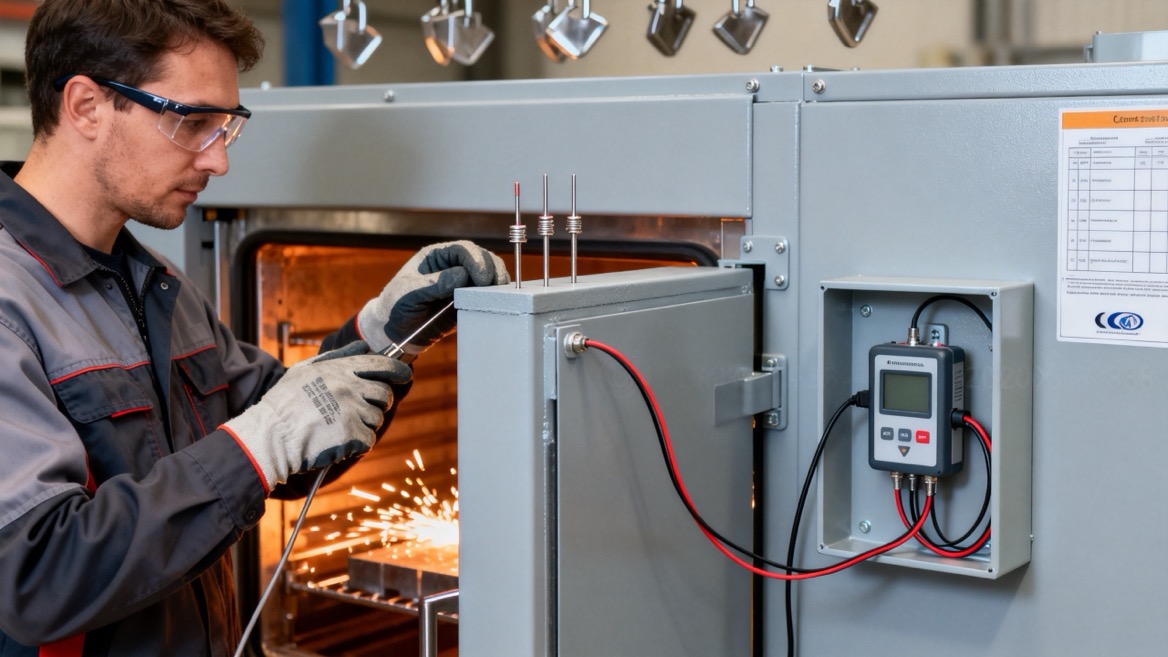
One frequent specification mistake is treating oven air temperature as proof of cure. Proper cure requires the specified time and metal temperature.
A thick component may heat more slowly than a thin bracket. Time spent warming the component is not the same as time spent at the required cure temperature.
For production validation:
1. Follow the selected powder's documented cure schedule.
2. Measure representative part temperatures with a suitable profiling system.
3. Include the slowest-heating areas in the evaluation.
4. Confirm film performance after the validated cycle.
5. Repeat checks when loading, geometry, line speed, or formulation changes.
Low-temperature epoxy formulations may help where the process requires lower curing temperatures. However, energy savings should be demonstrated on the actual line rather than assumed from the product description alone.
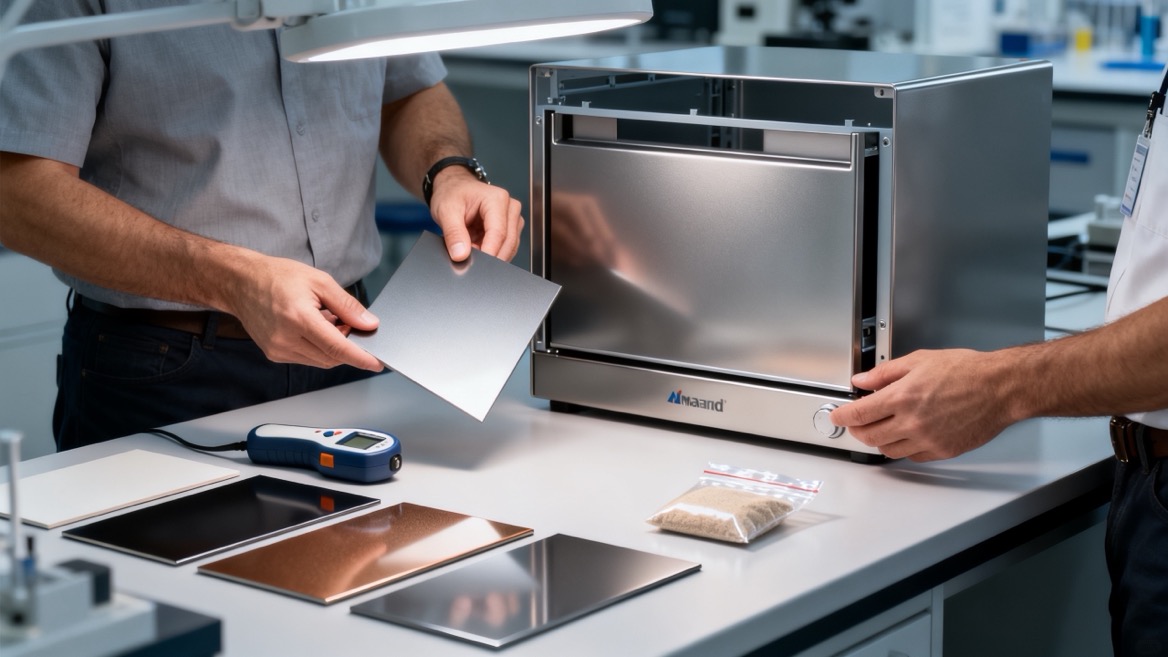
A test number is useful only when its meaning is clear.
| Evaluation | What to establish before comparing suppliers |
|---|---|
| Adhesion | Method, substrate, pretreatment, coating thickness, and acceptance rating |
| Salt spray | Exposure duration, panel preparation, scribing, and evaluation criteria |
| Chemical resistance | Chemical identity, concentration, temperature, exposure time, and assessment |
| Appearance | Approved color panel, gloss range, texture, and viewing conditions |
| Cure validation | Actual part-temperature profile and agreed performance checks |
ASTM D3359 provides tape-test methods for rating coating adhesion. It is not a direct numerical measurement of bond strength.
ASTM B117 describes salt-spray apparatus operation. It does not establish a universal pass requirement for every product, and stand-alone salt-spray results should not be converted into promised years of outdoor service.
For purchasing decisions, compare complete test conditions. A longer exposure time does not automatically identify the better coating when substrates, pretreatments, or failure criteria differ.
Yinda Technology describes its business as researching, manufacturing, and selling powder coatings and environmentally oriented materials, alongside promoting energy-saving technologies. Its supplied company profile identifies subsidiaries in China, Indonesia, and Saudi Arabia, with applications spanning architectural profiles, doors and windows, new energy vehicles, medical equipment, hardware, and appliances.
For small and midsize brands, Yinda can be positioned as an R&D-oriented factory option to evaluate for cost-conscious OEM development. The useful discussion is not whether it is universally "better," but whether it can offer the right flexibility, communication process, and technical support for your project.
Ask Yinda to confirm:
- Available customization for color, gloss, texture, and functional requirements.
- Sample quantities, revision procedures, and pilot-order options.
- A named technical contact and agreed response expectations.
- Support for interpreting line trials and refining the formulation.
- Documentation linking approved samples to production batches.
These checks turn claims about flexibility and deep OEM support into verifiable purchasing criteria.
IFS Coatings publishes epoxy products for interior and enclosed applications, with stated chemical-resistance and adhesion benefits. It is another manufacturer to consider when reviewing documented product suitability.
Industry directories also list businesses including Thermaset and Wright Coating Technologies. Distinguish powder manufacturers from coating-service providers: purchasing powder and outsourcing application solve different needs.
Directory click-share rankings indicate activity within that directory. They should not be treated as independent evidence of coating performance, technical capability, or customer satisfaction.
Consider a small appliance brand developing an indoor metal enclosure. This is an illustrative workflow, not a reported Yinda customer case.
The buyer sends Yinda a component drawing, pretreatment details, target appearance, cleaning conditions, and production constraints. The parties then define an initial formulation and agreed evaluation criteria.
The first sample establishes appearance. A production-representative trial checks coverage and cure. Chemical and adhesion evaluations follow under documented conditions.
If the trial exposes a problem, revise one variable at a time where practical. Finally, approve the reference panel, process window, and inspection requirements before scaling the order.
This staged approach makes customization more accountable and reduces the chance of approving a coating based only on visual appeal.
Send Yinda Technology your substrate, component drawings, service environment, target finish, estimated demand, and current curing conditions. Request a recommended coating chemistry, supporting documentation, sample-development plan, and quotation.
Ask for the proposal to separate confirmed capabilities from items requiring trials. A useful supplier response should explain the recommendation, identify limitations, and define the next validation step.
Neither is universally better. Epoxy is often selected for indoor adhesion and chemical resistance, while polyester is commonly considered for exterior weathering. The actual formulation and exposure requirements determine suitability.
There is no universal cure temperature. Follow the selected product's technical data sheet and verify the required time at actual part temperature, not simply oven air temperature.
It can provide a protective barrier on properly prepared metal. Performance still depends on pretreatment, film continuity, thickness, cure, and service conditions. Damaged coating and exposed edges require attention.
Customization depends on supplier capabilities and commercial terms. Ask Yinda about sample sizes, pilot batches, minimum orders, formulation options, and support during production trials before committing.
Solvent-free powder application offers negligible coating-related volatile organic compound emissions. That advantage does not make the entire process impact-free; consider energy consumption, pretreatment, material use, and waste management.
No. Salt-spray testing provides controlled comparative or qualification evidence. Without supporting exposure data, it does not reliably predict years of performance in a real operating environment.
1. Metoree — "5 Epoxy Powder Coating Companies in 2026." Original article used for the introductory topic, listed supplier roles, and the distinction between directory click-share rankings and performance evaluation. [us.metoree]
2. Powder Coating Institute — "What Is Powder Coating?" Technical foundation for electrostatic application, heating, and thermoset crosslinking. [powdercoating]
3. Powder Coating Institute — "Frequently Asked Questions." Guidance on cure time, actual metal temperature, bring-up time, dwell time, and temperature profiling. [powdercoating]
4. IFS Coatings — "Epoxy Powder Coatings." Manufacturer information covering interior and enclosed applications, chemical resistance, adhesion, and limitations under sustained ultraviolet exposure. Product statements are supplier-specific, not universal guarantees. [ifscoatings]
5. ASTM International — "ASTM D3359-23: Standard Test Methods for Rating Adhesion by Tape Test." Primary standard describing tape-based assessment of coating adhesion to metallic substrates. [store.astm]
6. American National Standards Institute — "ASTM D3359-23: Tape Test Methods for Measuring Adhesion." Explanation of the test methods and their limitations, including the distinction from direct bond-strength measurement. [blog.ansi]
7. ASTM International — "ASTM B117-07a: Standard Practice for Operating Salt Spray (Fog) Apparatus." Primary-source statement on the limited correlation between stand-alone salt-spray results and natural-environment performance. Referenced for that limitation, not as a claim that this edition is the latest. [store.astm]
8. Powder Coating Institute — "Environmental Impact." Basis for the solvent-free application and negligible volatile organic compound emissions discussion. [powdercoating]


