Language


Views: 228 Author: Yinda Powder Coating Publish Time: 2026-10-19 Origin: Site


Content Menu
● Singapore's Position in the Powder Coating Supply Chain
>> What the Latest Market Data Means for Buyers
● How We Selected These Powder Coating Suppliers
● Powder Coating Supplier Comparison: Capacity, MOQ, and Certification
● 1. Yinda Technology: An Overseas Alternative for Development-Led Procurement
>> Company Background and Markets
>> Core Strengths and Customization Fit
● 2. Lea Hin / OXYPLAST: An Established Local Manufacturing Option
>> Company Background and Markets
>> OEM/ODM Scope and Limitations
● 3. AkzoNobel / Interpon: A Broad Architectural and Industrial Portfolio
>> Company Background and Markets
>> OEM/ODM Scope and Limitations
● 4. Axalta Coating Systems: Regional Access to Decorative and Functional Powders
>> Company Background and Markets
>> OEM/ODM Scope and Limitations
● 5. Jotun: A Candidate for Architectural and Industrial Coating Projects
>> Company Background and Markets
>> OEM/ODM Scope and Limitations
● Technical Buyer's Guide: Specify the System Before Comparing Prices
>> Match the Resin Family to the Exposure
>> Do Not Confuse CE Marking, RoHS Evidence, and Coating Approval
>> Validate Curing on the Actual Part
● The Insider Pitfall: A Perfect Sample Can Fail Under Production Reclaim
● How to Avoid Common Powder Coating Procurement Problems
>> 1. Prevent Unapproved Product Substitution
>> 2. Treat Certificate Logos as Leads, Not Proof
>> 3. Use a Three-Stage Sample Approval Process
>> 4. Define OEM/ODM Responsibilities in Writing
● Logistics and Import Considerations for Singapore Buyers
● Conclusion: Select the Supply Model That Fits Your Operation
● FAQs
>> 1. How Can I Verify Whether a Supplier's ISO Certificate Has Expired?
>> 2. Can Two Powders With the Same Color Code Be Used Interchangeably?
>> 3. Does an Approved Powder Automatically Make the Finished Component Compliant?
>> 4. What Should I Do If Laboratory Panels Pass but Production Parts Fail?
>> 5. How Should I Compare a Lower-Priced Overseas Supplier With a Local Supplier?
Choosing a powder coating supplier in Singapore requires more than comparing colors, prices, and delivery promises. Professional buyers need to establish who manufactures the powder, which production site will supply each order, how consistently the coating performs, and whether technical documentation supports the intended application.
Singapore offers access to established local manufacturers and international coatings businesses. However, a Singapore sales office does not automatically mean Singapore-made powder. This guide distinguishes local manufacturing from regional supply and includes Yinda Technology as an overseas sourcing alternative—not as a Singapore-based factory.
The central purchasing principle is traceability: connect the quotation, manufacturing site, formulation, test evidence, approved sample, and delivered batch before committing to a long-term contract.

Singapore's chemical industry increasingly emphasizes specialty chemicals, sustainable materials, and lower-carbon innovation. The Singapore Economic Development Board's *Singapore Chemicals 2026* report describes this broader transition, providing useful context for buyers evaluating technically demanding coating systems and regional supply partnerships. It does not, however, establish Singapore as a high-volume powder coating production center.
For powder coating procurement, the country's practical advantage is its combination of local production, international commercial support, and regional sourcing connections. Lea Hin manufactures OXYPLAST powder coatings locally, while Axalta identifies Singapore as its Asia-Pacific industrial coatings headquarters outside China. Interpon also maintains a Singapore-specific product portal. These represent different supply models and should not be treated as interchangeable.
MarketsandMarkets estimates the global powder coatings market at USD 16.30 billion in 2025 and projects USD 23.07 billion by 2031, with a compound annual growth rate of 5.96%. These are global market estimates—not Singapore production, consumption, or export figures.
For procurement teams, the relevant implication is the breadth of competing applications: architectural aluminum, appliances, automotive components, furniture, and general industrial products all draw on powder coating supply chains. Buyers should therefore ask about capacity allocated to their specific formulation rather than relying on a supplier's overall scale. The report identifies these sectors among its principal end-use categories.
This is an application-based shortlist, not a ranking by market share, audited factory performance, or lowest price. It includes five companies with relevant manufacturing or supply capabilities, with Yinda Technology presented first as the commissioning company and an overseas alternative.
Company descriptions draw on published corporate information. No independent factory audit, commercial trial, or transaction review was conducted for this article.
The assessment framework covers six purchasing dimensions:
| Selection dimension | Evidence buyers should request | Why it matters |
|---|---|---|
| Manufacturing identity | Legal entity, factory address, production origin, batch identification | Distinguishes manufacturers, distributors, and sales offices |
| Formulation and development | Application-specific technical proposals, development process, sample records | Tests whether customization goes beyond selecting a stock color |
| Quality control | Batch certificates, test methods, retained samples, change-control procedures | Makes repeat-order consistency measurable |
| Compliance | Current site certificates, product-specific reports, relevant approval numbers | Prevents unrelated documents from being used as proof |
| Supply reliability | Product-specific lead times, available capacity, stock policy, contingency arrangements | Establishes realistic replenishment expectations |
| Commercial fit | MOQ, development charges, technical response commitments, complaint procedures | Reveals whether the supplier suits the buyer's order profile |
A management-system certificate and a coating-product approval serve different purposes. IAF CertSearch supports verification of accredited management-system certificates, while QUALICOAT specifications address requirements for coating materials, plant and equipment, and finished architectural products. Neither should be substituted for the other.
The reviewed sources do not provide a consistent, comparable set of annual capacity figures, minimum order quantities, or current manufacturing-site certificates for these five suppliers. The table therefore identifies information that requires a quotation or document check instead of inventing numbers.
"Not established" means the evidence reviewed for this guide did not verify the item; it does not mean the supplier lacks that capability or certification.
| Supplier | Supply position for Singapore buyers | Main procurement focus | Production capacity | MOQ | Certification or approval status |
|---|---|---|---|---|---|
| Yinda Technology | Overseas manufacturer headquartered in Foshan, China | Development-led industrial powder coating sourcing | Comparable tonnage not established; request producing-site allocation | Request by formulation, color, and finish | Current site certificates and product approvals require verification |
| Lea Hin / OXYPLAST | Singapore powder coating manufacturer | Local sourcing, indoor industrial powders, architectural systems | Comparable tonnage not established | Request separately for stock and custom products | Publishes architectural performance claims; obtain product-specific evidence |
| AkzoNobel / Interpon | International manufacturer with Singapore product access | Architectural, automotive, and general industrial coatings | Singapore-specific manufacturing allocation not established | Confirm local stock versus made-to-order quantities | Verify the exact product, approval number, and supplying site |
| Axalta Coating Systems | International manufacturer with Singapore regional headquarters | Decorative and functional industrial coating systems | Singapore powder manufacturing capacity not established | Confirm product and supplying country | Verify product-specific approvals and manufacturing-site certificates |
| Jotun | International coatings group with Singapore market presence | Architectural and industrial powder coating requirements | Singapore-specific powder capacity not established | Confirm through the relevant sales channel | Verify the named powder product and production-site documentation |
The supply-position distinctions above are supported by the companies' published profiles, Singapore product information, and contact pages. They do not establish that every listed company manufactures powder in Singapore.
Yinda Technology states that it was established in 2010 and is headquartered in Foshan, Guangdong, China. Its profile distinguishes the founder's entry into the powder coating industry in 1998 from the company's establishment. Buyers should preserve that distinction rather than describing Yinda as a company founded in 1998.
The business focuses on powder coatings, environmentally oriented materials, and energy-saving technologies. Its published application sectors include architectural profiles, doors and windows, new-energy vehicles, medical equipment, hardware, and electrical appliances. The profile identifies operations in China, Indonesia, and the Middle East, but does not publish a market-by-market sales breakdown.
Yinda reports a dedicated research and development center, testing facilities, production lines, and an R&D team with more than 20 years of experience. These resources make it a relevant candidate for buyers seeking formulation discussions rather than only catalog purchasing.
For small and midsize brands, the proposed value is a development-led sourcing relationship: discussing application conditions, evaluating samples, and aligning a formulation with a commercial target. Yinda also emphasizes tailored support and fast service in its company profile. Actual response speed, small-order flexibility, and cost competitiveness should nevertheless be measured during qualification, not assumed.
An appropriate inquiry should ask Yinda to define its available support for:
- Custom color, gloss, texture, and appearance.
- Formulation development against an agreed performance specification.
- Compatibility with the buyer's substrate and curing equipment.
- Customer-specific packaging, labeling, and documentation.
- Repeat-order control and formulation-change notification.
These are proposed qualification topics, not confirmed service guarantees. The public profile does not establish private-label terms, exclusive formulation ownership, MOQ, annual tonnage, or guaranteed delivery periods.
Yinda is worth evaluating when the buyer wants an overseas manufacturing partner with a published development infrastructure and a broad industrial application focus. Compare its delivered cost and technical responsiveness against local alternatives through the same sample protocol. Do not present it as a Singapore manufacturer or assume that overseas sourcing automatically produces a lower total cost.

Lea Hin Co. (Powder Manufacturers) Pte Ltd states that it was established in 1982 and manufactures OXYPLAST powder coatings under license and technology from OXYPLAST Belgium. Its published regional coverage includes Singapore, Malaysia, and Indonesia.
For buyers specifically seeking a Singapore powder coating manufacturer rather than a regional sales office, this local manufacturing identity is an important distinction.
Lea Hin publishes a broad binder classification covering epoxy, epoxy-polyester hybrid, polyester, polyurethane, and fluoropolymer powders. Its indoor product information includes epoxy and hybrid systems for applications such as furniture, switchboards, shelving, lighting fixtures, and domestic appliances.
The company also states that it offers architectural products capable of meeting AAMA 2603, 2604, and 2605 requirements, alongside steel coating systems for demanding corrosion environments. Buyers should treat these as starting points for product selection and request the exact supporting reports, substrate preparation, and system specification.
Lea Hin is a relevant candidate for project-specific product selection and discussions about color, appearance, and application requirements. However, the reviewed pages do not establish private-label manufacturing, exclusive formulation development, or standard custom-color MOQs.
Its processing guidance also differentiates indoor epoxy or hybrid powders from outdoor-durable polyester grades. This is useful for preventing a common purchasing error: selecting a visually acceptable indoor coating for an exposed exterior component.
Shortlist Lea Hin when local manufacturing identity and access to documented industrial powder categories are priorities. Ask whether the quoted product is stocked, made locally to order, or supplied under another arrangement; obtain a written delivery commitment for the specific grade.
AkzoNobel's modern corporate identity dates to the 1994 combination of Akzo and Nobel Industries, although its predecessor businesses are older. This is a group-history date, not the establishment date of a Singapore powder coating factory.
Interpon is AkzoNobel's powder coatings brand. Its portfolio covers architectural products, automotive applications, general industrial components, appliances, furniture, and other metal products. A Singapore-specific product portal provides a relevant starting point for local purchasing inquiries.
Interpon's breadth makes it useful for buyers managing multiple product families. Its published offering includes different colors, gloss levels, textures, metallic effects, and application-oriented ranges. Architectural products emphasize weathering and corrosion performance, while other ranges address automotive and general industrial requirements.
The procurement advantage is not simply brand recognition. It is the ability to begin with an established product family and then evaluate the exact grade against the project specification.
OEM buyers should ask about product qualification, color matching, application support, and supply continuity for the named product. Do not assume that OEM technical support includes anonymous private-label supply or customer ownership of a formulation.
Likewise, a Singapore product listing does not prove Singapore manufacturing origin. Require the quotation to identify the manufacturing country and site supplying the approved grade.
Interpon is a strong candidate for specification-led architectural and multi-application industrial sourcing. Approval numbers, warranty conditions, applicator requirements, local stock, and custom-order lead times should all be confirmed at product level.
Axalta's history traces to predecessor operations founded in 1866. The current Axalta Coating Systems business was established in 2013, and the company records the launch of Alesta powder coatings in 1980. These dates describe different milestones and should not be merged into a single founding claim.
Axalta lists its Asia-Pacific industrial coatings headquarters outside China at 12 Tai Seng Link, Singapore. This verifies a regional commercial presence, not a Singapore powder production plant.
Axalta's industrial business serves applications including industrial and electrical components, pipelines, agricultural and construction equipment, structural steel, and other manufactured products. Its portfolio includes decorative powder products as well as specialized functional coating systems.
For Singapore procurement teams, the regional contact point can support initial product routing. Availability, technical service arrangements, and the supplying factory still need confirmation for the selected powder.
Axalta merits consideration for OEM projects requiring established industrial coating technologies and application-specific qualification. Buyers should ask which product family addresses the actual duty: decorative appearance, corrosion protection, electrical function, or another requirement.
Custom formulation, private-label packaging, exclusivity, and development charges should be negotiated separately rather than inferred from the breadth of the group's portfolio.
Shortlist Axalta where the project requires a clear technical distinction between decorative and functional powder coatings. Include product origin, regional availability, and complaint responsibility in the commercial agreement.
Jotun was founded in Norway in 1926. Its Singapore corporate information identifies four business segments: decorative paints, marine coatings, protective coatings, and powder coatings. The founding year refers to the group, not a Singapore powder manufacturing operation.
This distinction also matters when reviewing experience. A company's marine liquid-coating credentials do not, by themselves, establish the suitability of a particular powder coating.
Jotun's published powder coating material emphasizes consistency of application, appearance, and durability. Its Primax coating solutions provide a relevant starting point for buyers discussing protective system requirements.
The purchasing task is to connect that broad capability with an exact product, substrate, pretreatment process, and exposure condition.
For OEM procurement, ask about product selection, appearance options, application qualification, and the scope of technical support available through the Singapore channel. Confirm whether the proposed supply is a standard product, a color variant, or a separately developed formulation.
The reviewed sources do not establish Singapore-specific private-label services, custom-development MOQs, or local powder production capacity.
Jotun belongs on the shortlist for buyers comparing architectural and industrial systems from an established coatings group. Require powder-specific documentation rather than accepting evidence drawn from an unrelated coating technology.
A powder coating specification should begin with service conditions, not a color code. Lea Hin's published binder guide separates interior epoxy and epoxy-polyester hybrid applications from exterior polyester, polyurethane, and fluoropolymer applications. Individual product suitability must still be checked against its technical data sheet.
| Application | Initial supplier discussion | Evidence to request |
|---|---|---|
| Indoor furniture and equipment | Epoxy or hybrid products appropriate to the duty | Adhesion, appearance, chemical-resistance data |
| Exterior architectural aluminum | Exterior-durable grades matched to the project specification | Weathering evidence and applicable architectural approvals |
| Exposed steel components | Complete pretreatment, primer, and topcoat proposal | System-level corrosion evidence |
| Electrical or vehicle components | Application-specific functional and OEM requirements | Relevant qualification reports |
| Medical equipment housings | Appearance, cleaning exposure, and equipment requirements | Product-specific evidence; no assumed medical-device approval |
The table is an inquiry framework, not a universal material prescription. For demanding projects, submit the substrate, exposure, cleaning regime, coating thickness, curing constraints, and acceptance standard together.
CE marking is not a general quality badge for powder coatings. European Commission guidance states that it is required only for products covered by applicable harmonized rules that mandate it; it must not be used where no such requirement applies.
RoHS addresses restricted substances in electrical and electronic equipment. A powder supplier may provide relevant substance declarations or test evidence for a coating used on an electrical product, but that evidence is not a blanket certification of weatherability, corrosion resistance, or finished-equipment conformity.
For architectural aluminum, ask whether the project requires a particular QUALICOAT approval or architectural performance specification. Verify the named product and system rather than accepting a corporate brochure as proof. QUALICOAT's requirements cover coating materials, equipment, and finished products.
A satisfactory oven setting does not establish that a heavy component achieved the coating supplier's curing conditions.
QUALICOAT's technical guidance explains that curing assessment depends on the aluminum profile's temperature-versus-time history relative to the supplier's prescribed schedule. Temperature logging helps establish whether the coated part received the necessary cure.
Before production approval, request:
1. The exact product technical data sheet.
2. The required time and part-temperature conditions.
3. A temperature trace from representative components.
4. Film-thickness and appearance records.
5. Results from the agreed performance tests.
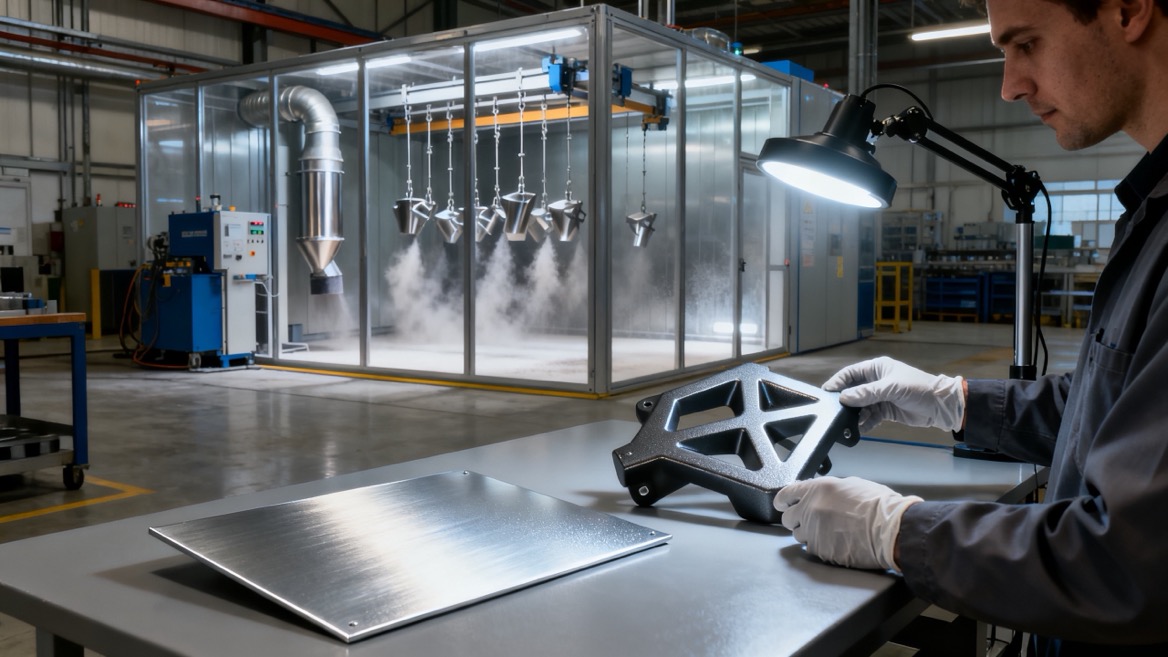
A commonly overlooked qualification gap is the difference between a sample sprayed with fresh powder and production using a mixture of virgin and reclaimed powder.
This is especially important for metallic finishes. TIGER's processing guidance states that color and effect consistency depend on maintaining a controlled virgin-to-reclaim ratio. Its guidance also notes that some metallic powders are not reclaim-consistent and recommends establishing acceptable limits through samples.
The purchasing consequence is straightforward: approving a flat appearance panel does not qualify the entire production process.
Before releasing a metallic finish, require a trial that records:
- Powder batch and product code.
- Application line and operating settings.
- Film thickness.
- Virgin-to-reclaim ratio.
- Component orientation.
- Appearance acceptance under agreed viewing conditions.
Ask the supplier and applicator to agree on the reclaim conditions for the specific product. Do not apply a ratio from another manufacturer's guide as a universal rule. TIGER's published numerical guidance is product-processing advice, not an industry-wide guarantee.
Write the approved product code, resin family, intended exposure, appearance standard, and supporting documentation into the purchase specification.
An indoor hybrid and an exterior polyester can belong to different application categories even when their initial appearance is similar. Lea Hin's published product classification illustrates why "same color" is not a sufficient equivalence test.
Require written approval before changing the formulation, manufacturing site, or approved product.
Request the certificate number, certified legal entity, site address, scope, issuing body, and validity status. IAF CertSearch allows buyers to check management-system certificate records and identify statuses such as active, suspended, withdrawn, or expired.
Separately verify any coating-product approval. A valid management-system certificate does not identify which powder formulation meets an architectural requirement.
For a controlled supplier comparison, use the same approval sequence:
1. Appearance panel: establish color, gloss, texture, and viewing conditions.
2. Component trial: coat the actual substrate and geometry.
3. Production validation: evaluate the intended line, curing conditions, reclaim policy, and batch records.
This proposed process connects the sample to the manufacturing conditions that can affect cure and appearance. The underlying importance of part-temperature control and metallic reclaim consistency is documented in QUALICOAT and TIGER guidance.
"Customized powder coating" can mean several different services: selecting a catalog shade, matching a color, adjusting a formulation, developing a new product, or supplying under private label.
The contract should specify:
- Who owns the approved formulation and reference panels.
- Whether exclusivity exists.
- Which changes require notification.
- Who pays for development and repeat testing.
- How nonconforming batches are handled.
- Whether packaging and labels are customer-specific.
These terms are particularly important when a small brand relies on the supplier for both development and ongoing production.
When sourcing internationally, establish the importer of record, customs responsibilities, delivery terms, manufacturing origin, and required documentation before shipment.
Singapore Customs explains that commercial imports generally require customs declarations and the relevant permits, with applications submitted through TradeNet. The importer or its declaring agent must also check whether goods are controlled.
IRAS states that import GST is generally payable unless an applicable exemption, relief, suspension, or deferment arrangement applies. Its current guidance sets the rate at 9% and describes the taxable basis as including CIF value, applicable duties, and relevant incidental charges. Recoverability depends on the buyer's circumstances and the conditions for input-tax claims.
A powder coating shipment checklist should include:
- Commercial invoice and packing list.
- Agreed product and batch identification.
- Technical and safety documentation.
- Declared origin and customs classification confirmation.
- Supplier-specified storage and transport conditions.
- Remaining shelf life at delivery.
- Responsibility for delays, damage, and replacement material.
Do not use a generic customs code or assume every formulation has identical transport requirements. Obtain classification and shipment advice for the actual product from the supplier and declaring agent.
Singapore buyers can choose among local powder manufacturing, international brands with regional access, and overseas development-led suppliers. The shortlist is useful because these options solve different procurement problems—not because one company is universally superior.
Begin with the application specification, identify the producing factory, verify the relevant documents, and approve performance under actual production conditions. Then negotiate capacity allocation, MOQ, delivery commitments, and change control.
For buyers evaluating Yinda Technology, submit the substrate, end-use environment, target appearance, monthly demand, curing conditions, and required tests with the initial inquiry. Request a written technical proposal, sample plan, and commercial quotation so its development support and delivered cost can be compared objectively with Singapore-based alternatives.
Search the exact legal entity or certificate number in IAF CertSearch and compare the result with the supplier's document. Review status, standard, scope, site, issuing certification body, and the available validity information.
If the record is missing or inconsistent, contact the certification body directly before accepting the certificate. A printed expiry date alone does not resolve whether a certificate has been suspended or withdrawn. IAF CertSearch distinguishes these statuses.
Do not approve substitution solely on the color designation. Interpon's range illustrates that powders can differ in gloss, texture, metallic effect, and intended application even within a broad color offering.
Treat the replacement as a qualification change: compare the product specification, approved panel, technical data, manufacturing origin, and actual component trial.
No. QUALICOAT specifications address coating materials as well as plant, equipment, and finished products. The applicator's process remains part of the result.
Request evidence connecting the approved powder to the actual pretreatment, coating application, curing record, and finished-part tests. Product approval alone does not demonstrate that every production batch was correctly processed.
Investigate the process difference before concluding that the powder formulation is defective.
Compare part-temperature records, coating thickness, substrate preparation, application settings, powder batches, and reclaim practices. Curing history and reclaim variation are documented sources of performance or appearance differences.
Preserve retained powder, approved panels, failed components, and production records so the supplier and applicator can investigate the same evidence.
Use an agreed total-cost model rather than price per kilogram alone. Include freight, customs handling, inventory, qualification work, rejected production, technical support, and replenishment time.
For Singapore imports, distinguish landed cash requirements from recoverable input tax: IRAS permits eligible GST-registered businesses to claim import GST subject to conditions, including correct importer documentation.
Run both suppliers through the same specification and production trial. A price comparison is only meaningful when the approved coating performance and commercial responsibilities are equivalent.
- Company profiles and product information for Yinda Technology, Lea Hin/OXYPLAST, AkzoNobel/Interpon, Axalta, and Jotun. [leahin-oxyplast.com]
- Singapore Economic Development Board's *Singapore Chemicals 2026* for national chemical-industry context. [edb.gov]
- MarketsandMarkets' powder coatings market release for the explicitly identified global estimates. [marketsandmarkets]
- QUALICOAT specifications and curing guidance for architectural coating qualification. [qualicoat]
- TIGER's processing guidance for metallic appearance and reclaim controls. [tiger-coatings]
- European Commission guidance for CE marking and RoHS scope. [europa]
- IAF CertSearch for management-system certificate verification. [iafcertsearch]
- Singapore Customs and IRAS for import procedures and GST treatment. [customs.gov]


