Language


Views: 237 Author: Yinda Powder Coating Publish Time: 2026-10-14 Origin: Site


Content Menu
● Epoxy Powder Coating vs Epoxy-Polyester Hybrid: Quick Comparison
● What Is Epoxy Powder Coating?
>> Where Epoxy Powder Coating Performs Best
>> Important Epoxy Limitations
● What Is Epoxy-Polyester Hybrid Powder Coating?
>> Why Manufacturers Choose Hybrid Powder Coatings
● Key Performance Differences for Indoor Applications
>> Chemical Resistance: Start With the Cleaning Regime
>> Corrosion Resistance: Evaluate the Complete System
>> Appearance and Overbake Resistance
>> Flexibility, Impact, and Handling Resistance
● Choosing the Right Coating for Specific Industries
>> Appliances, Hardware, and Metal Furniture
>> New-Energy Vehicle Components
>> Architectural Profiles, Doors, and Windows
● An Often-Missed Issue: Indoor Does Not Mean Low Exposure
● A Six-Step Qualification Process for Manufacturers
>> 1. Define the Service Conditions
>> 2. Compare Candidates on Equivalent Substrates
>> 3. Measure the Part's Cure Profile
>> 4. Test the Required Properties
>> 5. Include Production Variability
>> 6. Approve the Specification
● Cost and Energy: Compare Accepted Parts, Not Powder Price
● How Yinda Technology Can Support Your Selection
>> Is epoxy powder coating better than epoxy-polyester hybrid?
>> Can epoxy-polyester hybrid powder coating be used outdoors?
>> Which coating is better for white indoor components?
>> Does epoxy always provide better corrosion protection?
>> Do both coatings use the same curing temperature?
>> Is a hybrid coating suitable for medical equipment?
Choosing between epoxy powder coating and epoxy-polyester hybrid powder coating starts with a practical question: what must the finish withstand? For indoor applications, epoxy is often the stronger candidate when chemical resistance and protective performance dominate. Epoxy-polyester hybrid is frequently preferred when appearance, mechanical properties, and resistance to oven-induced yellowing must work together.
At Yinda Technology, our focus on powder coatings, environmentally responsible materials, and energy-saving technologies makes this comparison relevant to manufacturers across multiple industries. With subsidiaries in China, Indonesia, and Saudi Arabia, we serve applications ranging from appliances and hardware to medical equipment and new-energy vehicle components.
Our selection principle is straightforward: performance must be evaluated on the finished part, not inferred from the resin name alone.

The following table summarizes typical differences. These are selection guidelines, not guaranteed specifications for every formulation.
| Selection factor | Epoxy powder coating | Epoxy-polyester hybrid powder coating |
|---|---|---|
| Resin system | Epoxy resin with a compatible curing agent | Reactive combination of epoxy and polyester resins |
| Chemical resistance | Often preferred for demanding chemical exposure | Generally suitable for less aggressive indoor exposure |
| Corrosion protection | Strong protective potential with correct pretreatment | Good indoor protection with correct pretreatment |
| Appearance | Decorative finishes are available | Often selected for smooth, decorative indoor finishes |
| Overbake yellowing | Generally more sensitive | Generally better resistance |
| Mechanical properties | Strong adhesion and toughness; formulation-dependent | Good flexibility and balanced mechanical properties |
| Sunlight exposure | Limited resistance to chalking and discoloration | Improved yellowing stability, but still limited weatherability |
| Typical application | Protective indoor industrial components | Appliances, furniture, cabinets, and decorative hardware |
| Cost assessment | Evaluate the complete coating process | Often cost-effective for volume interior finishing |
Neither chemistry compensates for contaminated metal, insufficient coverage, or incomplete curing.
Epoxy powder coating is a thermosetting finish. During curing, epoxy resin reacts with a curing agent to form a crosslinked film. Once properly cured, the coating does not simply melt again when reheated.
Its appeal is the combination of adhesion, chemical resistance, and protective properties. These characteristics make epoxy a useful starting point for indoor metal components exposed to demanding operating conditions.
Consider epoxy when the specification prioritizes:
- Resistance to particular chemicals or solvents.
- Protection of non-decorative industrial components.
- Adhesion to correctly prepared metal.
- A functional barrier against moisture and corrosive exposure.
However, "chemical resistant" does not mean resistant to every chemical. Concentration, temperature, contact duration, and cleaning frequency all influence performance.
The sensible approach is to identify the actual substances involved and test the proposed coating against them.
Epoxy coatings have limited resistance to sunlight. Chalking, discoloration, and loss of appearance can occur with exposure.
They can also be more sensitive to overbake yellowing than comparable hybrid formulations. This matters when producing white, cream, or other light-colored parts, especially when components experience uneven heating.
For visible surfaces near windows, indoor placement alone is not sufficient justification for selecting epoxy.
Epoxy-polyester hybrid powder coating combines reactive epoxy and polyester resins within a thermosetting system. The finished film reflects the formulation as a whole—not merely the presence of two familiar resin names.
Hybrid coatings are widely associated with decorative interior applications because they combine good mechanical properties, attractive finishes, and improved resistance to overbake yellowing compared with pure epoxy.
A hybrid is often a practical candidate for:
- Appliance housings and interior panels.
- Metal office furniture and shelving.
- Electrical cabinets installed indoors.
- Decorative hardware and equipment covers.
- Indoor components requiring consistent color and gloss.
For these products, severe chemical exposure may be less important than finish consistency, handling resistance, and economical production.
Nevertheless, a hybrid is not automatically "the best of both worlds." Incorporating polyester does not turn an epoxy-containing coating into a weather-resistant exterior finish.
Epoxy commonly provides stronger chemical and solvent resistance than hybrid coatings. The difference becomes relevant when parts encounter aggressive cleaners, process chemicals, or repeated solvent contact.
For a medical equipment housing, for example, the useful question is not simply whether the powder is epoxy or hybrid. It is whether the exact formulation withstands the facility's disinfectant and cleaning procedure.
Specify:
1. Chemical name and concentration.
2. Application method.
3. Contact time and frequency.
4. Operating temperature.
5. Acceptable changes in gloss, color, hardness, and adhesion.
A hybrid may perform adequately under routine cleaning. A more demanding exposure may justify epoxy. Testing should settle the decision.
Epoxy is a strong candidate for protective applications, while hybrids can provide good indoor corrosion protection.
However, corrosion resistance depends on more than resin chemistry. Pretreatment, substrate condition, film thickness, curing, and coverage all contribute.
An epoxy coating over poorly cleaned steel can fail prematurely. A correctly applied hybrid over a suitable pretreatment may provide reliable protection in a moderate indoor environment.
Edges, welds, seams, and recessed areas deserve particular attention. Thin coverage or exposed metal can become the starting point for corrosion.
Hybrids are frequently selected when visible appearance is a central purchasing requirement. Their improved resistance to overbake yellowing can help preserve light colors when production temperatures fluctuate.
This is valuable on mixed-component lines. Thin panels and heavy brackets may heat at different rates, even when passing through the same oven.
Still, overbake resistance has limits. Buyers should request an approved cure window and agree on acceptable color variation rather than assume unlimited tolerance.
Both chemistries can deliver useful mechanical performance. Hybrids are particularly associated with balanced flexibility and decorative finishing.
Avoid treating hardness, impact resistance, and scratch resistance as interchangeable. A hard surface may still chip under impact, while a flexible coating may resist deformation without satisfying every abrasion requirement.
Evaluate the damage mechanisms the product actually encounters: assembly contact, packaging abrasion, installation knocks, or occasional bending.
Epoxy-polyester hybrid is often an effective starting point for indoor products where appearance, handling resistance, and production consistency matter.
Examples include washing-machine panels, cabinet components, handles, and shelving. Where moisture or cleaners are significant, validate those exposures separately.
Either chemistry may be appropriate, depending on the cleaning protocol and required appearance.
An illustrative selection exercise would compare epoxy and hybrid samples under repeated disinfectant exposure, checking discoloration, softening, adhesion, and surface deterioration.
A powder chemistry designation alone does not establish medical suitability, antimicrobial performance, or compliance with a device specification.
Enclosed brackets, equipment housings, and other protected components require application-specific assessment.
Fluid contact, temperature, electrical requirements, and installation location can be more important than whether the component is technically "inside" the vehicle.
Neither epoxy nor hybrid should be described as electrically insulating, flame-retardant, or automotive-approved without evidence for the exact product.
For genuinely interior metalwork without significant sunlight exposure, hybrid may be suitable.
Exterior-facing profiles and sun-exposed window components require a weatherability review. In these applications, an appropriate exterior-grade polyester system may be a more suitable route than either coating discussed here.
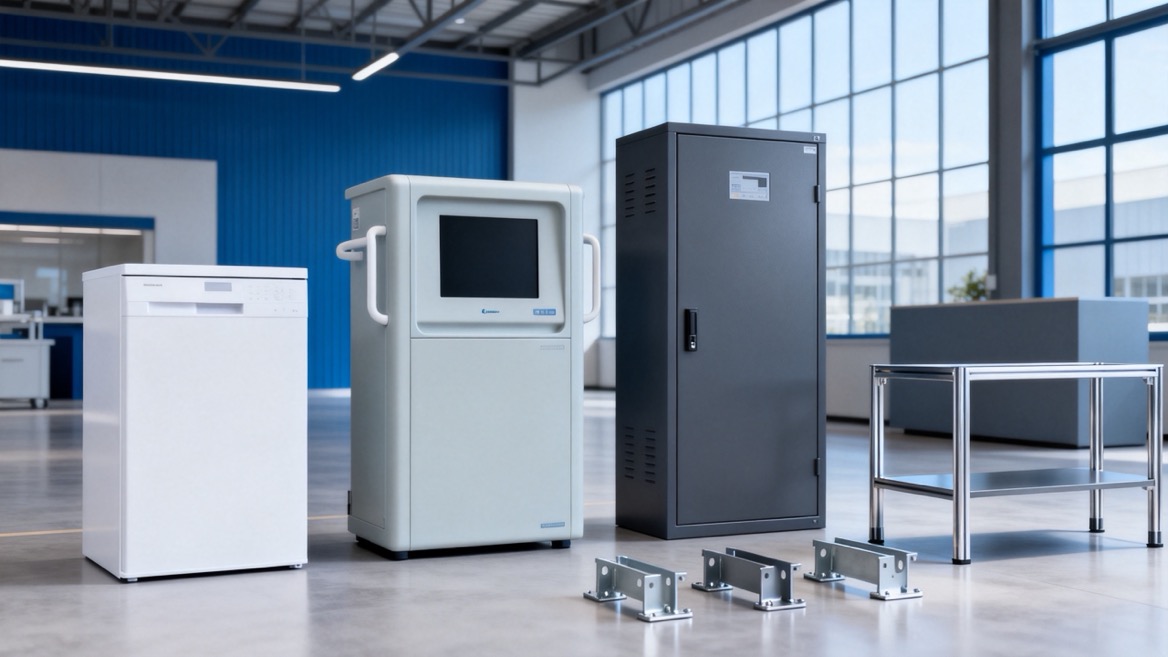
Indoor applications can still experience demanding conditions:
- Condensation inside equipment.
- Frequent disinfectant cleaning.
- Sunlight through glazing.
- Humidity in poorly ventilated rooms.
- Chemical vapors in production areas.
This distinction is especially useful for manufacturers supplying different markets. A cabinet used in an air-conditioned office may face a different exposure profile from an identical cabinet installed in a humid service room.
Our practical recommendation is to describe the installation environment before specifying the finish. Building location alone does not adequately describe coating exposure.
A controlled comparison produces more useful evidence than comparing two color samples.
Document substrate, installation location, chemical exposure, sunlight, temperature, moisture, and expected handling.
Separate essential requirements from desirable appearance features.
Use representative parts or panels with the same pretreatment.
Apply both candidates within their specified film-thickness ranges. Record actual thickness rather than relying on spray settings.
Powder curing depends on the required part temperature and time.
The oven display does not prove that the component reached the specified temperature. Use a suitable temperature-recording device to check thin and heavy parts.
Select tests that match the application:
- Adhesion.
- Impact or bend resistance.
- Gloss and color consistency.
- Cleaner or chemical resistance.
- Corrosion performance where relevant.
A solvent-rub check can help assess cure, but it is not a substitute for testing service conditions.
Evaluate realistic variations in part mass, line speed, film thickness, and thermal exposure.
For light-colored finishes, compare nominal cure with the anticipated upper process limit.
Record the product code, pretreatment, thickness range, cure schedule, finish standard, and acceptance criteria.
This creates a repeatable purchasing requirement rather than a subjective instruction to provide "good-quality powder."
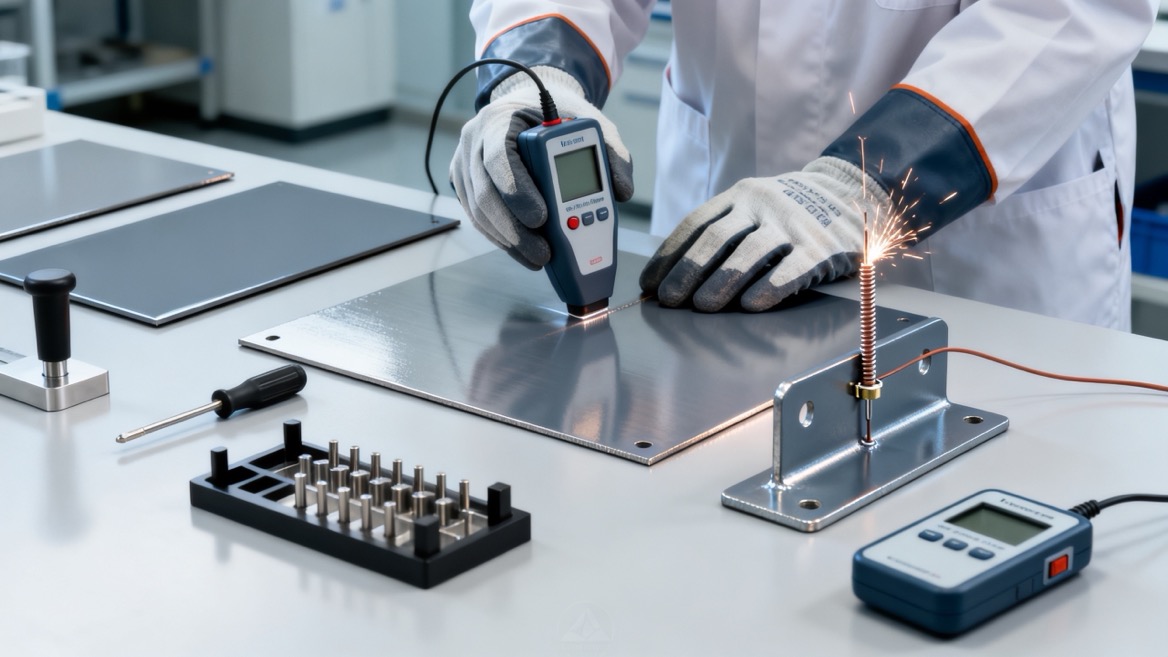
Hybrids can be cost-effective for high-volume interior finishing. However, price per kilogram is only one part of the decision.
A more useful comparison includes:
- Powder consumption per accepted part.
- Rejects and rework.
- Line speed and oven residence time.
- Pretreatment requirements.
- Finish consistency.
- Maintenance and service expectations.
Lower-temperature products exist within hybrid ranges, but that does not mean every hybrid cures at a lower temperature than every epoxy.
One published commercial hybrid range offers a curing-temperature option 20°C below its standard counterpart. This is product-specific evidence—not a universal temperature reduction or a guaranteed energy saving.
Any proposed low-bake solution should be validated against actual part temperatures, oven operation, and required film properties.
Yinda Technology develops, manufactures, and supplies powder coatings and environmentally responsible materials while promoting energy-saving technologies.
For an indoor coating project, the most useful starting information is:
- Substrate and component dimensions.
- Installation environment.
- Required color, gloss, and texture.
- Cleaning chemicals.
- Existing pretreatment and oven conditions.
- Performance requirements and approval tests.
Send these details to Yinda Technology when requesting an epoxy or epoxy-polyester hybrid powder coating recommendation. Ask for the relevant technical data sheet, application guidance, and trial samples before approving volume production.
The objective is a coating system that protects the component, supports consistent manufacturing, and meets the agreed appearance standard.
Not universally. Epoxy is often preferred for demanding chemical resistance and protective performance. Hybrid is frequently preferred for decorative indoor applications requiring balanced mechanical properties and improved overbake yellowing resistance.
It is generally not recommended where long-term outdoor appearance matters. Its epoxy content limits weatherability. Sun-exposed applications should be reviewed for an appropriate exterior-grade system.
Hybrid is often the stronger starting point because of its improved overbake yellowing resistance. Final selection should still include color checks at nominal cure and the expected upper processing limit.
No. Epoxy has strong protective potential, but corrosion performance depends on the complete coating system. Pretreatment, cure, coverage, and the actual environment can outweigh a simple resin comparison.
Not necessarily. Cure requirements belong to the individual formulation. Follow its technical data sheet and verify that the component reaches the specified temperature for the required duration.
It may be suitable for certain housings and components. Validate the exact coating against cleaning procedures, disinfectants, appearance requirements, and any applicable product specifications.
1. [Powder Coating Institute — Frequently Asked Questions]. Industry guidance on pretreatment, part-temperature curing requirements, epoxy overbake considerations, and the outdoor limitations of epoxy-containing coatings. [powdercoating]
2. [AkzoNobel Interpon — Hybrid Technology in Powder Coatings]. Manufacturer explanation of epoxy-polyester chemistry, interior applications, mechanical properties, finish quality, and limited UV resistance. [interpon]
3. [AkzoNobel — Interpon 700: The Interior Solution, Product Brochure]. Product-family information on flexibility, smooth films, corrosion protection, and improved yellowing resistance compared with pure epoxy. [powdercoatings.brand.akzonobel]
4. [AkzoNobel Interpon — Interpon 700]. Source for the product-specific lower-temperature option stated as 20°C below standard Interpon 700. This claim should not be generalized to other formulations. [interpon]
5. [IFS Coatings — Hybrid Powder Coatings]. Manufacturer comparison covering interior finishing, overbake resistance, yellowing stability, cost positioning, and chemical resistance relative to pure epoxy. [ifscoatings]
6. [Powder Coated Tough — Formulators Forum: Powder Coating for Corrosion Protection]. Technical discussion of protective coating selection, complete coverage, film build, technical data sheets, and cure verification. [powdercoatedtough]
7. [PCI Magazine — Catalysts' Role in Low-Gloss Hybrid Powder Coatings]. Formulation research supporting the qualified comparison of hybrid solvent resistance with comparable epoxy formulations. Published in 2003; used for established chemistry context, not current market data. [pcimag]


