Language


Views: 299 Author: Yinda Powder Coating Publish Time: 2026-11-24 Origin: Site


Content Menu
● Epoxy Powder Coating vs Conventional Metal Paint: The Essential Differences
● Production Efficiency: Compare Accepted Parts, Not Spray Speed
>> Application Speed Is Only One Part of Throughput
>> Cure Time Must Be Measured at the Part
>> Color Changes Can Reverse the Advantage
● Material Utilization: Separate First-Pass Transfer from Overall Recovery
>> First-Pass Transfer Efficiency
● Worked Example: Comparing Waste on an Equal-Solids Basis
● Waste Generation: What Changes—and What Does Not
>> Overspray and Cleaning Waste
>> VOC Emissions and Remaining Waste Streams
>> Worker Protection Still Matters
● Energy Efficiency: Test the Whole Line
● Epoxy Performance: Choose the Right Application Before Optimizing the Line
>> Where Epoxy Powder Coating Fits
>> Where Pure Epoxy Needs Caution
● A Practical Five-Step Conversion Trial
>> 1. Establish a Representative Baseline
>> 2. Define Equivalent Performance
>> 4. Reproduce Real Changeovers
>> 5. Calculate Cost per Accepted Output
● Build the Comparison Around Your Parts
>> Is epoxy powder coating always cheaper than conventional metal paint?
>> Can all epoxy powder overspray be reused?
>> Does powder coating eliminate hazardous waste?
>> Is epoxy powder suitable for outdoor metal products?
>> Which process is faster for metal production?
>> Can powder coating replace a multi-coat liquid system with one coat?
Epoxy powder coating vs conventional metal paint is not simply a comparison between dry powder and liquid paint. For manufacturers, it is a decision about production capacity, material utilization, curing requirements, waste handling, and the cost of delivering an accepted part.
My starting point is straightforward: compare the complete finishing process, not the coating price alone. Epoxy powder coating can offer substantial advantages on repeatable, oven-compatible metal components. Conventional liquid paint can remain more practical for oversized assemblies, heat-sensitive parts, frequent small batches, and field repairs.
For Yinda Technology, a powder coating manufacturer with subsidiaries in China, Indonesia, and Saudi Arabia, this distinction matters across applications ranging from electrical hardware to new-energy vehicle components. The right recommendation begins with the part and its operating environment—not a blanket preference for one coating technology.
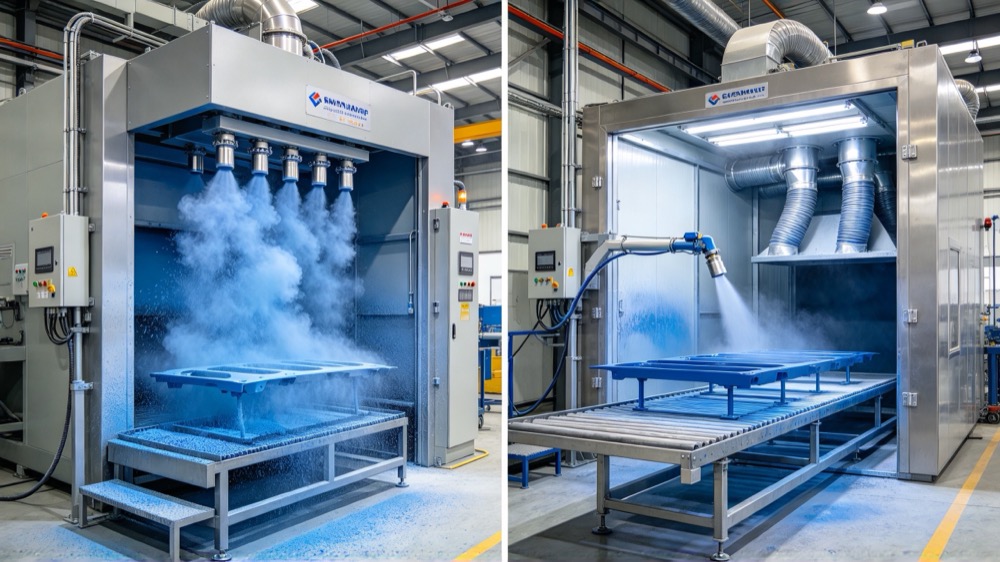
Epoxy powder coating is a dry, thermosetting material. In a typical electrostatic process, charged particles deposit onto grounded metal. Heating then melts and crosslinks the coating into a continuous film.
"Conventional metal paint" covers several liquid technologies. This article primarily compares epoxy powder with solvent-borne spray-applied paint, while recognizing that waterborne, high-solids, and electrostatically applied liquid systems can perform differently.
An important distinction: epoxy identifies a resin chemistry, while powder identifies a delivery format. Liquid metal paint may also contain epoxy resin. Neither format alone determines corrosion resistance, chemical resistance, or service life.
| Production factor | Epoxy powder coating | Conventional liquid metal paint |
|---|---|---|
| Delivery medium | Dry coating particles | Resin and pigments carried in solvent, water, or a combination |
| Application | Usually electrostatic spraying onto grounded parts | Conventional, air-assisted, airless, or electrostatic spraying |
| Film formation | Melting and crosslinking during a specified cure | Carrier evaporation and/or chemical curing |
| Overspray recovery | Often reusable when collected and controlled correctly | Spray overspray is generally difficult to reuse as paint |
| Production constraint | Oven capacity, part temperature, cooling, and changeovers | Flash-off, drying or curing, mixing, and handling |
| Typical suitability | Repeatable, heat-tolerant industrial metal components | Broad part sizes, temperature-sensitive assemblies, and repairs |
| Outdoor suitability | Pure epoxy generally needs protection from sunlight | Depends on resin chemistry and coating system |
Powder coating can simplify production when a suitable single-coat system replaces multiple liquid-coating stages. It also avoids the carrier-evaporation stage associated with solvent-borne application.
However, one powder coat does not automatically replace a specified primer-and-topcoat system. Corrosion requirements, substrate condition, appearance, and exposure may still require multiple layers.
Liquid paint is equally varied. A fast-curing industrial coating and a slowly air-drying enamel should not be assigned the same production assumptions.
The useful output measure is accepted parts per hour. A fast spray booth delivers little benefit if the oven, cooling area, inspection station, or rework process becomes the bottleneck.
A powder curing schedule is not simply an oven-air setting. The component must reach the specified metal temperature and remain within the required curing window.
A heavy casting heats differently from thin sheet metal. Mixed loads can therefore create uneven curing unless the process has been profiled.
For a meaningful comparison, include:
- Pretreatment and drying.
- Loading and masking.
- Application and any flash-off.
- Heating and required cure exposure.
- Cooling and safe handling.
- Inspection, rework, and unloading.
Liquid coatings may cure at ambient temperature or require baking. Their handling time, recoat window, and full-performance development can differ. Compare the actual products under consideration.
Powder reclaim works especially well with long runs of compatible material. Frequent color changes introduce cleaning, purge losses, contamination risks, and downtime.
Liquid systems also require cleaning and may generate flushing-solvent waste. Two-component paints introduce another variable: mixed material can become unusable after its pot life expires.
The better choice depends on batch size and color frequency. A line producing one color all shift has different economics from a workshop changing colors repeatedly for small orders.
First-pass transfer efficiency measures the proportion of sprayed coating deposited on the workpiece during its initial application.
A Products Finishing technical article reports illustrative first-pass ranges of 70–90% for powder and 25–65% for liquid application, depending on the process and part complexity. These are not guaranteed production figures.
Geometry, grounding, gun settings, operator technique, and application equipment all matter. Recesses and internal corners can make electrostatic powder coverage difficult. Advanced liquid application can also perform better than a basic conventional spray setup.
Overall utilization additionally accounts for usable overspray recovered and returned to production. Industry reporting describes powder systems achieving 95% or more overall efficiency under suitable reclaim conditions.
That does not mean 95% of every gun discharge immediately reaches saleable parts.
Losses can include:
- Powder deposited on racks and hooks.
- Contaminated or discarded reclaim.
- Color-change cleanout.
- Filter and collection losses.
- Excess film thickness.
- Rejected or stripped components.
Keep first-pass transfer, recovery performance, and accepted-product yield separate in purchasing calculations.
Comparing kilograms of powder with liters of liquid paint is misleading. Liquid paint contains a carrier, and coating density affects coverage.
Consider an illustrative production run requiring 100 kg of cured coating solids on acceptable parts. Assume equal required deposited mass solely to isolate utilization.
| Assumption or result | Powder system | Liquid system |
|---|---|---|
| Required deposited coating solids | 100 kg | 100 kg |
| Assumed effective solids utilization | 95% | 60% |
| Coating solids required | 105.3 kg | 166.7 kg |
| Solids not reaching acceptable parts | 5.3 kg | 66.7 kg |
These figures are calculated assumptions, not Yinda production results. They exclude carrier liquids, cleaning materials, pretreatment waste, and differences in film requirements.
They also do not show total liquid paint purchasing quantity. That requires the product's solids content and density.
For an actual quotation, compare cost per accepted square meter at the specified dry-film thickness. A cheaper kilogram can become expensive when it delivers less usable coverage.
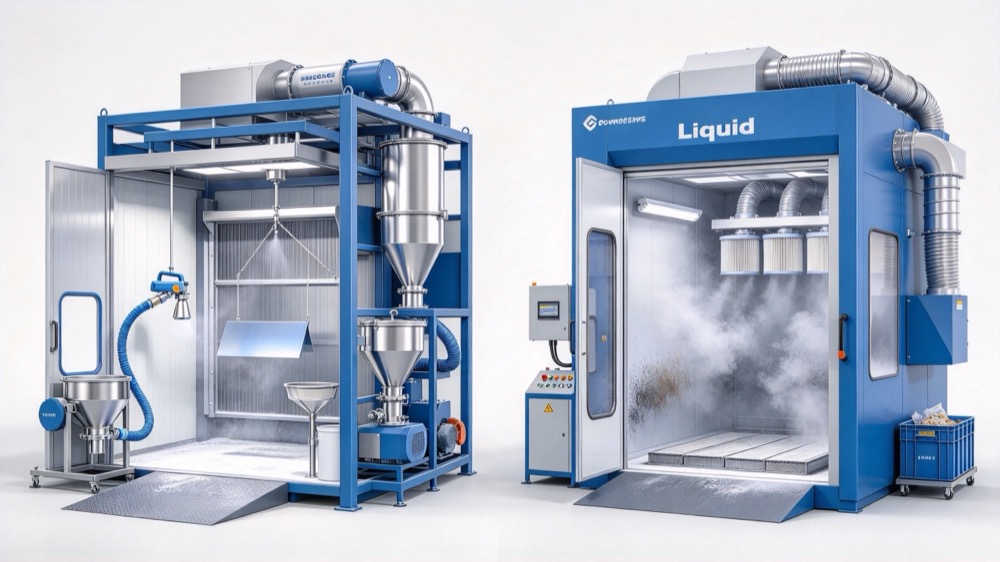
Clean powder overspray may be screened and blended back into the process within validated operating limits. Contamination, incompatible colors, or changes in particle distribution can limit reuse.
Liquid overspray generally cannot be returned directly to the paint supply. Depending on booth design, it becomes loaded filters, collected residue, or paint sludge.
Powder equipment cleaning can also reduce reliance on solvent flushing. Nevertheless, booth cleaning, filter replacement, and discarded powder remain real operating costs.
Solvent-borne coatings release volatile organic compounds as their carriers evaporate. Powder coatings generally produce very low VOC emissions because they do not need a conventional liquid solvent carrier.
"Low VOC" does not mean "zero environmental impact."
Powder finishing can still generate:
- Pretreatment wastewater and sludge.
- Spent filters and rejected powder.
- Masking and packaging waste.
- Stripping residues from rejected parts.
- Emissions associated with ovens and energy generation.
Waste classification depends on formulation, contamination, and local requirements. A factory should not assume that every powder waste stream is nonhazardous.
Removing solvent carriers changes the risk profile; it does not remove the need for controls.
Powder handling requires suitable extraction, housekeeping, grounding, and assessment of dust and formulation-specific exposure hazards. Liquid systems require controls matched to their solvents, reactive ingredients, and spraying conditions.
Use the relevant safety data sheets and a site-specific risk assessment for either process.
It is tempting to describe powder coating as automatically energy-saving. That conclusion needs measurement.
Thermal powder curing requires heat. Liquid systems may also need ovens, heated booths, ventilation, or emissions-control equipment, but some cure at ambient temperature.
Compare:
- Pretreatment heating and dry-off.
- Oven warm-up and standby.
- Part and rack heating.
- Booth ventilation and conditioned replacement air.
- Compressed air and recovery equipment.
- Energy consumed by rework.
A powder line running well-loaded racks may perform very differently from the same line processing sparse batches.
The decision metric should be energy per accepted part or square meter—not oven temperature alone. Lower-temperature powder formulations may help, but only when the actual substrate reaches a validated cure and the finished coating meets requirements.
Epoxy powders are valued for adhesion, chemical resistance, and corrosion protection in suitable systems.
Potential applications include indoor electrical enclosures, industrial hardware, and protected vehicle components. Performance still depends on pretreatment, film thickness, cure, formulation, and exposure.
For medical equipment, qualification must reflect the actual cleaning agents and service conditions. For new-energy vehicle components, requirements may include electrical insulation, thermal exposure, and corrosion resistance. Those properties require product-specific evidence.
Pure epoxy generally has poor resistance to prolonged ultraviolet exposure. Chalking, gloss loss, and appearance deterioration can make it unsuitable as an exposed decorative outdoor finish.
That distinction is particularly important for architectural profiles, exterior doors, and windows. A suitable exterior polyester powder or another qualified weather-resistant system may be more appropriate.
Epoxy can also serve as a primer beneath a compatible protective topcoat. Evaluate the complete system rather than treating all powder coatings as interchangeable.
Record material consumption, accepted area, rejects, downtime, labor, energy, cleaning materials, and waste over representative production—not only an unusually easy batch.
Agree on substrate, pretreatment, appearance, film thickness, corrosion resistance, chemical resistance, and any electrical requirements before comparing cost.
Otherwise, a thinner or less protective finish may appear artificially efficient.
Include recesses, welded areas, sharp edges, cast surfaces, and different metal thicknesses. Assess coverage, outgassing, masking, and cure uniformity.
Run the actual color sequence and batch sizes. Measure cleaning time, discarded material, contamination defects, and reclaim quality.
Include coating, labor, energy, pretreatment, maintenance, waste disposal, rework, and annualized equipment costs.
Then divide by accepted production area or accepted parts. This cost per accepted output is more useful than material price alone.
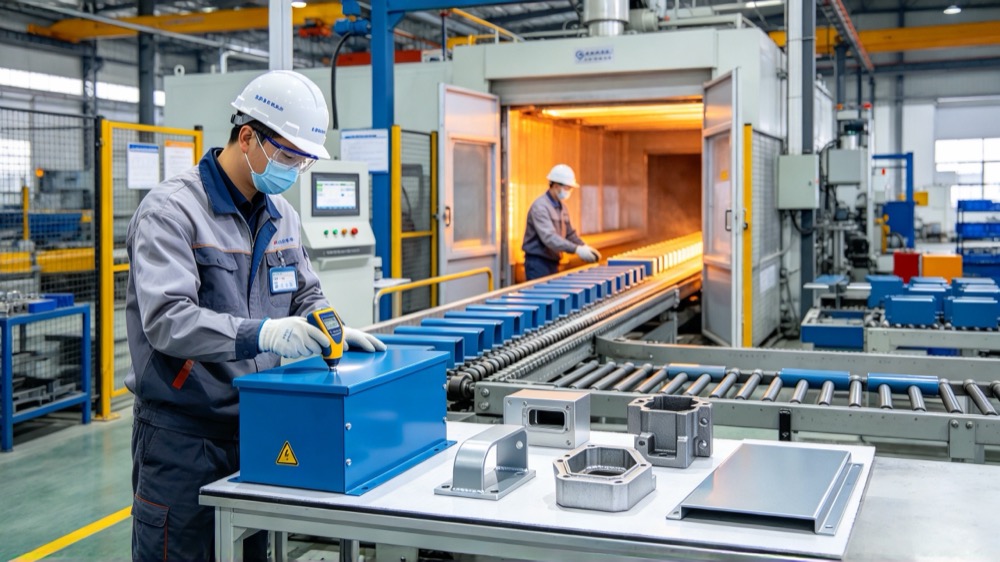
Epoxy powder coating offers compelling opportunities to reduce coating-material losses and simplify suitable industrial finishing operations. Conventional liquid paint remains valuable where heat exposure, assembly size, repair access, or production flexibility governs the decision.
To assess your application with Yinda Technology, share your substrate, component dimensions, annual coating area, color-change frequency, exposure conditions, current coating specification, and available curing equipment. Request a formulation recommendation and comparative trial plan based on accepted output, measured waste, and verified coating performance.
No. It can reduce material losses and support repeatable production, but ovens, recovery equipment, part geometry, batch sizes, and changeovers affect the result. Compare the complete installed process.
No. Reuse depends on cleanliness, compatibility, particle characteristics, appearance requirements, and validated process limits. Some collected powder must be discarded.
No. It can reduce solvent-related waste, but pretreatment residues, contaminated powder, filters, and stripping wastes still require assessment under applicable local rules.
Pure epoxy is generally unsuitable as an exposed decorative finish under prolonged sunlight. Consider an exterior-grade chemistry or a qualified epoxy-primer/topcoat system.
Neither is universally faster. Powder can support efficient repeat production, while liquid paint can suit large assemblies or parts that cannot tolerate baking. The line's bottleneck determines throughput.
Sometimes, but not automatically. The proposed system must meet the same corrosion, appearance, chemical, and service requirements before a reduced layer count becomes a valid saving.
1. U.S. Environmental Protection Agency. [*Guide to Clean Technology: Organic Coating Replacements*]. Technical background on solvent replacement, powder application, material utilization, and waste reduction. Historical process guidance, not a current equipment-performance guarantee. [nepis.epa]
2. U.S. Environmental Protection Agency. [*Powder Coat Applications Final Report*]. Demonstration findings addressing pretreatment, wastewater, powder recovery, and remaining waste streams. Site-specific conclusions should not be generalized to every facility. [nepis.epa]
3. Products Finishing. ["How Sustainable Are Powder Coatings?"]. September 25, 2026. Source for illustrative first-pass transfer ranges, reclaim potential, and the distinction between application losses and overall system efficiency. [pfonline]
4. Products Finishing. ["The Real Cost of Downtime"]). February 12, 2025. Discussion of reclaim configurations, color changes, production scheduling, and their economic consequences. [pfonline])
5. Products Finishing. ["Automotive Powder Coating"]. September 15, 2025. Technical discussion of epoxy adhesion, corrosion and chemical resistance, ultraviolet limitations, and representative cure schedules. [pfonline]
6. Products Finishing. ["Liquid Coating Types, Composition and Applications"]. October 16, 2026. Explains distinctions among conventional solvent-borne, high-solids, waterborne, and other liquid coating technologies. [pfonline]
7. U.S. Environmental Protection Agency. [*Powder Coatings Technology Update*]. Background on pretreatment and electrostatic application limitations, including coverage of internal corners. [nepis.epa]


