Language


Views: 298 Author: Yinda Powder Coating Publish Time: 2026-11-23 Origin: Site


Content Menu
● Why Source Powder Coating in the UAE?
>> The UAE's main sourcing clusters
>> What recent industry data actually tells buyers
● Selection Criteria: How These Suppliers Were Evaluated
>> 1. Manufacturing identity and supply-chain transparency
>> 2. Product-specific technical evidence
>> 3. Research and customization capability
>> 4. Quality control and production repeatability
>> 5. Delivery reliability and commercial fit
● Comparison Table: Capacity, MOQ, Approvals, and Buying Fit
● 1. Yinda Technology: An International Alternative for Custom Development
>> Company background and market coverage
>> Core strengths and customization relevance
>> OEM/ODM scope and buyer fit
● 2. Jotun Powder Coatings: Architectural Systems With Detailed Technical Documentation
>> Company background and market coverage
>> OEM/ODM scope and buyer fit
● 3. AkzoNobel / Interpon: Broad Application Coverage and Lower-Energy Options
>> Company background and market coverage
>> OEM/ODM scope and buyer fit
● 4. Axalta Coating Systems: UAE Manufacturing Backed by a Wider Powder Portfolio
>> Company background and market coverage
>> OEM/ODM scope and buyer fit
● 5. National Paints / National Powder: Local Supply and Functional Coating Options
>> Company background and market coverage
>> OEM/ODM scope and buyer fit
● 6. Qemtex: A Newer UAE Production Platform With Published Expansion Plans
>> Company background and market coverage
>> OEM/ODM scope and buyer fit
● Technical Buyer's Guide: Specify the Coating System Before Requesting Prices
>> Match the chemistry and grade to the application
>> Separate management certification from product approval
>> Treat CE and RoHS claims accurately
● How to Verify a Factory and Approve Samples
>> Step 1: Establish the legal and manufacturing identities
>> Step 2: Agree on a controlled technical specification
>> Step 3: Move beyond the laboratory panel
>> Step 4: Evaluate logistics as part of product qualification
● Common Procurement Pitfalls and How to Avoid Them
● An Insider's Avoidance Guide: Test Metallic Powders After Reclaim, Not Just Before It
● Conclusion: Choose the Supplier That Can Reproduce the Approved Result
>> 1. How can I verify whether a supplier's ISO certificate has expired or been suspended?
>> 2. Does a QUALICOAT-approved manufacturer mean every powder it sells is approved?
>> 3. Can two powders with the same RAL color be substituted during a façade project?
>> 4. Does a powder advertised as curing at 150°C automatically reduce our energy bill?
>> 5. Can we approve a new supplier using only its certificate and a laboratory sample?
Choosing a powder coating supplier in the UAE requires more than comparing prices or collecting color cards. A dependable manufacturing partner should be able to demonstrate product-specific approvals, formulation expertise, traceable quality control, and consistent delivery—not simply offer an attractive finish on a laboratory panel.
For professional buyers, the first screening questions should be practical:
- Does the quoted powder carry the approvals required for the actual application?
- Can the manufacturer adjust color, gloss, texture, and curing behavior without compromising performance?
- Does its quality system connect raw materials, production batches, test results, and shipment records?
- Can it support repeat orders consistently, including smaller custom requirements?
- Is the material manufactured locally, supplied through a regional operation, or imported?
This guide compares six powder coating manufacturers and supply options relevant to UAE procurement. It distinguishes locally established producers from an international alternative, explains where published evidence is available, and identifies the information buyers should obtain before placing an order.
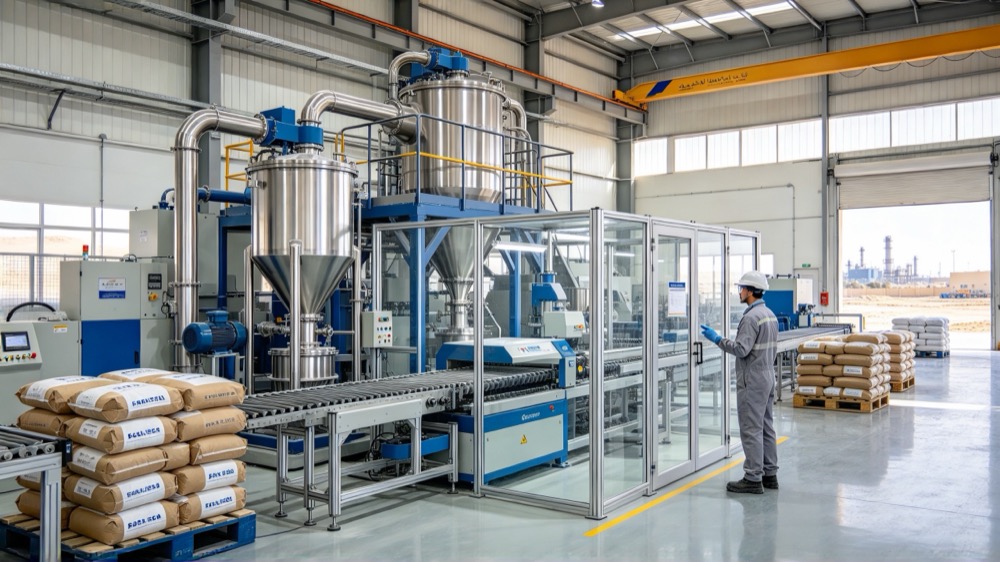
The UAE combines established coatings production with a network of architectural aluminium fabricators, extrusion companies, and surface-treatment businesses. The regional association QMEA lists powder manufacturers and applicators across Dubai, Sharjah, Ras Al Khaimah, and Umm Al Quwain, illustrating the concentration of complementary suppliers available to buyers. Its directory includes Jotun, AkzoNobel, Axalta, National Paints, and Qemtex.
That industrial network matters because coating performance depends on more than powder chemistry. Pretreatment, application conditions, curing, inspection, and handling all influence the finished result. Jotun's architectural application guidance, for example, specifies substrate preparation, pretreatment conditions, coating thickness, and curing requirements rather than treating powder selection as an isolated purchasing decision.
For an initial supplier search, the following locations are particularly relevant:
| Location | Documented industry presence | Procurement relevance |
|---|---|---|
| Dubai | Jotun Powder Coatings UAE and AkzoNobel UAE operations | Established supplier access and architectural coating discussions |
| Sharjah | National Paints and multiple licensed coating applicators | Powder purchasing alongside local finishing and fabrication support |
| Ras Al Khaimah | Axalta's regional operation | Access to an international powder coating portfolio |
| Umm Al Quwain | Qemtex's production and distribution facility | A newer UAE manufacturing option serving domestic and export customers |
These locations reflect documented company operations, not a ranking of emirates by production volume.
Market Data Forecast's October 2026 update estimates the Middle East and Africa powder coating market at USD 0.96 billion in 2025 and USD 1.02 billion in 2026, forecasting a 6.19% compound annual growth rate through 2034. These are commercial research estimates for the entire region—not official UAE production, consumption, or export statistics.
A more directly actionable development is new local manufacturing investment. Qemtex announced its Umm Al Quwain plant in August 2024, stating an initial annual capacity of 5,000 tonnes and a planned second-stage increase to 10,000 tonnes. Buyers should distinguish that announced expansion target from independently confirmed current output.
The practical implication is straightforward: sourcing choices are expanding, but available capacity for a particular resin, color, or delivery window still requires direct verification.
This shortlist uses five procurement dimensions. No numerical scores are assigned because comparable factory-audit results, customer complaint rates, and on-time delivery records are not publicly available for every company.
A buyer should establish whether the contracting party is:
- The powder manufacturer;
- An authorized distributor;
- A regional sales operation; or
- A coating applicator purchasing powder from another company.
These are different business models. A licensed applicator may provide excellent finishing services without manufacturing powder.
Approval should be checked against the quoted product series and production site—not inferred from a company logo.
Jotun's Super Durable 2901 technical data sheet, for example, identifies QUALICOAT Class 2 performance and separate approval references for manufacturing origins including the UAE and Saudi Arabia. This is more useful than an unsupported statement that "all products are certified."
The relevant question is not whether a supplier offers "customization," but what it can actually change:
- Color and gloss;
- Surface texture;
- Metallic appearance;
- Cure temperature and holding time;
- Mechanical performance;
- Corrosion protection system; and
- Compatibility with the buyer's production line.
Private-label packaging, exclusive formulations, and formulation ownership should be negotiated separately. They should not be assumed from the availability of custom colors.
Request evidence of incoming-material checks, batch identification, retained samples, film testing, and nonconformance handling.
For metallic finishes, also ask how the manufacturer controls appearance under reclaim conditions. AkzoNobel's application guidance specifically warns that reclaim can separate pigments in dry-blended metallic powders and produce substantial appearance inconsistency.
Published installed capacity is not the same as available production capacity.
Ask for a delivery commitment covering your actual product, batch size, packaging, approval requirements, and destination. Review repeat-order lead time separately from first-order sampling time.
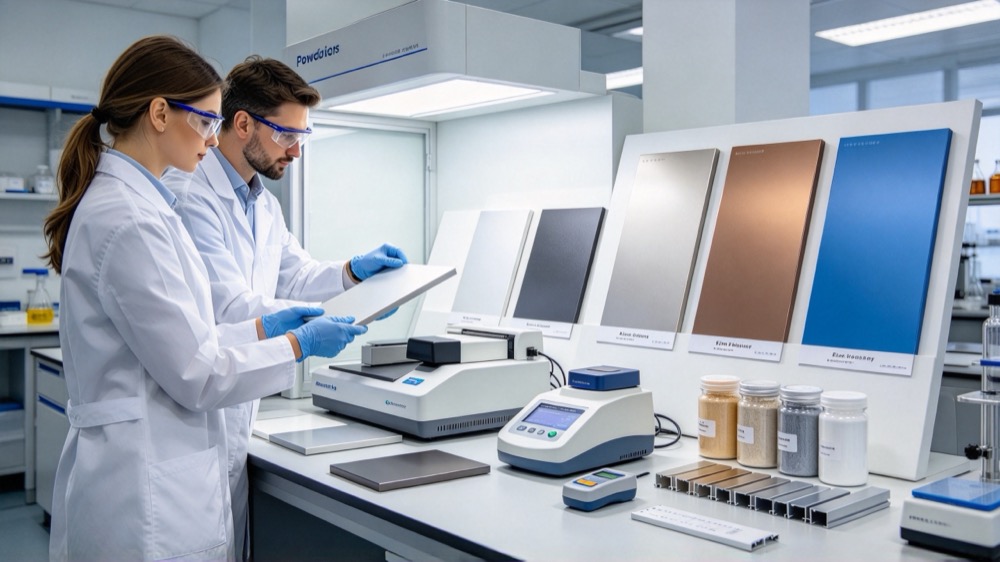
"Not publicly confirmed" means the cited sources do not establish a comparable figure. It does not mean the supplier lacks capacity or certification.
| Supplier | UAE sourcing position | Public powder capacity information | MOQ position | Certification or approval evidence | Main purchasing focus |
|---|---|---|---|---|---|
| Yinda Technology | International manufacturer; no UAE factory established by the reviewed source | Not publicly confirmed | Request standard-color and custom-formulation MOQs separately | Current product and factory certificates require direct verification | R&D-led customization and a value-focused alternative for smaller brands |
| Jotun Powder Coatings | Established UAE powder operation | Comparable current UAE powder-only figure not confirmed | Obtain product-specific quotation | Selected Facade and Super Durable products identify Class 1/Class 2 approvals and performance standards | Specification-driven architectural aluminium projects |
| AkzoNobel / Interpon | Documented Dubai powder manufacturing | New Dubai plant recorded in 2014; current comparable tonnage not confirmed | Obtain quotation by product and color | Selected architectural ranges identify QUALICOAT performance requirements | Architectural, industrial, and lower-energy curing applications |
| Axalta Coating Systems | UAE manufacturing presence established through Capital Paints acquisition | Not publicly confirmed | Obtain quotation | QMEA lists the regional business; verify the exact product approval separately | Architectural and industrial thermosetting powder coatings |
| National Paints / National Powder | Established UAE powder supplier | Powder-only capacity not confirmed | Obtain quotation | Company states Class 1 and Class 2 approvals for architectural powders | Local architectural supply, color matching, and functional coatings |
| Qemtex | Manufacturing and distribution in Umm Al Quwain | Announced 5,000 tonnes/year initially; 10,000 tonnes/year planned second stage | Selected stock listings offer one-box inquiries; custom MOQ requires quotation | Company publishes Class 1/Class 2 approval announcements; verify the quoted system | UAE-made architectural and industrial powders with product-development support |
Packaging size should never be treated automatically as MOQ. A 25 kg carton, for example, does not establish the minimum order for a custom metallic formulation or an exclusive color.
Yinda Technology states that it was established in 2010 and is headquartered in Foshan, Guangdong, China. Its company profile describes a dedicated R&D center, testing facilities, production lines, and an R&D team with more than 20 years of experience. The founder's industry history dates to 1998, which should not be confused with the company's establishment year.
Its stated application markets include architectural profiles, doors and windows, new energy vehicles, medical equipment, hardware, and electrical appliances. The profile also describes international operations involving Indonesia and the Middle East, alongside worldwide sales.
Yinda belongs in this guide as an international sourcing alternative—not as a verified UAE-based manufacturer. Its reviewed company page discusses Middle Eastern expansion but does not establish a UAE manufacturing address.
Yinda's public positioning emphasizes tailored products, technical development, and responsive support. These make it a relevant candidate for buyers seeking a closer development relationship rather than selecting exclusively from a fixed stock range.
For smaller brands and mid-sized manufacturers, the most useful discussion would cover:
- Color, gloss, and texture development;
- Adjustment to the buyer's curing conditions;
- Sample revision procedures;
- Production-scale validation;
- Repeat-order consistency; and
- Packaging or private-label requirements.
These are proposed qualification topics, not verified promises that every customization is available at every order quantity.
Yinda can be positioned as a value-focused, R&D-oriented candidate for buyers seeking deeper customization support. However, "cost-effective" should mean competitive cost per accepted coated component—not an unverified claim that its price is lower than every UAE producer.
To assess flexibility and communication efficiency objectively, ask Yinda to nominate one technical contact, provide a written development schedule, and document how sample revisions become controlled production specifications.
Before approval, request current certificates, production capacity, MOQ by formulation, shipment origin, and a quotation separating development charges from recurring supply costs.
Jotun's UAE manufacturing history dates to 1973, according to Coatings World. That date refers to its broader UAE presence and should not be presented as the establishment year of the separate powder coatings entity. QMEA lists Jotun Powder Coatings UAE in Dubai.
Its documented powder offering is particularly relevant to architectural aluminium extrusions, cladding, façades, and related building components.
Jotun provides useful distinctions between architectural durability levels.
Its Facade range identifies QUALICOAT Class 1 and AAMA 2603 performance, while its Super Durable range identifies Class 2 and AAMA 2604 performance. Buyers should still review the exact grade, manufacturing origin, and current approval rather than assume that every color or finish has identical coverage.
This documentation makes Jotun a strong candidate when a consultant, façade contractor, or building owner has specified a particular architectural performance level.
The documented offering supports product-system selection and architectural finishes, including decorative collections. Exclusive formulations, private labeling, and small-batch development are separate commercial questions and are not established by the cited product pages.
For long-term procurement, obtain the proposed grade's technical data sheet, approved applicator requirements, and written warranty conditions. A product performance guarantee should not be interpreted as unconditional coverage of pretreatment or application failures.
AkzoNobel's 2014 annual report records the start of operations at a new Dubai powder coatings plant serving Interpon and Resicoat customers in the region. This is a verified local manufacturing milestone, rather than the founding date of the wider group.
The portfolio covers architectural and industrial applications, with additional automotive powder coating systems under the Interpon and Resicoat brands.
Interpon is relevant when buyers need to balance coating performance with curing-line productivity.
For example, AkzoNobel describes Interpon D1036 Low-E as capable of curing at temperatures as low as 150°C while retaining QUALICOAT Class 1 certification. The company also describes potential energy and throughput benefits, but these should be validated on the buyer's actual oven, substrate mix, and line speed.
Its polyester technology page identifies architectural ranges meeting Class 2, GSB Master, or AAMA 2604 requirements, demonstrating why buyers must specify the required product family rather than request "polyester powder" generally.
Documented development strengths include lower-energy curing, architectural metallic effects, and coatings for specialized industrial substrates. Private-label manufacturing and exclusive formula ownership are not established by those capabilities and require direct negotiation.
Interpon is a relevant shortlist option for architectural fabricators and industrial manufacturers seeking established product platforms and process-development discussions.
Axalta's corporate history identifies 2013 as the establishment year of Axalta Coating Systems. Its sustainability reporting confirms the acquisition of UAE powder manufacturer Capital Paints in 2019 to extend powder coating reach in the Middle East and North Africa.
QMEA lists Axalta Coating Systems' regional operation in Ras Al Khaimah.
Axalta's UAE website presents thermosetting powder coatings as part of its regional offering. Its wider corporate portfolio includes both thermosetting and thermoplastic technologies, while the Alesta range covers interior and exterior applications.
The important procurement distinction is availability: a technology in the global portfolio is not necessarily manufactured in the UAE or stocked locally.
Axalta is a relevant candidate for buyers requiring architectural or industrial powders within an international technical network.
For customization, establish which color-matching, formulation-development, and technical services the regional team can provide. Request written confirmation of manufacturing origin, product approval, development lead time, and repeat-order supply arrangements.
Do not treat global portfolio breadth as proof of local capacity for every specialty product.
National Paints traces its paint production history to Jordan in 1969 before its subsequent UAE expansion. That group history should be kept distinct from the commissioning date of a particular UAE powder line.
Its powder business serves architectural applications and functional markets, including pipes and reinforcing steel. The published portfolio includes fusion-bonded epoxy, architectural polyester, super-durable polyester, pure polyester, and hybrid powders.
National Powder provides unusually specific public service statements. Its website advertises custom color and finish matching within 24–48 hours and production lead times of four to five working days after order confirmation. These are supplier-published targets, not independently measured delivery performance.
The company also states that its architectural powders carry QUALICOAT Class 1 and Class 2 approvals and describes investment in research facilities and manufacturing capabilities.
The publicly documented customization scope includes color and finish matching. Buyers requiring exclusive formulations, private labels, or application-specific qualification should obtain separate written confirmation.
National Powder is particularly relevant for purchasers comparing local replenishment, architectural product availability, and functional coating requirements. Confirm whether the advertised lead time applies to the exact order quantity, color, approval class, and delivery location.
Qemtex's company history records its first in-house manufacturing plant in 2019 and the start of UAE manufacturing operations in 2024. Its UAE facility and distribution center are located in the Umm Al Quwain Free Trade Zone.
The company markets powders for architectural, general industrial, appliance, functional, automotive, and agricultural and construction equipment applications.
Qemtex's August 2024 announcement identifies initial annual capacity of 5,000 tonnes, with a second-stage increase planned to 10,000 tonnes. Procurement teams should request confirmation of the currently installed and commissioned capacity rather than use the planned figure automatically.
Its website also identifies product development, production audits, training, and technical support among its services.
Qemtex is relevant to buyers seeking UAE-made powder with product-development support. Its public materials describe tailored formulations, but private-label terms, formula exclusivity, and custom production MOQs still require quotation.
The company publishes announcements concerning Class 1, Class 2, and decorative approvals. Ask for the approval number covering the quoted formulation and verify its current status before treating it as a project-compliant supply option.
"Powder coating" is not a single interchangeable material category. National Powder's portfolio alone distinguishes hybrid, pure polyester, super-durable polyester, and fusion-bonded epoxy products, while Interpon's portfolio includes polyester grades designed for different interior and exterior requirements.
A useful request for quotation should therefore identify:
| Application | Information to specify |
|---|---|
| Architectural aluminium | Required durability class, weathering standard, pretreatment, substrate, and warranty conditions |
| Indoor equipment or furniture | Cleaning exposure, mechanical requirements, appearance, and curing limitations |
| Exterior steel components | Corrosion environment, substrate preparation, primer/topcoat arrangement, and edge protection |
| Pipes or reinforcing steel | Applicable functional coating specification and qualification requirements |
| EV or electrical components | Whether the coating is decorative, protective, insulating, or part of another validated function |
Avoid accepting a standard indoor formulation as a substitute for a specified exterior grade merely because the initial color match looks correct.
A factory management-system certificate and a coating product approval answer different questions.
For architectural procurement, request both the relevant factory documentation and the quoted powder's technical approval. Jotun's data sheets illustrate product-level identification through named grades and approval numbers, while CertSearch provides a separate route for checking management-system certification status and scope.
CE marking is not a universal environmental certificate for powder coating. EU guidance states that it applies only where specific legislation requires it; it must not be used on products outside those requirements.
RoHS concerns restricted substances in electrical and electronic equipment. A coating used on an in-scope product may therefore require appropriate substance-compliance evidence, but a generic "RoHS compliant" statement does not establish outdoor durability, corrosion performance, or complete equipment conformity.
Ask for declarations and supporting test evidence that clearly identify the relevant material or formulation.
Collect the registered company name, factory address, invoicing entity, manufacturing origin, and bank beneficiary details.
If the supplier uses multiple plants, ask which site will produce the approved sample and subsequent orders. Document any permission required before changing sites.
Before sampling, record:
- Substrate and pretreatment;
- Product code and resin family;
- Color reference and measurement method;
- Gloss range and measurement angle;
- Texture or metallic appearance standard;
- Film-thickness range;
- Cure conditions;
- Required testing; and
- Acceptance and rejection procedures.
The cure specification should identify object temperature and holding time—not simply the oven display setting. AkzoNobel's guidance explicitly requires the product data sheet's object-temperature and holding-time conditions to be followed.
Use a staged approval process:
1. Review the technical data sheet and documentation.
2. Approve a laboratory color and finish sample.
3. Run a pilot batch on actual components.
4. Evaluate normal production conditions.
5. Approve the first commercial batch.
6. Retain reference powder and coated parts for repeat-order comparisons.
For metallic finishes, the production trial should include the intended reclaim practice, gun settings, component orientation, and curing conditions. These variables can affect appearance even when the powder itself is unchanged.
Ask the supplier to specify storage limits, shelf life, packaging, and remaining usable life at delivery.
The purchase order should also identify the shipment origin, agreed Incoterm and named place, customs-document responsibilities, and procedure for handling damaged or heat-affected goods.
Do not assume that an international brand's UAE office means every product will ship from a UAE plant.
| Pitfall | Why it creates risk | Prevention |
|---|---|---|
| Buying by color code alone | A color reference does not define gloss, texture, resin grade, or weathering performance | Approve a complete specification and physical reference |
| Accepting a company-wide certification claim | The quoted grade or production site may not be covered | Verify product and site identifiers |
| Treating future capacity as current capacity | Announced expansion may not be commissioned | Request current installed capacity and available scheduling |
| Comparing price per kilogram only | Consumption, rejects, and rework affect actual component cost | Compare cost per accepted coated component |
| Approving only hand-sprayed panels | Production application conditions may produce different results | Run actual parts through the intended line |
| Leaving formula changes uncontrolled | Repeat orders may no longer match the approved system | Require written change notification and reapproval |
The need for product-specific approvals and production-condition validation is illustrated by the grade-level approval details in Jotun's data sheets and the application controls in AkzoNobel's metallic coating guidance.
One easily missed purchasing risk is approving a metallic finish under conditions that cannot be maintained during normal production.
A supplier's sample panel may look consistent when sprayed using fresh powder. The buyer may then introduce reclaim to reduce consumption, only to encounter differences in shade, sparkle, or appearance across production.
AkzoNobel's technical guidance explains the underlying issue: reclaim can separate metallic pigment from the basecoat in dry-blended powders. It recommends spraying dry-blended metallic powders to waste. Bonded metallic powders can often be reclaimed, but appearance control still requires care; spraying to waste may remain preferable where precise appearance is essential.
Before approving a metallic powder, ask:
1. Is the product dry-blended, bonded, or produced using another stabilization technology?
2. Is reclaim permitted for this exact product?
3. What operating controls does the manufacturer require?
4. Has the appearance been validated after representative production circulation?
5. Can adjacent visible components be supplied from a controlled batch allocation?
The purchasing lesson is not that one manufacturing method is always superior. It is that the quoted powder, expected material yield, and approved production method must agree.
A lower-priced material can become more expensive if its required application method was omitted from the original cost comparison.
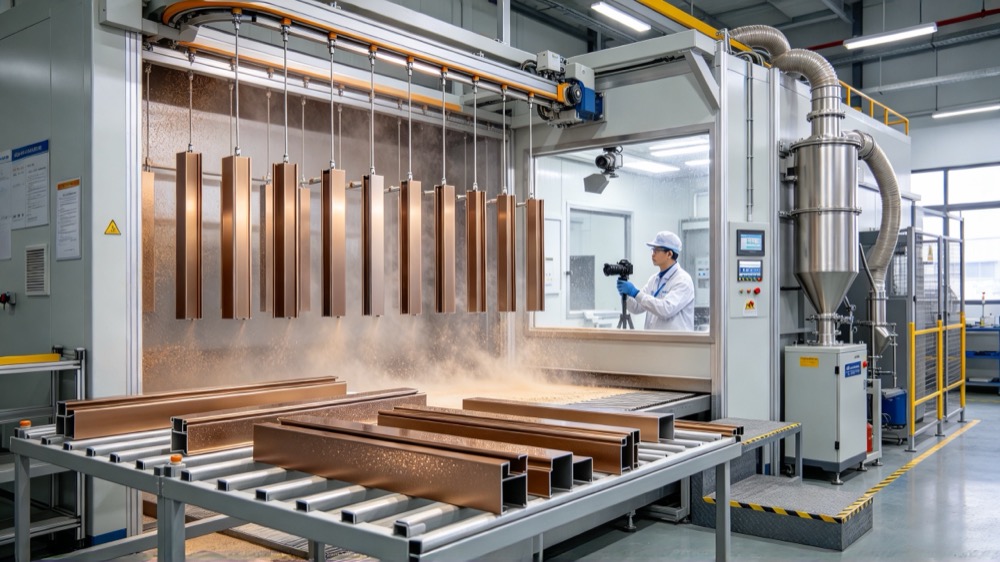
The most useful shortlist depends on the purchasing requirement.
Jotun and Interpon offer documented architectural systems and technical guidance. Axalta combines a UAE manufacturing history with a wider international powder portfolio. National Powder publishes local color-matching and production service targets. Qemtex adds a newer UAE production platform with product-development services. Yinda Technology provides an international alternative for buyers exploring R&D-led customization and a closer development relationship.
The final decision should rest on a controlled specification, verified documentation, a successful line trial, and written repeat-order commitments—not on brand recognition or the lowest price per kilogram alone.
For a Yinda Technology quotation, submit your substrate, application environment, color and finish reference, curing conditions, required approvals, expected order volume, and destination. Request a product recommendation, sample-development plan, current documentation, and clearly stated production and logistics terms before commercial approval.
Search by the exact certificate number or legal company name in CertSearch. Compare the standard, scope, legal entity, site coverage, status, issuing certification body, and last update. The platform distinguishes active, suspended, withdrawn, and expired certificates.
If the record is absent or inconsistent, request written confirmation directly from the certification body. Do not rely only on a PDF expiry date or a logo on the supplier's website.
No. Procurement should verify the actual coating system and manufacturing origin.
For example, Jotun's Super Durable 2901 data sheet lists specific approval references by production origin. QMEA also directs buyers to check active systems rather than treating directory membership as blanket approval of every product.
Do not approve substitution based on the color code alone.
Require comparison of the specified durability grade, gloss, texture, metallic appearance, cure conditions, and physical reference. Metallic products need particular care because application and reclaim conditions can alter appearance. Treat a supplier or formulation change as a requalification event rather than a routine purchasing substitution.
No. First establish the required object temperature and holding time, then validate the effect on your actual line.
AkzoNobel identifies lower-temperature and faster-curing benefits for selected Low-E products, but its processing guidance also emphasizes substrate thickness, line speed, and oven adjustment. A laboratory cure claim does not establish a guaranteed saving for every factory.
That is insufficient for production qualification.
Certificates help verify defined requirements, and laboratory panels help assess appearance. Neither demonstrates how the powder will behave on your actual parts under your pretreatment, spraying, reclaim, and curing conditions. The manufacturer's application guidance should inform a documented production trial before unrestricted commercial approval.
- QMEA member directory: regional manufacturer and applicator identities, locations, and scheme information. Check active product approvals separately. [qualimiddleeast]
- QUALICOAT: architectural coating quality-scheme information and access to its official resources. [qualicoat]
- CertSearch: management-system certificate verification by company or certificate number. [iafcertsearch]
- European Commission RoHS guidance: restricted-substance requirements relevant to electrical and electronic applications. [environment.ec.europa]
- Your Europe CE-marking guidance: when marking is required and when it must not be used. [europa]
- Market Data Forecast's 2026 regional report: commercial Middle East and Africa market estimates, not official UAE export statistics. [marketdataforecast]


