Language


Views: 258 Author: Yinda Powder Coating Publish Time: 2026-10-08 Origin: Site


Content Menu
● Laser Oxide Removal vs. Chemical Pickling: Quick Comparison
● Why Oxide Removal Matters Before Powder Coating Steel
● How Laser Oxide Removal Works Before Powder Coating
>> Where Laser Cleaning Provides Practical Advantages
>> Why Laser Parameters Cannot Be Copied Blindly
● How Chemical Pickling Works Before Powder Coating
>> Where Pickling Offers an Advantage
>> The Main Risks of Acid Pickling
● Which Method Produces Better Powder-Coating Adhesion?
>> Surface Texture Matters More Than Appearance Alone
>> Conversion Treatment and Primer Selection Remain Important
● Structural Steel Geometry: The Hidden Selection Factor
>> Laser Access Around Welds, Corners, and Recesses
>> Pickling Access Inside Hollow Sections
● Safety and Environmental Performance: Compare the Whole Process
● A Practical Qualification Plan for Steel Fabricators
>> Step 1: Define the Finished-Coating Requirement
>> Step 2: Select Representative Samples
>> Step 3: Record Preparation Conditions
>> Step 4: Control Powder Application and Cure
>> Step 5: Test the Complete System
>> Step 6: Establish Production Controls
● Total Cost: Calculate Cost per Accepted Component
● Two Application Scenarios That Clarify the Choice
>> Localized Oxidation on Fabricated Frames
>> Repeated Batches with Widespread Mill Scale
● Discuss Your Steel Coating Requirements with Yinda Technology
>> Can Laser-Cleaned Steel Be Powder Coated Immediately?
>> Is Chemical Pickling the Same as Phosphating?
>> Does Laser Cleaning Always Remove Mill Scale?
>> Can Pickling Cause Hydrogen Embrittlement?
>> Which Method Is Better for Outdoor Structural Steel?
>> Should Fabricators Choose Laser Cleaning Only to Reduce Chemical Use?
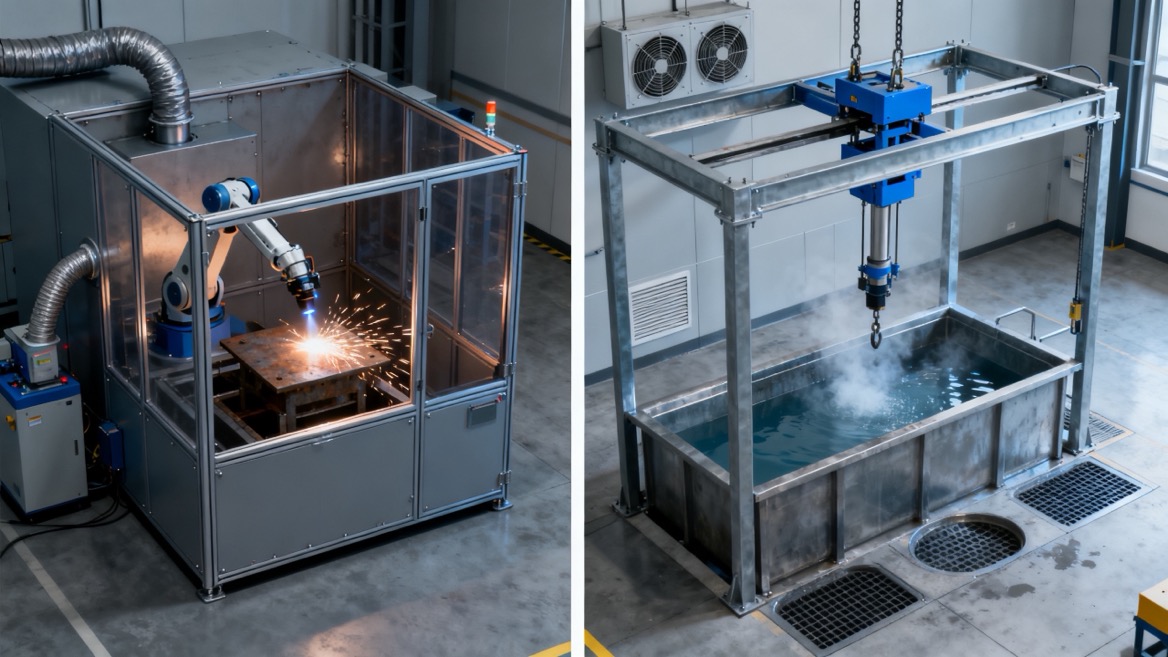
Laser oxide removal vs. chemical pickling before powder coating structural steel components is not simply a choice between modern equipment and established chemistry. It is a decision about oxide removal, coating adhesion, corrosion protection, production flow, and the cost of delivering an acceptable finished component.
Laser cleaning offers precise, localized treatment without an acid bath. Chemical pickling can remove rust and mill scale across immersed surfaces, including some areas that are difficult to reach with a laser. Neither method, however, automatically produces a surface ready for durable powder coating.
From a powder-coating manufacturer's perspective, the deciding factor is qualification: proving that the complete preparation and coating system performs on your actual steel, geometry, and service environment.
For Yinda Technology, serving manufacturers across China, Indonesia, and Saudi Arabia, this comparison is especially relevant to fabricated frames, architectural steelwork, equipment supports, and other components requiring dependable protection.
| Decision factor | Laser oxide removal | Chemical pickling |
|---|---|---|
| Removal mechanism | Laser energy disrupts and removes surface contamination | Acid dissolves rust and mill scale |
| Best-fit applications | Localized oxidation, accessible surfaces, selective treatment | Batch descaling where immersion is practical |
| Geometric limitation | Requires optical access and suitable scanning angles | Requires solution access, drainage, and effective rinsing |
| Surface profile | Depends strongly on equipment and processing parameters | Does not reliably create a specified anchor profile |
| Process waste | Extracted particles, filters, and possible fumes | Spent solutions, rinse water, and treatment residues |
| Main safety concerns | Laser exposure, reflections, fumes, and fire hazards | Acid exposure, chemical handling, and hydrogen generation |
| Corrosion protection | Requires validation of subsequent coating stages | Requires validation of rinsing and subsequent coating stages |
| Cost drivers | Equipment, scanning time, automation, extraction | Tanks, chemistry, handling, rinsing, and waste treatment |
The practical conclusion is straightforward: choose laser cleaning for controlled, accessible treatment; consider pickling for immersion-compatible batch descaling. Validate both against the same finished-coating requirements.
Structural steel can arrive with mill scale, rust, cutting oxides, welding residues, oil, and fabrication debris. These contaminants are different problems and should not be treated as one uniform layer.
A powder coating may look smooth while remaining poorly attached to an unstable surface beneath it. Moisture entering through scratches, edges, or defects can then expose weaknesses in the coating–steel interface.
Successful preparation therefore addresses four separate requirements:
- Remove contaminants that interfere with bonding.
- Establish an appropriate surface condition.
- Provide the specified pretreatment or corrosion-protection system.
- Prevent contamination and rusting before coating.
An important distinction is often overlooked: oxide removal is not the same as conversion coating. Removing rust does not automatically create the chemically bonded layer associated with phosphate or zirconium-based pretreatment.
Laser cleaning directs controlled energy onto the steel surface. Depending on the equipment, contamination, and operating conditions, this energy can cause ablation, thermal expansion, and disruption of the oxide layer.
Laser oxide removal is particularly attractive when contamination is localized.
Examples include accessible weld-adjacent oxidation, selected cut edges, and isolated rusty areas on otherwise acceptable components. A manufacturer may avoid immersing an entire assembly when only a limited surface needs treatment.
Potential advantages include:
- Selective cleaning of defined areas.
- No acid bath for the laser-removal stage.
- Integration with robotic positioning.
- Reduced wet-process handling.
- Adjustable treatment for different contamination conditions.
These advantages become meaningful only when access, cycle time, extraction, and cleaning consistency are verified.
Laser power alone does not define cleaning quality. Pulse characteristics, scanning speed, overlap, stand-off distance, and oxide condition all influence the result.
Insufficient treatment can leave residual oxide. Excessive treatment can alter the steel surface or promote undesirable thermal effects.
Published research also shows that laser cleaning can change roughness in different ways. It may expose an existing profile, reduce roughness, or generate new surface features.
My recommendation is to ask suppliers for trials on representative components—not demonstrations on a flat plate with unusually light rust.
A clean-looking surface is useful evidence, but it is not proof of reliable powder-coating adhesion.
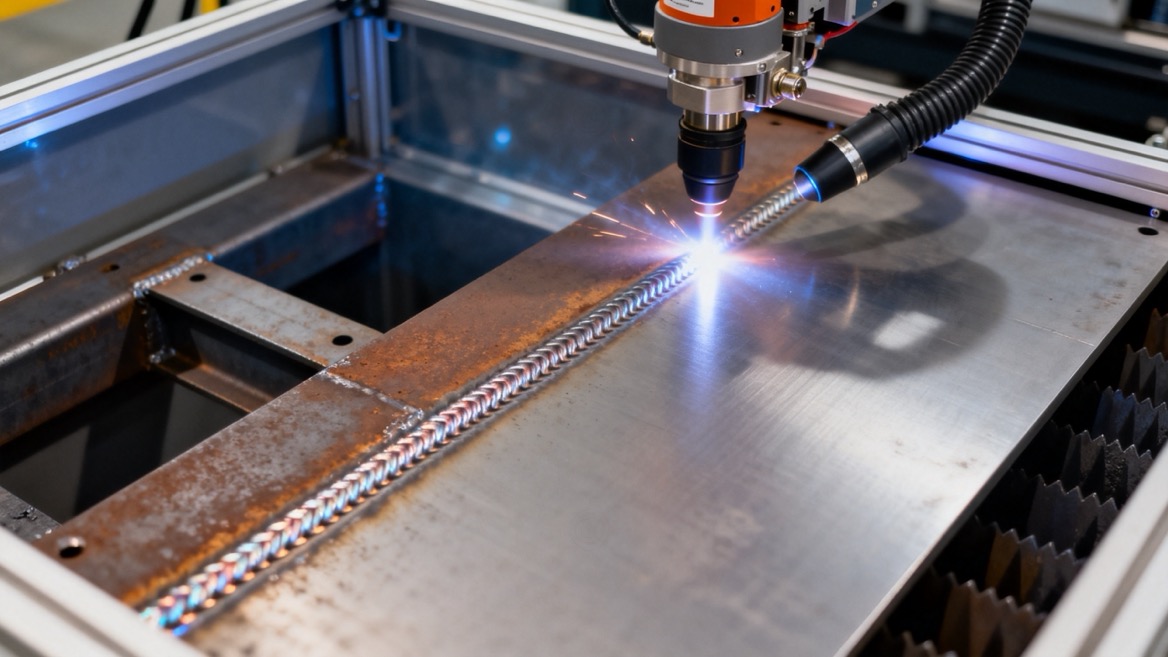
Chemical pickling uses an acid solution to dissolve rust and scale. Hydrochloric and sulfuric acids are established options for steel descaling, although the correct chemistry depends on the material and process.
A typical preparation sequence may include:
1. Degreasing to remove oils and fabrication soils.
2. Controlled acid pickling.
3. Thorough rinsing.
4. Specified conversion treatment.
5. Final rinsing or treatment according to the chemistry supplier.
6. Drying and powder application.
Some proprietary systems combine functions or use different sequences. The approved process specification should govern operation.
Immersion can treat multiple components together and contact surfaces that are not directly visible to a laser.
This can make pickling attractive for repeatable batches and some complex assemblies. However, solution contact alone is insufficient.
The design must also allow chemicals to enter, displaced air to escape, and rinse water to remove residues. Blind cavities, overlapping joints, and poorly drained sections can undermine the process.
Poorly controlled pickling can cause excessive attack on the steel, inconsistent cleaning, or chemical carryover.
Residual chemicals and contaminated rinse water can compromise the coating interface. Freshly cleaned steel can also rust during delays before subsequent processing.
Acid exposure may introduce hydrogen into steel. The significance is especially important for susceptible high-strength or hardened parts, including certain fasteners and highly stressed components.
Do not assume that a normal powder-curing cycle provides an approved hydrogen-embrittlement relief treatment. Material specifications and responsible engineering review must determine the required controls.
Neither process is universally superior.
Adhesion depends on the resulting surface and the complete coating system—not the cleaning method's name.
A bright steel surface may still retain oil, salts, or weak oxide. Conversely, a visually darker surface may require further analysis before rejection.
Laser-cleaning studies have reported successful adhesion under specific conditions, but findings from bridge recoating or other coating systems cannot automatically be transferred to powder-coated structural components.
Similarly, pickling may remove scale effectively without producing the profile required by a particular primer or powder system.
The appropriate question is:
"Does this preparation route consistently meet the coating supplier's requirements and the project's acceptance criteria?"
Where chemical pretreatment is specified, iron phosphate, zinc phosphate, or zirconium-based systems may be considered according to the substrate, production line, and performance target.
These options are not interchangeable solely on price.
For demanding exterior steel applications, a compatible powder primer and weather-resistant topcoat may be appropriate. Other projects require a different protective system.
Laser cleaning can also be followed by chemical pretreatment. The comparison is therefore not always "laser versus all chemistry," but "laser versus acid pickling within the overall preparation route."
Component geometry can determine the preferred method before any cost comparison begins.
Laser cleaning requires optical access. Weld toes, inside corners, stiffeners, and recessed surfaces can need repositioning or specialized scanning.
A demonstration on one exposed face says little about the reverse side of a bracket or a recessed connection.
Evaluate:
- Accessible surface area per component.
- Required repositioning.
- Shadowed regions and scan angles.
- Fixturing repeatability.
- Inspection access after cleaning.
Pickling can reach some non-visible surfaces, but only where liquid circulation and drainage are effective.
Trapped acid or rinse water creates problems during drying and curing. Fabrication details should therefore be reviewed before selecting immersion treatment.
Internal cleaning also does not guarantee internal powder coverage. Conventional powder application has its own access limitations.
Long beams and large frames introduce another constraint: both the preparation equipment and curing oven must accommodate the component safely.
Laser cleaning avoids an acid bath at the cleaning stage, but it is not waste-free.
Removed material becomes particles or fumes that require suitable extraction and filtration. High-powered systems also require controlled access, protection against direct and reflected radiation, and equipment-specific safety procedures.
Chemical pickling requires appropriate containment, chemical handling, ventilation, protective equipment, and waste management.
Environmental comparisons should include:
- Electricity used by cleaning and extraction.
- Heating requirements.
- Water consumption.
- Chemical replenishment.
- Filter disposal.
- Wastewater treatment.
- Rework and rejected components.
Neither "dry" nor "chemical" is a complete environmental assessment. Compare resources and waste per accepted finished component.
Before changing production methods, run a controlled comparison.
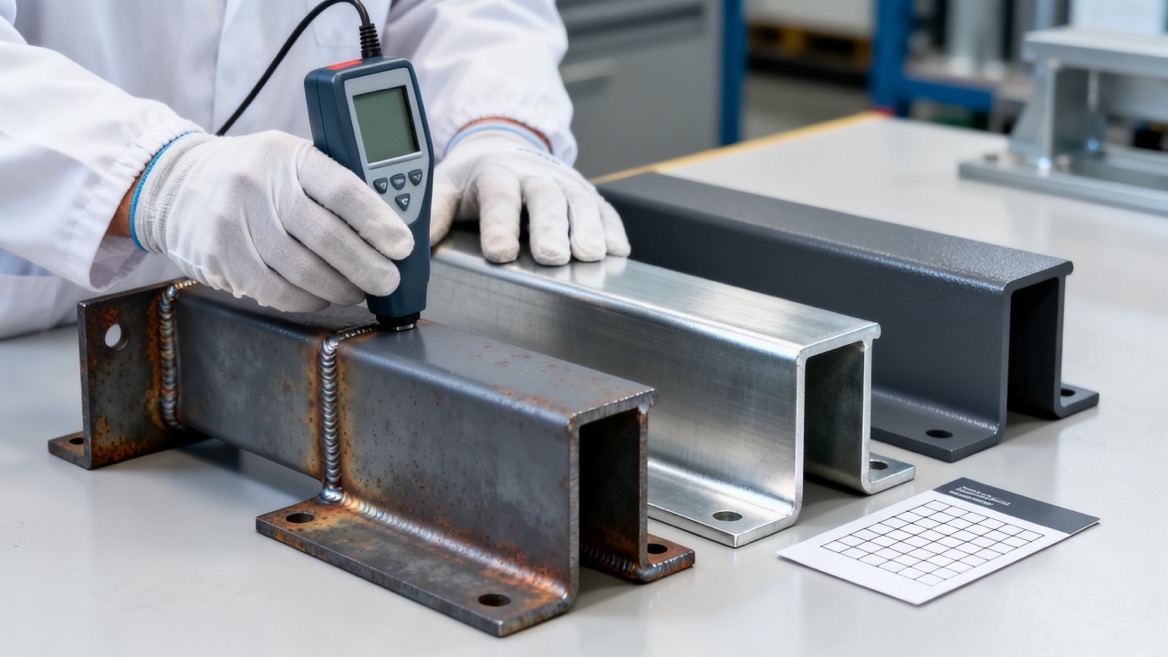
Document the steel grade, service environment, coating system, appearance requirements, and customer specification.
Separate indoor equipment supports from outdoor frames exposed to moisture, salt, or industrial contamination.
Include production welds, cut edges, recesses, and the worst expected oxide condition.
Use multiple specimens per route. One successful coupon does not establish process consistency.
For laser cleaning, record the machine configuration, scanning parameters, passes, and positioning.
For pickling, record chemistry, bath condition, temperature, immersion time, and rinse controls.
Assess residual contamination and surface condition before coating.
Keep powder batch, film thickness, and curing conditions comparable.
Measure component temperature rather than relying only on oven-air temperature. Heavy sections can take longer to reach the specified curing condition.
Use adhesion testing appropriate to the coating thickness and specification. Add corrosion, humidity, or cyclic exposure testing where required.
Inspect edges, welds, and deliberate scribes—not only broad flat areas.
Salt-spray testing provides comparative information under controlled conditions. Exposure hours should not be converted directly into years of outdoor service.
Define acceptable incoming condition, cleaning parameters, inspection frequency, handling limits, and actions for nonconforming parts.
Requalify after significant changes in steel condition, equipment, chemistry, or coating system.
The cheapest cleaning operation may not produce the cheapest finished part.
Compare the full route using:
Cost per accepted component=Total processing cost/Number of accepted components
Include labor, equipment allocation, utilities, chemistry, handling, waste management, maintenance, and rework.
For laser cleaning, measure actual production time, including repositioning and difficult areas.
For pickling, include loading, rinsing, drying, bath maintenance, and treatment of waste streams.
A useful trial dashboard tracks four figures:
- Preparation time per component.
- Resource consumption per batch.
- First-pass acceptance rate.
- Rework cost.
This creates a more defensible purchasing decision than an advertised cleaning speed or a quoted chemical price.
The following scenarios illustrate selection logic; they are not reported Yinda customer results.
Accessible frames with limited weld-adjacent oxidation may suit laser cleaning.
The trial should confirm complete removal at weld transitions and compatibility with subsequent pretreatment and coating.
Immersion-compatible components carrying widespread scale may suit pickling, provided chemical access, drainage, and rinse quality are controlled.
If neither route reliably meets the required surface condition, abrasive blasting or a combined process should remain under consideration.
Share your steel grade, component drawings, oxide condition, exposure environment, production volume, and available curing equipment with Yinda Technology.
Use those details to discuss suitable powder-coating options and the preparation trials needed before production approval. Request a component-specific evaluation rather than selecting a cleaning method from a generic comparison.
Sometimes, but only under a validated process. Laser cleaning does not automatically replace degreasing, conversion treatment, or a specified primer.
No. Pickling removes oxides. Phosphating forms a conversion layer. Their purposes differ, even where a proprietary process combines treatment functions.
No. Removal depends on scale condition and laser parameters. Research involving existing bridge steel found that a laser coating-removal process could leave underlying mill scale.
Acid treatment can introduce hydrogen. Risk depends on material susceptibility and processing conditions. High-strength or hardened components require particular attention.
Neither method wins automatically. Select the route that supports the specified corrosion-protection system and passes representative testing.
No. Reduced acid use can be valuable, but the decision should also consider cleaning consistency, extraction, electricity, accessibility, throughput, and finished-coating performance.
1. Research Progress and Challenges in Laser-Controlled Cleaning of Metal Surfaces. Open-access review available through PubMed Central, 2022. Supports discussion of laser-cleaning mechanisms, parameter sensitivity, and possible changes in surface roughness. [pmc.ncbi.nlm.nih]
2. The Effects of Laser Cleaning and Induction Coating Removal on Recoating Adhesion of Steel Surfaces. University of Virginia, 2023. Supports the discussion of residual mill scale and the limits of transferring adhesion findings between coating systems. [libraetd.lib.virginia]
3. Ferrous Metal Surface Preparation. Diamond Vogel. Summarizes steel-preparation methods, including acid pickling for rust and mill-scale removal. [diamondvogel]
4. Stress and Hydrogen Effects in Metal Finishing. Finishing & Coating, 2025. Supports discussion of hydrogen exposure during acid treatment and the importance of alloy and processing conditions. [finishingandcoating]
5. Powder Coating for Steel Structures. TIGER Coatings. Supports the importance of professional pretreatment and compatible primer–topcoat systems for corrosion protection. [tiger-coatings]
6. Conversion Coatings: Phosphate vs. Zirconium. Products Finishing, 2026. Explains distinctions among conversion-treatment technologies used before coating. [pfonline]
7. Conversion Coatings & Pretreatment Systems. Hubbard-Hall. Provides manufacturer information on phosphate, zirconium, and alternative bonding treatments. [hubbardhall]
8. The Limitations of ASTM B117 Salt Spray (Fog) Testing. Sherwin-Williams Protective & Marine. Explains why standalone salt-spray results should not be treated as direct predictions of natural-environment service life. [industrial.sherwin-williams]


