Language


Views: 222 Author: Yinda Powder Coating Publish Time: 2026-06-01 Origin: Site


Content Menu
● What Makes Aluminum So Challenging to Powder Coat?
● Core Keyword Focus: Best Primer for Aluminum Powder Coating
● Types of Powder Primers for Aluminum (And When to Use Them)
>> Epoxy Zinc‑Free Powder Primers
>> Epoxy Primers for Interior and Industrial Use
>> Advanced Low‑Temperature and UV‑Curable Primers
● Primer Selection Framework for Aluminum Substrates
● Real‑World Application Example: Architectural Aluminum Profiles
● How Yinda Technology Approaches Aluminum Powder Priming
● Step‑by‑Step Process: Preparing Aluminum for Powder Priming
● Industry Trend Insight: Why Primer Choice Matters More Each Year
● Simple Primer Selection Table for Aluminum
● How to Work With a Primer Supplier Like Yinda
● Call to Action: Get a Primer Recommendation for Your Aluminum Project
● Frequently Asked Questions (FAQ)
Choosing the right primer for aluminum before powder coating is the difference between a flawless, long‑lasting finish and a premature failure that costs you customers, warranty claims, and reputation. As a manufacturer working with architectural profiles, EV components, medical equipment and hardware, you cannot afford to treat primer selection as an afterthought. [tiger-coatings]
Aluminum is an excellent substrate: it is lightweight, formable, and naturally corrosion resistant thanks to its oxide layer. That same oxide layer, however, is also what makes adhesion and long‑term durability tricky if you do not prepare and prime correctly. [columbiacoatings]
From an application and troubleshooting perspective, the key challenges are:
- Tightly bound oxide layer that constantly reforms and can interfere with coating adhesion if not properly cleaned and converted. [columbiacoatings]
- Galvanic and filiform corrosion risk in coastal or industrial environments, especially for architectural facades and outdoor equipment. [linkedin]
- Mixed assemblies (aluminum with steel fasteners or inserts) that require primers able to protect dissimilar metals at once. [chemquest]
- Ever tougher performance specs from architects, OEMs and EV manufacturers for UV stability, corrosion resistance and mechanical durability. [linkedin]
In practice, the primer must do three things exceptionally well: adhere, protect, and stay compatible with your topcoat and curing window. [tiger-coatings]

If you are searching for the best primer for powder coating aluminum substrates, you are usually trying to solve one of three real‑world problems: [tiger-coatings]
1. Premature corrosion or blistering on exterior aluminum profiles or cladding.
2. Poor adhesion or chipping on high‑traffic components (handles, EV parts, medical frames).
3. Inconsistent appearance when you mix different alloys or complex geometries in one job.
At a formulation level, the products that typically deliver the best performance on aluminum combine:
- Zinc‑free epoxy or hybrid primer systems designed specifically for non‑ferrous metals. [tiger-coatings]
- Optimized corrosion‑resistant pigments and resins, balanced for both aluminum and steel use where needed. [chemquest]
- A robust curing window that matches common architectural and industrial topcoat schedules, avoiding over‑ or under‑bake issues. [columbiacoatings]
The original TIGER Coatings article highlights epoxy zinc‑free powder primers such as TIGER Dryprotector as an excellent option for aluminum architectural substrates because they offer strong barrier protection without the downsides of zinc for this metal. [tiger-coatings]
For most exterior and high‑corrosion‑risk aluminum applications, epoxy zinc‑free primers are the workhorse choice. [tiger-coatings]
Key advantages:
- High corrosion resistance in demanding environments when combined with proper pretreatment. [tiger-coatings]
- Excellent adhesion to pretreated aluminum profiles, sheet, and fabricated parts. [columbiacoatings]
- Smooth, consistent base for architectural topcoats (polyester, super‑durable powders). [chemquest]
Typical use cases:
- Building facades, architectural profiles, doors and windows. [indoent]
- EV battery trays, structural brackets, and under‑body aluminum components. [linkedin]
- Outdoor medical equipment frames and premium hardware for coastal climates. [linkedin]
Standard epoxy primers (not specifically zinc‑free engineered for aluminum) are widely used where:
- Service is primarily interior.
- Chemical or mechanical resistance is the main concern. [columbiacoatings]
They offer:
- Very strong adhesion and chemical resistance.
- Good hardness for industrial machinery, indoor furniture, and appliances. [linkedin]
However, for UV‑exposed aluminum, these primers must be over‑coated with UV‑stable topcoats, and they may not match the long‑term exterior performance of specialty zinc‑free systems. [chemquest]
Market data shows that low‑temperature and UV‑curable powder coatings are among the fastest growing technologies globally. These are increasingly used as primers for: [chemquest]
- Thin‑gauge aluminum parts that are sensitive to heat.
- High‑throughput lines where energy savings and shorter curing times are strategic. [linkedin]
While not yet the default choice for every job, they are strategically important if you are in EV, electronics, or high‑volume consumer hardware production. [chemquest]
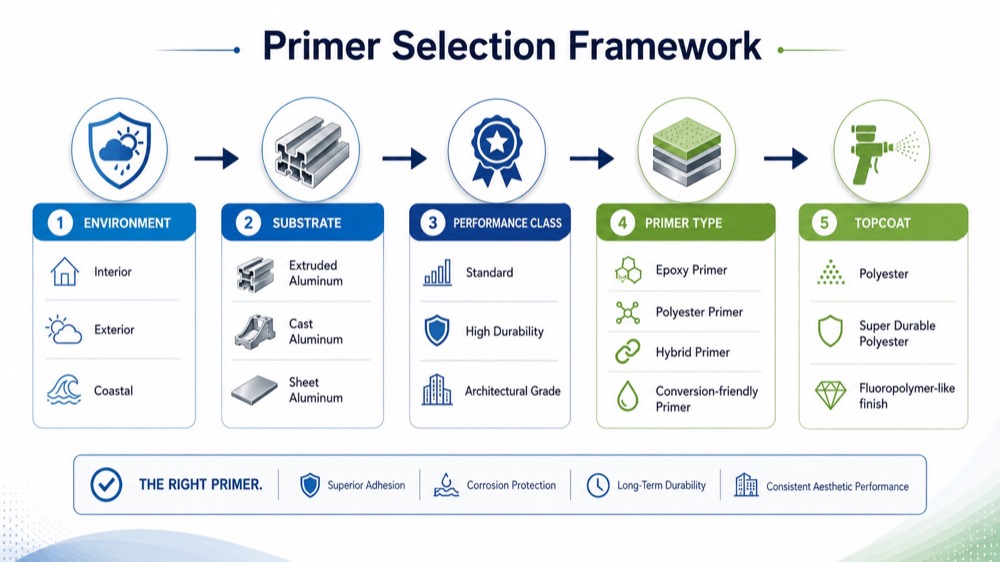
From a process engineering and QA standpoint, you can use a simple decision framework to select the best powder primer for aluminum:
1. Define environment and lifetime expectation.
- Mild interior vs coastal, industrial, or high‑UV exterior.
2. Confirm alloy, fabrication method, and pretreatment.
- Extruded profiles vs cast aluminum, mixed metal assemblies.
3. Match performance class.
- Standard architectural, super‑durable, or highly specialized (e.g., EV battery housing).
4. Select primer family and curing window.
- Epoxy zinc‑free, epoxy, or advanced low‑temperature/UV primers.
5. Verify compatibility with topcoat and line capability.
- Cure schedule overlap, film build, and appearance expectations.
This structured approach reduces trial‑and‑error and ensures the primer supports—not limits—your business strategy and product positioning. [columbiacoatings]
In architectural aluminum, the risks of getting primer selection wrong are significant: panel replacement, water ingress, and visible staining that damages your brand. [indoent]
A typical high‑reliability system looks like this:
- Substrate: Extruded aluminum profiles for curtain walls or window systems. [indoent]
- Pretreatment: Alkaline cleaning, etching, and conversion coating (e.g., chromate‑free pretreatment). [columbiacoatings]
- Primer: Zinc‑free epoxy powder primer designed for aluminum, applied at controlled film build, fully cured. [tiger-coatings]
- Topcoat: Super‑durable polyester powder optimized for UV and color stability. [chemquest]
Field results and supplier testing show that such systems can reach high salt‑spray and cyclic corrosion test performance that meets demanding architectural specifications. [tiger-coatings]
As a specialized powder coating and environmental materials manufacturer, Yinda Technology focuses on matching primer systems to real application scenarios rather than promoting a one‑size‑fits‑all solution. [made-in-china]
Key capabilities relevant to aluminum priming include:
- In‑house R&D center and senior technical team with more than 20 years of experience in powder coatings. [made-in-china]
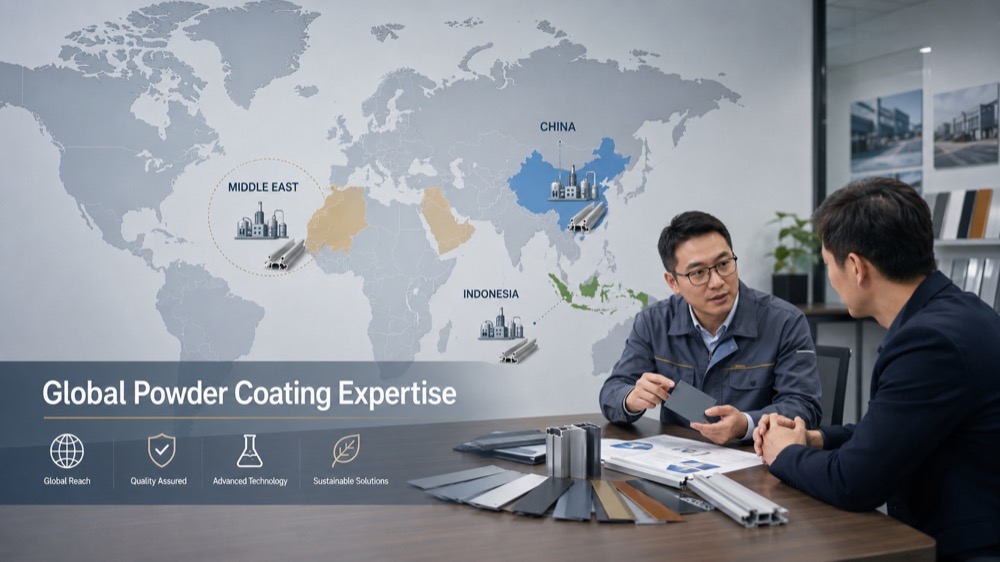
- Modern testing equipment and multiple production bases in China and Indonesia, serving aluminum processing, EV, medical equipment, hardware and electrical sectors. [made-in-china]
- Growing regional presence, including a new Indonesian production base with 16 high‑standard powder coating lines and annual capacity exceeding 15,000 tons. [indoent]
From a user perspective, this means you are not simply buying a primer; you are accessing localized technical support and customized powder systems built around your alloy, line configuration and end‑use requirements. [made-in-china]
Even the best primer for powder coating aluminum will fail if surface preparation is inconsistent. The following process steps reflect current industry best practice: [columbiacoatings]
1. Degreasing and cleaning
Remove oils, lubricants and shop soils using suitable alkaline or neutral cleaners, followed by thorough rinsing. [columbiacoatings]
2. Mechanical or chemical etching
Lightly etch the aluminum surface to remove the natural oxide layer and create a uniform profile for adhesion. [columbiacoatings]
3. Conversion coating
Apply a chromate‑free conversion coating or other approved pretreatment to enhance corrosion resistance and primer bonding. [chemquest]
4. Drying and contamination control
Ensure the substrate is completely dry and protected from dust and handling contamination before priming. [columbiacoatings]
5. Primer application
Apply the chosen powder primer with controlled film thickness, paying attention to edges, cavities and complex shapes. [columbiacoatings]
6. Curing and verification
Follow the recommended cure schedule (time and temperature), then verify cure with appropriate tests before topcoating. [columbiacoatings]
This repeatable workflow, backed by line training and QC records, is often where high‑performing coaters differentiate themselves in competitive markets. [chemquest]
Global market analyses point to sustained growth in powder coatings, driven by environmental regulations and the push toward durable, low‑VOC finishes in construction, automotive, appliances and industrial sectors. [linkedin]
Notable trends affecting aluminum priming include:
- Stricter VOC and hazardous substance limits, accelerating the shift from solvent‑borne primers to powder systems. [linkedin]
- Expansion of aluminum usage in EVs, lightweight structures, and medical equipment, increasing the demand for high‑performance priming solutions. [linkedin]
- Focus on energy efficiency, favoring low‑temperature cure primers where line design permits. [linkedin]
For buyers and OEMs, aligning with a powder supplier that invests in R&D, sustainable formulations and regional technical support is rapidly becoming a strategic requirement rather than a nice‑to‑have. [made-in-china]
Below is a practical at‑a‑glance guide you can share with production, purchasing, and quality teams.
| Application scenario | Environment | Recommended primer type | Key benefits | Notes |
|---|---|---|---|---|
| Architectural profiles, doors, windows | Exterior, high UV and possible coastal exposure | Zinc‑free epoxy powder primer for aluminum | Strong corrosion resistance, excellent adhesion, good base for super‑durable topcoats (tiger-coatings) | Requires proper pretreatment and compatible polyester topcoat |
| EV structural parts and battery components | Exterior / under‑body, complex geometries | High‑performance epoxy or hybrid zinc‑free primer | Robust protection for aluminum in multi‑metal assemblies (linkedin) | Validate film build in recessed areas and around fasteners |
| Medical and lab equipment | Mostly interior, frequent cleaning | Epoxy primer with strong chemical resistance | Smooth, cleanable surface and good adhesion (columbiacoatings) | Over‑coat with suitable topcoat for aesthetics and cleanability |
| Hardware and electrical housings | Mixed interior/exterior depending on product | Application‑specific epoxy or hybrid primers | Balanced corrosion and impact resistance (linkedin) | Select based on final environment and mechanical load |
| Thin‑walled or heat‑sensitive aluminum parts | Any, with energy‑saving focus | Low‑temperature or UV‑curable primer | Lower energy consumption and shorter cure cycles (linkedin) |
From a UX and buyer experience standpoint, the most successful powder coating projects on aluminum usually follow a collaborative approach rather than a simple "product catalog" purchase. [indoent]
To get the best primer recommendation:
- Share your real application conditions. Be specific about environment (coastal, industrial, interior), expected lifetime, and cleaning regimes.
- Provide substrate details. Alloy type, fabrication method, and whether dissimilar metals are present.
- Describe your line. Oven type, max temperature, line speed, and pretreatment system.
- Define success criteria. Target certifications, test standards, and visual expectations.
Yinda Technology's R&D and technical support teams can then match or customize primer systems that are optimized for aluminum, rather than adapting a generic solution. This includes process recommendations and on‑site support where needed. [made-in-china]
If you are currently facing corrosion, adhesion, or appearance issues on aluminum powder coating lines, do not wait for the next customer complaint to act. Bring your real production data, drawings and performance requirements, and ask for a tailored primer and topcoat system recommendation. [indoent]
Yinda Technology's regional teams in China, Indonesia and beyond are positioned to support you with:
- Application‑specific primer and topcoat combinations for aluminum.
- Process audits to stabilize pretreatment, curing and application parameters.
- Ongoing technical support as your product range and export markets evolve. [made-in-china]
1. Do I always need a primer when powder coating aluminum?
No, not always, but a dedicated powder primer is strongly recommended for exterior, high‑corrosion or high‑reliability applications such as architectural profiles and EV components, where long‑term performance is critical. [tiger-coatings]
2. What is the best primer type for exterior aluminum profiles?
For most exterior aluminum building components, a zinc‑free epoxy powder primer designed for aluminum, combined with a high‑quality polyester topcoat, offers excellent corrosion resistance and durability when applied over proper pretreatment. [tiger-coatings]
3. How does pretreatment affect primer performance on aluminum?
Pretreatment is crucial: proper cleaning, etching and conversion coating significantly enhance primer adhesion and corrosion resistance; without it, even high‑performance primers can fail prematurely. [chemquest]
4. Can one primer work for both aluminum and steel parts in a mixed assembly?
Many modern corrosion‑resistant powder primers are engineered to perform on both aluminum and steel, which is especially valuable for assemblies with mixed metals, but they must be carefully selected and validated for your specific system. [chemquest]
5. Why are low‑temperature and UV‑curable powder primers gaining interest?
They help reduce energy consumption and speed up curing cycles, which is attractive for high‑volume or energy‑sensitive operations, while still offering durable performance when correctly matched to the substrate and application. [linkedin]
1. TIGER Coatings. "Best Primer to Use for Powder Coating Aluminum Substrates." [Link]. [tiger-coatings]
2. TIGER Coatings. "How to Choose the Correct Primer for Powder Coating Applications." [Link]. [tiger-coatings]
3. Columbia Coatings. "Understanding Powder Coating Primers and Their Applications." [Link]. [columbiacoatings]
4. Vijay Belekar. "Powder Coatings Market Trends, Growth Drivers, and Key Challenges." LinkedIn Article, 2025. [linkedin]
5. ChemQuest. "Emerging Technical Trends in the Powder Coating Industry." [Link]. [chemquest]
6. Guangzhou Yinda Powder Coatings Co., Ltd. Company Profile on Made‑in‑China. [Link]. [made-in-china]
7. Yinda Technology Indonesia Powder Coating Production Base News Article. [Link]. [indoent]
Hot Tags: clear powder coat powder, paint testing, superior paints, ceramic coating installation, steel epoxy paint, wholesale, custom, manufacturers, suppliers, factory, sampling, trial, prototype


