Language


Views: 222 Author: Yinda Powder Coating Publish Time: 2026-06-03 Origin: Site


Content Menu
● Why Powder Coating Defects Matter in Modern Manufacturing
● Overview of the Most Common Powder Coating Defects
● Weld Spatter Defects: Causes and Practical Solutions
>> What Weld Spatter Looks Like After Coating
>> Why Weld Spatter Causes Coating Problems
>> How to Fix and Prevent Weld Spatter Defects
● Outgassing and Pinholes on Cast and Galvanized Parts
>> How Outgassing Appears on the Finished Film
>> Process‑Level Solutions: Pre‑Baking and OGF Primers
>> Preventive Best Practices in High‑Volume Lines
● Laser Cutting Scale and Adhesion Failures
>> Why Laser‑Cut Edges Are High‑Risk
>> Mechanical Cleaning: Non‑Negotiable Step
>> How We Implement This in Multi‑Site Production
● Other Frequent Powder Coating Defects You Should Monitor
● Step‑by‑Step Troubleshooting Workflow for Coating Teams
>> 1. Capture the Defect with an Action Report
>> 2. Analyze Root Causes Across People, Process, and Equipment
>> 3. Implement Corrective and Preventive Actions (CAPA)
>> 4. Verify Effectiveness and Standardize Improvements
● Latest Market and Technology Trends That Shape Defect Prevention
>> Sustainability and VOC Regulations
>> Growing Demand from Automotive, EV, and Heavy Industry
>> Asia‑Pacific's Role and Multi‑Regional Operations
● Practical Checklist: How to Prevent Powder Coating Defects Every Day
● Why Partner with an Expert Powder Coating Manufacturer
● Clear Call to Action: Get Expert Help on Your Defect Issues
● Frequently Asked Questions (FAQ)
As a powder coating engineer working across China, Indonesia, and Saudi Arabia, I have seen how a few recurring defects can quietly destroy line efficiency, customer satisfaction, and coating performance—yet most of them are preventable with the right process discipline and materials selection. This guide combines hands‑on shop‑floor experience with current industry best practices to help you identify, prevent, and correct the most common powder coating defects before they become costly rework. [crestcoating]

In today's manufacturing supply chains—whether you are coating architectural profiles, EV parts, or medical equipment—first‑pass yield is no longer a "nice to have"; it is a core competitiveness factor. Defects such as weld spatter marks, outgassing pinholes, and adhesion failures not only trigger rework, but also risk warranty claims, line stoppages, and reputational damage with global OEMs. [linkedin]
At the same time, the global powder coatings market is growing steadily, driven by sustainability regulations (VOC reduction) and the shift from liquid to powder systems in automotive, appliances, construction, and industrial applications. That growth also means more scrutiny: your customers are increasingly benchmarking your powder coating quality against international leaders, not just local competitors. [lasercentral.com]
Many plants see the same defect patterns regardless of country or industry segment. The most common powder coating defects include: [m.nbchao]
- Weld spatter marks under the coating
- Outgassing pinholes and craters
- Adhesion failure and flaking
- Orange peel and rough surface texture
- Uneven coverage and Faraday cage issues
Understanding root cause is more important than memorizing symptoms: most defects trace back to surface preparation, application parameters, or curing conditions. [crestcoating]
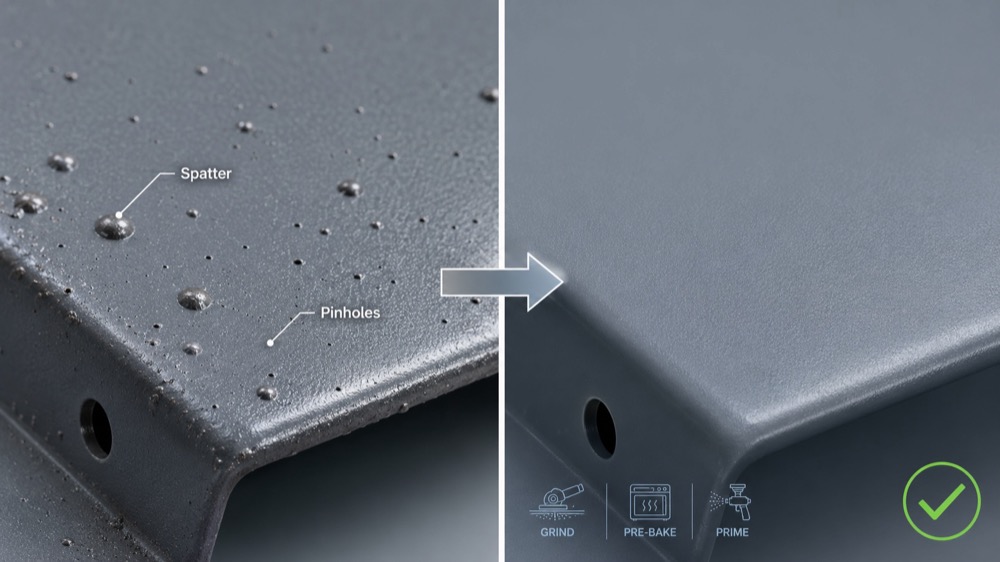
In production, weld spatter shows up as small, hard bumps or "islands" under an otherwise smooth coated surface. Under a glossy powder, these imperfections are immediately visible and unacceptable for architectural or automotive surfaces. [crestcoating]
When droplets of molten metal form near the welding arc, they stick to the surface and solidify as spatter, creating sharp, localized high points. Powder builds up around these points, and even if you achieve full cure, the surface will never be visually uniform. [crestcoating]
Typical root causes include:
- Inadequate grinding or finishing after welding
- Contaminated or worn grinding tools that re‑deposit residues
- Rushed pre‑treatment process that skips mechanical finishing for "non‑critical" areas
Once a batch is coated with visible spatter, there is no cosmetic shortcut—you must strip, rework, and recoat. A practical workflow is:
1. Strip the defective coating using a suitable chemical or thermal stripping process approved for your substrate and customer specs. [pfonline]
2. Grind or sand the spatter using a clean tool carriage, ensuring no embedded contaminants remain on the surface.
3. Re‑inspect under bright light to confirm a smooth surface profile before pre‑treatment. [crestcoating]
4. Re‑coat with standard process parameters, verifying gun distance, kV, and film thickness. [youtube]
To prevent future defects:
- Standardize post‑weld grinding as part of your work instructions, not as "optional polishing". [pfonline]
- Use visual acceptance samples to train welders and finishers on what "powder‑ready" surfaces look like. [pfonline]
- Introduce random audits before parts enter the pre‑treatment tunnel, especially for new welders or new suppliers. [pfonline]
Outgassing typically appears as small pinholes, blow‑outs, or craters in the cured film, often clustered in certain areas of the part. These defects are common on cast iron, cast aluminum, and hot‑dip galvanized steel used in architectural hardware, outdoor furniture, and heavy industry components. [lasercentral.com]
During casting or galvanizing, gases are trapped inside the substrate, especially in porous metal zones. When you heat the part during curing, these gases expand and escape through the molten film, leaving voids or craters in the final coating. [m.nbchao]
Key contributing factors:
- High substrate porosity, especially in low‑grade castings
- Residual moisture or oils not removed during pre‑treatment [m.nbchao]
- Cure profiles that ramp temperature too aggressively, forcing rapid gas expansion [lasercentral.com]
From a practical standpoint, the most reliable approach combines pre‑baking with specialized primers. [crestcoating]
- Pre‑bake ("outgas") the parts: Heat the parts above the powder's cure temperature to force gas release before coating.
- After cooling, apply an outgassing‑forgiving primer (OGF) designed to accommodate minor gas release and mask small defects.
- Finish with the specified topcoat within the powder manufacturer's recommended recoat window. [lasercentral.com]
This workflow is especially effective on zinc‑coated and hot‑dip galvanized substrates, which are notorious for trapped gases and surface irregularities. [m.nbchao]
For high‑volume lines serving construction and outdoor applications:
- Create separate process recipes for cast and galvanized parts (pre‑bake time, oven temperature, conveyor speed). [lasercentral.com]
- Log defect rate by substrate type; if pinholes cluster on certain castings, work with the upstream foundry on process adjustments. [pfonline]
- Use powders formulated for outgassing resistance when dealing with unavoidable porous substrates. [lasercentral.com]
Laser cutting is extremely common for architectural profiles, sheet metal components, and EV brackets, but it creates oxidized "scale" on the cut edge where molten metal meets oxygen. If this scale is not removed, it becomes a weak boundary layer between substrate and coating.
The powder film might initially look fine, but under mechanical stress or corrosion, you see:
- Edge flaking or peeling along laser‑cut contours
- Rust creep from edges despite correct coating thickness elsewhere [m.nbchao]
The most robust solution is mechanical removal of laser scale.
Effective techniques include:
- Grinding or sanding the cut edges with appropriate abrasives
- Abrasive blasting focused on laser‑cut zones, especially for structural components [m.nbchao]
After mechanical cleaning:
- Ensure parts are free from dust and debris before entering pre‑treatment.
- Confirm that your chemical pre‑treatment (e.g., phosphate or zirconium) can reach and convert these freshly exposed surfaces. [m.nbchao]
In multi‑country operations (e.g., China, Indonesia, Saudi Arabia), we standardize:
- Laser‑cut edge quality criteria in purchase specifications sent to fabricators
- Mandatory edge finishing for high‑risk applications, such as exterior façade elements or medical device brackets
- Cross‑site training so operators in different plants recognize and correct laser scale issues consistently [pfonline]
Beyond weld spatter, outgassing, and laser scale, several other defects regularly show up in audits. [crestcoating]
| Defect Type | Typical Appearance | Main Causes | Core Prevention Actions |
|---|---|---|---|
| Orange peel | Bumpy, textured surface like an orange skin (crestcoating) | Incorrect film thickness, poor flow, wrong cure profile (crestcoating) | Control thickness, optimize gun settings and cure schedule, verify oven calibration (crestcoating) |
| Pinholes / craters | Tiny holes or blow‑outs in film (crestcoating) | Outgassing, trapped moisture or oils | Pre‑bake, improved cleaning and drying, use OGF primers and suitable powders (m.nbchao) |
| Adhesion failure / flaking | Coating peeling, chipping, or delaminating (crestcoating) | Inadequate surface prep, contamination, under‑cure (crestcoating) | Thorough degreasing, robust pre‑treatment, proper cure time and temperature (crestcoating) |
| Uneven coverage / thin spots | Color variation, exposed metal (crestcoating) | Poor grounding, geometry challenges, wrong spray angle (crestcoating) | Improve grounding, adjust gun positioning, coat Faraday areas first (youtube) |
| Faraday cage effect | Under‑coated corners, recesses (crestcoating) | Electrostatic shielding in tight areas | Lower kV, indirect spray angles, multiple passes into recesses (youtube) |
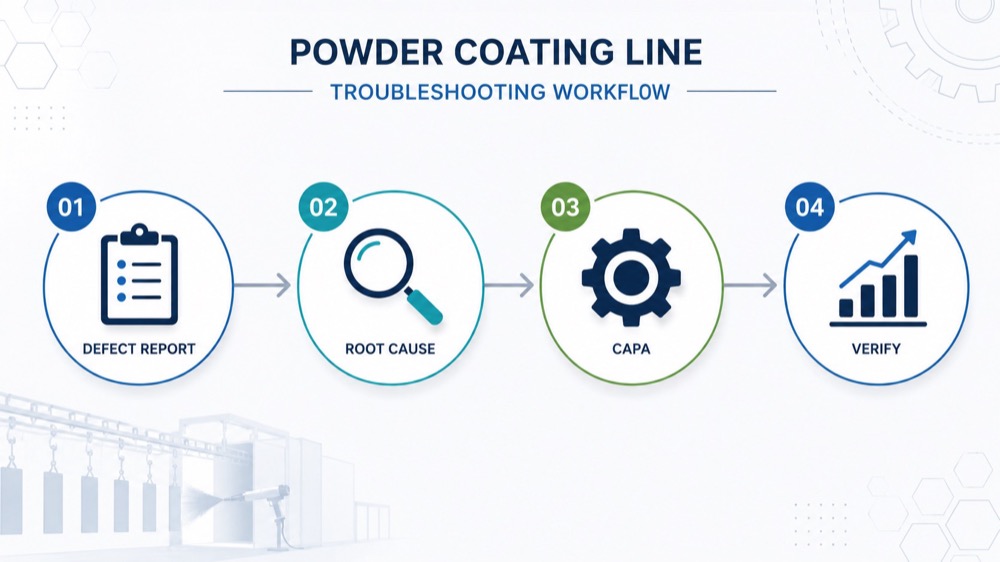
Many coating lines treat defects as isolated events instead of systematically learning from them. A more mature approach is to implement a repeatable troubleshooting workflow whenever defects appear. [pfonline]
- Record customer complaint or internal rejection reason. [pfonline]
- Attach clear photos and part identifiers (batch, line, date, operator). [pfonline]
- Note process parameters at the time: oven profile, gun settings, line speed, environmental conditions. [pfonline]
According to best practice in finishing, root causes often fall into: [lasercentral.com]
- Human error (e.g., skipped grinding, wrong recipe, rushed maintenance)
- Equipment failure (e.g., mis‑calibrated oven, clogged guns, poor grounding)
- Atmospheric and environmental factors (humidity, temperature, dust) [lasercentral.com]
- Upstream manufacturing issues (porous casting, inconsistent weld quality, laser scale) [m.nbchao]
Once causes are identified:
1. Define an immediate corrective action, such as reworking the current batch and adjusting parameters. [pfonline]
2. Plan a longer‑term preventive action, for example, updating SOPs, adding extra inspection gates, or retraining operators. [pfonline]
3. Set timelines and responsibilities and communicate clearly across teams. [pfonline]
- Run controlled trials to confirm that the new process steps actually reduce defects. [pfonline]
- Add successful solutions to your standard operating procedures and training materials. [pfonline]
- Review defect trends monthly or quarterly to ensure improvements are sustained. [pfonline]
By treating every defect as a structured learning opportunity, plants can significantly reduce recurring issues and improve customer satisfaction while protecting margins. [lasercentral.com]
Powder coating continues to gain share versus solvent‑based liquid coatings due to near‑zero VOC emissions and superior transfer efficiency. However, tighter environmental regulations also mean less tolerance for rework and scrap, pushing plants to adopt more consistent, data‑driven process control. [coatingsworld]
The global powder coatings market was valued at around USD 15.6 billion in 2023 and is projected to reach about USD 24.5 billion by 2032, with a CAGR near 5.1%. Growth is particularly strong in automotive, appliances, construction, and industrial applications, all of which demand high appearance quality and corrosion resistance. [linkedin]
As a manufacturer serving architectural, doors and windows, new energy vehicles, medical devices, hardware, and electrical equipment, you must align defect prevention strategies with these sectors' increasingly strict expectations. [linkedin]
Asia‑Pacific is expected to remain the fastest‑growing region for powder coatings, driven by manufacturing growth and investments in infrastructure. Operating plants in China, Indonesia, and Saudi Arabia requires consistent global standards adapted to local substrates, climate, and regulatory conditions, especially when it comes to curing profiles and corrosion protection systems. [linkedin]
Use this quick checklist in your daily production meetings to keep defects under control. [crestcoating]
Before Coating
- Verify that welds are ground smooth and free of spatter.
- Confirm laser‑cut edges and scales are mechanically cleaned.
- Ensure parts are fully degreased, rinsed, and dried, with no visible oil or moisture. [m.nbchao]
- For cast or galvanized parts, confirm pre‑bake schedule is correctly applied. [crestcoating]
During Application
- Check grounding continuity at racks and hooks.
- Set gun kV and microamps according to part geometry and powder data sheet. [youtube]
- Maintain 6–10 inches gun‑to‑part distance on flat areas and coat Faraday zones first. [youtube]
- Monitor film thickness with a gauge and keep within recommended range. [youtube]
During Curing
- Validate oven temperature and time with regular profile measurements. [crestcoating]
- Avoid overloaded ovens or blocked airflow that cause hot or cold spots. [m.nbchao]
Quality Control
- Perform visual inspection under consistent lighting.
- Use cross‑hatch adhesion tests on representative parts when changing substrates or powders. [lasercentral.com]
- Log defects and track them over time to spot trends before they become customer complaints. [pfonline]
Choosing the right powder coatings manufacturer and technical partner is just as important as optimizing your in‑house process. A strong partner can help you: [coatingsworld]
- Select application‑specific formulations for architectural, EV, medical, or heavy‑duty hardware needs. [coatingsworld]
- Optimize line design, application windows, and cure schedules to reduce defects and increase throughput. [lasercentral.com]
- Troubleshoot complex issues such as multi‑layer systems, metallic finishes, and demanding corrosion protection. [crestcoating]
As a specialized powder coatings and eco‑friendly materials manufacturer with subsidiaries in China, Indonesia, and Saudi Arabia, Yinda Technology supports customers with technical audits, on‑site training, and tailored coating systems designed for local climate and regulatory requirements while meeting international standards. [linkedin]
If you are struggling with recurring powder coating defects—whether it is weld spatter marks on façade profiles, pinholes on cast EV components, or flaking around laser‑cut edges—you do not need to solve them alone. [crestcoating]
Contact our technical team at Yinda Technology for a structured line audit and defect‑reduction plan tailored to your substrates, industry, and target markets. We can help you benchmark your process against best‑in‑class plants, optimize your powder selection, and design a sustainable roadmap to higher first‑pass yield and lower total coating cost. [coatingsworld]
1. What is the most common powder coating defect in architectural profiles?
One of the most frequent defects in architectural and façade applications is orange peel, especially on large, visible surfaces where texture differences are easy to see. It is usually linked to incorrect film thickness, poor flow, or non‑optimized cure schedules, and can be reduced by better control of application parameters and oven profiling. [youtube]
2. How can I stop pinholes on hot‑dip galvanized steel?
Pinholes on galvanized steel are typically caused by outgassing during cure. A combination of pre‑baking the substrate at a higher temperature than the final cure and using an outgassing‑tolerant primer is often the most effective approach. [m.nbchao]
3. Why does my coating peel off around laser‑cut edges?
Peeling around laser‑cut edges usually indicates oxide scale left on the cut surfaces, which prevents proper adhesion. Mechanical removal of the scale, followed by robust chemical pre‑treatment and correct curing, is essential to ensure long‑term performance. [m.nbchao]
4. What is the Faraday cage effect in powder coating?
The Faraday cage effect occurs when charged powder cannot easily reach deep recesses, tight corners, or holes because the electric field prefers the shortest path. This leads to thin or uncoated areas and can be minimized by lowering kV, adjusting spray angle, and coating difficult areas first. [youtube]
5. How often should I profile my curing oven?
For production lines with critical applications, oven profiling should be done regularly—for example, at every major change in part mass, racking pattern, or product mix. At minimum, a monthly profile check helps verify that actual metal temperature and time in the cure window match the powder manufacturer's recommendations. [lasercentral.com]
1. TIGER Coatings – "Common Powder Coating Defects & Solutions."
<https://www.tiger-coatings.com/us-en/tiger-group/tiger-blog/common-powder-coating-defects-solutions>
2. Crest Coating – "Common Powder Coating Defects and How to Prevent Them."
<https://www.crestcoating.com/cci-blog/common-powder-coating-defects-and-how-to-prevent-them/> [crestcoating]
3. Vijay Belekar – "Powder Coatings Market Trends, Growth Drivers, and Key Challenges."
<https://www.linkedin.com/pulse/powder-coatings-market-trends-growth-drivers-key-vijay-belekar-ahbxc> [linkedin]
4. Powder Coating Online – "How to Handle and Eliminate Powder Coating Defects."
<https://www.pfonline.com/articles/how-to-handle-and-eliminate-powder-coating-defects> [pfonline]
5. NBChao – "粉末涂装的常见涂层缺陷及解决方法 (Common powder coating defects and solutions)."
<https://m.nbchao.com/k/7341/> [m.nbchao]
6. Laser Central – "Powder Coating in Heavy Industry: A Comprehensive Guide."
<https://www.lasercentral.com.au/powder-coating-in-heavy-industry-a-comprehensive-guide/> [lasercentral.com]
7. TIGER Drylac – "Troubleshooting Guide" and orange peel troubleshooting video.
<https://www.youtube.com/watch?v=HUUIwM_H_TM> [youtube]
8. Coatings World – "The Powder Coatings Market Enjoys Growth."
<https://www.coatingsworld.com/the-powder-coatings-market-enjoys-growth/> [coatingsworld]
Hot Tags: meta coatings, protective paint, coating chemical, fusion epoxy coating, metal protection, wholesale, custom, manufacturers, suppliers, factory, sampling, trial, prototype


