Language


Views: 222 Author: Yinda Powder Coating Publish Time: 2026-06-02 Origin: Site


Content Menu
● What Makes a Powder Coating Chemical Resistant?
>> Common Chemical Exposure in Furniture Use
● Testing Standards That Build Trust
● Where These Coatings Deliver the Most Value
>> Office and Workspace Furniture
>> Healthcare and Laboratory Furniture
>> Storage, Lockers, and Utility Furniture
● How to Choose the Right Coating
● Surface Preparation Still Decides Success
● Hygiene-Ready Furniture Design
● Why Yinda Technology Is a Strong Partner
● FAQ
Chemical resistant powder coatings for furniture applications are no longer a niche finishing choice. For manufacturers of office furniture, healthcare seating, lockers, storage systems, and metal furniture components, they are now a strategic requirement for durability, hygiene, and long-term value. [cdn.standards.iteh]
Furniture surfaces are expected to survive repeated cleaning, disinfectant exposure, abrasion, moisture, and daily handling. That is why the right coating must do more than look good; it must protect the substrate, preserve appearance, and perform consistently in real-world conditions. [tiger-coatings]
The global powder coatings market continues to grow, with recent market estimates placing it in the multi-billion-dollar range and projecting steady expansion through the rest of the decade. This growth reflects rising demand for durable, low-VOC finishes across industrial and commercial applications, including furniture. [researchandmarkets]
At the same time, hygiene expectations have changed. In public, healthcare, education, and workplace settings, furniture is cleaned more often and with stronger chemicals than in the past. That makes chemical resistance a practical specification issue, not just a technical feature. [duke-nus.edu]

Chemical resistance is the coating's ability to withstand contact with cleaners, disinfectants, alcohols, acids, alkalis, detergents, and other common substances without visible or functional damage. Typical failures include discoloration, gloss loss, blistering, swelling, softening, and loss of adhesion. [img.antpedia]
In practice, the formulation matters as much as the resin family. TIGER's article notes that epoxies are generally more chemical resistant than standard polyester blends, but performance still depends on the exact formulation and testing regime. [tiger-coatings]
A coating can only be called truly chemical resistant when the chemistry and the validation process work together. That is why technical testing is central to product selection. [cdn.standards.iteh]
Furniture manufacturers should consider the most likely exposure scenarios before specifying a coating. These usually include the following:
- Household cleaners and disinfectants used on office, school, and healthcare furniture. [tiger-coatings]
- Alcohol-based solutions used for rapid sanitation. [img.antpedia]
- Acidic or alkaline substances found in industrial or cafeteria settings. [cdn.standards.iteh]
- Detergents, soaps, and grease-based contaminants from general use and maintenance. [img.antpedia]
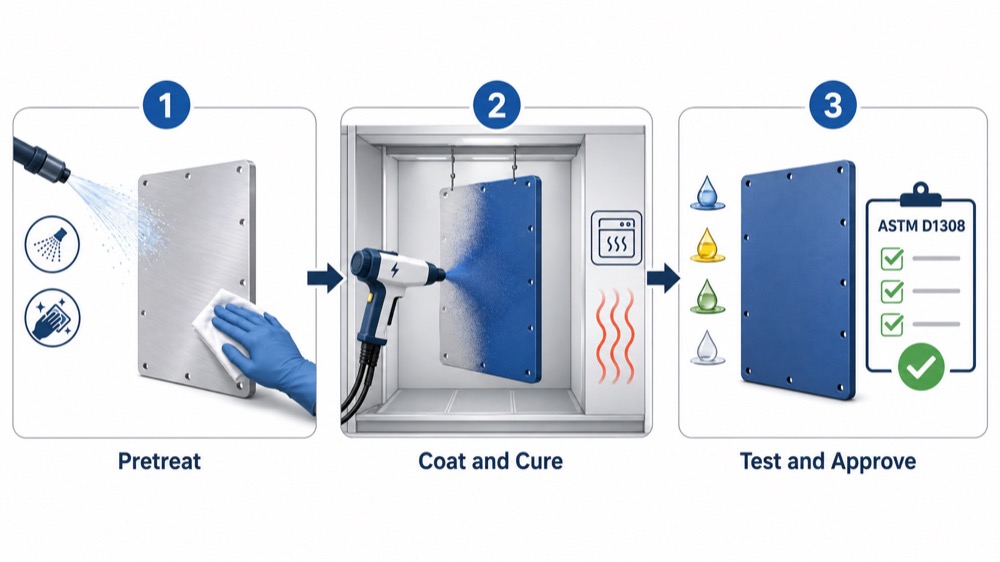
A high-quality coating claim should be backed by recognized testing. One of the most relevant standards is ASTM D1308, which evaluates the effect of household chemicals on clear and pigmented organic finishes and looks for changes such as discoloration, gloss change, blistering, softening, swelling, and adhesion loss. [store.astm]
ASTM D1308 includes spot testing and immersion testing, which help simulate how a finish behaves under direct or prolonged chemical exposure. For manufacturers, this is useful because it connects lab performance to end-use conditions. [cdn.standards.iteh]
TIGER also highlights the use of chemical fume hood testing and controlled laboratory procedures to assess performance against agents such as bleach, ammonia, and disinfectants. That kind of testing framework strengthens product credibility for specifiers and OEMs. [tiger-coatings]
Chemical resistant powder coatings are especially useful in furniture categories where both appearance and hygiene matter. They are most valuable in high-touch or high-cleaning environments, where the coating must resist repeated maintenance cycles. [tiger-coatings]
Metal desks, pedestals, filing cabinets, and shelving systems are frequently touched and cleaned. A durable powder coating helps preserve finish quality, reduce visible wear, and maintain a professional appearance over time. [tiger-coatings]
Waiting-room seating, carts, cabinets, and storage furniture are exposed to repeated disinfectant use. In these settings, resistance to cleaning agents is essential for both visual durability and operational confidence. [duke-nus.edu]
School furniture and public seating face constant handling, scuffing, and sanitation. A chemical-resistant finish helps keep surfaces looking clean while standing up to the realities of shared-use environments. [tiger-coatings]
Lockers and storage units often suffer from both physical abuse and chemical cleaning. Powder coatings offer a strong balance of mar resistance, appearance retention, and practical maintenance performance. [tiger-coatings]
Choosing a coating should be based on use case, not just color or gloss. Manufacturers should match the coating system to the environment, cleaning routine, and service life expectations. [cdn.standards.iteh]
Here is a simple selection framework:
| Decision factor | What to ask | Why it matters |
|---|---|---|
| Chemical exposure | What cleaners, disinfectants, or solvents will be used? | Determines resistance requirements. (cdn.standards.iteh) |
| Substrate type | Is the furniture steel, aluminum, or another metal? | Affects adhesion and pretreatment needs. (tiger-coatings) |
| Use intensity | Is the item high-touch or low-touch? | Higher use means greater wear and cleaning stress. (tiger-coatings) |
| Finish expectation | Matte, gloss, textured, or metallic? | Affects appearance, fingerprint masking, and maintenance. (tiger-coatings) |
| Compliance needs | Is antimicrobial performance or regional validation required? | Important in healthcare and public environments. (tiger-coatings) |
Even the best coating can fail if the substrate is not properly prepared. TIGER emphasizes degreasing and conversion coatings such as phosphate or chrome-free pretreatment for metal office furniture, because adhesion and corrosion resistance depend heavily on surface quality. [tiger-coatings]
This is one of the most overlooked issues in furniture coating projects. Poor preparation can create weak points that later allow sub-film corrosion, peeling, or early wear. [tiger-coatings]
For manufacturers, the message is simple: chemical resistance starts before the powder is applied. [tiger-coatings]
One of the biggest market shifts is the growing demand for coatings that support hygiene-focused furniture design. TIGER's antimicrobial powder coatings are formulated to help fight the growth of harmful microbes on coated surfaces and are designed to withstand repetitive use of chemical disinfectants. [tiger-coatings]
Singapore's SS 705 standard also shows how seriously surface-disinfectant and coating validation is being treated in modern markets, especially for non-porous materials such as metal and ceramic. [duke-nus.edu]
For B2B buyers, this means the best coatings are no longer judged only by hardness or color retention. They are also evaluated for how well they fit cleaning protocols, hygiene policies, and public trust. [duke-nus.edu]
Furniture OEMs can reduce risk by writing better coating specifications from the beginning. A strong specification should clearly define the following items:
1. The target service environment.
2. The expected cleaning chemicals.
3. The required test standard.
4. The acceptable gloss, texture, and color range.
5. The pretreatment method.
6. The minimum performance criteria for adhesion, gloss retention, and appearance. [img.antpedia]
This approach prevents vague procurement language and helps suppliers recommend the right chemistry for the job. It also improves consistency across production batches and geographic markets. [made-in-china]
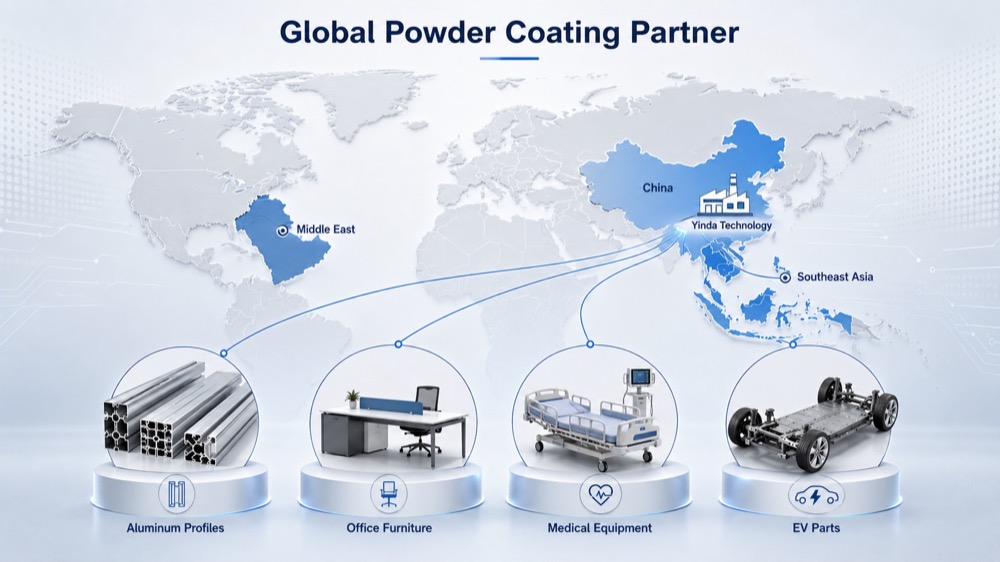
Yinda Technology positions itself as a powder coating and environmentally focused materials manufacturer with R&D, production, and sales capabilities, plus subsidiaries in China, Indonesia, and Hong Kong. Its products serve building profiles, doors and windows, new energy vehicles, medical equipment, hardware, and electrical appliance industries. [made-in-china]
That cross-industry experience matters. A manufacturer that understands industrial durability, outdoor exposure, and hygiene-critical applications is better equipped to create coatings that serve modern furniture markets. [made-in-china]
For international buyers, this also supports supply-chain confidence, because technical know-how, product development, and export-oriented service are all part of the value proposition. [made-in-china]
If you are specifying coatings for furniture OEM production, the next step is to define your service environment, cleaning protocol, and target performance standard before selecting the finish. A well-matched chemical resistant powder coating can reduce warranty risk, protect appearance, and improve customer satisfaction over the product lifecycle. [tiger-coatings]
For Yinda Technology, this is also an opportunity to position your technical expertise more strongly in international B2B markets with a content piece that speaks to both buyers and specifiers. [made-in-china]
1. What is a chemical resistant powder coating for furniture?
It is a powder coating formulated to resist cleaners, disinfectants, and common household or industrial chemicals without visible surface damage. [cdn.standards.iteh]
2. Which furniture items benefit most from chemical resistant coatings?
Office desks, filing cabinets, lockers, healthcare furniture, public seating, and storage systems benefit the most because they are frequently handled and cleaned. [tiger-coatings]
3. What standard is commonly used to test chemical resistance?
ASTM D1308 is a widely used method for evaluating how household chemicals affect coated surfaces. [store.astm]
4. Why is surface preparation important?
Because poor pretreatment can weaken adhesion and lead to corrosion, peeling, or early coating failure. [tiger-coatings]
5. Are antimicrobial powder coatings the same as chemical resistant coatings?
No. Antimicrobial coatings help inhibit microbial growth, while chemical resistant coatings focus on resisting damage from cleaners and other chemicals, although some products are designed to address both needs. [duke-nus.edu]
6. Can powder coating help with sustainability?
Yes. Powder coating is valued for being solvent-free and low in VOCs compared with many liquid finishing systems. [tiger-coatings]
1. TIGER Drylac, "Chemical Resistant Powder Coatings for Furniture Applications." [https://www.tiger-coatings.com/us-en/tiger-group/tiger-blog/chemical-resistant-powder-coatings-for-furniture-applications] [tiger-coatings]
2. TIGER Drylac, "Powder Coating Solutions for Metal & Office Furniture." [https://www.tiger-coatings.com/in-en/powder-coatings/applications/furniture/powder-coating-office-furniture] [tiger-coatings]
3. ASTM D1308-20, "Standard Test Method for Effect of Household Chemicals on Clear and Pigmented Coating Systems." [https://store.astm.org/d1308-20.html] [store.astm]
4. TIGER Drylac, "TIGER Drylac® Antimicrobial Powder Coatings." [https://www.tiger-coatings.com/us-en/tiger-group/tiger-blog/tiger-drylacr-antimicrobial-powder-coatings] [tiger-coatings]
5. Singapore Duke-NUS/Enterprise Singapore, SS 705 media release. [https://www.duke-nus.edu.sg/newshub/media-releases/ss-705] [duke-nus.edu]
6. Guangzhou Yinda Powder Coatings Co., Ltd. company profile. [https://www.made-in-china.com/showroom/6f4b36fdadb3f5c8/] [made-in-china]
7. Research and Markets, Powder Coatings Market Report 2026. [https://www.researchandmarkets.com/reports/5733926/powder-coatings-market-report] [researchandmarkets]
Hot Tags: fbe powder, fbe powder coating, unique coating, bonded coating, rebar epoxy coating, wholesale, custom, manufacturers, suppliers, factory, sampling, trial, prototype


