Language


Views: 288 Author: Yinda Powder Coating Publish Time: 2026-10-22 Origin: Site


Content Menu
● What Is Epoxy Coating, and Which Application Method Fits?
● How Is Epoxy Powder Coating Applied? A Step-by-Step Guide
>> 1. Define the Service Conditions Before Selecting the Powder
>> 2. Clean and Pretreat the Substrate
>> 3. Prepare the Powder, Equipment, and Hanging Arrangement
>> 4. Spray the Epoxy Powder Evenly
>> 6. Cure at the Specified Part Temperature
>> 7. Cool, Inspect, and Release the Parts
● How Is Liquid Epoxy Coating Applied?
>> Prepare the Surface and Check Conditions
>> Measure and Mix the Components
>> Apply, Recoat, and Allow Full Cure
● Three Often-Overlooked Controls That Improve Results
>> Validate the Coldest Part—not Just the Oven Setting
>> Specify Performance for the Real Application
>> Investigate the Whole Coating System
● Common Epoxy Coating Defects and What to Check
● Safety and Environmental Controls Still Matter
● Discuss Your Epoxy Coating Requirements With Yinda Technology
>> Can Epoxy Coating Be Applied Directly to Bare Metal?
>> Does Epoxy Powder Coating Need a Primer?
>> How Long Does Epoxy Coating Take to Cure?
>> Can Epoxy Coating Be Used Outdoors?
>> Can Epoxy Powder Be Applied Without an Oven?
>> Can I Apply Epoxy Coating Myself?
Epoxy coating is applied by preparing the surface, depositing the coating at a controlled thickness, and curing it under specified conditions. The application method depends on the material: liquid epoxy is normally mixed with a hardener and applied by roller, brush, or spray, while epoxy powder coating is typically electrostatically sprayed onto metal and heat-cured.
For industrial manufacturers, that distinction matters. A process designed for a concrete floor cannot simply be transferred to an appliance housing or automotive component.
At Yinda Technology, our work centers on powder coatings, environmentally conscious materials, and energy-saving technologies. This guide therefore emphasizes industrial epoxy powder coating while explaining how it differs from liquid epoxy application.
The most important principle is process control: preparation, application, and curing must work together to deliver a reliable finish.

Epoxy coatings use epoxy resins and curing agents to form a crosslinked protective film. Correctly specified systems can provide strong adhesion, corrosion protection, and chemical resistance.
However, "epoxy coating" describes several different technologies—not one universal product.
| Coating type | How it is applied | How it cures | Typical applications |
|---|---|---|---|
| Two-component liquid epoxy | Brush, roller, or suitable spray equipment | Chemical reaction after resin and hardener are mixed | Floors, steel structures, maintenance coatings |
| Epoxy powder coating | Usually electrostatic spray; specialized systems may use other methods | Heat activates the formulated curing reaction | Metal housings, hardware, electrical components |
| Fusion-bonded epoxy | Specialized powder application, often onto preheated steel | Controlled heat-driven fusion and curing | Pipelines and reinforcing steel |
These categories have different equipment requirements, preparation standards, and acceptance criteria. Always begin with the selected product's technical data sheet rather than a generic application recipe.
Before discussing spray settings, establish what the coated component must withstand.
Ask:
- Will it remain indoors or face sunlight?
- Which chemicals, cleaners, or moisture will contact it?
- What substrate and geometry are involved?
- Can the assembled part tolerate the required curing temperature?
- Which appearance, corrosion, or electrical tests must it pass?
Pure epoxy powders are generally selected for interior or protected applications. Prolonged ultraviolet exposure can cause chalking and appearance deterioration.
For exterior architectural profiles, doors, and windows, evaluate a suitable weather-resistant finish instead. An epoxy primer may form part of a compatible multilayer system, but an epoxy topcoat should not automatically be treated as an exterior architectural finish.
Surface preparation establishes the foundation for adhesion.
Oil, rust, machining fluids, salts, and other contaminants can undermine an otherwise well-applied coating. Simply spraying more powder over contamination does not solve the problem.
A typical preparation sequence includes:
1. Inspect the incoming metal.
2. Remove oil and grease.
3. Remove rust, oxide, or scale as required.
4. Apply the specified chemical or mechanical pretreatment.
5. Rinse where the process requires it.
6. Dry the component completely.
Steel may require abrasive blasting or a suitable conversion treatment, depending on the specification. Aluminum commonly requires an appropriate conversion treatment or another qualified preparation route.
Pretreatment chemistry must suit both the substrate and the required performance. Control bath condition, rinse quality, and drying—not just the visible cleanliness of the finished part.
Before spraying, verify the powder's identity, batch, storage condition, and technical requirements.
Keep the material protected from moisture and contamination. Follow the supplier's guidance when transferring powder from storage into a warmer production environment.
The component must also have a reliable electrical connection through its hanger. Accumulated coating on hooks can interfere with grounding and reduce deposition consistency.
Check:
- Clean, suitable contact points.
- Dry, clean compressed air.
- Correct powder delivery and fluidization.
- Booth extraction and recovery operation.
- Masking of threads, mating faces, and critical dimensions.
Hanging orientation should expose difficult areas while allowing stable transport through the line.
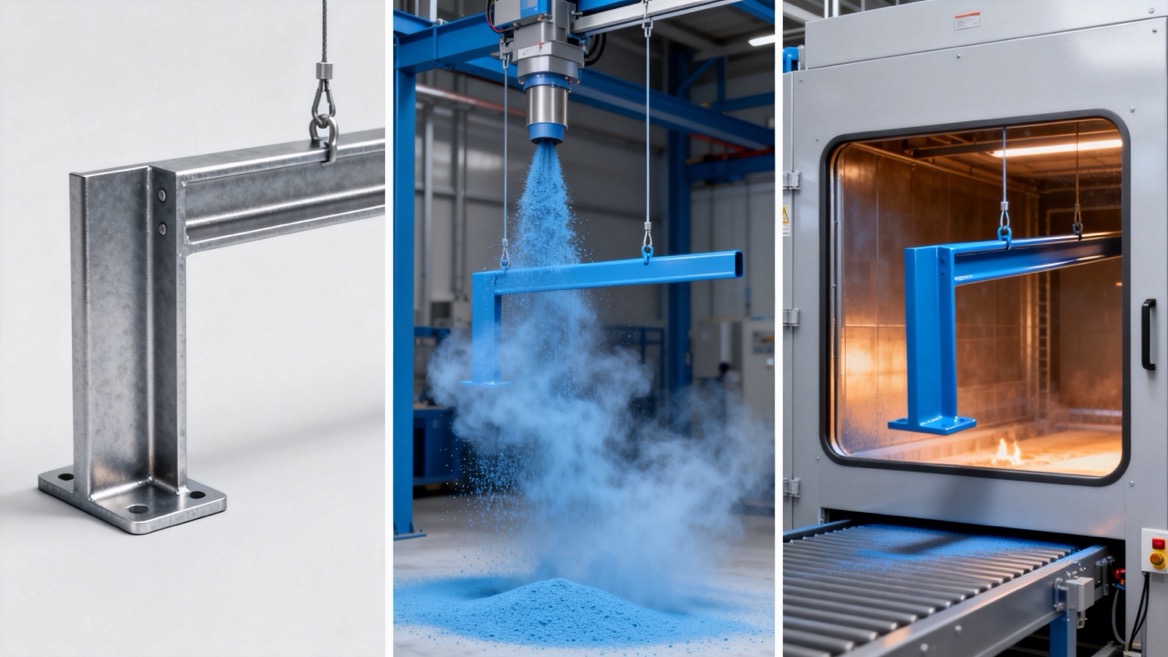
An electrostatic spray gun charges the powder particles. The grounded component attracts them, creating an uncured powder layer.
The operator adjusts powder delivery, airflow, charging conditions, gun distance, and movement to suit the part.
More voltage or more powder does not necessarily improve coverage. Recesses and internal corners can be difficult to coat because electrostatic behavior favors exposed surfaces.
For complex parts:
- Address recessed areas deliberately.
- Avoid excessive powder velocity.
- Maintain consistent gun movement.
- Check edges and corners separately.
- Verify the deposited film rather than judging appearance alone.
There is no universal gun setting suitable for every epoxy formulation and component geometry.
The target thickness must come from the product specification and end-use requirements.
Too little coating can leave inadequate protection. Excessive thickness may create appearance defects, interfere with fit, or contribute to application problems.
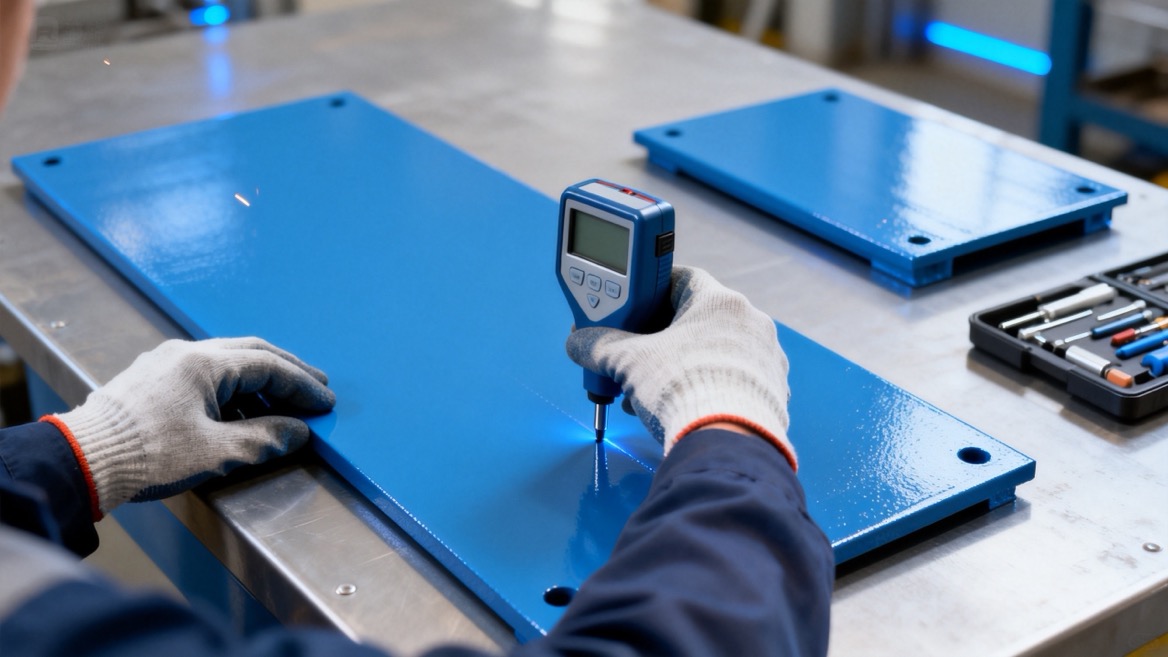
After curing, measure dry film thickness using a suitable instrument calibrated for the substrate.
Sample multiple locations, including:
- Broad flat surfaces.
- Edges and corners.
- Recesses.
- Areas near hanger contacts.
- Functionally critical surfaces.
A single reading on an easily accessible face cannot establish uniform coverage across a complex component.
The coated component enters an oven, where the powder melts, flows, and chemically crosslinks.
The crucial distinction is between oven air temperature and actual part temperature.
A heavy steel bracket takes longer to heat than a thin metal cover. Both may travel through the same oven, yet experience different curing conditions.
Published schedules for one commercial epoxy powder range include 15–20 minutes at 180°C, 9–12 minutes at 190°C, or 5–7 minutes at 200°C. These are product-specific examples—not universal epoxy settings.
Use the selected powder's approved schedule. Verify the component's temperature history with a suitable profiling system, particularly when changing part mass, loading density, or conveyor speed.
Allow coated parts to cool sufficiently before handling or packaging.
Inspection should connect directly to the customer's specification. Depending on the application, checks may include:
- Appearance and color.
- Dry film thickness.
- Adhesion.
- Cure verification.
- Impact or flexibility.
- Corrosion or chemical resistance.
- Electrical performance.
A smooth, glossy surface alone does not prove complete cure or long-term suitability.
Liquid epoxy follows a different workflow because the resin and hardener are mixed before application.
Steel requires the specified cleanliness and surface profile. Concrete requires preparation appropriate to its condition and the selected flooring system, including moisture evaluation where required.
Measure environmental conditions before coating.
Some industrial epoxy application guides require the substrate to remain at least 3°C above the dew point. Treat this as a product-specific requirement and confirm the applicable temperature and humidity limits.
Use the exact mixing ratio stated by the manufacturer. Weight ratios and volume ratios are not automatically interchangeable.
Mix thoroughly, including material near the container's sides and bottom. Observe any required induction time before application.
Pot life is the usable period after mixing under stated conditions. It is not the same as drying time or full cure.
Never add extra hardener to accelerate curing. This changes the formulation rather than providing reliable temperature control.
Apply by brush, roller, or approved spray equipment, maintaining the specified wet film thickness.
Observe the required recoat interval. If that window is exceeded, additional preparation may be necessary.
Distinguish between:
- Dry enough to touch.
- Ready for recoating.
- Ready for handling.
- Fully cured for chemical exposure or service.
Those milestones can occur at very different times.
Consider an illustrative production load containing thin appliance panels and thick brackets.
The panels may reach curing temperature quickly, while the brackets lag behind. Increasing conveyor speed based only on panel appearance could leave the brackets undercured.
Profile representative components and loading arrangements. Establish the operating window around actual metal temperature, not assumptions about oven performance.
This approach also makes energy-saving trials more credible: lower settings are useful only when the required cure remains verified.
"High chemical resistance" is not a complete specification.
A coating may perform differently depending on chemical concentration, temperature, exposure duration, and cleaning frequency.
For medical equipment housings, assess the actual cleaning agents and contact conditions. Do not assume that an industrial epoxy coating is suitable for direct patient contact or repeated sterilization.
For new energy vehicle components, electrical insulation claims require appropriate testing. A continuous-looking coating is not, by itself, evidence of dielectric performance.
When corrosion or adhesion fails, the powder is only one possible cause.
Review the substrate, pretreatment, application thickness, curing profile, and service conditions together.
For qualification work, retain representative samples and record:
- Powder batch and product identity.
- Pretreatment operating conditions.
- Part temperature profile.
- Film thickness measurements.
- Test methods and acceptance criteria.
These records help distinguish a material-selection problem from a production-process problem.
| Defect | Possible contributors | First checks |
|---|---|---|
| Poor adhesion | Contamination, unsuitable preparation, insufficient cure | Cleaning records, pretreatment, temperature profile |
| Pinholes | Substrate outgassing, moisture, contamination | Substrate condition, drying, approved outgassing controls |
| Uneven coverage | Poor grounding, geometry, unstable powder delivery | Hooks, gun settings, spraying sequence |
| Rough or uneven appearance | Film build, spray conditions, flow or curing mismatch | Thickness readings and product instructions |
| Soft or weak film | Incomplete cure or incorrect liquid mixing | Part temperature or component ratio |
| Early exterior chalking | Unsuitable exposed epoxy chemistry | Exposure conditions and coating-system selection |
These are diagnostic starting points, not automatic conclusions. Change one controlled variable at a time and confirm the outcome on representative parts.
Powder coating avoids the liquid mixing step and generally eliminates the need for carrier solvents in the powder itself. However, it is not a hazard-free process.
Airborne powder, combustible dust, electrical equipment, hot surfaces, and pretreatment chemicals require appropriate controls.
Use effective extraction, grounding, suitable housekeeping, and protective equipment selected through a workplace assessment. Follow the safety data sheet and applicable local requirements.
For liquid epoxy, also address resin and hardener exposure, ventilation, and any solvent-related hazards.
Yinda Technology develops, manufactures, and supplies powder coatings and environmental materials, with subsidiaries in China, Indonesia, and Saudi Arabia.
For your next project, send our team the substrate, component drawing, service environment, target finish, required tests, and available curing conditions. These details provide a practical starting point for discussing an epoxy powder or alternative coating system suited to your application.
It can be applied to appropriately prepared metal, but "bare" must not mean oily, rusty, or untreated without justification. The required cleaning, profile, and pretreatment depend on the coating specification.
Not always. Some products are designed for direct application over properly prepared metal. Other systems require a primer for specified performance. Validate the complete system rather than adding layers automatically.
There is no universal time. Powder cure depends on the specified part temperature and dwell time. Liquid cure depends on formulation, temperature, and application conditions. Consult the product data sheet.
Exposed pure epoxy generally has limited ultraviolet durability. For outdoor components, select a suitable weather-resistant system or a compatible protective topcoat where specified.
Conventional thermosetting epoxy powder requires a validated heat-curing process. Specialized heating equipment may be used, but room-temperature drying is not a substitute for the specified cure.
Some liquid products permit small-scale application with suitable preparation and safety measures. Industrial epoxy powder coating normally requires dedicated spraying, extraction, grounding, curing, and inspection equipment.
1. Powder Coating Institute. "Frequently Asked Questions." Industry guidance covering pretreatment, substrate temperature, bring-up time, and curing dwell time.
[https://www.powdercoating.org/page/FAQ] [powdercoating]
2. Powder Coating Institute. "What Is Powder Coating?" Overview of powder application, oven curing, and crosslinking.
[https://www.powdercoating.org/page/WhatIsPC] [powdercoating]
3. AkzoNobel, Interpon. "Interpon 100 Technical Data Sheet." Product-specific information on epoxy powder performance, interior use, pretreatment, and curing schedules. The example schedules in this article are not Yinda product specifications.
[https://powdercoatings.brand.akzonobel.com/m/4b0a47127ba17b49/original/Interpon-100-TDS.pdf] [powdercoatings.brand.akzonobel]
4. TIGER Coatings. "Powder Coating Process Explained—A Detailed Breakdown." December 20, 2023. Overview of cleaning, application, and heat curing.
[https://www.tiger-coatings.com/us-en/blog/powder-coating-process] [tiger-coatings]
5. Jotun. "Jotaprime 500: Technical Data Sheet and Application Guide." Product-specific guidance on environmental conditions and maintaining substrate temperature above the dew point.
[https://www.jotun.com/api-b2b/v1/datasheets/download/merged?selectedFiles=36] [jotun]
6. WEST SYSTEM. "Epoxy Chemistry Basics." Explanation of pot life, temperature effects, and epoxy curing behavior.
[https://www.westsystem.com/instruction/epoxy-basics/epoxy-chemistry/] [westsystem]
7. Occupational Safety and Health Administration. "29 CFR 1910.107—Spray Finishing Using Flammable and Combustible Materials." U.S. regulatory reference addressing spray operations, powder handling, ventilation, and electrostatic equipment; local requirements must be assessed separately.
http://www.osha.gov/laws-regs/regulations/standardnumber/1910/1910.107 [osha]


