Language


Views: 222 Author: Yinda Powder Coating Publish Time: 2026-06-05 Origin: Site


Content Menu
● What Are Electrostatic Dissipative Powder Coatings?
● Understanding Static Electricity and ESD Risk
>> What Is an Electrostatic Charge?
>> Why Conventional Powder Coatings Are Not Enough
● How Electrostatic Dissipative Coatings Work
● Types of Materials by Conductivity (Insulative, Dissipative, Conductive)
● Key Benefits of ESD Powder Coatings for Industry
>> 1. ESD Protection for Sensitive Electronics
>> 2. Mechanical and Chemical Durability
>> 3. UV and Aesthetic Performance
>> 4. Cost and Sustainability Advantages
● Where ESD Powder Coatings Are Used
>> Electronics Manufacturing and Assembly
>> Automotive, EV, and Aerospace
>> Telecommunications, IT, and Data Centers
● Market Insights: Why ESD Coatings Are Growing
● Yinda Technology: ESD Powder Coatings from a Global Supplier
● Practical Considerations When Specifying ESD Powder Coatings
● Example Use Case: Smart EV Charging Infrastructure
● Summary Table: ESD Powder Coatings vs Standard Powder Coatings
● How Yinda Technology Can Support Your ESD Projects
● FAQs: Electrostatic Dissipative Powder Coatings
Electrostatic dissipative (ESD) powder coatings have become a critical protective technology for modern electronics, smart manufacturing, and high‑value industrial equipment, especially as more products integrate sensors, chips, and connectivity features. Drawing on hands‑on collaboration with manufacturers across China, Southeast Asia, and the Middle East, I will unpack what ESD coatings are, how they work in real factories, and where an innovation‑driven powder coating manufacturer like Yinda Technology can deliver extra value for global buyers. [linkedin]
Electrostatic dissipative powder coatings are a specialized class of powder coatings formulated with conductive or semi‑conductive additives to safely dissipate static electrical charges from a coated surface. Unlike standard insulating powder coatings, which can trap charge and allow dangerous voltage spikes, ESD coatings are engineered to control surface resistance within a defined range so static can flow away in a controlled, non‑damaging manner. [tiger-coatings]
In practice, these coatings are applied as a dry powder and then cured into a hard, durable film that combines surface protection, aesthetics, and static control in a single layer. Because they are still powder coatings, they retain classic benefits such as excellent adhesion, impact resistance, and long‑term color stability when properly specified. [linkedin]

Static electricity occurs when there is an imbalance between positive and negative charges on the surface of a material. Everyday examples include hair standing after removing a hat or a balloon sticking to a wall after rubbing it on clothing. In industrial environments, the same principle applies when people walk across floors, handle plastic components, or move insulated parts along a conveyor. [linkedin]
As charges accumulate, the voltage on a surface can become extremely high until it suddenly discharges to another object at a different potential. That discharge is what we call electrostatic discharge (ESD), and in sensitive electronics it can silently damage integrated circuits long before there is any visible sign of failure. [conro]
Typical powder coatings are highly insulating, with surface resistivity values often exceeding 1×10¹² ohms. This makes them very effective electrical insulators for wires, pipes, or structural components, but it also means they cannot safely dissipate static charge when used on housings, cabinets, or enclosures that interact with electronics or flammable dust. [linkedin]
In such scenarios, voltage peaks during ESD events can reach tens of thousands of volts, which can damage circuit boards, corrupt data, or even ignite explosive dust atmospheres in certain process areas. This is why engineers now specify ESD‑controlled coatings instead of standard insulating finishes for many critical applications. [conro]
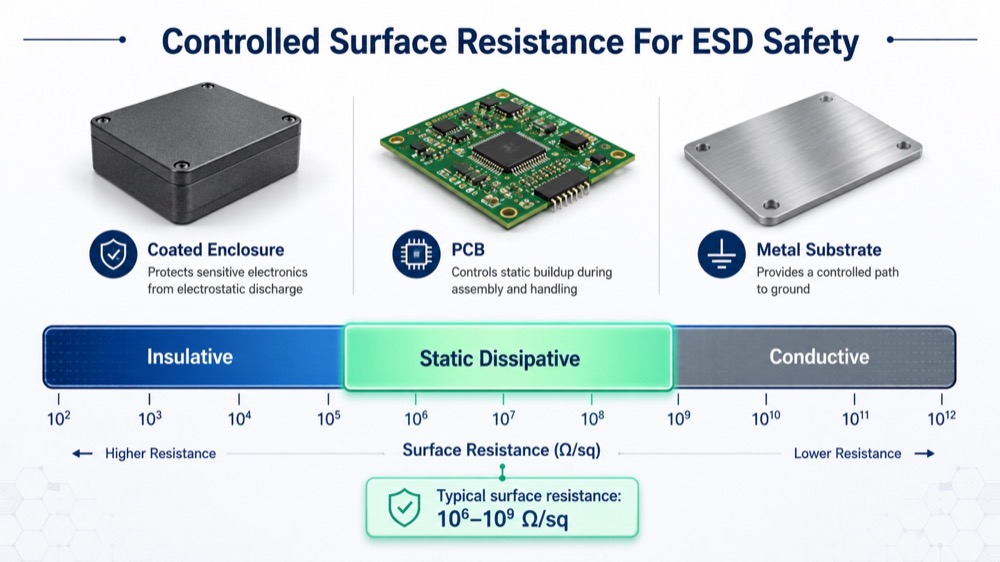
Electrostatic dissipative powder coatings are formulated so that their surface resistance falls in a controlled window, typically between 1×10⁶ and 1×10⁹ ohms. At these levels, charge no longer accumulates like on an insulator, nor does it rush away instantly like on a metal conductor; instead, it flows slowly enough to avoid damaging voltage spikes. [linkedin]
For ESD control to work reliably, two technical conditions are essential:
- The substrate or the total system must provide a path to ground, often via a conductive metal base or designed grounding points. [conro]
- The coating formulation must maintain its dissipative performance over time, despite UV exposure, contamination, or mechanical wear. [linkedin]
ESD powder coatings are usually applied with standard electrostatic spray equipment and then cured, so they fit well into existing powder coating lines in sectors like electrical cabinets, machine housings, and automotive or EV components. [made-in-china]
From an electrical perspective, powder coatings and substrates are typically grouped into three categories based on surface resistance: [linkedin]
- Insulating materials: Above 1×10¹² ohms, charge does not flow freely, and static can build to very high voltages. Many standard epoxy and polyester powders sit here. [linkedin]
- Static dissipative materials: Between roughly 1×10⁶ and 1×10⁹ ohms, charge flows in a controlled, gradual way, which is considered the ideal range for ESD control around electronics. [linkedin]
- Conductive materials: Below about 1×10⁶ ohms, electrons move very easily; metals usually show resistance close to 0–0.1 ohms, and highly conductive zinc‑rich coatings fall into this region. [linkedin]
Colors, pigments, and functional additives all influence the final resistance of a coating; for instance, moving from black to white in the same system or adding zinc or specialized conductive fillers can significantly change measured resistivity. Because of this, experienced coaters and manufacturers work closely with project engineers and powder suppliers to ensure the final ESD performance matches the specification. [linkedin]
The primary value of ESD powder coatings is protection against electrostatic discharge on and around sensitive components. By dissipating charge, these coatings help prevent latent damage to integrated circuits, memory chips, sensors, and communication modules in areas such as: [tiger-coatings]
- PCB assembly lines and test fixtures
- Electrical cabinets and control panels
- Computer housings and server racks
This protection translates directly into higher product reliability and lower field failure rates, which is critical for global OEMs and Tier‑1 suppliers.
Like other high‑quality powder coatings, ESD systems offer a tough, abrasion‑resistant finish with strong resistance to impact, chemicals, and mechanical wear. In industries where cabinets and housings are frequently opened, cleaned, or moved, this durability reduces downtime and keeps equipment looking professional over its lifetime. [linkedin]
They also provide effective corrosion resistance, especially when combined with properly prepared substrates and appropriate primers in harsh industrial or coastal environments. [linkedin]
Modern ESD powder coatings can be specified with enhanced UV resistance, helping maintain color and gloss in outdoor or high‑light environments. This matters in applications such as EV charging stations, outdoor telecom cabinets, and building‑integrated electronics where both performance and appearance are evaluated by end users and regulators. [tiger-coatings]
Because they are available in multiple colors, textures, and gloss levels, design teams can align brand, safety, and compliance in a single coating system. [linkedin]
Although ESD coatings may have a higher upfront material cost than standard powder, they can deliver total cost savings by reducing failure rates, maintenance, and replacements. [tiger-coatings]
From a sustainability standpoint, powder coatings are typically solvent‑free and generate minimal VOCs, aligning with emerging EHS and ESG requirements. This is increasingly important for global buyers sourcing from Asia for regulated markets in Europe, North America, and the Middle East. [linkedin]
In electronics manufacturing, ESD powder coatings are widely used on racks, fixtures, cabinets, and housings to keep static under control throughout assembly, testing, and logistics. This complements other ESD control measures such as grounded workstations, dissipative flooring, wrist straps, ionizers, and humidity management. [stellartechnical]
These coatings are particularly valuable where metal enclosures protect high‑density PCBs, power electronics, or embedded systems that are crucial for industrial automation and robotics. [made-in-china]
In the automotive and aerospace sectors, ESD coatings help prevent static buildup on cockpit consoles, instrument panels, and interior components, where sensitive electronics and human operators interact. For EVs and hybrid vehicles, dissipative finishes can be specified on battery management housings, charging infrastructure, and related electrical enclosures to reduce ESD risk around high‑value systems. [made-in-china]
They can also be used for fuel system components and areas where flammable vapors or dust might be present, helping to mitigate ignition risks associated with static discharges. [tiger-coatings]
Telecommunications and IT infrastructure rely on server racks, network cabinets, and equipment enclosures to protect critical hardware. ESD powder coatings contribute to a well‑controlled electrostatic environment, supporting system uptime and reducing the risk of damage during installation, maintenance, or unplanned interventions. [tiger-coatings]
For data center operators, specifying ESD‑controlled finishes is part of a broader risk management strategy that also includes environmental monitoring, grounding, and cable management. [stellartechnical]
Recent market analyses indicate that electrostatic dissipative coating demand is rising steadily, with regional markets such as Europe projected to grow at around 4–5% CAGR through 2033. Reports for Asia‑Pacific hubs like Singapore also point to strategic growth opportunities in ESD coatings, driven by semiconductor, electronics, and advanced manufacturing investments. [linkedin]
This growth is closely linked to three trends:
- Increasing electronics content in vehicles, machinery, and consumer products
- Tighter ESD control standards in global supply chains
- Rising adoption of environmentally friendly powder technologies as an alternative to solvent‑borne coatings [linkedin]
For manufacturers like Yinda Technology, this creates a strong opportunity to offer tailored ESD powder systems aligned with industry‑specific performance and regulatory requirements. [made-in-china]
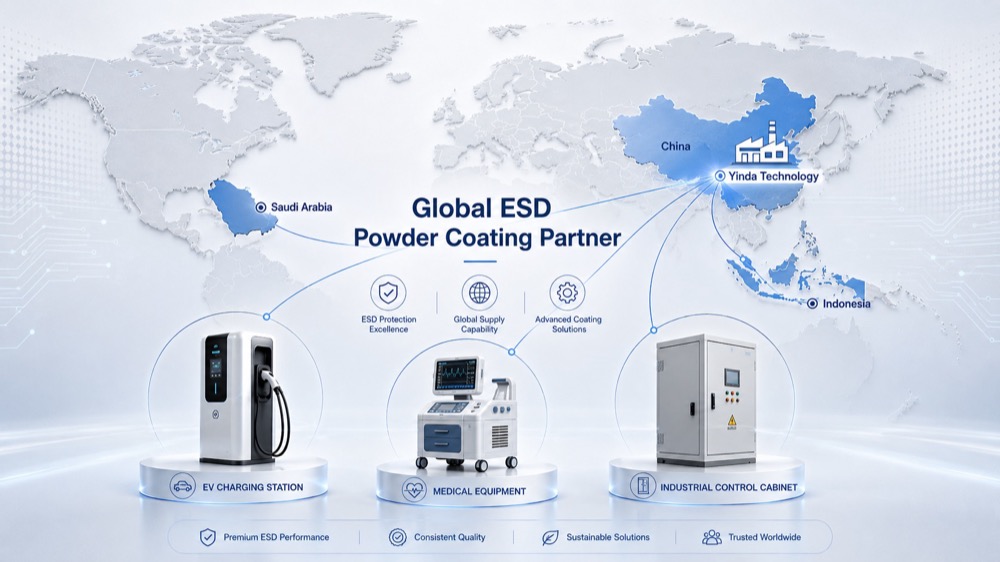
Yinda Technology, founded in 2010 and headquartered in Foshan, Guangdong, has grown into a global powder coating manufacturer with subsidiaries in China, Indonesia, and Saudi Arabia. The company focuses on R&D, manufacturing, sales, and energy‑saving coating technologies, supplying powder solutions for building profiles, doors and windows, new energy vehicles, medical equipment, hardware, and electrical appliances. [langgenglarisgemilang.business]
By combining environmentally friendly powder chemistries with application engineering, Yinda aims to support OEMs and coaters seeking consistent ESD performance across multi‑plant operations in Asia and the Middle East. With production and service close to local markets, the company can help customers balance technical performance, lead time, and total cost in competitive export‑oriented supply chains. [langgenglarisgemilang.business]
From a practical engineering and QA perspective, successful ESD coating projects typically follow a phased approach:
1. Define ESD requirements clearly
- Set the target surface resistance range for the finished assembly.
- Identify test methods and sampling plans.
2. Evaluate substrate and grounding design
- Confirm that metals or conductive layers provide a reliable path to ground.
- Ensure grounding is maintained through assembly and installation. [conro]
3. Select appropriate ESD powder system
- Match base chemistry (epoxy, polyester, hybrid) to environment and corrosion exposure. [linkedin]
- Validate color and appearance tolerances alongside ESD performance.
4. Optimize application and curing parameters
- Use calibrated electrostatic spray settings and film thickness controls.
- Verify curing profiles to avoid under‑cure or over‑bake that can affect properties. [linkedin]
5. Implement ongoing testing and maintenance
- Periodically measure surface resistance of coated components.
- Review any process changes that might impact ESD performance. [conro]
By embedding these steps into the project lifecycle, manufacturers can prevent costly redesigns or field issues and ensure consistent, auditable ESD protection.
Consider an international OEM producing outdoor EV charging stations:
- The units combine power electronics, communication modules, and payment systems.
- Enclosures are installed outdoors in high‑UV, high‑humidity environments across Asia and the Middle East.
- Operators require stable ESD performance to protect sensitive electronics and ensure reliable user interaction.
By selecting an ESD‑controlled polyester powder coating with UV resistance, tested surface resistance in the specified dissipative range, and proven corrosion performance, the OEM can:
- Protect internal electronics from ESD during installation, servicing, and everyday use. [conro]
- Maintain brand appearance thanks to long‑term color and gloss stability. [linkedin]
- Demonstrate compliance with environmental and ESD management requirements in tenders and audits. [linkedin]
A regional supplier like Yinda, with existing experience in new energy vehicle and electrical appliance applications, is well positioned to support such projects with both technical data and localized service. [langgenglarisgemilang.business]
| Aspect | ESD Powder Coatings | Standard Powder Coatings |
|---|---|---|
| Electrical behavior | Static dissipative, controls charge between 1×1061×106 and 1×1091×109 ohms (linkedin) | Highly insulating, typically above 1×10121×1012 ohms (linkedin) |
| Main purpose | Protect electronics and reduce ESD risk in sensitive areas (linkedin) | General corrosion, mechanical and aesthetic protection (linkedin) |
| Typical applications | Electronics, EVs, telecom racks, IT cabinets, control panels (linkedin) | Building profiles, furniture, general hardware and appliances (langgenglarisgemilang.business) |
| Substrate requirements | Must integrate with grounding design and conductive path (linkedin) | Can be used on a wide range of substrates where insulation is acceptable (linkedin) |
| Cost profile | Higher material cost but lower ESD‑related failure cost (linkedin) | Lower material cost; may require extra protection in ESD‑critical use (linkedin) |
As a manufacturer dedicated to powder coatings and eco‑friendly surface solutions, Yinda can support OEMs, contractors, and coaters through the full project cycle:
- Application‑specific formulation for electronics, EV, medical equipment, building hardware, and electrical appliances. [langgenglarisgemilang.business]
- Regional technical service via subsidiaries in China, Indonesia, and Saudi Arabia to align coating selection, line parameters, and QA processes with local conditions. [langgenglarisgemilang.business]
- Integration of energy‑saving technologies in curing and application, helping customers improve environmental performance while maintaining or elevating coating quality. [made-in-china]
For buyers and engineers seeking a long‑term partner for ESD and functional powder coatings, engaging early with Yinda's technical team can help optimize both coating design and production efficiency at scale.
1. What is the ideal surface resistance range for ESD powder coatings?
The ideal range for most ESD‑controlled environments is typically between 1×10⁶ and 1×10⁹ ohms, where static charge is dissipated in a controlled, non‑damaging way. [linkedin]
2. Can ESD powder coatings be applied over existing coatings?
In many cases yes, provided the existing layer is compatible, properly cleaned, and prepared; however, the complete coating stack must still achieve the target ESD performance and adhesion. [linkedin]
3. Are ESD powder coatings suitable for outdoor applications?
Yes, ESD powder coatings can be used outdoors if the formulation includes UV‑resistant chemistry and is tested for weathering performance in the specific climate and exposure type. [tiger-coatings]
4. How do ESD coatings fit into a broader ESD control program?
They are one layer in a multi‑layer system that includes grounding, ESD flooring, personnel gear, humidity control, and training, all working together to reduce ESD risk across the facility. [stellartechnical]
5. Which industries benefit most from ESD powder coatings today?
Key adopters include electronics and semiconductor manufacturing, EV and automotive, aerospace, telecommunications, data centers, and medical equipment, especially where global reliability and safety standards apply. [linkedin]
1. TIGER Coatings – "What Are Electrostatic Dissipative (ESD) Powder Coatings And How Do They Work?" (accessed 2026). [linkedin]
2. ConRo Electronics – "Mastering ESD Protection for Electronics Manufacturing". [conro]
3. Stellar Technical – "Effects of Temperature on ESD in Electronics Manufacturing". [stellartechnical]
4. Yinda Technology – Company introduction and product scope. [langgenglarisgemilang.business]
5. Europe Electrostatic Dissipative Coating (ESD Coating) Market Report – Growth outlook 2026–2033. [linkedin]
6. Singapore Electrostatic Dissipative Coating (ESD Coating) Market – Size and strategic outlook. [linkedin]


