Language


Views: 299 Author: Yinda Powder Coating Publish Time: 2026-11-17 Origin: Site


Content Menu
● How Epoxy Powder Coating Protects Steel
● What Makes a Steel Coating System High-Performance?
>> Epoxy Powder vs. Multi-Coat Corrosion Protection: Side-by-Side Comparison
● How to Specify Corrosion Protection for the Actual Exposure
>> Classify the Environment Before Choosing a Coating
>> Read Salt Spray Test Reports Beyond the Hour Count
● Three Practical Checks Before Approving a Steel Coating System
>> 1. Inspect the Areas a Flat Test Panel Cannot Represent
>> 2. Qualify a Production Part, Not Just a Sample Panel
>> 3. Compare Installed and Maintenance Costs, Not Price per Kilogram
● Choosing a Coating System With Yinda Technology
● FAQs
>> 1. Is epoxy powder coating waterproof?
>> 2. Can epoxy powder coating be used outdoors?
>> 3. Is epoxy powder coating better than a liquid epoxy coating?
>> 4. Can you powder coat hot-dip galvanized steel?
>> 5. Does thicker powder coating always provide better corrosion protection?
>> 6. What should a coating supplier provide before an order is approved?
Epoxy powder coating is often a good choice for factory-finished steel parts used indoors. High-performance anti-corrosion coatings for steel are the better starting point when the specification calls for protection against coastal salts, persistent moisture, or severe industrial exposure. But these are not opposing categories: epoxy powder describes a coating chemistry and application form, while a high-performance anti-corrosion coating describes what a complete system is designed to do. An epoxy powder primer can be part of that system.
The practical question is not "Which coating is stronger?" It is "Which system can we apply consistently to this part, verify against its exposure, and repair after installation?" At Yinda Technology, that is the framework we recommend for OEM buyers, fabricators, and specifiers comparing steel finishes.

Epoxy powder is typically applied electrostatically and heat-cured. When the steel is properly prepared and the powder is correctly cured, the resulting film can provide good adhesion and resistance to moisture and selected chemicals. That makes it a candidate for indoor electrical enclosures, hardware, and medical equipment housings. For equipment cleaned regularly, verify compatibility with the actual disinfectants, concentrations, and contact times instead of relying on a general chemical-resistance claim.
The main limitation is sunlight. Conventional epoxy powder can chalk, lose gloss, or change color under ultraviolet exposure. Chalking is a powdery surface change; it does not necessarily mean the steel underneath has already started to rust. It does mean that exposed epoxy is a poor choice when outdoor color and gloss retention matter.
For outdoor steel, a compatible epoxy powder primer and an exterior-grade polyester topcoat can divide the work: the primer supports adhesion and corrosion protection, while the topcoat handles weather exposure. The two layers still need to be qualified together, with an approved cure schedule and film thickness for each coat.
A high-performance system is selected for a defined substrate, exposure, and maintenance objective. One common atmospheric system uses a zinc-rich primer, a high-build epoxy intermediate coat, and a weather-resistant polyurethane topcoat. The zinc-rich primer can provide sacrificial protection near small defects, the intermediate coat builds a barrier, and the topcoat protects against weathering. That layer sequence is an example, not a universal specification.
Other options include an epoxy powder primer with a weatherable powder topcoat, or a duplex system that combines hot-dip galvanizing with paint or powder. When powder coating galvanized steel, preparation must account for the condition of the zinc surface and the risk of outgassing during cure. Bid documents should distinguish atmospheric exposure from immersion or splash-zone service: a system qualified for one should not be assumed suitable for the other.
| Decision factor | Single-coat epoxy powder | Qualified high-performance system |
|---|---|---|
| Typical fit | Factory-finished indoor steel parts | Steel exposed to demanding conditions defined in the project specification |
| Sunlight exposure | Chalking and appearance changes are likely over time | An exterior-grade topcoat can improve color and gloss retention |
| Application | Generally requires a powder line and a curing oven | May use factory-applied powder, shop- or field-applied liquid coatings, or galvanizing with a topcoat |
| Edges and recesses | Coverage depends on geometry, pretreatment, and application control | Can incorporate requirements for edge preparation, additional coverage, and inspection |
| Field repair | Usually requires a compatible repair material rather than reapplying powder in place | Can be specified with a documented touch-up procedure and approved repair materials |
| Evidence to request | Substrate, pretreatment, cure window, adhesion, and relevant resistance data | Complete system test report, per-coat thickness, exposure scope, and inspection and repair criteria |
Start with the part's actual exposure, not simply its location. A steel cabinet under a canopy may avoid direct rain but still collect salt and experience regular condensation. A bracket installed inside an electric vehicle may need to tolerate road salts and stone impact without requiring the same gloss retention as visible exterior trim.
For structural steel in atmospheric service, ISO 12944 provides a framework for describing corrosivity and setting durability objectives. Its four durability ranges are low (up to 7 years), medium (7–15 years), high (15–25 years), and very high (more than 25 years). These ranges refer to the expected time to first major maintenance, not a warranty or a promise of rust-free service. A report should identify what was tested and how it relates to the project; a broad claim such as "C5 powder coating" is not enough to establish suitability.
A salt spray result does not translate into years outdoors. Before comparing two reports, check whether they used the same method, substrate, pretreatment, and film thickness. Then look beyond the exposure duration: was the panel deliberately scored, and if so, how far did corrosion spread from that cut? Also check what the report says about blistering, rust elsewhere on the panel, and adhesion if it was measured.
For steel exposed to alternating wet and dry conditions, sunlight, and temperature changes, ask what cyclic testing or comparable field evidence is available for the proposed system. A high chamber-hour count on a smooth panel does not tell you whether a finished enclosure will hold up around welds, fasteners, or drainage holes.
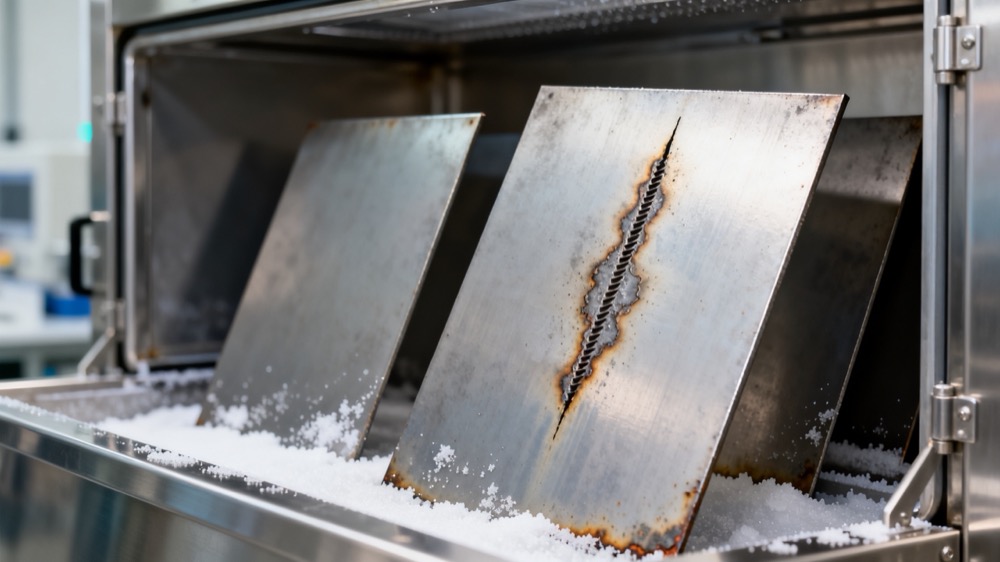
Ask the fabricator to identify sharp edges, weld spatter, deep recesses, and seams that can trap water. An electrostatic powder spray may deposit less material inside deep recesses than on open faces. Sharp edges can also have less film coverage than adjacent flat surfaces. A part can pass a thickness check on its broad face and still be vulnerable where corrosion is most likely to start.
Before releasing a drawing, agree on which edges must be dressed, which locations need additional inspection, and how the applicator will verify coverage. For a liquid system, the specification may call for a stripe coat—an extra pass over edges, welds, or other difficult areas before or between full coats.
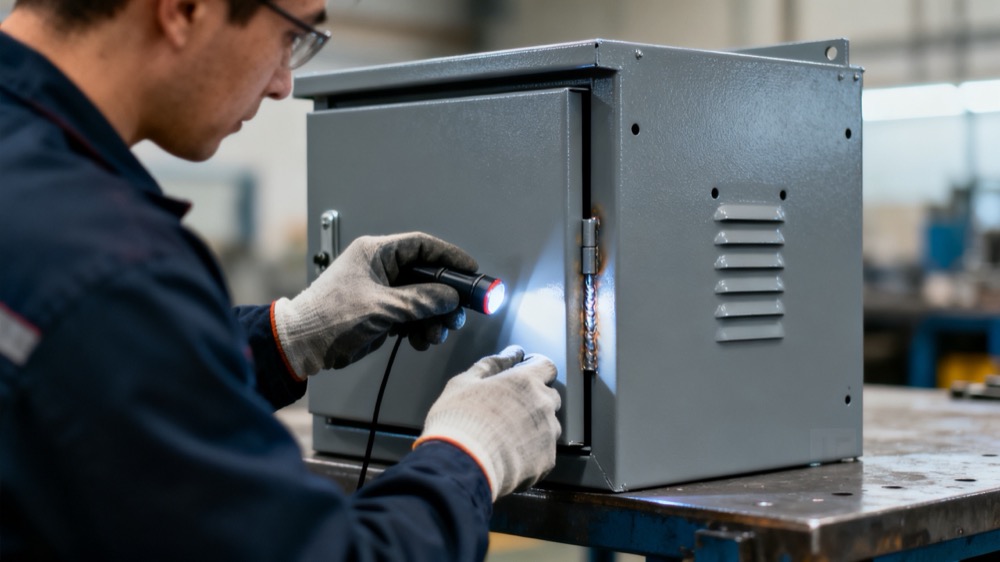
Consider an illustrative case: an OEM is moving an indoor electrical enclosure to a sheltered coastal site. Leaving the epoxy powder unchanged overlooks salt and condensation. Adding a weatherable topcoat is worth evaluating, but it will not correct poor preparation or thin coverage around the door return and hardware openings.
A useful trial would coat a representative enclosure and flat witness panels in the same production run. Record the steel grade, pretreatment, coating batch, and film thickness for each layer. For powder, verify cure against the supplier's specified part-metal temperature and time, rather than relying on the oven air setting alone. Inspect the recesses and cutouts, and check assembly fit after coating. Use the results to decide whether the two-coat powder system is adequate or whether to evaluate another route, such as a galvanized duplex finish.
For high-volume parts that fit an existing oven, powder may be economical. For a large welded frame that must be finished or repaired on site, a liquid system may be easier to apply and maintain. Neither route is automatically cheaper once stripping, rework, transport, access equipment, and downtime are included.
Ask each bidder to price the same scope: steel preparation, masking, application, inspection, shipping protection, and touch-up after assembly. For assets that are expensive to access, include the cost of the first major maintenance event. This comparison often matters more than the difference in coating material price.
Yinda Technology develops and manufactures powder coatings and has subsidiaries in China, Indonesia, and Saudi Arabia. Its products serve industries including architectural profiles, doors and windows, electric vehicles, medical equipment, hardware, and appliances. When requesting a recommendation for any of these applications, identify the substrate explicitly. A finish qualified on aluminum profiles does not establish equivalent corrosion performance on carbon steel or galvanized steel.
Send Yinda Technology your part drawing, substrate and pretreatment details, installation location, appearance requirements, and any required test method or acceptance criteria. Ask for a written system proposal that identifies the primer and topcoat, target thickness per layer, cure window, and evidence relevant to your exposure. For repeat production, request a sample run on representative parts before final approval.
A continuous, properly cured epoxy film can resist moisture, but "waterproof" does not establish suitability for standing water or continuous immersion. If the steel will be submerged, specify a system qualified for the relevant water chemistry, temperature, and exposure conditions.
Yes, as a primer beneath a compatible, weather-resistant topcoat. Conventional epoxy powder is generally not the best exposed finish when color and gloss retention are important. Confirm intercoat adhesion, cure requirements, and corrosion performance for the exact combination.
Neither is universally better. Powder is often practical for repeatable factory production on parts that can be oven-cured. A liquid epoxy system may be more practical for large structures, field application, or planned maintenance. Compare the complete systems on the intended substrate, not the resin names alone.
Yes. The combination is called a duplex system. Specify preparation for the condition of the galvanized surface and address outgassing before coating. ASTM D7803 covers preparation of hot-dip galvanized iron and steel surfaces for powder coating.
No. The goal is to stay within the qualified film thickness range, including at critical locations. A thicker film on a broad face does not compensate for poor edge coverage, contamination, or incomplete cure. Excess build can also interfere with threaded holes and mating surfaces.
Request the system build-up, substrate preparation requirements, film thickness range for each coat, cure schedule, relevant test reports, inspection criteria, and a compatible repair procedure. Confirm that the test samples represent the proposed substrate and coating stack closely enough to support the purchase decision.
- Powder Coated Tough, *A Guide to Powder Coatings for Extreme Service Environments* — epoxy weathering limitations and epoxy primer systems with exterior-grade powder topcoats. [powdercoatedtough]
- AkzoNobel International, *ISO 12944: A Guide to the Protective Coatings Standard* — atmospheric corrosivity categories, durability ranges, and changes to laboratory testing requirements. [international.brand.akzonobel]
- SteelConstruction.info, *Standard Corrosion Protection Systems for Buildings* — structural-steel coating system examples, corrosivity categories, and the distinction between coating durability and a guarantee. [steelconstruction]
- KTA-Tator, *ISO Testing Specifications According to ISO 12944-6 and 12944-9* — laboratory test methods, cyclic aging, evaluation criteria, and the limits of translating accelerated testing to service life. [kta]
- American Galvanizers Association, *Specifying Duplex Systems* and *Duplex Systems for Corrosion Protection* — galvanized steel preparation, ASTM D7803, outgassing, and how zinc and organic coatings work together. [galvanizeit]


