Language


Views: 231 Author: Yinda Powder Coating Publish Time: 2026-11-20 Origin: Site


Content Menu
● Powder Coating Temperature Ratings: What the Numbers Actually Mean
>> Cure Temperature Is Not Service Temperature
● How Much Heat Can Different Powder Coatings Handle?
>> Standard Polyester, Epoxy, and Hybrid Powders
>> Specialty High-Temperature Powder Coatings
>> When a Ceramic or Other Specialty System Is a Better Candidate
● How to Specify Heat-Resistant Powder Coating for a Real Part
>> 1. Measure the Hottest Coated Surface
>> 2. Define Failure Before Requesting Samples
>> 3. Match the Complete Coating System
● Worked Example: A Visible Appliance Panel With a Hot Spot
● A Practical Qualification Checklist Before Production
● Discuss Your Temperature Requirements With Yinda Technology
>> Can powder coating withstand 400°F (204°C)?
>> Can powder coating withstand 500°F (260°C)?
>> Is powder coating suitable for exhaust parts or barbecue components?
>> Why did my powder coating yellow even though it did not peel?
>> Does a low-cure powder also work at high service temperatures?
>> Can I use the same heat-resistant powder on aluminum and steel?
What temperature can powder coating withstand? There is no universal limit. One exterior polyester powder lists continuous color stability up to 120°C (248°F), while one specialty heat-resistant powder lists exposure at 400°C (752°F) for 24 hours and 600°C (1,112°F) for one hour, with possible color and gloss loss. Those figures describe different products, exposure times, and performance criteria. For purchasing and engineering teams, the right question is: What temperature can this coating withstand on our part, for how long, and what must it still do afterward?

A temperature rating is only useful when it tells you what was tested and what counted as passing. A coating can stay attached while losing gloss or changing color. That might be acceptable on a concealed exhaust component, but not on a white appliance panel that customers see every day.
| Rating or test condition | What it tells you | What it does not prove |
|---|---|---|
| Cure temperature and time | The conditions needed to form the finished coating during production | That the cured coating can operate at that temperature |
| Continuous service rating | The sustained exposure supported by the product documentation for a stated property | That every color, substrate, or performance property is covered |
| Timed heat exposure | Performance after a defined exposure, such as 24 hours at a specified temperature | That the coating can withstand that temperature indefinitely |
| Short peak exposure | Performance during or after a brief high-temperature event under stated conditions | That the same peak can recur daily without damage |
| Thermal cycling test | Performance after repeated heating and cooling under a defined test profile | That different ramp rates, dwell times, or cycle counts will give the same result |
The part metal temperature is the temperature of the metal itself, not the oven air. If a technical data sheet calls for 10 minutes at 180°C (356°F) at object temperature, the relevant dwell starts when the monitored area of the part reaches 180°C, not when the rack enters the oven.
This distinction matters on mixed loads. A thin cover and a thick mounting bracket can travel through the same oven yet spend different amounts of time at the target temperature. Profile representative parts rather than approving a cure schedule from the oven display alone.
An exterior polyester provides a useful example: its data sheet lists a cure option of 10 minutes at 180°C, but describes continuous color stability only up to 120°C. A short production bake and years of service are different demands on the coating.
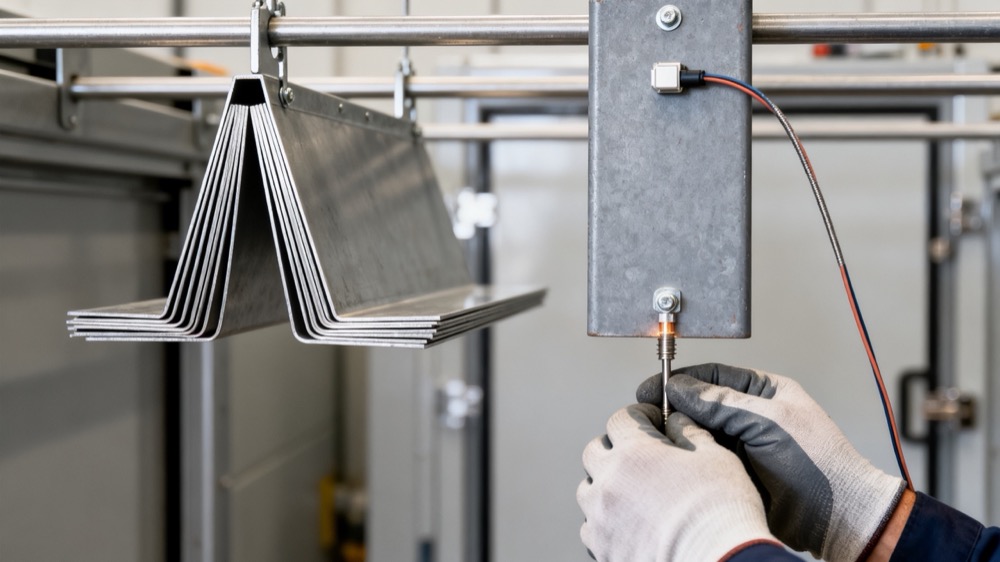
Start with the grade, not just the resin family. A weather-resistant polyester may be a good candidate for building profiles, doors, windows, and exterior housings. Its outdoor weathering performance, however, does not establish its heat limit in an appliance or next to a heater.
Likewise, an epoxy or epoxy-polyester hybrid should not be selected for hot service solely because its data sheet shows good adhesion or chemical resistance. Ask whether those properties were measured after heat exposure. A result from a freshly cured panel is a useful baseline, but it is not evidence of what the coating will do after repeated heating.
High-temperature formulations, including silicone-based powders, are candidates for suitably specified stove components, flues, mufflers, and industrial heater parts. Published data illustrate why a temperature without a duration or performance criterion can mislead:
| Published product example | Stated exposure | How to interpret it |
|---|---|---|
| Interpon HT 350 | 200°C (392°F) for 24 hours; 250°C (482°F) for one hour | The manufacturer reports adhesion and appearance performance under the stated test conditions. |
| Interpon HT 450 | 300°C (572°F) for 24 hours; 450°C (842°F) for one hour | The manufacturer reports no cracking or detachment at the stated exposures. |
| Interpon HT 550 | 400°C (752°F) for 24 hours; 600°C (1,112°F) for one hour | The film can remain attached without cracking, but color and gloss may change. |
These are examples from another manufacturer, not Yinda Technology product ratings or interchangeable specifications. Use the current technical data sheet, or TDS, for the exact product code you intend to buy. Check the substrate, surface preparation, film thickness, and cure schedule behind the published result.
If a part is exposed to direct flame or exceeds the documented limits of the powder systems under review, reassess the coating technology instead of looking for a higher number on a brochure. A ceramic or other specialty coating may warrant evaluation, but its rating does not transfer to conventional powder coating. The same principle applies to fluoropolymer finishes: evaluate the exact coating system rather than relying on a temperature associated with the polymer name.
Use the temperature of the coated surface, not the temperature of the nearby air, exhaust gas, or heating element. On an appliance enclosure, for example, the area near a vent may run hotter than the center of the visible panel. On a machine guard, the face closest to the heat source may have a different exposure from the face an operator sees.
Record temperatures at representative locations during warm-up, steady operation, and shutdown. Note the hottest point, how long it stays hot, and how often the event repeats. Where the operating profile changes with load, document the highest relevant load as well as normal operation.
A buyer who asks for a "250°C-resistant powder" may receive several plausible options because the supplier does not yet know what success means. Replace that shorthand with measurable requirements:
- Set allowable color and gloss changes for visible surfaces.
- Specify acceptable adhesion after the heat exposure, not just before it.
- State whether blistering, cracking, peeling, or corrosion is unacceptable and where you will inspect for it.
- Identify any additional conditions, such as humidity, outdoor exposure, oils, or cleaning agents, that the coated part must tolerate.
Decide which properties are essential and which changes are acceptable. That distinction can prevent rejection of a functional finish on a hidden part or approval of a finish that looks unacceptable on a visible one.
Send the supplier the substrate and alloy, surface preparation, any primer or undercoat, target film thickness, and available curing conditions. The topcoat is only one part of the system. A heat test on aluminized steel does not automatically qualify the same powder on your aluminum profile or on steel prepared by a different process.
Include drawings or photos showing edges, welds, recesses, and masked areas. Use flat samples to compare candidates, then verify the preferred system on production-representative parts. A flat panel is useful for measuring color and gloss consistently; an actual part shows what happens at edges and other locations the panel cannot represent.
Consider a hypothetical appliance panel that normally operates at 110°C (230°F), reaches 170°C (338°F) near a vent for 15 minutes per cycle, and must retain its white finish. This is a specification example, not a Yinda Technology test result.
A polyester powder with documented continuous color stability at 120°C could be a candidate for the cooler area. That rating alone does not qualify the hot spot. Conversely, a specialty powder that stays attached well above 170°C could still be unsuitable if it yellows beyond the buyer's tolerance or is unavailable in the required white.
Ask for samples in the exact color and finish. Coat the intended substrate at the proposed film thickness, then run the agreed cycle on representative parts. Compare the vent area with the cooler face for color and gloss, and check adhesion after cycling. If no candidate meets both requirements, evaluate the design as well as the coating: changing the vent layout, adding a heat shield, or separating the hot component from the visible panel may be worth exploring.
The useful question here is not "Which powder has the highest rating?" It is "Which coating keeps the visible panel within its acceptance limits after the expected duty cycle?"
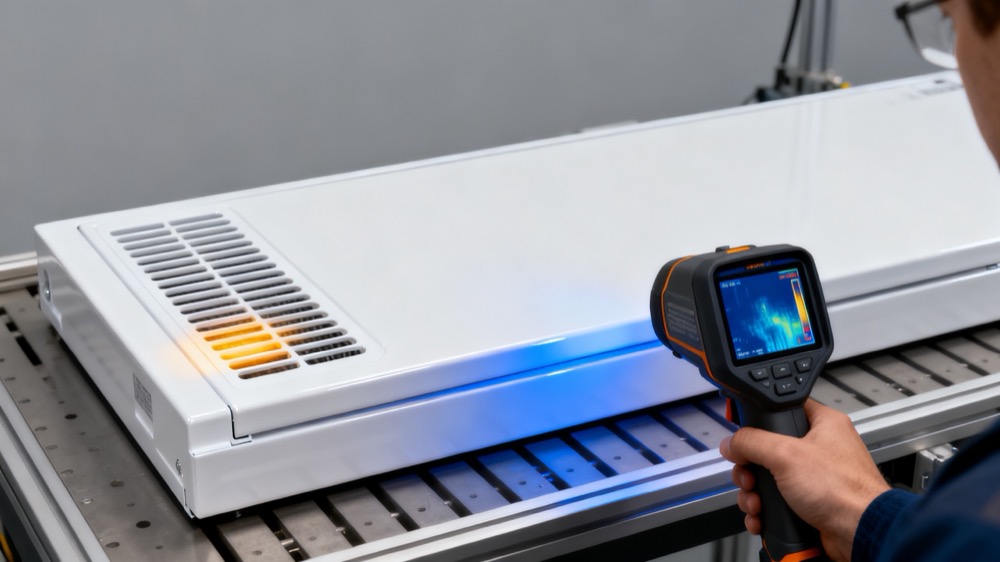
A trial should answer two questions: did the line apply and cure the coating as specified, and did the finished part survive the service exposure? Keep those checks separate so you can investigate a failure without guessing where it began.
1. Document the baseline. Record the powder code, batch, substrate, surface preparation, film thickness, and initial appearance.
2. Verify the cure on representative parts. Use a part temperature profile to confirm that relevant locations meet the supplier's time-and-temperature window.
3. Reproduce the service profile. Agree on steady temperature, peak temperature, peak duration, cooling conditions, and the number of cycles.
4. Inspect after exposure. Compare heated parts with an unexposed control. Use consistent lighting for visual checks and agreed methods for any measured properties.
5. Record the approved configuration. Treat a change in color, substrate, pretreatment, film thickness, or line settings as a reason to review whether the qualification still applies.
Give heat and corrosion their own acceptance criteria if both matter. A part can look sound after a dry heat test without demonstrating how the coating will perform when heat is followed by condensation, outdoor exposure, or cleaning.
Send Yinda Technology your part drawing or photos, substrate, normal and peak surface temperatures, peak duration and frequency, and required color, gloss, adhesion, and corrosion performance. If your project involves architectural profiles, EV components, medical equipment, hardware, or appliances, tell us which surfaces are visible and which are closest to the heat source. That gives our team a basis to review candidate powders, identify missing test data, and propose a sample evaluation before you commit to production.
Some specialty grades can. Do not assume a standard powder can operate at 400°F because it was baked at or near that temperature during cure. Request documentation covering service at 400°F for your exposure duration and required performance.
Some high-temperature grades are candidates at 500°F. Ask whether the published data cover sustained service, a timed test, or a short peak. If the part is visible, also ask what happened to color and gloss after exposure.
A specialty powder may be suitable for specified exhaust parts or barbecue components when the substrate, temperature profile, and exposure match the product documentation. Do not infer approval for direct flame or food contact from a temperature rating. Evaluate those requirements separately.
Appearance and adhesion are different properties. Compare the affected part with an unexposed control and, if available, a retained sample from the original production run. Review the original cure record and the service temperature history to see whether the change appeared during processing or in use.
Not necessarily. A low-cure formulation reaches its specified cure under a lower-temperature production schedule. That does not establish its service temperature. Ask for the cure window and the service-exposure data separately.
Possibly, but verify both. Ask which substrate the supplier tested and whether the same surface preparation, film thickness, and cure are appropriate for your parts. Qualify each substrate if both are part of the production specification.
1. Precision Coating Technology & Manufacturing. *What Temperature Can Powder Coating Withstand?* [Read the original article]. Background on powder coating heat resistance and industrial applications. [precisioncoatingtech]
2. AkzoNobel Interpon. *Interpon HT Range.* [View the product range]. Manufacturer guidance on specialty heat-resistant powders and their intended applications. [interpon]
3. AkzoNobel Interpon. *Interpon TC: Product Datasheet.* [View the technical datasheet (PDF)]. Source for the exterior polyester example, including continuous color stability up to 120°C (248°F) and a separate cure schedule of 10 minutes at 180°C (356°F). [specifyinterpon.com]
4. AkzoNobel Powder Coatings. *Interpon HT 450 Burner Black (WN209QF): Product Data Sheet.* [View the technical datasheet (PDF)]. Grade-specific documentation for substrate, film thickness, cure conditions, and heat exposure performance. [powdercoatings.brand.akzonobel]
5. TIGER Coatings. *TIGER Drylac Series 39: Interior and Exterior Product Data Sheet.* [View the technical datasheet (PDF)]. Additional manufacturer reference for cure schedules expressed in terms of part temperature and dwell time. [tiger-coatings]


