Language


Views: 219 Author: Yinda Powder Coating Publish Time: 2026-10-23 Origin: Site


Content Menu
● Epoxy Powder Coating vs Zinc-Rich Primer: Quick Comparison
● What Is Epoxy Powder Coating?
>> Where Epoxy Powder Coating Works Well
>> The Main Limitation: Exposed Outdoor Weathering
>> Organic, Inorganic, and Powder Zinc-Rich Primers
● Comparing Corrosion Protection Under Real Service Conditions
>> Barrier Protection vs Sacrificial Protection
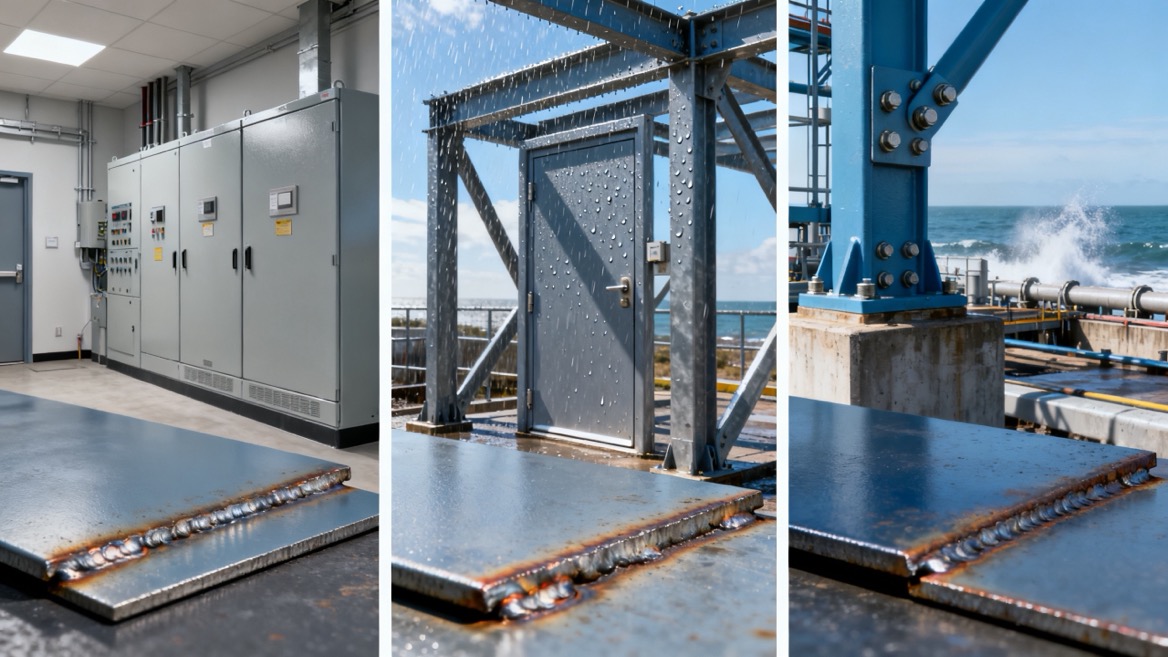
>> Scratches, Edges, and Welds
>> Moisture and Chemical Exposure
● Surface Preparation: Where Either System Can Fail
>> Preparing Steel for Epoxy Powder Coating
>> Preparing Steel for Zinc-Rich Primer
● Application, Curing, and Repair: Which Fits Your Production?
>> Large Structures and Field Repairs
● Three Practical Tools for Better Coating Decisions
>> 1. Build a Failure-Mode Map Before Choosing the Primer
>> 2. Read Corrosion Test Reports Beyond the Headline Hours
>> 3. Compare Cost per Acceptable Component
● Environmental Performance: Compare the Process, Not the Label
● How to Specify the Right Steel Coating System
● Discuss Your Steel Protection Requirements With Yinda Technology
>> Is epoxy powder coating better than zinc-rich primer?
>> Can a zinc-rich primer also be an epoxy powder coating?
>> Can powder coating be applied over zinc-rich primer?
>> Does epoxy powder coating need an outdoor topcoat?
>> Does zinc-rich primer eliminate rust after scratching?
>> How many salt-spray hours equal ten years outdoors?
Epoxy powder coating vs zinc-rich primer is not simply a choice between two competing products. Epoxy powder coating primarily protects steel through a tightly bonded barrier. A zinc-rich primer can add sacrificial protection, helping defend exposed steel when the coating is locally damaged. However, some zinc-rich primers are themselves epoxy-based powders.
For buyers specifying steel components, my starting point is system selection: match the coating chemistry, surface preparation, application process, and topcoat to the actual exposure.
At Yinda Technology, our focus on powder coatings, environmentally responsible materials, and energy-saving technologies makes this distinction especially relevant. Customers in construction, new-energy vehicles, medical equipment, hardware, and appliances need more than an attractive finish. They need a practical protection system that their production line can apply consistently.

The comparison below distinguishes conventional, non-zinc-rich epoxy powder from zinc-rich primers, which may be liquid or powder products.
| Selection factor | Epoxy powder coating | Zinc-rich primer |
|---|---|---|
| Main protection mechanism | Barrier protection | Sacrificial protection plus barrier effects |
| Typical chemistry | Thermosetting epoxy resin | Zinc-rich epoxy, inorganic zinc silicate, or another specified binder |
| Protection at scratches | Depends strongly on film integrity and adhesion | Can protect small exposed areas while effective electrical contact remains |
| Application | Usually electrostatic spraying followed by oven curing | Liquid spraying or powder application, depending on formulation |
| Outdoor appearance | Normally requires a weather-resistant topcoat | Normally used beneath a compatible protective finishing system |
| Production suitability | Factory-coated parts compatible with oven dimensions and temperatures | Factory or site application, depending on product |
| Main purchasing concern | Preparation, coverage, cure, and chemical compatibility | Zinc connectivity, preparation, overcoating, and system qualification |
Neither category guarantees a particular service life. Performance belongs to the complete, correctly applied coating system.
Epoxy powder coating is a dry, thermosetting coating applied to prepared metal and heated to form a crosslinked protective film. Conventional epoxy powders can provide strong adhesion and useful resistance to moisture and many industrial chemicals.
Their primary role in corrosion protection is to restrict the movement of water, oxygen, and dissolved salts toward the steel surface.
Epoxy powder is worth evaluating for:
- Indoor electrical enclosures and appliance components.
- Steel hardware and equipment frames.
- Medical equipment housings with defined cleaning requirements.
- Automotive components requiring a compatible corrosion-protection system.
- Primer layers beneath weather-resistant powder topcoats.
Chemical resistance remains formulation-specific. A coating suitable for occasional detergent cleaning may not withstand continuous chemical immersion.
Epoxy coatings can chalk and lose gloss during ultraviolet exposure. This does not mean corrosion protection disappears immediately, but it makes exposed epoxy a poor default choice when outdoor appearance matters.
For exterior steel doors, window components, and architectural hardware, a qualified epoxy primer with a suitable weather-resistant polyester topcoat is generally a more appropriate arrangement than exposed conventional epoxy.
A zinc-rich primer contains metallic zinc particles in a binder. When the formulation and application establish suitable electrical connectivity between zinc particles and steel, the zinc can corrode preferentially and provide cathodic protection.
As zinc corrosion products develop, they can also help restrict pathways through the coating. Protection therefore involves both electrochemical activity and barrier effects.
"Zinc-rich primer" describes a protective function, not one application method.
- Organic zinc-rich primers commonly use epoxy binders.
- Inorganic zinc-rich primers typically use silicate-based binders.
- Zinc-rich powder primers combine metallic zinc with a thermosetting powder formulation.
This distinction changes the purchasing question. Buyers may actually be comparing a barrier epoxy powder primer against a zinc-rich epoxy powder primer—not powder coating against liquid paint.
Also, zinc phosphate pigmentation should not be confused with metallic zinc-rich protection. A zinc-containing product does not automatically provide the same sacrificial mechanism.
An intact epoxy film separates steel from its environment. Its effectiveness depends on adhesion, film continuity, adequate coverage, and resistance to the expected exposure.
A zinc-rich primer can add protection at small coating defects. However, that protection is neither unlimited nor permanent. It depends on zinc availability, electrical connectivity, exposure conditions, and the size and geometry of the damage.
My recommendation is to treat zinc as additional protection—not permission to accept poor preparation or damaged coatings.
Flat test panels are useful, but fabricated steel introduces different challenges:
- Sharp edges may receive insufficient film coverage.
- Weld spatter can create coating discontinuities.
- Recesses can be difficult to coat uniformly.
- Handling damage can expose steel after finishing.
A zinc-rich primer may improve damage tolerance, but edge preparation and application control remain essential. Include representative edges and welds in qualification trials rather than testing only smooth panels.
Do not select either coating category from a generic "chemical-resistant" claim.
Specify the actual liquid, concentration, temperature, contact duration, and cleaning frequency. Then obtain evidence for the exact coating system.
For medical equipment, this means checking the intended disinfectants. For vehicle components, it means considering relevant fluids and road exposure. Atmospheric corrosion results alone do not establish immersion or chemical compatibility.
Surface preparation is often the most consequential difference between a successful specification and a disappointing installation.
Oil, soluble salts, mill scale, rust, and dust can compromise protection even when the coating material is appropriate.
The required process may involve chemical pretreatment, abrasive blasting, or a qualified combination.
Before approval, establish:
1. The incoming condition of the steel.
2. Cleaning and pretreatment requirements.
3. Acceptable contamination limits.
4. Surface profile requirements, where relevant.
5. Time and handling controls between preparation and coating.
A process proven on clean sheet steel should not automatically be transferred to heavily scaled welded fabrications.
Zinc-rich systems also require product-specific preparation. For example, Jotun's Barrier 80 S application guidance specifies abrasive blasting to Sa 2½ and a defined surface profile.
That is an example from a particular product—not a universal instruction for every zinc-rich primer.
Follow the selected manufacturer's requirements for cleanliness, profile, application conditions, and overcoating. Before subsequent coats, address contamination and zinc corrosion products as required by that system.
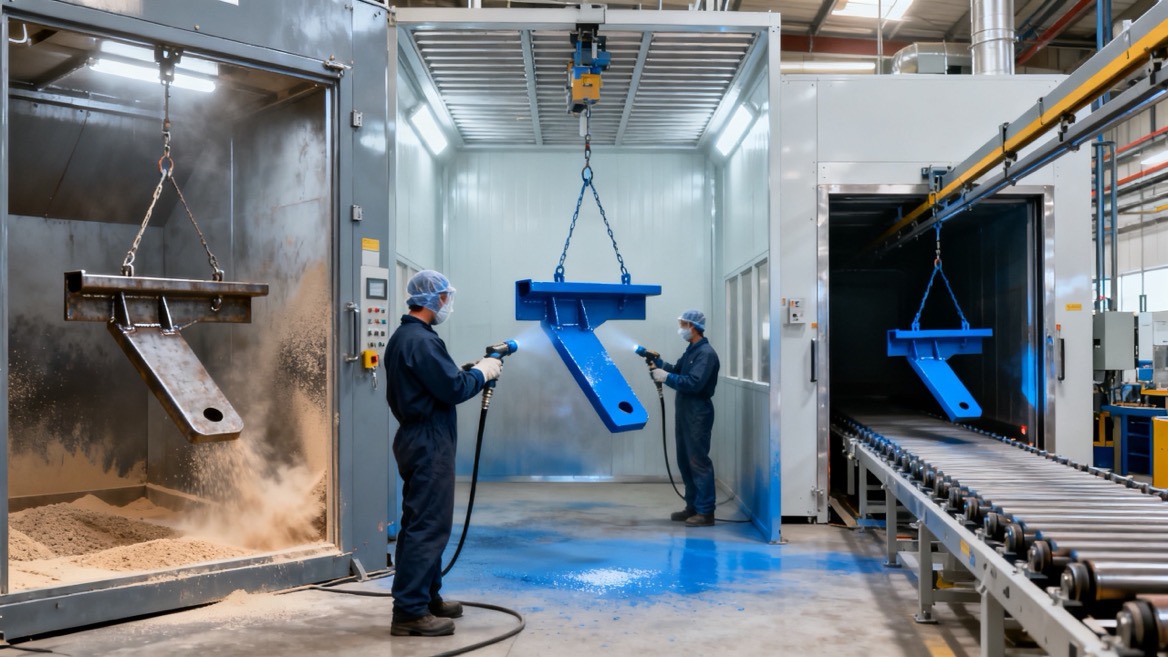
Epoxy powders suit controlled production when the components fit the coating line and tolerate the required curing cycle.
The key measurement is the component's temperature history, not simply the oven setpoint. Heavy sections and thin panels can heat differently, creating inconsistent cure within the same batch.
Zinc-rich powders introduce similar production considerations. Some systems require the primer to be cured or gelled before topcoating, with schedules defined by the manufacturer.
Liquid zinc-rich primers may offer practical advantages for structures that cannot enter an oven or require site application.
However, they introduce their own controls, including mixing, pot life where applicable, environmental conditions, and recoat intervals.
For either system, define the repair procedure before production begins. A convenient touch-up material is not automatically compatible with the original system or equivalent to its qualified performance.
Instead of asking which coating is "stronger," identify the most likely route to failure.
| Component or exposure | Main concern | What to investigate |
|---|---|---|
| Indoor appliance housing | Cleaning, appearance, manufacturing consistency | Epoxy powder compatibility and process control |
| Exterior steel door | Weathering, edge corrosion, handling damage | Qualified primer plus weather-resistant topcoat |
| Coastal fabricated assembly | Chlorides, wetting, damaged areas | Zinc-rich and barrier alternatives within complete systems |
| Medical equipment frame | Repeated cleaning and disinfectants | Exact chemical compatibility and finish integrity |
| Vehicle underbody bracket | Chips, salts, complex geometry | Component-level cyclic corrosion and damage testing |
These are selection scenarios, not reported customer installations. They help turn a broad comparison into a testable specification.
A statement such as "passed 1,000 hours" is incomplete without the test conditions and acceptance criteria.
Request:
- Substrate and preparation details.
- Primer and topcoat identification.
- Individual dry-film thicknesses.
- Cure conditions.
- Whether panels were scribed.
- Blistering, rusting, adhesion, and corrosion-creep results.
- The applicable test method and acceptance limits.
ISO 9227 explicitly cautions against using salt-spray methods to predict long-term corrosion resistance or rank different materials generally.
Salt-spray hours therefore do not convert directly into field years. Use testing appropriate to the intended exposure, supported by relevant field experience where available.
Price per kilogram can obscure the real economics.
A more useful purchasing model considers:
> Total finishing cost = preparation + coating material + application + curing + inspection + rework + expected maintenance.
Powder consumption depends on film build, geometry, transfer efficiency, and usable recovery. Zinc-rich formulations can also differ significantly in density.
Ask suppliers to compare documented coverage at the specified film thickness. A cheaper material may cost more if it creates extra coats, rejects, or difficult repairs.
Powder coatings generally use no carrier solvent and produce negligible solvent-related volatile organic compound emissions. This can be valuable for manufacturers seeking to reduce solvent handling.
However, "powder" does not mean impact-free. Oven energy, pretreatment, ventilation, powder management, and rejected parts still matter.
Likewise, zinc-rich primer is not one environmental category: solvent-borne liquids, other liquid formulations, and powders have different processing requirements.
For Yinda Technology's energy-saving focus, the useful comparison is measurable: energy per acceptable component, material utilization, reject rate, and maintenance demand.
Before requesting a quotation, prepare a short technical brief:
1. Describe the environment, including indoor or outdoor service, salts, moisture, and chemicals.
2. Identify the steel condition, fabrication details, welds, and edges.
3. State appearance and weathering requirements.
4. Confirm application-line and curing limitations.
5. Define the complete primer-and-topcoat system.
6. Agree on inspection, qualification, and repair requirements.
For mainly indoor service, a properly selected epoxy powder may be an efficient solution. For demanding exterior exposure or greater concern about local damage, evaluate a qualified zinc-rich primer system alongside barrier-primer alternatives.
The deciding evidence should concern the full system—not the ingredient name.
Yinda Technology develops, manufactures, and supplies powder coatings and environmentally responsible materials, with subsidiaries in China, Indonesia, and Saudi Arabia.
Send our team your steel substrate details, service environment, component drawings, production conditions, and required testing. Request an application-specific coating proposal covering preparation, primer selection, compatible topcoats, curing, and validation.
That information makes the discussion more useful than asking for a universal "best anti-rust powder."
Neither is universally better. Epoxy powder primarily provides barrier protection. A suitable zinc-rich primer adds sacrificial protection. Selection depends on exposure, damage risk, preparation, and the complete coating system.
Yes. Zinc-rich epoxy powder primers are available. "Epoxy," "powder," and "zinc-rich" describe different aspects of a coating: binder chemistry, delivery form, and protective pigmentation.
Yes, when the combination is qualified. Check primer chemistry, cure or gel requirements, topcoat compatibility, application intervals, and potential film defects before production.
Conventional epoxy generally needs a weather-resistant topcoat when exposed outdoor appearance matters. Epoxy can chalk and lose gloss under ultraviolet exposure.
No. It can protect small exposed areas under suitable conditions, but protection is limited by zinc availability, electrical contact, environment, and damage size.
There is no reliable universal conversion. Salt-spray exposure does not reproduce every field condition, and service performance depends on the substrate, preparation, system, application, and environment.
1. [AkzoNobel — Interpon Redox PZ Product Data Sheet]. Documents a zinc-rich epoxy powder primer, its combined protective mechanisms, and primer/topcoat curing considerations. [powdercoatings.brand.akzonobel]
2. [AkzoNobel — Interpon Redox Plus Product Data Sheet]. Describes a pure epoxy barrier primer intended for a compatible two-layer protective system. [powdercoatings.brand.akzonobel]
3. [Powder Coating Institute — Frequently Asked Questions]. Explains powder-coating preparation considerations and the weathering limitations of epoxy-containing coatings. [powdercoating]
4. [Jotun — Barrier 80 S Technical Data Sheet and Application Guide]. Provides product-specific requirements for preparation, application conditions, and overcoating. [jotun]
5. [ISO — ISO 9227:2022, Corrosion Tests in Artificial Atmospheres: Salt Spray Tests]. Defines salt-spray test methods and explains limitations concerning material ranking and prediction of long-term corrosion resistance. [iso]
6. ["Promoting Barrier Performance and Cathodic Protection of Zinc-Rich …" — Full-Text Research Article]. Discusses electrical connectivity, sacrificial zinc protection, and the barrier contribution of zinc corrosion products. [pmc.ncbi.nlm.nih]
7. [Powder Coating Institute — Sustainability]. Describes solvent-free powder formulations and negligible solvent-related volatile organic compound emissions. [powdercoating]


