Language


Views: 243 Author: Yinda Powder Coating Publish Time: 2026-08-26 Origin: Site


Content Menu
● Powder Coating vs. Liquid Paint at a Glance
● Why Powder Coating Performs So Well
>> Strong Protection for Demanding Metal Parts
>> More Consistent Factory Appearance
>> Lower Solvent Dependence and Material Waste
● Where Liquid Paint Still Makes Sense
● The Most Important Decision: Start with the Service Environment
>> Ask These Questions Before Choosing a Coating
● Pretreatment Is the Foundation of Coating Performance
>> A Practical Pretreatment Checklist
● Choosing Powder Chemistry by Application
● How to Compare Cost Beyond Price Per Kilogram
>> Evaluate Total Applied Cost
● A Coating Specification Example
● Powder Coating vs. Liquid Paint: The Final Decision
>> Is powder coating more durable than liquid paint?
>> Can powder coating be used outdoors?
>> Can powder coating prevent rust?
>> Can powder-coated products be repaired?
>> What metals can be powder coated?
>> Does powder coating contain VOCs?
>> Is powder coating suitable for EV components?
When manufacturers compare powder coating vs. liquid paint, the best choice is not simply the finish that looks better on day one. It is the system that delivers the right balance of corrosion protection, weatherability, appearance, production efficiency, repairability, and lifecycle cost for the product's real operating environment.
For architectural aluminium profiles, doors and windows, electric-vehicle components, medical equipment, hardware, appliances, and industrial metal parts, powder coating is often the stronger long-term option. However, liquid paint remains valuable where air-dry application, complex touch-up work, very thin films, or highly specific visual effects are required.

Powder coating is a dry finishing process. A finely ground powder is electrostatically applied to a prepared metal surface, then heated so the powder melts, flows, and cures into a continuous protective film.
Liquid paint is applied as a wet coating through spraying, brushing, rolling, dipping, or other methods. It forms a film as solvents or water evaporate and, depending on the chemistry, as the coating chemically cures.
| Decision factor | Powder coating | Liquid paint |
|---|---|---|
| Application material | Dry powder | Liquid coating |
| Typical substrate | Conductive metal parts | Metal, wood, plastic, concrete, and more |
| Film consistency | Highly uniform on properly prepared parts | Depends heavily on spray settings and operator control |
| Runs and sags | Less likely because the coating is dry before curing | More likely if wet-film application is excessive |
| Durability | Often excellent for abrasion, impact, and corrosion resistance | Can range from basic to very high performance depending on system |
| VOC profile | Usually negligible coating-related VOC emissions because powders contain no solvents | May involve VOCs, depending on formulation |
| Overspray recovery | Often possible with suitable reclaim systems | Usually more difficult and may generate more waste |
| Small-area repair | Can be challenging after curing | Often easier for onsite touch-up and spot repair |
| Low-temperature substrates | Requires a cure schedule compatible with the part | Offers more air-dry and low-bake options |
| Best fit | Repeatable factory finishing of metal components | Field work, repairs, mixed substrates, specialized effects |
The key point is simple: powder coating is not automatically better for every project, and liquid paint is not automatically cheaper over the product's full life. The coating must match the substrate, part geometry, exposure conditions, required standard, production line, and maintenance plan.
For many fabricated metal products, powder coating provides a durable, attractive, and production-friendly finish because it creates a relatively thick, continuous cured film without relying on liquid solvents.
A properly selected powder coating system can help protect metal from scratches, impacts, chemicals, moisture, UV exposure, and corrosion. This makes it especially relevant for products that are touched frequently, transported often, installed outdoors, or exposed to demanding industrial conditions.
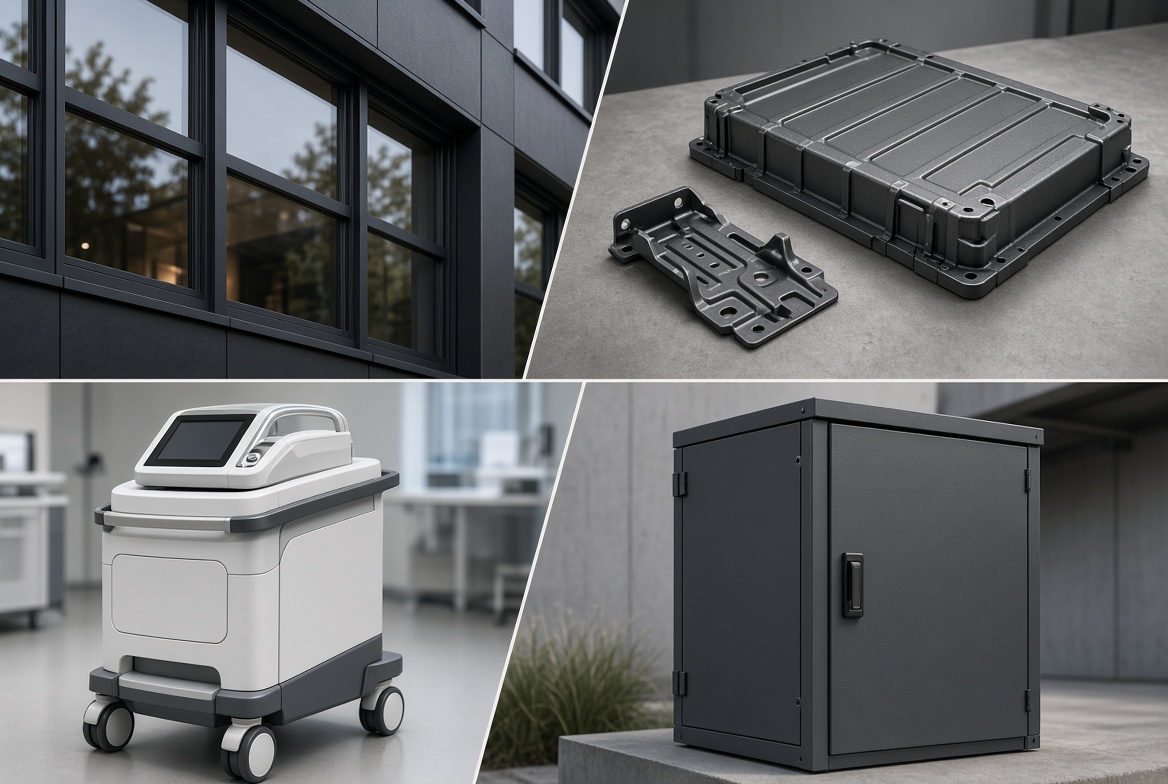
Typical applications include:
- Aluminium window and door profiles.
- Curtain-wall and façade components.
- EV battery enclosures, brackets, frames, and charging-equipment housings.
- Medical carts, cabinets, frames, and equipment casings.
- Metal furniture, shelving, fencing, and outdoor structures.
- Electrical cabinets, appliance panels, and hardware accessories.
The coating itself matters, but so does the entire system. Research on powder-coated materials shows that corrosion performance depends on factors such as substrate type, surface preparation, conversion coating, film quality, and service environment—not only the topcoat formulation.
Powder coatings can provide smooth, matt, satin, gloss, textured, metallic, sand-texture, wrinkle, and special-effect finishes. They are particularly useful when a manufacturer needs repeatable visual consistency across high production volumes.
With the right process controls, powder coating can reduce familiar wet-paint defects such as:
- Runs and drips.
- Uneven coverage.
- Solvent popping.
- Surface contamination.
- Variable gloss between production batches.
For product designers, texture can also have a practical purpose. A fine texture may help disguise minor substrate imperfections, reduce visible fingerprints, or create a more tactile premium feel on architectural and consumer products.
Because powder coatings contain no solvents, they generally produce negligible coating-related VOC emissions during application. Powder overspray can also be collected and reused in appropriately designed systems, helping reduce material waste.
This matters to manufacturers working to improve plant cleanliness, material utilization, operator safety practices, and environmental performance. It also changes the production conversation: instead of comparing only the purchase price per kilogram, teams should compare applied material cost, reject rate, reclaim potential, energy use, maintenance requirements, and expected service life.
Liquid paint should not be dismissed. It remains a practical and sometimes necessary solution for many coating challenges.
Choose liquid paint when the project requires:
- Coating of non-metal or heat-sensitive materials.
- Field application after installation.
- Frequent spot repair or cosmetic touch-up.
- Very large structures that cannot enter a curing oven.
- Extremely thin film builds.
- Highly specialized colours or visual effects.
- Air-dry or low-temperature curing.
- Complex internal cavities that are difficult to coat electrostatically.
For example, a powder-coated aluminium window profile may be an excellent factory-finished solution. But if the installed frame is damaged during transport or construction, a liquid touch-up coating may be the more realistic repair method.
The best finishing strategy may combine both technologies: powder coating for factory-applied protection and controlled liquid coatings for approved repair procedures.
The most expensive coating mistake is selecting a finish based only on colour, gloss, or initial price. A finish must be specified according to where and how the product will be used.
1. What is the substrate?
Steel, galvanized steel, aluminium, stainless steel, cast aluminium, and zinc die-cast parts require different preparation approaches.
2. Will the part be used indoors or outdoors?
Outdoor products need stronger resistance to UV exposure, moisture, temperature cycling, and atmospheric pollutants.
3. Is the environment corrosive?
Coastal, industrial, agricultural, chemical-processing, and high-humidity environments require more robust corrosion protection.
4. What mechanical stresses will occur?
Consider handling, assembly, transport, impact, abrasion, and repeated cleaning.
5. What cleaning agents or chemicals will contact the surface?
Medical equipment, kitchen appliances, industrial cabinets, and EV components may face detergents, disinfectants, oils, salts, acids, or alkalis.
6. What appearance must be maintained over time?
Define colour retention, gloss retention, texture, surface feel, and acceptable visual variation.
7. Can the part tolerate curing heat?
Conventional powder systems require a controlled cure schedule. The part's mass, geometry, and heat sensitivity must be considered.
A premium powder coating cannot compensate for inadequate pretreatment. If oil, weld spatter, oxides, salts, fingerprints, dust, or corrosion remain on the substrate, adhesion and long-term corrosion resistance can be compromised.
The Powder Coating Institute notes that pretreatment improves the coating base by creating a surface that promotes adhesion and corrosion resistance; powder coatings can often outperform liquid coatings when applied over the same properly prepared substrate.
Before application, manufacturers should verify:
- Surface cleanliness and degreasing effectiveness.
- Removal of oxides, rust, scale, and contaminants.
- Compatibility of the conversion coating with the substrate.
- Water quality and rinse control.
- Drying performance before the coating booth.
- Correct handling to prevent recontamination.
- Coating film thickness and cure verification.
- Routine adhesion, impact, and corrosion testing.
For aluminium architectural products, pretreatment selection should reflect the project location and expected exposure. For steel components used near saltwater, the whole system—substrate, pretreatment, primer where needed, topcoat, edge coverage, and film thickness—must be evaluated together.
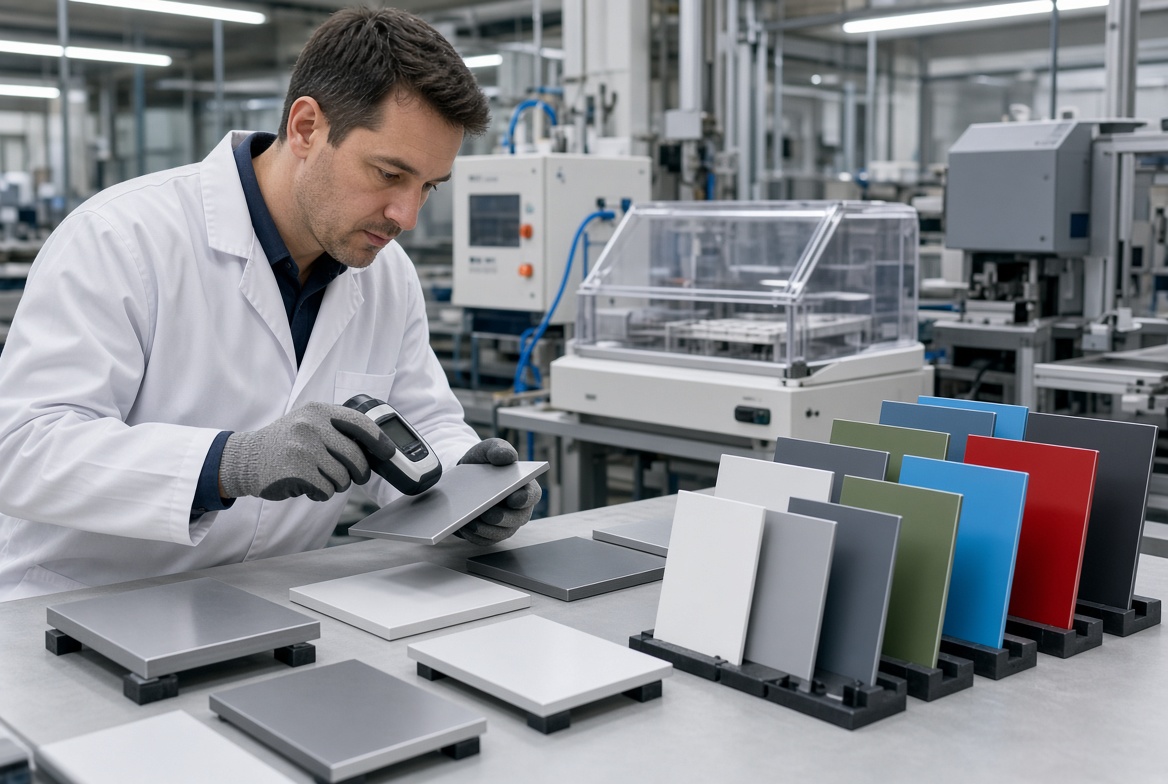
Not all powder coatings offer the same performance. Selecting the correct resin system is as important as selecting the correct colour.
| Powder coating type | Typical strengths | Common applications |
|---|---|---|
| Epoxy | Strong adhesion and chemical resistance; limited outdoor weatherability | Indoor equipment, pipelines, functional industrial parts |
| Epoxy-polyester hybrid | Good appearance and indoor durability | Appliances, furniture, office equipment, electrical cabinets |
| Standard polyester | Good general outdoor performance and broad colour range | Metal furniture, hardware, general architectural products |
| Super-durable polyester | Enhanced colour and gloss retention outdoors | Doors, windows, façade elements, outdoor equipment |
| Fluoropolymer powder | High weatherability for demanding exterior exposure | Premium architectural and long-life outdoor projects |
| Polyurethane powder | Strong appearance, chemical resistance, and smooth finish | Automotive parts, instruments, selected industrial applications |
For external architectural aluminium, project specifications often distinguish between standard and higher-weatherability coating systems. AAMA 2604-class products are commonly used where stronger outdoor performance is required, while more demanding environments may call for higher-performance specifications.
A liquid paint quotation may appear less expensive at first because the equipment or material price is lower. Yet that comparison can be misleading if it ignores coating waste, rework, labour, ventilation, touch-ups, warranty exposure, and product replacement.
Use this comparison framework:
- Material utilization: How much purchased coating actually remains on the part?
- Reclaim potential: Can overspray be recovered and reused?
- Reject rate: How many parts need rework because of appearance or coverage defects?
- Energy demand: What are the curing, ventilation, and line-operation requirements?
- Labour requirement: How much skill and time does application require?
- Maintenance burden: How often will the finished product need cleaning, repair, or recoating?
- Service life: How long should the coating retain appearance and protection in its actual environment?
A low-cost finish that fails early can become the most expensive option after warranty claims, replacement work, operational disruption, and brand damage are included.
Consider a manufacturer producing aluminium door and window profiles for a humid coastal development.
A weak specification might say:
> "Black powder coating, matt finish."
A stronger specification would define:
- Substrate grade and surface condition.
- Required pretreatment process.
- Powder chemistry and approved product series.
- Colour reference and gloss range.
- Minimum and maximum dry-film thickness.
- Cure window and process verification method.
- Adhesion, impact, corrosion, and weathering requirements.
- Approved acceptance criteria for colour, texture, and surface defects.
- Packaging and handling requirements after coating.
This approach reduces ambiguity between the coating supplier, extrusion plant, applicator, fabricator, installer, and project owner.
Choose powder coating when you need a durable, repeatable, factory-applied finish for metal parts and can control pretreatment, application, and oven curing. It is particularly suitable for high-volume industrial manufacturing, architectural aluminium, appliances, hardware, EV components, and equipment housings.
Choose liquid paint when you need field application, straightforward repairs, low-temperature processing, very thin films, unusual substrates, or specialised visual effects.
At Yinda Technology, we work with manufacturers that need more than a colour sample. Our powder coating and environmentally responsible material solutions are developed around real production requirements—substrate condition, part geometry, climate exposure, visual expectations, application efficiency, and long-term performance.
Contact Yinda Technology to discuss your product, operating environment, target performance level, and custom powder coating requirements. Our technical team can help you select a finish that supports both manufacturing efficiency and durable product value.
Often, yes. Properly applied powder coating can provide strong resistance to chipping, abrasion, impact, and corrosion. However, final performance depends on the substrate, pretreatment, coating chemistry, film thickness, curing quality, and service environment.
Yes. Polyester, super-durable polyester, and selected fluoropolymer powder coatings are widely used for exterior products. The right formulation should be selected based on UV exposure, humidity, salt exposure, pollution, and required colour retention.
Powder coating helps protect steel from moisture and corrosive exposure, but it does not replace proper metal preparation. Rust protection depends on a complete system that may include cleaning, conversion coating, suitable primer technology, adequate film thickness, and edge coverage.
Yes, but repairs must be handled carefully. Small cosmetic areas may be repaired using compatible liquid touch-up coatings, while heavily damaged parts may require stripping and recoating for the most uniform result.
Common powder-coated materials include steel, galvanized steel, aluminium, stainless steel, and cast metal components. Conductive substrates are the most straightforward to coat with conventional electrostatic powder application.
Powder coatings generally contain no solvents and therefore emit negligible coating-related VOCs during application. The overall environmental profile of a production line should still consider pretreatment, cleaning chemicals, energy use, filtration, and waste-management practices.
Yes. Powder coatings are widely used on EV-related components such as metal housings, brackets, frames, charging equipment, enclosures, and hardware. The exact coating must be chosen according to heat exposure, electrical requirements, chemical exposure, corrosion conditions, and appearance needs.
- Kroma Coatings. [Powder Coat Or Paint: Which Finish Should You Choose?]
- Powder Coating Institute. [Environmental Impact]
- Powder Coating Institute. [Frequently Asked Questions]
- ASTM International. [ASTM B117: Standard Practice for Operating Salt Spray (Fog) Apparatus]
- National Library of Medicine. [Accelerated Corrosion Tests in Quality Labels for Powder Coatings]
- TIGER Coatings. [AAMA Powder Coating Requirements in Architectural Design]
- U.S. Environmental Protection Agency. [Powder Coatings Technology Update]


