Language


Views: 236 Author: Yinda Powder Coating Publish Time: 2026-08-25 Origin: Site


Content Menu
● Why Aluminum Busbar Insulation Matters
● What Is Dielectric Powder Coating?
>> Typical Dielectric Powder Coating Process
● Dielectric Powder Coating vs. Liquid Insulation: Core Comparison
● Electrical Performance: Dielectric Strength Is Only One Metric
● Thickness and Voltage: A Practical Design Perspective
● Thermal Management: The Most Misunderstood Trade-Off
● Aluminum Surface Preparation Determines Reliability
● Environmental and Production Considerations
● When to Choose Dielectric Powder Coating
● When Liquid Insulation May Be Better
● A Procurement Checklist for Grid Busbar Projects
● Partner With Yinda Technology
● FAQ
>> 1. Is dielectric powder coating suitable for aluminum busbars?
>> 2. Is epoxy powder coating better than liquid insulation for busbars?
>> 3. What coating thickness is needed for an insulated aluminum busbar?
>> 4. Can dielectric powder coating reduce busbar spacing?
>> 5. Does powder coating affect busbar heat dissipation?
>> 6. How should coated aluminum busbars be tested?
>> 7. Can Yinda Technology customize dielectric powder coatings?
For electric grid aluminum busbars, insulation is not simply a protective finish. It is a critical design layer that affects dielectric safety, heat dissipation, corrosion resistance, assembly spacing, maintenance requirements, and long-term reliability. The choice between dielectric powder coating and liquid insulation should therefore be based on the busbar's voltage class, geometry, operating environment, production volume, and verification requirements—not on coating price alone.
As a powder coating manufacturer serving electrical, construction, new-energy vehicle, medical-device, hardware, and appliance markets, Yinda Technology evaluates insulating powder systems from both formulation and application perspectives. In practical busbar projects, dielectric powder coating often offers a more repeatable, lower-emission, and mechanically durable solution for aluminum conductors. Liquid insulation can still be appropriate for complex repairs, small-batch components, or installations where an oven-based powder process is impractical.
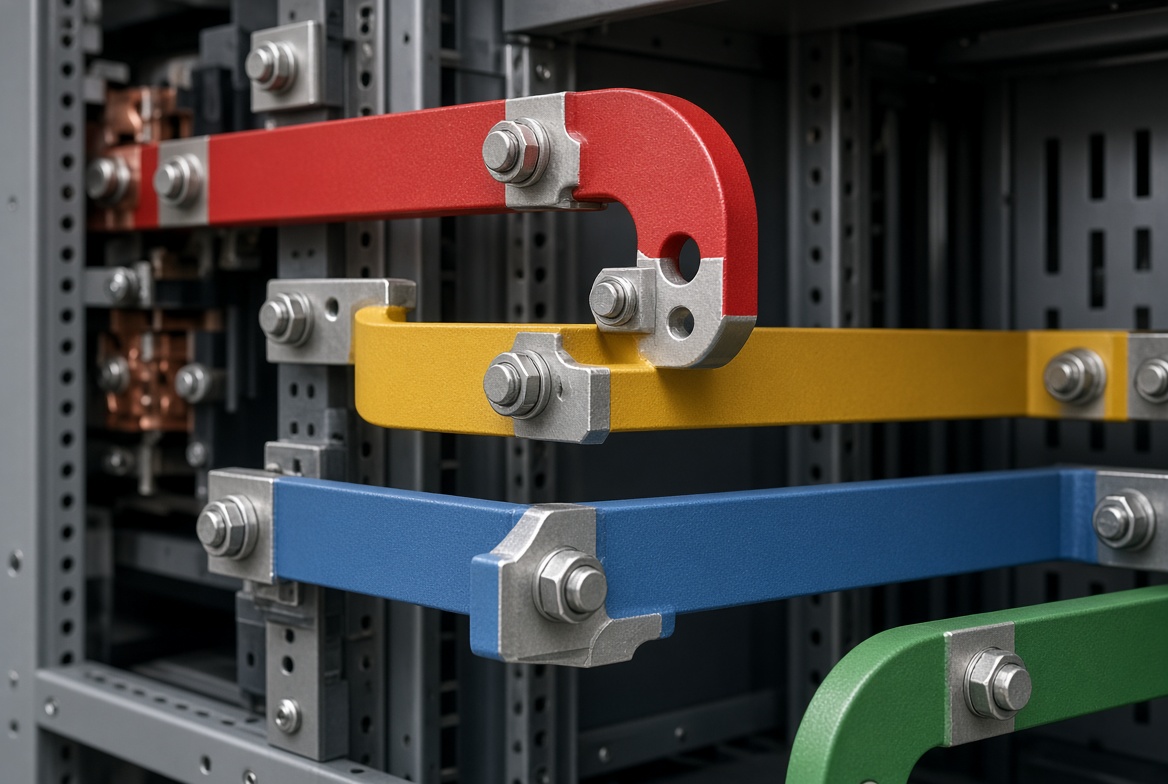
Aluminum busbars are widely used in grid distribution equipment, switchgear, renewable-energy systems, energy-storage cabinets, charging infrastructure, transformers, and industrial power assemblies. Aluminum provides lower weight and lower material cost than copper, but it also requires careful surface preparation and insulation design.
A bare aluminum busbar can be exposed to several risks:
- Electrical flashover between closely spaced conductors
- Phase-to-phase short circuits caused by contamination or foreign objects
- Corrosion in humid, coastal, chemical, or polluted environments
- Mechanical damage during fabrication, transport, installation, or service
- Tracking and partial discharge in high-voltage or harsh operating conditions
- Reduced design freedom when larger electrical clearances are required
An insulation coating can help engineers reduce exposed conductive surfaces and improve safety margins. However, its actual performance depends on the complete system: aluminum substrate condition, pretreatment, coating chemistry, film thickness, curing profile, busbar geometry, and electrical testing.
Dielectric powder coating is a dry, thermosetting insulation material applied to a grounded metal busbar. The powder is normally deposited by electrostatic spray or fluidized-bed dip coating. After heating and curing, it cross-links into a continuous insulating film bonded to the aluminum surface.
For electric grid aluminum busbars, epoxy-based dielectric powder coatings are commonly selected because they can provide high dielectric strength, strong adhesion, chemical resistance, and dependable mechanical protection. Published product data for epoxy-coated busbars commonly show dielectric-strength ranges around 40–45 kV/mm, although actual results depend on the formulation, substrate, thickness, cure, and test method.
1. Degrease the aluminum busbar to remove oils, fingerprints, machining fluid, and particulate contamination.
2. Apply pretreatment suitable for aluminum, such as conversion treatment or another qualified pretreatment system.
3. Mask electrical contact zones, bolting areas, and grounding points where coating is not permitted.
4. Apply powder through electrostatic spray or a fluidized bed.
5. Cure the coating according to the validated metal-temperature and time profile.
6. Inspect film thickness, coverage, adhesion, and cosmetic condition.
7. Perform electrical and quality tests, such as high-potential testing, pinhole inspection, or other project-specific verification.
The most important point is that the coating is not "just paint." A qualified dielectric powder system is an engineered insulation layer.
Liquid insulation generally refers to liquid-applied insulating paints, varnishes, epoxies, resins, or dip coatings. These materials are applied by brushing, spraying, dipping, flow coating, or other wet-coating processes and then dried or cured.
Liquid insulation remains useful in several situations:
- Small production batches
- Field repairs and rework
- Components with difficult-to-reach areas
- Parts that cannot be processed through a powder-coating oven
- Localized insulation repair after machining or assembly
- Applications requiring a specific resin chemistry or very thin film
However, liquid insulation introduces variables that must be carefully controlled, including viscosity, solvent evaporation, sagging, edge coverage, drying conditions, operator technique, and volatile emissions. These factors can make it more difficult to achieve consistent insulation performance across large-scale busbar production.
| Evaluation Factor | Dielectric Powder Coating | Liquid Insulation |
|---|---|---|
| Application format | Dry powder, electrostatic spray or fluidized-bed dip | Liquid paint, varnish, epoxy, or resin |
| Film uniformity | Typically highly repeatable in automated lines | Depends heavily on viscosity, spray control, drainage, and drying |
| Thickness capability | Suitable for thin to thick films; fluidized-bed methods can build substantially thicker insulation | Can be applied thinly, but thick films may require multiple coats |
| Edge coverage | Strong when formulation and process are optimized | May be vulnerable to thinning, sagging, or pullback on sharp edges |
| Mechanical durability | Often strong abrasion, impact, and chip resistance after full cure | Varies widely by resin system and cure condition |
| VOC profile | Typically low or zero VOC during coating application | May contain solvents, depending on formulation |
| Production efficiency | Well suited to repeatable, high-volume manufacturing | Can be slower due to flash-off, drying, and multi-coat cycles |
| Repairability | Requires controlled touch-up methods | Often easier for local repair and field application |
| Material recovery | Overspray may be recoverable in appropriate powder systems | Overspray is generally waste and may require solvent handling |
| Best-fit scenario | Standardized aluminum busbars, switchgear, grid equipment, renewable-energy assemblies | Repair work, low-volume production, unusual geometry, on-site application |
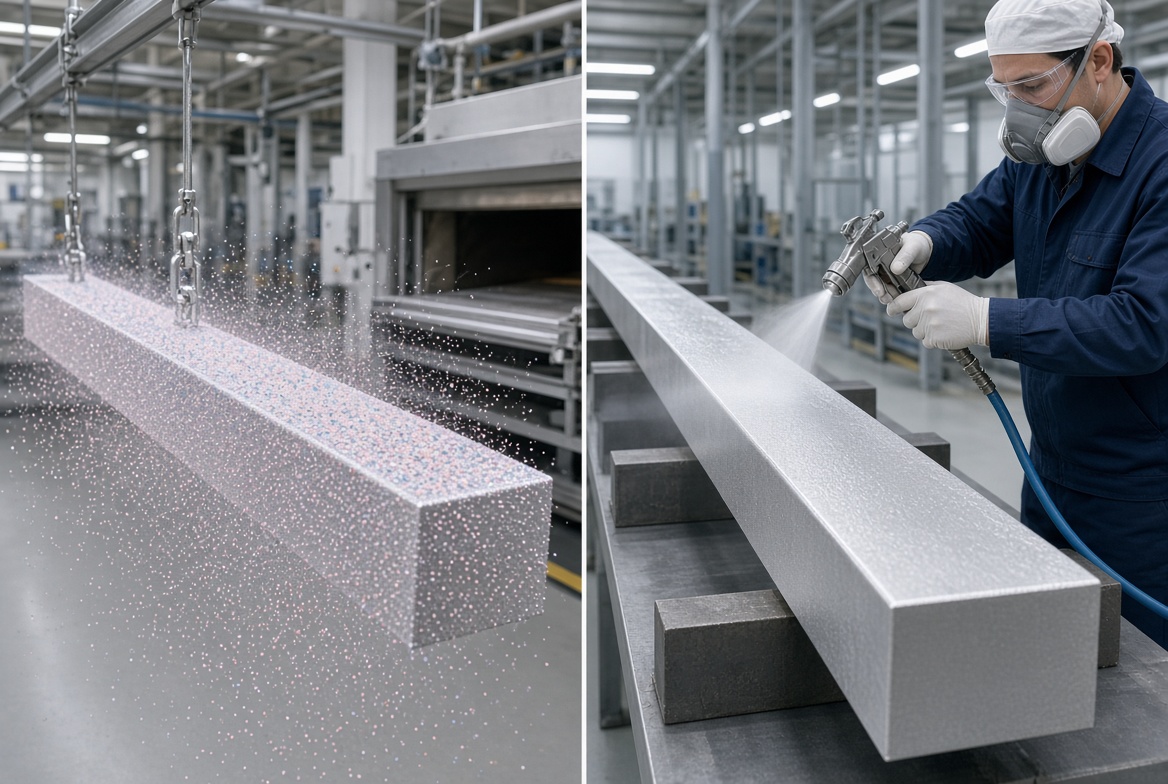
Many purchasing teams focus first on dielectric strength. It is important, but it is not sufficient on its own. A coating that performs well in a laboratory dielectric test may still fail in service if it has poor adhesion, incomplete edge coverage, trapped contamination, under-cure, or damage during installation.
For example, some epoxy powder-coated busbar products list dielectric strength around 40–45 kV/mm, with operating temperatures up to 130°C and coating thicknesses around 0.3–0.6 mm. Other published epoxy powder data for busbar applications specifies dielectric strength above 35–42 kV/mm, UL 94 V-0 flammability performance, and coating thickness ranges from 0.1 mm to 3 mm depending on the product and process.
The key lesson is simple: do not select insulation by a single headline number.
A robust busbar specification should consider:
- Rated system voltage and transient overvoltage
- AC or DC operation
- Required creepage and clearance distances
- Minimum and maximum coating thickness
- Edge-radius requirements
- Resistance to thermal cycling
- Moisture, salt fog, chemical, and pollution exposure
- Flame-retardancy requirements
- Resistance to abrasion and assembly damage
- Adhesion to properly pretreated aluminum
- High-potential test requirements after coating
Thicker insulation is not automatically safer. Excessive coating thickness can increase cost, create fit-up problems, affect heat transfer, and create stress during thermal cycling. Too little thickness can leave edges, bends, or corners vulnerable to electrical breakdown.
Electrostatic spray powder coating is often effective for thinner and more controlled insulation layers. Fluidized-bed coating is generally better suited to applications requiring heavy film build. Industry guidance notes that spray coating can suit lower-voltage applications with approximately 10–20 mil coatings, while fluidized-bed processing may be used for higher-voltage requirements requiring 50–120 mil film thicknesses.
For context:
- 10 mil is approximately 0.25 mm.
- 20 mil is approximately 0.51 mm.
- 50 mil is approximately 1.27 mm.
- 120 mil is approximately 3.05 mm.
A published example also notes that low-voltage building-distribution busbars around 600 V may use less than 0.5 mm of epoxy insulation, while a 1.5 mm epoxy layer can be designed for 15 kV insulation in a specific tested configuration. These figures should be treated as design references, not universal specifications. Final thickness must be validated for the specific busbar design and electrical system.
Aluminum busbars carry current and generate heat. Any insulation layer adds thermal resistance between the conductor and surrounding air. That does not mean coatings should be avoided; it means thermal design must be assessed as part of the whole electrical assembly.
A well-designed powder coating can provide electrical insulation while supporting reliable heat dissipation when thickness, resin chemistry, airflow, busbar cross-section, conductor spacing, and enclosure design are properly engineered.
When comparing dielectric powder coating and liquid insulation, evaluate:
- Maximum continuous operating temperature
- Short-term overload temperature
- Thermal cycling range
- Coating flexibility after repeated heating and cooling
- Thermal aging performance
- Busbar temperature rise under actual current load
- Coating thickness at high-current zones
- Ventilation and enclosure temperature
For high-current electric grid aluminum busbars, the right question is not "Which coating is cooler?" It is: Which qualified coating system provides safe electrical insulation without compromising the required thermal margin?
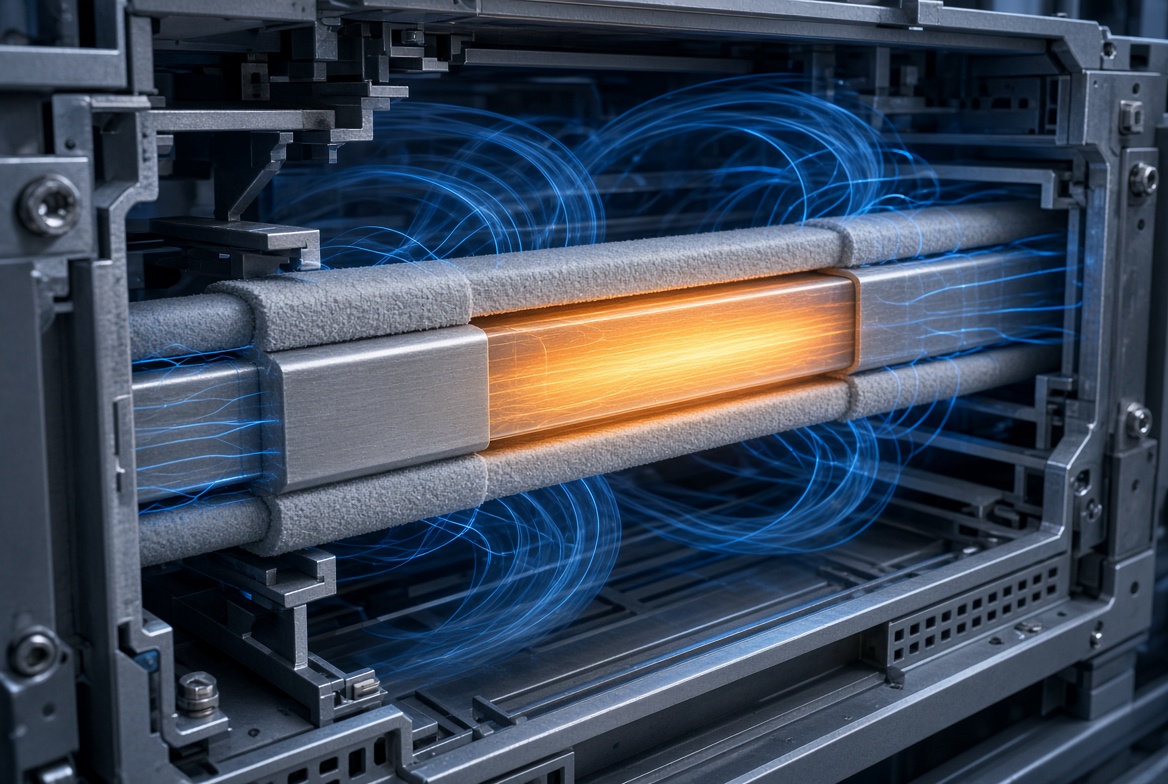
Aluminum is not copper. Its naturally formed oxide layer, surface contamination, and variable fabrication condition can affect coating adhesion. A premium dielectric powder cannot compensate for poor cleaning or unsuitable pretreatment.
Before coating aluminum busbars, manufacturers should control:
- Cutting and machining oils
- Oxide and corrosion products
- Handling contamination
- Surface roughness
- Conversion-coating quality
- Rinse-water cleanliness
- Drying conditions before powder application
- Masking quality at contact pads
In my experience with industrial powder-coating projects, adhesion failures often begin before the powder reaches the spray gun. Surface preparation is usually the hidden reason behind blistering, delamination, poor edge adhesion, or reduced long-term corrosion resistance.
Dielectric powder coating is frequently favored by manufacturers that want to reduce solvent handling and simplify environmental control. Because powder is applied as a dry material, it generally avoids the solvent evaporation associated with many traditional liquid insulation systems.
This can offer practical advantages:
- Lower VOC-related process burden for many applications
- Less flammable solvent storage
- Better suitability for automated coating lines
- Potential powder recovery from overspray
- Cleaner production areas
- More consistent film build in high-volume production
Liquid insulation may still be the better operational choice where mobility and repairability matter more than line efficiency. For example, a maintenance team repairing a coated busbar assembly after installation may benefit from a field-applicable liquid insulating material, provided the product is qualified for the required voltage, temperature, and environmental conditions.
Choose dielectric powder coating for aluminum busbars when the project requires:
- Repeatable coating thickness across large production volumes
- Strong resistance to abrasion, impact, and handling damage
- High dielectric performance with reliable coverage
- Low-solvent or solvent-free production processes
- Automated manufacturing capability
- Durable protection for indoor or outdoor electrical equipment
- Improved appearance and color identification of phases
- A long-term insulation solution for switchgear, cabinets, chargers, inverters, energy-storage systems, and grid equipment
Epoxy powder coatings are particularly common for busbar insulation because they combine high dielectric properties with direct bonding to copper, aluminum, or silver-plated surfaces.
Liquid insulation may be the better choice when:
- The busbar is already installed and cannot be oven cured
- The coating area requires localized repair
- Production volume is low
- The part geometry creates drainage or access challenges
- A very thin insulating layer is needed
- The manufacturing site lacks powder application and curing equipment
- The specification calls for a particular liquid resin system
The selection should be functional, not ideological. Powder coating is not automatically superior in every scenario. The correct choice is the one that meets the electrical, mechanical, environmental, and manufacturing requirements with repeatable quality.
Before approving either dielectric powder coating or liquid insulation, ask suppliers these questions:
1. What dielectric-strength test method is used, and what is the tested value?
2. What is the recommended minimum and maximum dry-film thickness?
3. What pretreatment is approved for aluminum busbars?
4. What are the coating's continuous and peak temperature limits?
5. Is the coating resistant to humidity, salt spray, chemicals, and thermal cycling?
6. What adhesion test method and acceptance standard are used?
7. Can the supplier support high-potential testing after coating?
8. What edge-radius requirement is needed for reliable film coverage?
9. Is the coating flame retardant, and what test classification is available?
10. Can the coating color support phase identification and inspection?
11. Is the coating suitable for indoor, outdoor, coastal, or industrial-pollution environments?
12. What quality records are available for batch traceability?
For electric grid aluminum busbars, the coating should be engineered around the application—not selected from a generic color chart. Yinda Technology can support manufacturers, switchgear builders, renewable-energy equipment producers, and electrical-component suppliers with dielectric powder coating solutions tailored to substrate condition, insulation thickness, curing capability, operating environment, and performance targets.
If you are developing insulated aluminum busbars for grid distribution, energy storage, charging systems, or power equipment, contact Yinda Technology to discuss a coating evaluation plan, sample testing, and a production-ready powder coating specification.
Yes. Dielectric powder coating can be applied to aluminum busbars when the surface is properly cleaned, pretreated, masked, coated, and cured. The coating system should be selected and validated for the electrical voltage, operating temperature, environment, and required film thickness.
For standardized, high-volume busbar production, epoxy powder coating is often preferred because it can provide repeatable film thickness, strong mechanical durability, and low-solvent processing. Liquid insulation may be more practical for repair work, low-volume production, or field application.
The correct thickness depends on voltage, busbar geometry, edge radius, spacing, contamination level, environmental exposure, and applicable electrical testing. Low-voltage applications may use thinner films, while higher-voltage designs may require substantially thicker insulation and more stringent validation.
A qualified insulating coating can help engineers reduce exposed-conductor risk and may support more compact designs. However, it should not be used to reduce electrical clearance or creepage distances without a complete, verified design assessment.
Yes, any insulating coating affects heat transfer to some degree. The impact should be evaluated through busbar current loading, coating thickness, enclosure ventilation, ambient temperature, and temperature-rise testing. Properly engineered systems balance insulation performance with thermal management.
Typical checks include dry-film thickness, visual inspection, adhesion testing, cure verification, high-potential testing, pinhole detection where applicable, thermal cycling, and environmental testing. The exact test plan should match the project's voltage class and operating conditions.
Yes. Yinda Technology can develop or recommend powder coating systems based on the aluminum substrate, expected coating thickness, application method, color requirement, cure window, electrical performance target, and service environment.
1. [Electronic Design — Modern Powder Coating for High-Performance Busbar Insulation]
2. [Exxelia — Powder Coated Bus Bars]
3. [CAPLINQ — Busbars for Renewable Energy Applications]
4. [Storm Power Components — Cracking the Code on Epoxy-Coated Bus-Bar Design]
5. [Storm Power Components — Dielectric Finishing / Epoxy Powder Coated Insulation]
6. [SolEpoxy — Fast Cooling Busbar Insulation]
7. [SolEpoxy — Epoxy Coating Powder for Busbars]
8. [Google Patents — System and Method for Dielectric Coated Busbars]


