Language


Views: 222 Author: Yinda Powder Coating Publish Time: 2026-06-19 Origin: Site


Content Menu
● Where Under-Hood Chemical Exposure Comes From
● Nylon Powder Coating – Thermoplastic Armor Under the Hood
>> Key Performance Characteristics of Nylon Powder Coating
● Polyester Powder Coating – Thermoset Workhorse for Automotive Metals
>> Key Performance Characteristics of Polyester Powder Coating
● Side-by-Side Comparison: Nylon vs. Polyester Under Chemical Exposure
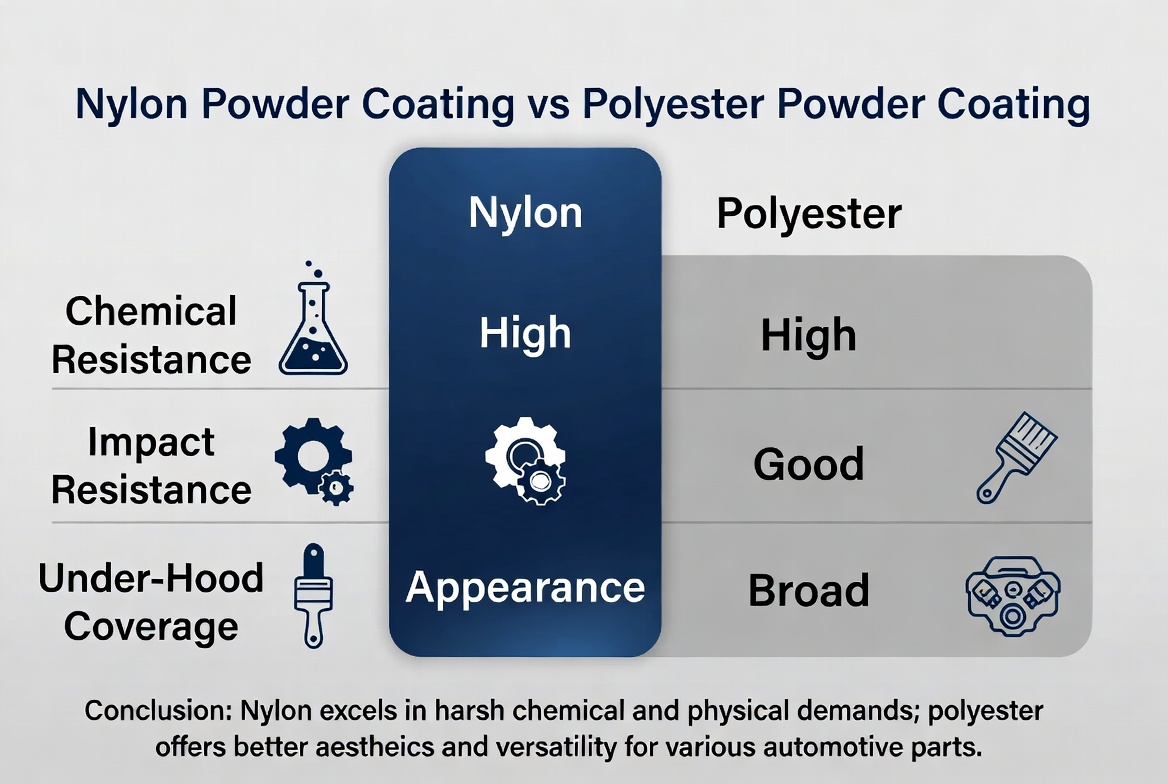
>> Technical Comparison for Under-Hood Applications
● Real-World Under-Hood Use Cases and Failure Modes
>> Nylon Powder on Fuel and Fluid Handling Components
>> Polyester Powder on Structural and Visible Components
● Process and Production Considerations for Global Automotive Programs
>> Application and Curing Differences
>> Environmental and Regulatory Drivers
● Expert Selection Framework – When to Choose Nylon vs. Polyester
● Unique Perspective – Designing for Multi-Region Platforms (China–Indonesia–Saudi)
● Practical Testing Roadmap Before Final Specification
● How a Specialist Powder Coating Partner Can Help
● Conclusion – Choosing the Right Powder for the Right Under-Hood Job
● FAQ
Under-hood automotive components are exposed to heat, oil mist, brake fluid, road salt and aggressive cleaners every single day, so the choice between nylon powder coating and polyester powder coating is a strategic engineering decision, not just a finishing detail. From both a formulator's and OEM engineer's perspective, the right system under the hood often ends up being a hybrid approach: nylon for the most demanding chemical and impact zones, and polyester for broader, cost-sensitive coverage where UV and appearance stability matter more. [thermoplasticcoating]
As a coating engineer working with under-hood platforms in Asia and the Middle East, I have seen how chemical exposure profiles differ dramatically between regions, fuels and maintenance habits. For global platforms, especially those assembled in China and exported to markets like Indonesia and Saudi Arabia, chemical-resistance specifications now sit alongside VOC and sustainability targets when selecting powder coatings. Powder systems from suppliers like Yinda Technology must therefore balance chemical resistance, mechanical durability, application efficiency and environmental compliance in one coherent coating strategy. [allnex]
Under-hood components face a complex cocktail of chemicals across the vehicle lifetime. Understanding these sources is the starting point before comparing nylon and polyester powder coatings. [pdf.dfcfw]
- Fuel and oil: gasoline, diesel, engine oil, ATF, power steering fluid and fuel additives
- Coolants: glycol-based coolants with corrosion inhibitors and pH modifiers
- Brake and clutch fluids: typically glycol ethers, highly aggressive to many polymers
- Cleaning agents: alkaline degreasers, engine shampoos, surfactant-rich detailing products
- Road contamination: road salt, de-icing fluids, dust with metal oxides and sulfates
- Under-hood condensate: water condensate mixed with trace acids and oils
From a design-for-coating standpoint, this means any under-hood powder system must manage both short-term immersion (e.g., accidental spills) and long-term splash or vapor exposure at elevated temperatures. [pdf.dfcfw]
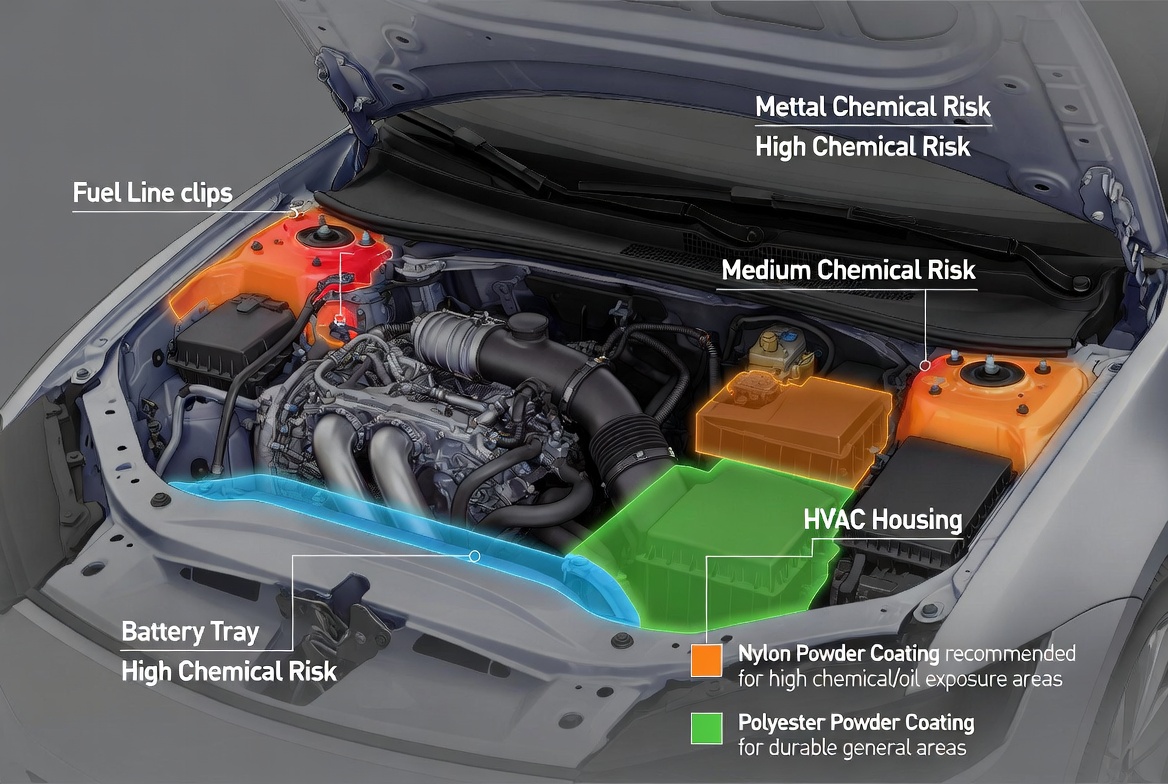
Nylon (polyamide) powder coatings are thermoplastic systems; they soften when heated but do not crosslink like thermoset resins. Modern modified nylon powders blend PA6, PA66 or copolymers with additives to tailor flow and crystallinity while keeping strong chemical resistance. [patents.google]
- Chemical resistance: Excellent resistance to fuels, oils, many solvents and salts, especially in hot splash conditions. [patents.google]
- Impact and abrasion: Very high impact strength and abrasion resistance, ideal for brackets, springs and supports exposed to vibration. [thermoplasticcoating]
- Thickness and edge coverage: Fluid-bed or electrostatic spray processes can produce thicker, more forgiving films that protect welds and edges. [thermoplasticcoating]
- Noise and vibration damping: Slightly elastic film can reduce squeaks and rattles on moving or contacting parts. [thermoplasticcoating]
- Repairability: As a thermoplastic, nylon can sometimes be reflowed or over-coated for minor defect corrections. [thermoplasticcoating]
From personal experience in OEM projects, nylon powder often becomes the go-to for high-risk components like fuel line clamps, spring clips, under-hood wire routing hardware and certain brake-system brackets where stone-chipping and hot fluid splash are common.
Polyester powder coatings are thermoset systems that cure via crosslinking, usually with epoxy or TGIC-free hardeners, to form a dense three-dimensional network. Automotive-grade polyesters are engineered for salt spray resistance, color and gloss stability and good general chemical resistance. [njpurda.en.made-in-china]
- UV and color stability: Excellent outdoor durability, making polyester attractive when under-hood components are partially visible or in high-visibility engine bays. [alibaba]
- Corrosion resistance: When applied over properly pre-treated steel or aluminum, polyester delivers robust corrosion protection under cyclic salt and humidity testing. [allnex]
- Chemical resistance: Good resistance to many automotive fluids and cleaners, but typically lower than nylon in severe hot-splash or immersion situations. [alibaba]
- Thin, aesthetic films: Capable of smooth, thin films with tight color tolerance across platforms. [njpurda.en.made-in-china]
- Process flexibility: Wide cure windows and compatibility with high-throughput conveyor lines used by many Tier-1 and Tier-2 suppliers. [allnex]
In real manufacturing environments, polyester powder is often specified for battery trays, engine covers, brackets, housings and HVAC components where appearance, UV stability and broad-spectrum corrosion resistance are critical but chemical immersion is limited. [alibaba]
| Criteria | Nylon powder coating | Polyester powder coating |
|---|---|---|
| Coating type | Thermoplastic polyamide system, re-melt capable (patents.google) | Thermoset polyester network, permanent crosslinking (allnex) |
| Chemical resistance (fuels, oils) | Very high; especially strong in hot fuel and oil splash (patents.google) | Good; acceptable for most splash, but can be challenged by long hot exposure (allnex) |
| Brake fluid & aggressive cleaners | Generally better resistance, especially in modified nylon grades (patents.google) | Highly formulation-dependent; some systems soften or stain under prolonged contact (allnex) |
| Heat resistance under hood | Good up to typical under-hood temperatures; softening at elevated temperatures must be considered (patents.google) | Excellent thermal stability within normal automotive cure and service ranges (allnex) |
| Impact & chip resistance | Superior impact and stone-chip resistance, good for exposed brackets and clips (patents.google) | Good but usually below nylon in high-impact locations (allnex) |
| Film build | Often thicker protective films; excellent edge coverage (thermoplasticcoating) | Optimized for thinner, smooth films and visual quality (allnex) |
| UV and color stability | Moderate; not optimized for long-term UV exposure (thermoplasticcoating) | Excellent, especially in super-durable grades (allnex) |
| Typical under-hood use cases | Fuel line clamps, springs, clips, high-wear brackets (thermoplasticcoating) | Engine covers, battery trays, HVAC housings, visible brackets (allnex) |
For chemical-exposure-dominated zones, nylon usually delivers a wider safety margin, while polyester wins in appearance-driven and UV-exposed areas.
In fuel handling and fluid routing, the highest risk is permeation or rapid coating breakdown leading to corrosion under the film. Nylon's dense, polar structure slows diffusion of hydrocarbons and provides durable protection at repeated hot-splash cycles. In benchmarking programs, nylon-coated clamps and brackets typically show fewer blisters and less edge creep after cyclic chemical and salt spray tests. [patents.google]
On the shop floor, a common pattern is to specify nylon powder for:
- Fuel line support brackets and clamps
- Power steering and transmission line clips
- Under-hood spring clips exposed to road splash
- Battery-related hardware in regions with high temperature and dust
For structural brackets, engine dress components and HVAC housings, polyester powder delivers a good balance of corrosion resistance, appearance and cost. Typical failure modes when polyester is pushed into high chemical-exposure areas include gloss loss, softening, discoloration and localized underfilm corrosion around chip sites. [allnex]
As a result, many OEMs now design with a mixed-material coating map: nylon specified in the bill-of-materials for certain fasteners and clips, and polyester for larger components where coating uniformity and color matching dominate.
From a manufacturing standpoint, nylon and polyester powders behave quite differently on the coating line.
- Nylon powders often require higher film builds and may use fluidized-bed dipping or thicker electrostatic application, which can influence line speed, part preheat and masking strategy. [thermoplasticcoating]
- Polyester powders integrate smoothly into standard electrostatic spray lines with conventional metal pre-treatment and oven profiles, making them easier to roll out across multiple plants. [alibaba]
For global suppliers operating lines in China, Indonesia and Saudi Arabia, consistency of oven capability, pre-treatment chemistry and operator skill can determine whether nylon's performance advantages can be fully realized.
Automotive OEMs now push for low-VOC, low-waste finishing systems, especially in export platforms. Both nylon and polyester powder coatings are already low-VOC technologies compared with liquid paints, but polyester systems have seen more extensive optimization around curing efficiency and low-temperature formulations for energy savings. [pdf.dfcfw]
In markets with tightening environmental regulations, the ability to use TGIC-free polyester systems and heavy-metal-free pigment packages has become a key selection criterion for engine-bay components. [allnex]
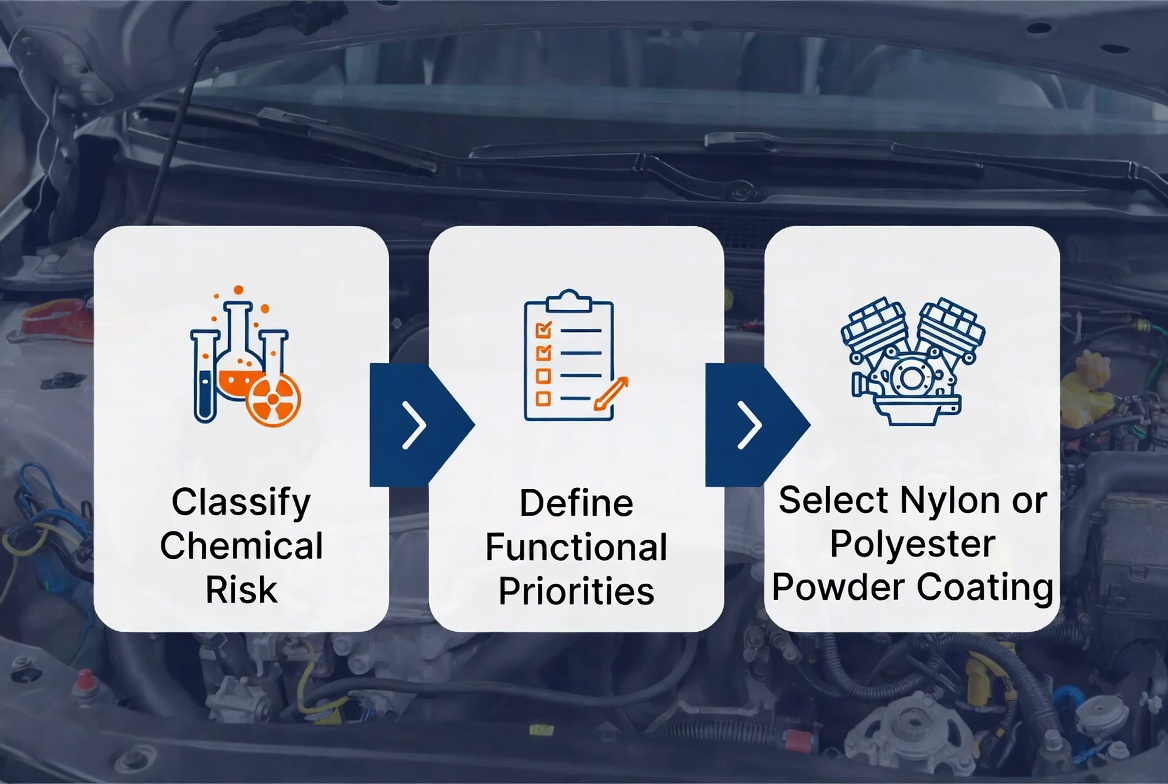
As an industry practitioner looking at both performance and cost, I recommend treating coating selection as a risk-based mapping exercise:
1. Classify the component by chemical risk
- High risk: direct contact or frequent splash of fuel, brake fluid, hot oil, aggressive cleaners
- Medium risk: occasional splash, condensate, road salt and moisture
- Low risk: primarily thermal and humidity loads, limited chemical contact
2. Define functional priorities
- Is chemical resistance more important than UV stability?
- Is chip resistance and noise reduction more critical than super-smooth appearance?
3. Map to coating strategy
- High-risk components: favor nylon powder coatings with proven resistance to the specific fluids used on the platform.
- Medium-risk components: allow polyester where engineering testing confirms performance, particularly on brackets and housings.
- Low-risk components: optimize for polyester-based systems with strong corrosion resistance and appearance.
This framework helps Tier-1 and Tier-2 suppliers standardize decisions across platforms and plants while still allowing site-level optimization.
When working on global platforms manufactured in China and localized for Indonesia and Saudi Arabia, climate, fuel quality and maintenance habits subtly shift the chemical exposure profile. [pdf.dfcfw]
- In hot, dusty climates like Saudi Arabia, under-hood temperatures and dust loadings are high, which increases abrasion and thermal cycling stress on coatings.
- In humid regions like Indonesia, condensation cycles and road splash promote underfilm corrosion if chips are not well protected.
- Fuel and service fluids can differ slightly in additive packages and purity, which can influence solvent and chemical aggressiveness.
In these scenarios, using nylon powder on high-risk clips and supports provides additional insurance against unexpected fluid variability, while polyester continues to carry the bulk of structural components and visible engine-bay parts.
Before locking in a global under-hood coating spec, I advise OEMs and Tier-1s to run a structured testing program:
- Chemical spot and immersion tests at service temperatures with actual production fluids (fuel blends, oils, brake fluids, cleaners).
- Stone chip and gravelometer tests followed by cyclic salt spray to understand underfilm corrosion behavior.
- Thermal cycling reflecting real under-hood heat-up and cool-down cycles.
- Field validation in at least two climatic regions, such as a dry-hot region and a humid-tropical region.
This data-driven approach tends to confirm the theoretical advantages of nylon in extreme chemical zones and polyester in broader, appearance-driven areas, giving engineering teams confidence in their mixed-coating map.
A technology partner like Yinda Technology, focusing on powder coatings and environmentally friendly materials, can support OEMs in several ways.
- Tailoring nylon powder formulations (e.g., PA6/66 blends, impact modifiers, anti-oxidants) to specific under-hood chemical and thermal profiles. [patents.google]
- Developing automotive-grade polyester powders that balance corrosion resistance, chemical resistance and cure efficiency for multi-plant deployment. [alibaba]
- Providing regional technical support from teams in China, Indonesia and Saudi Arabia to align coating specifications with local substrate, pre-treatment and oven capabilities. [pdf.dfcfw]
For under-hood components, success comes not from a single "best" powder, but from a co-engineered system that matches resin chemistry, pre-treatment, component design and real chemical exposure.
When chemical exposure is the dominant risk, nylon powder coating offers superior resistance to fuels, oils and aggressive fluids, combined with excellent impact and abrasion performance. For broader under-hood hardware where UV stability, appearance and cost are decisive, polyester powder coating remains the workhorse solution. The most robust strategy for modern under-hood automotive components is therefore a hybrid specification: nylon on critical, chemical-intense parts and polyester on structural and visual components, optimized per region and platform. [allnex]
For engineering teams reviewing upcoming platforms, the next step is to map your under-hood bill-of-materials against chemical risk and run targeted validation tests. If you are planning such a review, you can reach out to a specialized powder coating partner to co-develop a nylon–polyester strategy that reflects your specific fluids, climates and manufacturing lines.
If your under-hood components are heading into more aggressive chemical environments or new export markets, this is the right time to revisit your coating map. Engage your materials team and coating supplier to:
- Audit which parts currently use liquid paint where powder could improve durability.
- Identify high-risk chemical exposure zones where nylon powder would significantly reduce warranty risk.
- Validate whether your existing polyester powders are truly automotive-grade for the fluids and climates you now serve.
A focused review now can prevent premature failures, warranty claims and re-engineering later in the vehicle lifecycle.
Q1: Is nylon powder coating always better than polyester under the hood?
A1: No. Nylon is generally better for extreme chemical and impact exposure, while polyester is better for appearance, UV stability and broad corrosion protection. The best strategy is to use each where it fits best.
Q2: Can a single polyester powder system handle all under-hood components?
A2: In low to medium chemical exposure areas, a high-quality polyester can perform well, but in fuel and brake fluid splash zones you increase risk if you avoid nylon on critical parts.
Q3: How does coating thickness influence chemical resistance?
A3: Thicker films, often easier to achieve with nylon, can delay chemical penetration and underfilm corrosion, but resin chemistry still dominates performance over the long term.
Q4: Are there sustainability differences between nylon and polyester powder coatings?
A4: Both are low-VOC powders, but many polyester systems are now optimized for lower cure temperatures and energy savings, while nylon's higher film builds can mean more material per part.
Q5: What is the most common mistake when specifying under-hood powder coatings?
A5: The biggest mistake is treating all under-hood components as having the same exposure profile and using one coating everywhere, instead of segmenting parts by chemical and mechanical risk and specifying nylon or polyester accordingly.
1. Google Patents – “Modified nylon powder coating and preparation method thereof (CN102898941A)” – discussion of nylon powder compositions and performance. https://patents.google.com/patent/CN102898941A/en
2. PECOAT – “Polyamide (Nylon) Powder Coatings” – applications and performance characteristics of nylon powder for automotive and industrial parts. https://www.thermoplasticcoating.com/zh-TW/fluid-bed-hot-dipping-powder/nylon-powder-coating/
3. Allnex – “Polyester Powder Coating Resins” – overview of polyester powder chemistry, durability and application. https://allnex.cn/cn/technologies/powder-coating-resins/polyester-powder-coating
4. Alibaba Product Insights – “A Complete Guide to China Polyester Powder Coating: Specifications, Types, and Applications” – market-oriented summary of polyester powder uses and properties. https://www.alibaba.com/product-insights/china-polyester-powder-coating.html
5. China Coatings Industry Reports – “2023 China Coatings Industry Overview” and “Industrial Coatings Core Technologies” – background on powder coatings trends, automotive applications and environmental drivers. https://pdf.dfcfw.com/pdf/H3_AP202401181617692761_1.pdf and https://pdf.dfcfw.com/pdf/H3_AP202312111613716292_1.pdf


