Language


Views: 220 Author: Yinda Powder Coating Publish Time: 2026-09-15 Origin: Site


Content Menu
● Why Exterior Aluminum Trim Is Demanding
● UV-Stabilized Acrylic Powder Overview
>> Where Acrylic Powder Performs Well
>> Acrylic Powder Limitations to Consider
>> Why Super-Durable Polyester Is Common in Automotive Trim
>> Standard Polyester vs. Super-Durable Polyester
● UV-Stabilized Acrylic vs. Polyester Powder Comparison
● The Aluminum Pretreatment Factor
>> Recommended Process Sequence
● Performance Criteria That Should Be Specified
● Corrosion Testing: Look Beyond Hours
● How to Choose the Right System
>> Choose UV-Stabilized Acrylic Powder When
>> Choose Super-Durable Polyester Powder When
>> Consider a Multi-Layer System When
● Expert Checklist Before Production Approval
● FAQ
>> 1. Is UV-stabilized acrylic powder better than polyester powder for automotive exterior trim?
>> 2. Can polyester powder coating be used on aluminum automotive trim?
>> 3. Does aluminum need pretreatment before powder coating?
>> 4. What is more important: powder resin or pretreatment?
>> 5. What coating is best for piano-black automotive aluminum trim?
>> 6. How should exterior automotive powder coating be tested?
>> 7. Can powder coating meet premium automotive appearance requirements?
Exterior automotive aluminum trim must do more than look premium on the production line. It must retain color, gloss, adhesion, corrosion protection, and surface smoothness after years of ultraviolet radiation, rain, road salt, heat cycles, detergents, fuel splashes, stone impact, and repeated washing.
For automotive OEMs, tier suppliers, and aluminum-trim manufacturers, the core question is not simply whether to choose UV-stabilized acrylic powder or polyester powder. The right question is: Which powder-coating system can meet the required appearance, durability, production efficiency, and lifecycle-cost targets for the specific exterior trim part?
At Yinda Technology, we work with powder-coating applications across automotive, architectural aluminum, hardware, electrical appliances, medical equipment, and energy-saving material sectors. From that practical manufacturing perspective, UV-stabilized acrylic powder and polyester powder should be evaluated as complete coating systems—not only as resin families. Aluminum alloy, pretreatment, coating thickness, curing window, geometry, color, gloss level, and validation method all influence final performance.
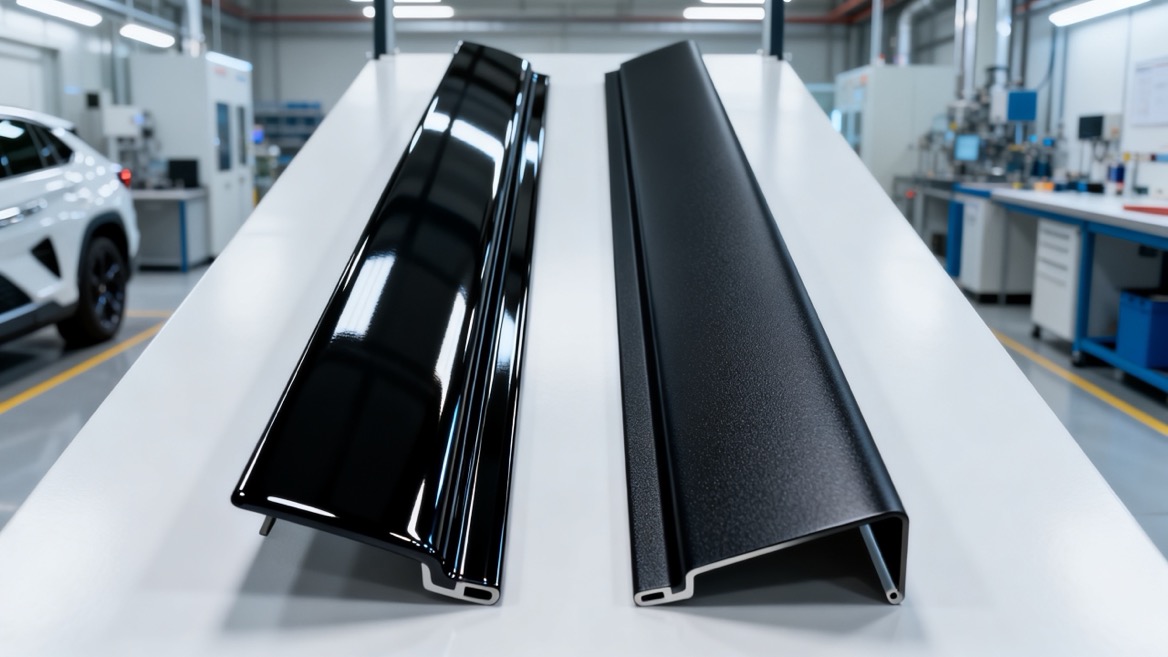
Automotive aluminum trim includes window surrounds, roof rails, grille components, decorative appliqués, pillar trims, door strips, mirror-related components, bumper accents, and other visible exterior parts. These components are frequently exposed to the harshest conditions on the vehicle.
Unlike hidden metal brackets, visible aluminum trim is judged by both engineering teams and end users. A minor defect can become highly noticeable when the component has a piano-black, high-gloss, metallic, satin, or clear-coated finish.
Key exposure risks include:
- UV radiation, which can cause fading, chalking, yellowing, or gloss loss.
- Thermal cycling, especially on dark-colored parts exposed to direct sunlight.
- Humidity and condensation, which can challenge adhesion at the aluminum/coating interface.
- Road salt and coastal air, which can accelerate underfilm corrosion near scratches, seams, and edges.
- Stone chips and abrasion, which can damage high-visibility surfaces.
- Automotive chemicals, including detergents, windshield-washer fluid, fuel residues, oils, and cleaning agents.
- Complex part geometry, which can make consistent film build difficult around corners, recesses, slots, and narrow profiles.
A well-designed powder coating for exterior automotive aluminum trim needs to balance appearance quality and protective durability. This is why resin selection alone is never sufficient.
UV-stabilized acrylic powder coatings are commonly selected when the priority is an exceptionally smooth, clear, glossy, or visually refined surface. Acrylic-based systems can be especially attractive for premium decorative trim, bright-clear applications, high-gloss black accents, and Class A-style appearance targets.
Acrylic powder chemistry can offer strong flow and leveling characteristics. When correctly applied and cured, it can help minimize surface texture and produce a more refined visual result than many conventional powder systems.
PPG identifies acrylic and polyester powder clearcoats as external-use coatings designed to provide high-gloss color and maximum smoothness, with applications that include automotive clear coats and other exterior gloss metal products.
UV-stabilized acrylic powder may be a strong candidate when a trim program requires:
- High gloss and surface clarity
- Excellent flow and leveling
- Low visible orange-peel appearance
- Premium decorative appearance
- Clearcoat or transparent protective-layer performance
- Smooth piano-black or special-effect finishes
- Strong resistance to appearance degradation under outdoor exposure
For highly visible aluminum trim, appearance often drives the material decision. A roof-rail accent or window surround may occupy a small portion of the vehicle, but it strongly influences the perceived quality of the entire exterior.
Acrylic powder is not automatically the best answer for every exterior trim part. It may require tighter process discipline, more careful control of coating thickness, and closer matching between substrate condition, powder formulation, application settings, and cure profile.
Potential considerations include:
- Higher material cost in certain formulations.
- More demanding application or curing control for premium appearance.
- Need for careful compatibility review with primers, basecoats, metallic layers, and clearcoats.
- Potentially narrower manufacturing tolerance depending on the selected system.
- The need to validate scratch, chemical, chip, and corrosion performance on the actual component design.
For an automotive aluminum trim supplier, acrylic powder is often most valuable where finish quality is the primary differentiator and the part has strong consumer-facing visibility.
Polyester powder coatings are widely used for exterior metal applications because they provide a practical balance of durability, mechanical protection, color retention, process robustness, and cost control. For automotive exterior trim, the most relevant category is usually not ordinary polyester powder, but super-durable polyester powder designed for demanding outdoor service.
AkzoNobel lists super-durable polyester powder coatings for automotive trim parts such as pillars, appliqués, roof racks, grille guards, bumpers, mirror housings, and wiper arms. Its published technical data identifies both aluminum and steel as compatible substrates when suitable pretreatment is used.
Super-durable polyester powder is a practical choice for exterior automotive aluminum components because it can combine:
- Strong outdoor durability
- Reliable UV resistance
- Good color and gloss retention
- Mechanical toughness
- Scratch and chip resistance
- Chemical resistance
- Broad color and gloss flexibility
- Good productivity for high-volume coating lines
- Competitive total applied cost
An automotive-grade polyester system can be engineered for smoothness, metallic finishes, deep blacks, matt surfaces, satin finishes, and textured effects. This makes it suitable for trim programs that require both visual styling freedom and robust performance.
AkzoNobel describes its automotive powder portfolio as providing UV durability, smoothness, corrosion protection, and protection against chemicals, chips, and scratches for exterior trim and body applications.
This distinction is critical. A standard exterior polyester may perform adequately for general outdoor equipment, furniture, or less demanding hardware, but it may not provide the long-term appearance stability required for premium automotive trim.
A super-durable polyester typically uses a specialized resin system designed for improved UV resistance compared with standard polyester powder. Industry guidance notes that super-durable polyester is formulated to meet more demanding exterior-durability classifications, including performance associated with Qualicoat Class 2, GSB Florida 3, or AAMA 2604-type requirements.
For automotive aluminum trim, buyers should avoid broad specifications such as "outdoor polyester powder." Instead, they should define the required weathering, corrosion, chemical, and appearance criteria in measurable terms.
| Evaluation Factor | UV-Stabilized Acrylic Powder | Super-Durable Polyester Powder |
|---|---|---|
| Primary strength | Premium appearance, flow, leveling, clarity | Balanced exterior durability, toughness, process stability |
| Surface smoothness | Often excellent, especially for high-gloss and clear finishes | Very good with an optimized automotive-grade formulation |
| Gloss potential | Excellent for high-gloss decorative finishes | Broad gloss range, including gloss, satin, matt, and textured finishes |
| UV durability | Strong when formulated with suitable UV stabilizers and pigments | Strong, especially in super-durable grades |
| Color retention | Can be excellent with appropriate pigment selection | Strong with outdoor-stable pigments and super-durable chemistry |
| Scratch and chip resistance | Must be validated by formulation and film structure | Often a major strength of automotive-grade polyester systems |
| Corrosion protection | Depends heavily on pretreatment, primer, film build, and damage resistance | Depends heavily on pretreatment, primer, film build, and damage resistance |
| Chemical resistance | Often suitable for automotive exterior applications | Commonly strong for automotive exterior applications |
| Process robustness | May require tighter control for premium visual results | Typically offers practical latitude for high-volume manufacturing |
| Cost position | Often higher for premium appearance systems | Often more economical for broad exterior-trim use |
| Best-fit applications | Clearcoats, high-gloss black, premium visible trim, appearance-critical accents | Roof rails, appliqués, pillars, grilles, mirror housings, durable decorative trim |
The comparison is not a simple "better versus worse" decision. Acrylic powder usually leads when visual precision is the highest priority. Super-durable polyester often leads when a program needs durable exterior protection, design versatility, production efficiency, and cost balance.
For exterior automotive aluminum trim, pretreatment can determine whether a coating system succeeds or fails. Even a high-quality UV-stabilized acrylic or polyester powder cannot compensate for poor cleaning, incomplete conversion treatment, contamination, inadequate rinsing, or uncontrolled drying.
Aluminum trim may include extrusions, die-cast parts, stamped components, machined profiles, or mixed-alloy assemblies. Each substrate can behave differently during pretreatment and powder application.
Automotive powder-coating technical data for aluminum substrates commonly specifies chromate or chrome-free conversion pretreatment before coating.
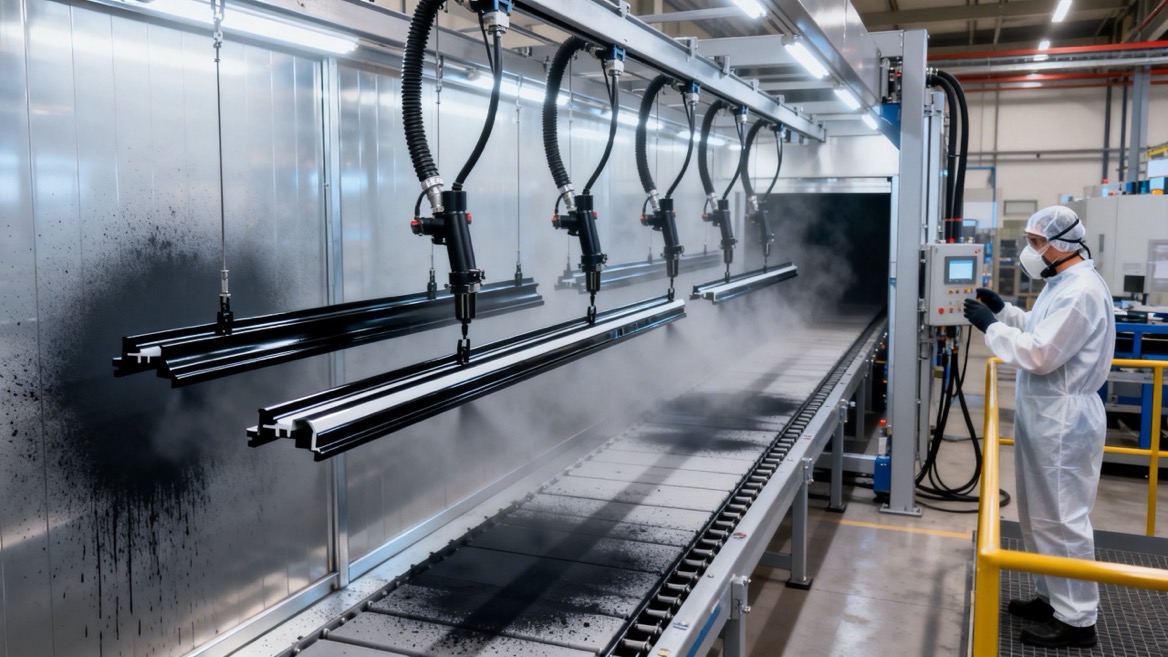
A robust coating process for exterior automotive aluminum trim generally includes:
1. Incoming material inspection
Verify alloy condition, surface contamination, extrusion lubricants, machining oils, casting residues, and visible defects.
2. Cleaning and degreasing
Remove oils, polishing compounds, fingerprints, dust, and production residues.
3. Etching or surface conditioning
Create a controlled surface profile where required by the pretreatment system.
4. Conversion coating
Apply a suitable chromate or chrome-free conversion layer to improve adhesion and corrosion resistance.
5. Rinsing and drying
Prevent carryover, water spots, salts, and chemical residues.
6. Electrostatic powder application
Control grounding, gun distance, voltage, powder output, and reclaim quality.
7. Curing
Confirm actual metal temperature and time at temperature rather than relying only on oven air temperature.
8. Final inspection and validation
Measure film thickness, gloss, color, adhesion, cure response, visual appearance, and corrosion resistance.
The most common mistake is to compare resin families while overlooking the complete system. In practice, the coating system is substrate + pretreatment + powder + application + cure + inspection.
A meaningful automotive trim specification should establish measurable requirements before a supplier proposes acrylic or polyester powder. This prevents vague requirements and reduces the risk of qualification disputes after production begins.
For visible exterior trim, define:
- Color target and permitted color difference.
- Gloss target at the specified measurement angle.
- Metallic-effect consistency, if applicable.
- Orange-peel or waviness expectation.
- Surface defect limit.
- Edge coverage requirement.
- Clearcoat clarity and transparency requirement.
- Resistance to fingerprints, water spotting, and detergent marks.
A high-gloss black trim part may require a different coating route than a low-gloss roof rail. The visual target should guide the resin selection.
Exterior trim should also be validated for:
- UV exposure and gloss retention.
- Color retention after accelerated and natural exposure.
- Adhesion before and after humidity exposure.
- Resistance to cracking, peeling, blistering, and chalking.
- Resistance to thermal cycling.
- Resistance to detergents and automotive fluids.
- Scratch resistance and abrasion resistance.
- Stone-chip resistance.
- Corrosion resistance at scribe marks and damaged areas.
The AAMA 2604 and AAMA 2605 frameworks are architectural rather than automotive trim specifications, but they provide useful context for comparing exterior-durability levels. AAMA 2604 is associated with five-year South Florida exposure, while AAMA 2605 is associated with ten-year exposure and stricter retention requirements.
For automotive development, the final requirement should still follow the vehicle maker's internal engineering standards and test methods.
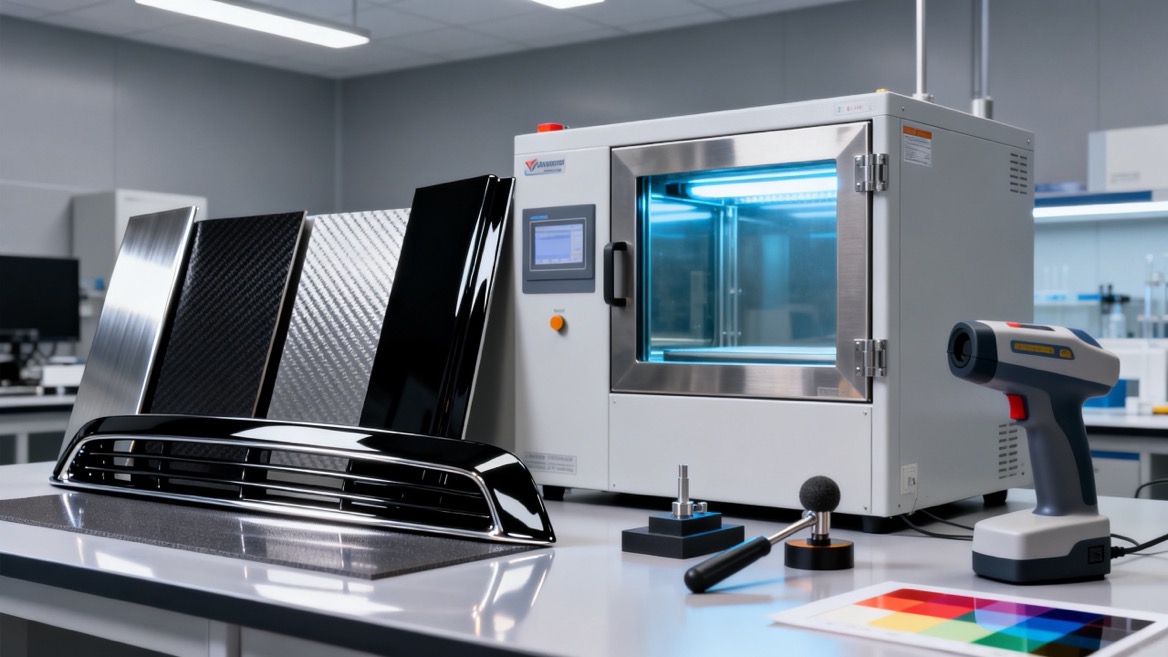
Salt-spray test duration is often used as a quick purchasing comparison, but the total number of hours does not tell the full story. A coating can survive many hours in a chamber yet still perform poorly if corrosion spreads rapidly from scratches, stone chips, seams, or cut edges in real use.
ASTM B117 and ISO 9227 are widely used salt-fog test methods for assessing coating-system durability under controlled saline exposure. ISO 9227 also notes that acidified salt-spray testing can be suitable for certain organic coatings on aluminum.
For exterior automotive aluminum trim, evaluate:
- Scribe creep, not just panel appearance.
- Blistering near damaged areas.
- Adhesion retention after exposure.
- Filiform corrosion tendency where relevant.
- Edge corrosion.
- Performance after combined humidity, thermal, UV, and corrosion exposure.
- Actual component testing, not only flat test panels.
A published technical guide notes that automotive and heavy-equipment coating requirements often fall in the 1,000–1,500-hour range for salt-spray testing, with scribe creep commonly more important than exposure hours alone. Actual OEM requirements can differ substantially, so this should be treated as a development reference rather than a universal acceptance rule.
The best selection process begins with the trim part's real function, location, visual importance, and vehicle market positioning.
UV-stabilized acrylic powder may be the stronger option when:
- The component is highly visible and must deliver a premium Class A-style appearance.
- High gloss, deep black, optical clarity, or smooth clearcoat performance is required.
- The styling team is highly sensitive to orange peel, waviness, or surface texture.
- The part is a premium decorative accent rather than a heavily impact-exposed structural trim piece.
- The manufacturing line can maintain controlled film build and curing conditions.
- Cost is secondary to visual differentiation and brand perception.
Super-durable polyester powder may be the better option when:
- The part needs durable outdoor protection with strong production practicality.
- Scratch, chip, mechanical damage, and exterior service exposure are major concerns.
- The vehicle program requires flexible color, gloss, texture, or metallic options.
- The supplier needs robust application behavior for high-volume manufacturing.
- The component includes roof rails, grille guards, pillars, mirror housings, or utility-oriented decorative trim.
- The program needs a favorable balance between quality, throughput, and lifecycle cost.
Some premium programs benefit from using more than one functional layer:
- Polyester primer for adhesion and corrosion protection.
- Pigmented basecoat for color and visual effect.
- Acrylic or polyester clearcoat for gloss, depth, chemical resistance, and surface protection.
This structure can help separate corrosion protection from appearance optimization. It also gives engineers more flexibility when the same vehicle platform includes both durable functional trim and appearance-critical decorative elements.
Before approving either UV-stabilized acrylic powder or polyester powder, ask the coating supplier for the following:
- Full technical data sheet.
- Safety documentation.
- Resin family and intended end-use statement.
- Recommended aluminum pretreatment route.
- Recommended film-thickness range.
- Cure schedule, including required metal temperature.
- Gloss and color-control method.
- UV-weathering test results.
- Salt-spray or cyclic-corrosion test results.
- Adhesion results before and after humidity exposure.
- Chemical-resistance data for relevant automotive fluids.
- Scratch, abrasion, and chip-resistance data.
- Trial-part results using the actual aluminum alloy and geometry.
- Batch traceability and quality-control plan.
Do not qualify a coating only from a flat-panel sample. A successful trial should include real trim geometry, realistic edge conditions, correct pretreatment, intended production equipment, and full validation testing.
For exterior automotive aluminum trim pieces, UV-stabilized acrylic powder and super-durable polyester powder both have important roles. Acrylic powder is often the better choice for premium visible surfaces where exceptional flow, gloss, clarity, and surface refinement are essential. Super-durable polyester powder is often the more balanced choice for durable, high-volume automotive trim that must resist UV exposure, scratches, chemicals, chips, and outdoor weather while maintaining reliable processing economics.
The strongest decision is based on part-specific validation rather than a general preference for one chemistry. A premium window surround may justify a UV-stabilized acrylic clearcoat system. A roof rail, mirror housing, grille guard, or pillar appliqué may benefit more from an automotive-grade super-durable polyester powder.
Yinda Technology can support automotive aluminum-trim projects with powder-coating selection, outdoor-durability evaluation, color and gloss matching, coating-process guidance, and customized solutions for global manufacturing programs. Contact our technical team to discuss your aluminum substrate, visual target, test standard, production line, and target market before finalizing the coating specification.
Not always. UV-stabilized acrylic powder is often preferred for premium visual appearance, high gloss, clarity, and smoothness. Super-durable polyester powder is often preferred for balanced exterior durability, mechanical protection, process reliability, and cost efficiency. The correct choice depends on the specific trim part and OEM requirements.
Yes. Automotive-grade super-durable polyester powder is used for exterior trim components, including pillars, appliqués, roof racks, grille guards, bumpers, mirror housings, and related aluminum or steel parts. Proper aluminum pretreatment is essential for adhesion and corrosion protection.
Yes. Aluminum should normally be cleaned and treated with an appropriate conversion process before powder coating. This supports adhesion and improves resistance to moisture-driven corrosion and coating delamination.
Both matter, but pretreatment is often decisive for corrosion resistance and adhesion. A high-performance acrylic or polyester powder cannot fully compensate for poor surface preparation, contamination, inadequate rinsing, or an unsuitable conversion layer.
A UV-stabilized acrylic powder, acrylic clearcoat, or carefully engineered high-gloss polyester system may be suitable. The best option depends on the required gloss, smoothness, scratch resistance, chemical resistance, film build, and production capability. Appearance trials on actual parts are necessary.
Testing should combine visual inspection, film-thickness measurement, gloss and color control, adhesion, humidity exposure, UV weathering, chemical resistance, stone-chip resistance, abrasion resistance, and corrosion testing such as ASTM B117 or ISO 9227 where specified. Real-part testing is more meaningful than flat-panel testing alone.
Yes. Automotive powder technologies are used for high-gloss, smooth, metallic, textured, and clear finishes. However, premium appearance depends on the entire process, including substrate quality, pretreatment, powder formulation, application control, curing, and inspection.
1. [Gordon Inc. — Powder Coatings for AAMA 2604 and AAMA 2605 Applications]
2. [High Performance Coatings — Understanding AAMA 2605 Standards for High Performance Coatings]
3. [PPG — Enviracryl Powder Clearcoats]
4. [AkzoNobel — Interpon A2201 Automotive Trim Powder Coating Technical Data Sheet]
5. [AkzoNobel — Interpon A Automotive Powder Coatings Brochure]
6. [ChemQuest — Selecting the Right Outdoor-Durable Powder Coating]
7. [ISO — ISO 9227:2022 Corrosion Tests in Artificial Atmospheres]
8. [Laboratory Testing Inc. — Salt Spray Testing to ASTM B117 and ISO 9227]


