Language


Views: 269 Author: Yinda Powder Coating Publish Time: 2026-09-18 Origin: Site


Content Menu
● What Is Powder Coating Paint?
● Why Powder Coating Is Used Across Industries
>> Key Benefits of Powder Coating Paint
>> Powder Coating Paint vs. Liquid Paint
● Choose the Right Powder Coating Chemistry
● Start With the Service Environment
>> For Architectural Aluminium Profiles, Doors, and Windows
>> For New-Energy Vehicle Components
>> For Medical Equipment and Electrical Appliances
● Pretreatment Determines Coating Life
>> A Reliable Pretreatment Workflow
● Film Thickness and Curing Are Not Optional Details
● Common Powder Coating Defects and How to Prevent Them
>> Orange Peel
● A Practical Specification Checklist for Buyers
● Work With Yinda Technology on Your Powder Coating Project
>> Is powder coating paint better than liquid paint?
>> How long does powder coating last outdoors?
>> Can powder coating be applied to aluminium?
>> Does powder coating contain VOCs?
>> What is the best powder coating for outdoor use?
>> Why does powder coating peel or flake?
>> Can powder coating resist high temperature?
Powder coating paint is a dry finishing technology designed to protect metal products while delivering consistent colour, texture, and long-term surface performance. For manufacturers of architectural profiles, doors and windows, new-energy vehicles, medical equipment, hardware, and electrical appliances, the right powder coating system is not simply a colour decision—it is a decision about corrosion protection, appearance retention, production efficiency, compliance, and total lifecycle cost.
At Yinda Technology, we develop, manufacture, and supply powder coatings and environmentally responsible material solutions for customers across China, Indonesia, Saudi Arabia, and international markets. From our experience working with industrial manufacturers, the best coating result comes from matching the powder chemistry, substrate pretreatment, application parameters, and end-use environment as one complete system.
This guide explains what powder coating paint is, how it performs, where it fits best, how to compare it with liquid paint, and how purchasing teams can specify a solution with greater confidence.
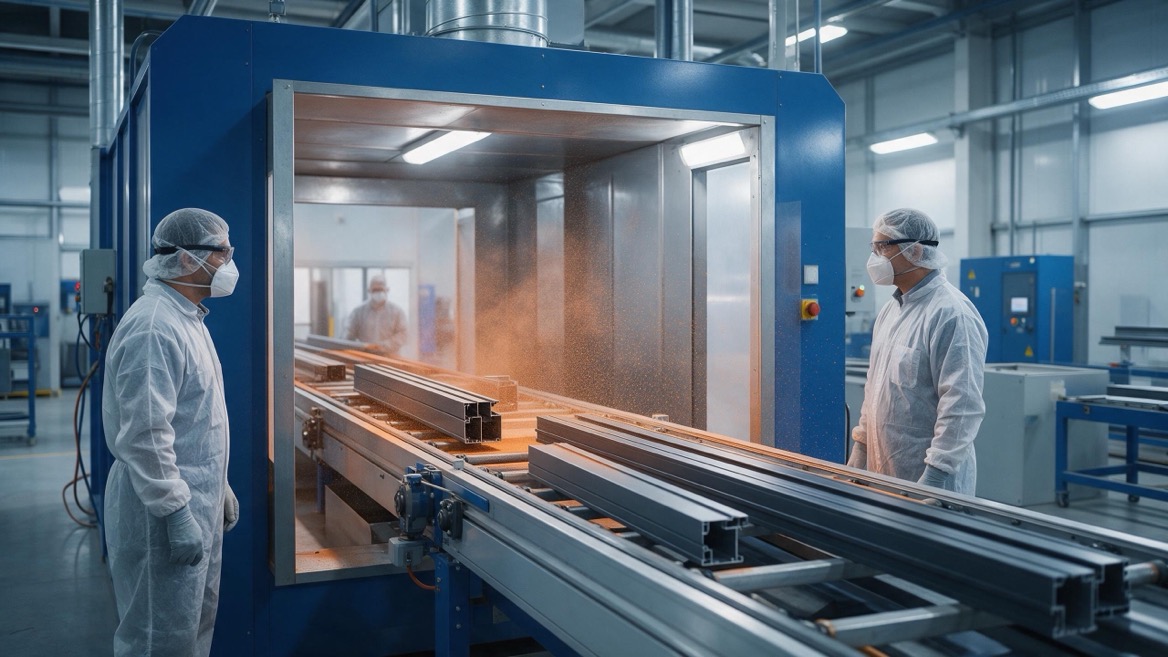
Powder coating paint is a dry, finely ground coating material that is electrostatically sprayed onto a properly prepared, grounded workpiece. The coated part then enters an oven, where heat causes the powder to melt, flow, and chemically crosslink into a continuous protective film.
Unlike conventional liquid paint, powder coating generally does not rely on the same volume of organic solvents to carry resin and pigment to the substrate. This makes it a preferred finishing option for many industrial production lines seeking durable coatings with substantially reduced solvent-related emissions. The U.S. Environmental Protection Agency notes that powder coatings contain almost no VOCs and can greatly reduce emissions when used on metal products.
A typical powder coating system includes:
- Resin, which determines the coating family and core performance profile
- Pigments, which create colour, opacity, metallic effects, and visual consistency
- Curing agents, which form the crosslinked film during baking
- Functional additives, which can improve flow, levelling, scratch resistance, degassing, texture, or weatherability
- Fillers, which may help control mechanical properties, appearance, and formulation cost
The finished coating can be smooth, textured, matte, satin, glossy, metallic, hammered, wrinkle-effect, sand-textured, or custom-coloured. However, visual appearance should never be selected in isolation. A coating that looks excellent on a colour panel may fail prematurely if its resin type or pretreatment system does not match the actual service environment.
Powder coating is widely used because it combines a decorative finish with practical protection. When the system is properly designed and applied, it can help reduce visible damage, resist corrosion, maintain colour, and simplify maintenance over the life of a product.
Durable film formation. During curing, thermoset powder coatings form a crosslinked film that can deliver strong adhesion, impact resistance, and resistance to abrasion. This is important for products that are transported, assembled, handled frequently, or exposed to daily wear.
Low-solvent finishing. Powder coating provides a low-VOC or near-zero-VOC alternative to many solvent-borne coating processes. The EPA describes powder coatings as emitting virtually no VOCs and not requiring organic solvents in the coating material.
High material utilization potential. In suitable automated lines, overspray may be collected and reused, subject to colour-control and quality-management requirements. This can reduce material loss compared with processes in which overspray is not recoverable.
Uniform appearance on complex metal parts. Electrostatic attraction helps powder particles adhere to grounded components. With appropriate gun settings, part grounding, racking, and curing control, manufacturers can achieve a more consistent film build across large batches.
Broad design flexibility. Powder coatings can be formulated in standard and custom shades, including RAL-matched colours, brand colours, fine textures, metallic effects, and low-gloss surfaces.
Long-term maintenance value. Although a powder coating line may require upfront investment in pretreatment, spray equipment, recovery systems, and curing ovens, a durable coating system can reduce repainting, touch-up work, rejects, and field-maintenance costs.
| Factor | Powder Coating Paint | Conventional Liquid Paint |
|---|---|---|
| Form | Dry powder | Liquid coating containing resin, pigment, and often solvent or water |
| Application | Electrostatic spraying followed by thermal curing | Spray, dip, brush, roll, or other wet-film application methods |
| VOC profile | Usually very low because the coating is largely solvent-free | Varies widely; solvent-borne systems may produce significant VOC emissions |
| Film build | Often achieves useful film thickness in one application | May need multiple coats to achieve coverage and appearance |
| Overspray handling | May be recoverable in controlled single-colour operations | Often more difficult to recover for reuse |
| Heat requirement | Usually requires oven curing | Can air dry, force dry, or oven cure depending on chemistry |
| Best fit | High-volume metal parts and heat-tolerant substrates | Heat-sensitive parts, field repair, very large structures, or specialised coatings |
Powder coating is not automatically the best answer for every part. Large installed structures, heat-sensitive assemblies, products that cannot fit into an oven, and applications needing field repairs may still favour a liquid coating system. The correct choice depends on the part geometry, production method, repair expectations, coating performance target, and operating environment.
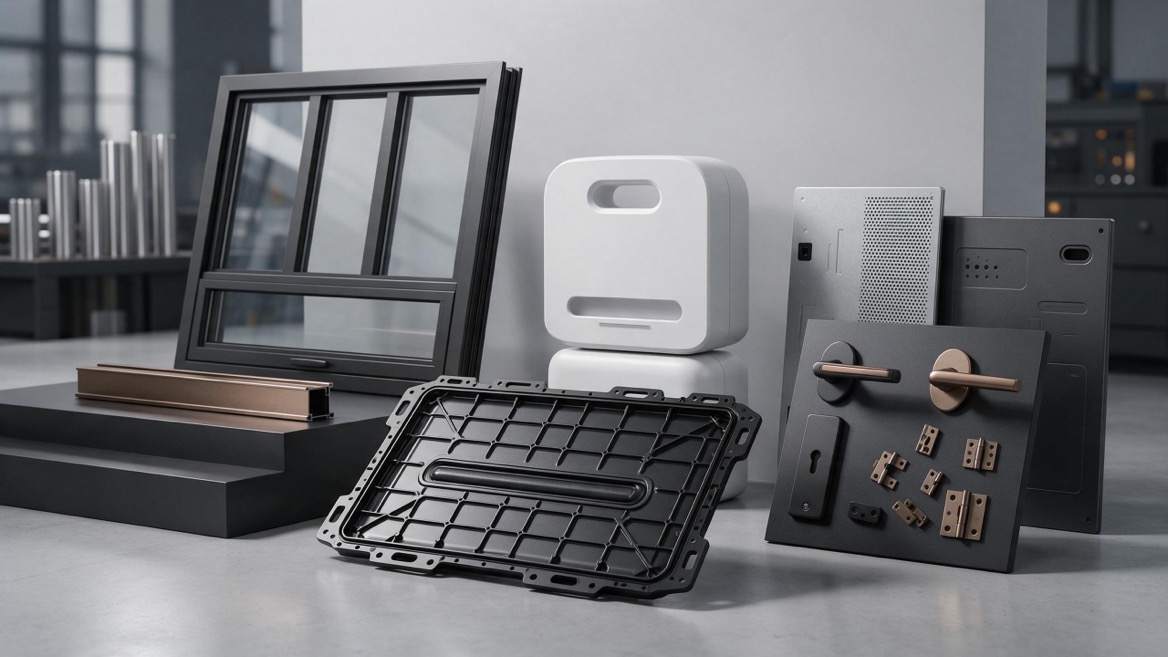
The most important technical question is not "Which colour do we need?" It is "What must the coating survive?"
Different resin systems are designed for different environments. Selecting the wrong chemistry can result in chalking, colour fade, reduced gloss, corrosion, poor chemical resistance, or cracking after forming.
| Powder Coating Type | Typical Strengths | Common Applications | Key Consideration |
|---|---|---|---|
| Epoxy powder coating | Strong adhesion and chemical resistance | Indoor machinery, electrical cabinets, pipelines, laboratory furniture | Can chalk or lose appearance under long-term outdoor UV exposure |
| Epoxy-polyester hybrid | Balanced appearance, cost, and interior durability | Office furniture, household appliances, shelving, indoor fixtures | Better suited to indoor or protected environments |
| Polyester powder coating | Good exterior durability and broad colour range | Aluminium profiles, doors, windows, fencing, outdoor furniture | Select performance grade based on UV and climate exposure |
| Super-durable polyester | Improved gloss and colour retention outdoors | Architectural metalwork, premium outdoor products, EV components | Often preferred where appearance retention is critical |
| Polyurethane powder coating | Strong finish quality, chemical resistance, and exterior performance | Automotive parts, high-end industrial components, selected exterior uses | Requires careful process control and appropriate safety handling |
| Fluoropolymer powder coating | High weatherability and colour retention | Landmark architecture, demanding façades, severe sunlight exposure | Usually selected for premium specifications and longer service expectations |
| High-temperature powder coating | Heat resistance for specified operating temperatures | Grills, selected exhaust components, ovens, industrial equipment | Validate temperature cycling, substrate temperature, and actual heat exposure |
For exterior architectural aluminium, polyester and super-durable polyester are commonly considered because they offer useful weatherability and decorative flexibility. For demanding architectural work, purchasing teams should request evidence against the applicable project specification instead of relying only on generic claims such as "outdoor grade."
QUALICOAT specifications establish minimum requirements for coating materials, production equipment, and finished products used in architectural applications. Depending on the market and project, additional requirements may relate to weathering, film thickness, adhesion, impact, humidity, salt spray, chemical resistance, and colour retention.
A coating should be selected according to the conditions the finished product will face after installation—not only the conditions inside the factory.
Architectural products may face sunlight, rain, humidity, airborne contaminants, cleaning chemicals, and coastal salt exposure. A project in an inland residential area may require a different coating system from a façade installed near the sea or in a hot, high-UV region.
Before specifying architectural powder coating paint, confirm:
- The project location and distance from the coast
- Annual UV exposure and temperature range
- Expected humidity and rainfall
- Industrial pollution or chemical exposure
- Aluminium alloy and profile design
- Pretreatment process, including conversion coating quality
- Required gloss level, metallic effect, and batch-to-batch colour tolerance
- Applicable architectural performance specification
For high-visibility façades and premium window systems, colour stability should be treated as a long-term performance requirement. Dark colours, bright reds, intense yellows, and some metallic effects may need more careful formulation and validation because pigment selection strongly affects weathering performance.
New-energy vehicle parts can involve demanding requirements for mechanical durability, corrosion resistance, appearance, electrical insulation, and compatibility with complex manufacturing processes.
Typical coated components include:
- Battery enclosure components
- Metal brackets and mounting systems
- Chassis-related parts
- Wheels and trim components
- Charging equipment housings
- Electrical cabinets and protective enclosures
The coating specification should account for vibration, stone-chip exposure, humidity, salt, cleaning fluids, and thermal cycling. It is also essential to verify whether the part will be formed, welded, assembled, or exposed to adhesives after coating. A coating with excellent hardness but insufficient flexibility may crack during downstream processing.
Medical equipment and appliance coatings often require a controlled combination of appearance, cleanability, chemical resistance, and reliable coverage over edges and complex shapes.
For these sectors, ask practical questions:
1. Will the surface be cleaned frequently with disinfectants or detergents?
2. Is a low-gloss or anti-glare surface required?
3. Are colour consistency and premium appearance important for brand perception?
4. Will the coating contact heat, moisture, or electrical components?
5. Are low-odour, low-emission production requirements relevant to the facility?
A textured finish can help conceal minor substrate imperfections and handling marks, but it may also affect cleanability. Smooth finishes can be easier to wipe down, while matte surfaces can reduce glare and fingerprints. The best option depends on the user's actual operating environment.
Many coating failures are blamed on the powder when the real issue began before the powder was sprayed.
Oil, grease, oxide layers, welding residue, rust, dust, moisture, soluble salts, and poor conversion coatings can reduce adhesion and accelerate corrosion. A premium powder coating cannot fully compensate for an inconsistent cleaning and pretreatment process.
For steel structures, international corrosion-protection guidance recognizes that coating performance is tied to surface preparation, coating technology, film thickness, and the number of coating layers used to meet a specified corrosivity category.
1. Inspect the substrate. Identify metal type, surface defects, weld spatter, rust, oil, and contaminants before production begins.
2. Remove oils and soils. Use a controlled cleaning process that matches the substrate and manufacturing residues.
3. Rinse thoroughly. Poor rinsing can leave chemical residues that affect adhesion or corrosion resistance.
4. Apply the correct conversion treatment. Steel, galvanized steel, aluminium, and mixed-metal assemblies may require different pretreatment approaches.
5. Dry completely. Residual moisture can cause coating defects, pinholes, or poor adhesion.
6. Control the time before coating. Do not allow prepared parts to sit too long in contaminated or humid conditions.
7. Verify the process. Monitor bath concentration, pH, conductivity, temperature, coating weight where relevant, and rinse-water quality.
For a manufacturer, pretreatment control is not simply a quality-department issue. It affects powder consumption, reject rate, corrosion performance, customer claims, and brand reputation.
Even an appropriate powder formulation can underperform when film thickness or curing is inconsistent.
A coating film that is too thin may provide inadequate coverage, poor edge protection, and reduced corrosion resistance. A film that is too thick may create sagging, poor appearance, trapped air, reduced impact performance, or curing difficulties. The correct target depends on the powder type, substrate, geometry, surface condition, and project specification.
Curing must also be verified by part metal temperature, not oven-air temperature alone. A thick steel component, thin aluminium extrusion, and densely loaded rack do not heat at the same rate.
A practical production-control approach includes:
- Measuring dry-film thickness at representative locations
- Using oven data loggers to confirm the part's real cure profile
- Checking cross-hatch adhesion after curing
- Monitoring gloss, colour, and visual appearance against approved standards
- Testing impact resistance where required
- Conducting corrosion and humidity testing according to the agreed specification
- Retaining production panels for traceability and customer comparison
Industry performance programs may evaluate coated products through tests such as adhesion, impact, abrasion, chemical resistance, corrosion exposure, humidity resistance, and long-term weathering. This is why a supplier should be able to discuss test methods, sample preparation, film thickness, cure schedule, and acceptance criteria—not only provide a colour card.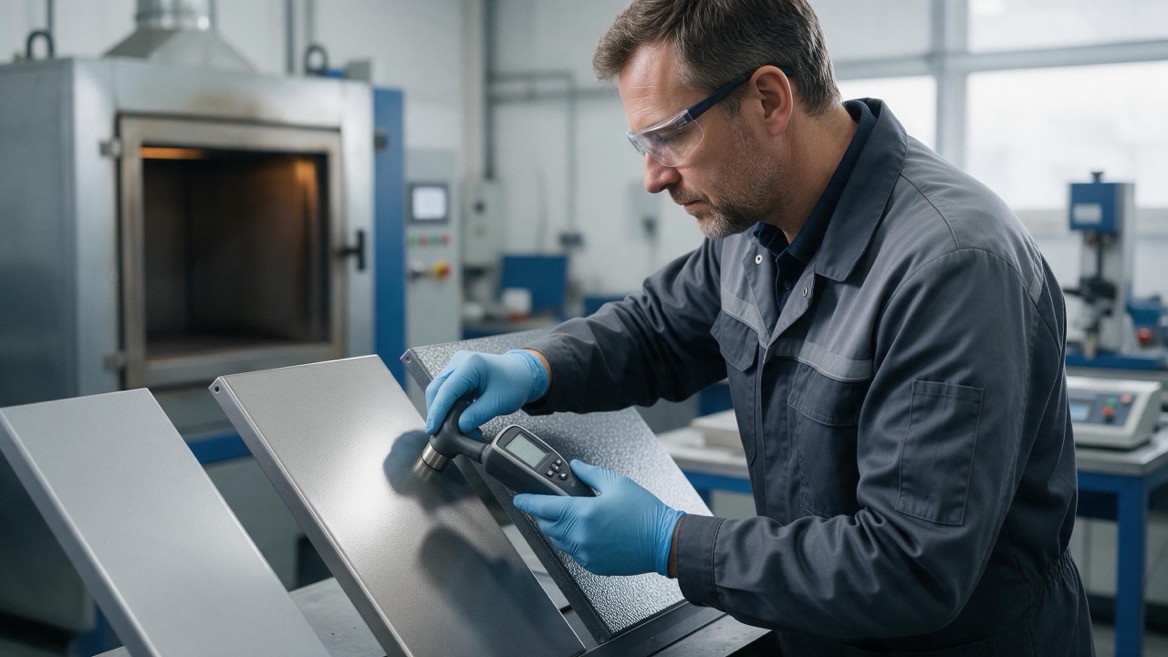
Orange peel is an uneven surface texture that resembles citrus skin. It may result from poor powder flow, insufficient heat, incorrect film thickness, unsuitable spraying parameters, or inconsistent substrate condition.
Prevention: Confirm cure profile, adjust film build, check powder storage, and optimize gun voltage, air settings, and spray distance.
Pinholes can appear when trapped gases escape from porous castings, galvanized steel, contaminated substrates, or inadequately degassed materials during curing.
Prevention: Improve substrate preparation, use suitable degassing-grade powder where appropriate, optimize pre-bake conditions, and avoid excessive film thickness.
Poor adhesion can occur because of inadequate cleaning, weak pretreatment, incorrect curing, contamination, or unsuitable coating selection.
Prevention: Audit pretreatment stages, perform regular adhesion testing, prevent handling contamination, and validate the cure schedule using actual metal temperature.
Colour inconsistency may arise from mixing batches, inconsistent film thickness, varying cure conditions, metallic pigment orientation, or different substrate shades.
Prevention: Use approved production standards, maintain batch traceability, control application parameters, and evaluate metallic finishes under consistent lighting conditions.
Sharp edges are naturally difficult to cover because the electric field can pull powder away from certain geometries.
Prevention: Use suitable part design where possible, optimise grounding and gun settings, control spray angle, and consider powder formulations designed for edge coverage.
A clear request for quotation produces a better coating recommendation and reduces trial-and-error production.
When contacting a powder coating manufacturer, provide the following information:
- Substrate type: steel, galvanized steel, aluminium, die-cast aluminium, or another material
- Part dimensions, thickness, geometry, and whether edges are sharp or rounded
- End-use industry and installation environment
- Indoor, outdoor, coastal, industrial, chemical, or high-temperature exposure
- Required colour standard, gloss range, texture, metallic effect, or custom sample
- Required film thickness
- Pretreatment process currently used or planned
- Application equipment and powder-recovery configuration
- Oven type, target cure condition, and maximum part temperature
- Performance targets, test standards, and required certifications
- Expected annual volume and batch size
- Packaging, storage, export destination, and lead-time requirements
This information enables a coating manufacturer to recommend a formula based on actual risk factors. It also creates a documented baseline for sample approval, line trials, quality control, and future colour matching.
Selecting powder coating paint is a systems decision. The best product is the one that performs consistently on your parts, with your pretreatment line, your spray equipment, your curing profile, and your end-user environment.
Yinda Technology supports industrial customers with powder coating development, manufacturing, colour matching, technical consultation, and lower-emission material solutions. With subsidiaries in China, Indonesia, and Saudi Arabia, we are positioned to support regional manufacturing needs while helping customers align coating performance with application requirements.
If you are developing aluminium profiles, doors and windows, EV components, medical equipment, hardware, electrical enclosures, or other metal products, share your substrate, environmental conditions, colour target, and required performance level with our technical team. We can help you evaluate the right powder coating system before you commit to full-scale production.
Powder coating can be the better choice for many factory-coated metal products because it offers durable film formation, broad finish options, and a low-solvent application method. However, liquid paint may be more suitable for oversized structures, on-site repair, heat-sensitive components, or applications that cannot be oven cured.
Outdoor service life depends on resin chemistry, pigment selection, pretreatment, coating thickness, installation location, maintenance, UV exposure, and salt or industrial pollution. For exterior products, use a coating system designed for the actual climate and validate it against the relevant performance requirement.
Yes. Powder coating is widely used on aluminium profiles, window frames, doors, curtain-wall components, furniture, enclosures, and industrial parts. Proper cleaning and conversion treatment are essential to obtain reliable adhesion and corrosion resistance.
Powder coatings typically contain little to no VOC because they are applied as dry particles rather than dissolved in conventional organic solvents. Actual emissions can still depend on the total manufacturing process, oven operation, cleaning materials, and any auxiliary products used on the line.
Polyester, super-durable polyester, polyurethane, and fluoropolymer powder coatings may be selected for outdoor projects depending on the level of UV exposure, climate severity, colour-retention expectations, corrosion conditions, and project specification. A technical review is recommended before choosing.
Peeling or flaking is commonly linked to poor surface cleaning, inadequate pretreatment, contamination, insufficient curing, incorrect powder selection, or coating over an unsuitable substrate. Investigating the full pretreatment-to-curing process is more effective than evaluating the powder alone.
Special high-temperature powder coatings can be formulated for parts exposed to elevated temperatures, including selected grills, ovens, industrial equipment, and automotive components. The acceptable temperature range must be confirmed for the specific formula and actual use conditions because thermal cycling, exposure duration, and substrate type all affect performance.
- [Kroma Coatings — Powder Coating Paints: Top 6 Things You Need to Know About]
- [U.S. Environmental Protection Agency — AP-42, Other Metal Coating] [epa]
- [U.S. Environmental Protection Agency — Clean Lines: Powder Coatings] [epa]
- [ASTM International — ASTM D3451: Standard Guide for Testing Coating Powders and Powder Coatings] [astm]
- [QUALICOAT — Specifications for Architectural Coatings] [qualicoat]
- [Sherwin-Williams — ISO 12944 Steel Coatings Specification Guide] [industrial.sherwin-williams]
- [Gordon Inc. — Powder Coatings for AAMA 2604 and AAMA 2605 Applications] [gordon-inc]


