Language


Views: 257 Author: Yinda Powder Coating Publish Time: 2026-09-16 Origin: Site


Content Menu
● What Is Inside a Powder Coating Color?
>> Resin: The Foundation of Performance
>> Pigments: More Than "Color Powder"
● How Powder Coating Powder Colors Are Manufactured
>> Step 1: Raw Material Inspection and Formula Weighing
>> Step 4: Cooling, Flaking, and Crushing
>> Step 5: Milling and Particle-Size Classification
>> Step 6: Post-Blending and Final Packaging
● How Manufacturers Create Consistent Powder Coating Colors
>> Color Matching Starts With a Physical Standard
>> Color Is Measured, Not Only Observed
>> Gloss, Texture, and Film Thickness Change Perceived Color
● Choosing the Right Powder Coating Chemistry
● Application Methods and Their Effect on Color
● Curing: Where Powder Becomes a Protective Film
● Quality Control: What Buyers Should Ask a Powder Coating Supplier
>> A Practical Example: Aluminum Window Profiles
● Environmental and Production Benefits
● Work With Yinda Technology on Your Next Powder Coating Project
>> 1. What are powder coating colors made of?
>> 2. How is colored powder coating powder manufactured?
>> 3. Can powder coating colors be customized?
>> 4. Why does the same powder coating color look different on different parts?
>> 5. Which powder coating is best for outdoor aluminum profiles?
>> 6. Does particle size affect powder coating quality?
>> 7. Is powder coating environmentally responsible?
Powder coating colors are made by combining carefully selected resins, pigments, additives, and functional fillers, then processing the blend through extrusion, cooling, milling, classification, and quality testing. For industrial buyers, the finished color is not simply a visual choice—it is a formulated performance system that must achieve the required appearance, weatherability, adhesion, corrosion resistance, application efficiency, and curing behavior.
At Yinda Technology, we develop and manufacture powder coatings and environmentally responsible material solutions for architectural profiles, doors and windows, new-energy vehicles, medical equipment, hardware, electrical products, and other demanding metal-finishing applications. With operations in China, Indonesia, and Saudi Arabia, our technical teams work with customers across different climates, substrates, production lines, and performance specifications.
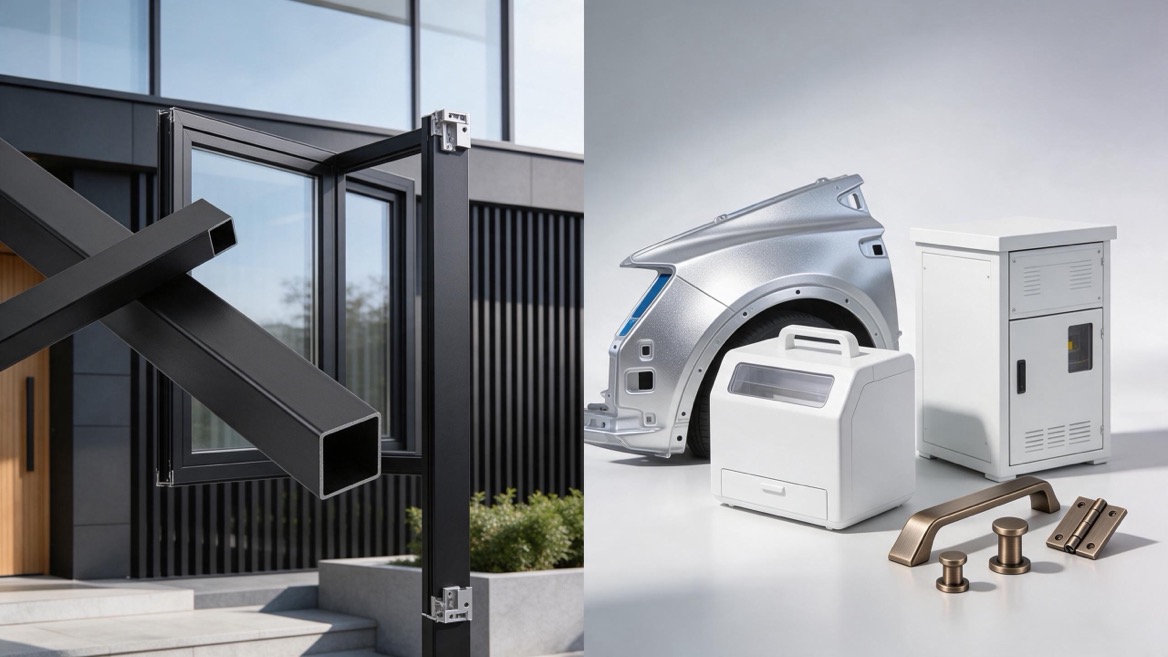
A powder coating is a dry, finely ground coating material. Unlike conventional liquid paint, it does not rely on a liquid solvent to carry the coating onto the part. Its final appearance and protection come from the interaction of multiple precisely controlled ingredients.
The four main groups of raw materials are:
| Material Group | Primary Function | Effect on the Final Coating |
|---|---|---|
| Resin or binder | Forms the continuous coating film after curing | Determines adhesion, flexibility, chemical resistance, durability, and heat resistance |
| Pigment | Creates color and opacity | Controls hue, brightness, hiding power, and color consistency |
| Additives | Improve processing and application behavior | Support flow, leveling, degassing, anti-cratering, texture, and charging performance |
| Fillers and extenders | Adjust formulation balance and film properties | Influence cost, gloss, mechanical strength, texture, and surface appearance |
The resin system is usually the first decision in powder coating formulation. It affects far more than durability. It also determines how the powder melts, flows, crosslinks, and performs after curing.
Common resin systems include:
- Epoxy powder coatings for strong adhesion and chemical resistance, especially in indoor or protected environments.
- Epoxy-polyester hybrid coatings for indoor furniture, appliances, electrical cabinets, shelving, and general metal products.
- Polyester powder coatings for outdoor metal applications that require good weather resistance.
- Super-durable polyester powder coatings for higher outdoor durability in architectural, infrastructure, and demanding exterior projects.
- Polyurethane powder coatings for smooth appearance, chemical resistance, and high decorative performance.
- Fluoropolymer powder coatings for premium outdoor applications where long-term color and gloss retention are especially important.
A color that looks identical on a small sample panel may perform very differently outdoors depending on the resin chemistry behind it. This is why a project should begin with service conditions—not only a color code.
Pigments provide the visible color, but their role is more complex than many buyers expect. A pigment must be compatible with the resin system, stable during extrusion and curing, properly dispersed, and appropriate for the product's intended environment.
For example:
- Organic pigments can create vivid reds, yellows, oranges, and blues, but certain grades may have limitations in heat stability or exterior durability.
- Inorganic pigments often provide stronger weather resistance, heat resistance, and chemical stability.
- Titanium dioxide is widely used to create white coatings and improve opacity in light colors.
- Carbon black is used for black shades and can influence UV protection.
- Metallic pigments create silver, gold, bronze, champagne, and other visual effects.
- Pearlescent pigments create depth, sparkle, or shifting visual effects.
In our experience as a powder coating manufacturer, the most difficult shades are often not basic black, white, or gray. Bright yellow, saturated red, deep blue, transparent effects, metallic finishes, and low-gloss dark colors can require more detailed formulation work and stricter production controls.
The production process must transform different raw materials into a homogeneous powder with stable color, controlled particle size, reliable flow, and predictable curing behavior. A good formulation can still fail if it is processed inconsistently.
Before production begins, incoming raw materials are checked against internal specifications. This may include appearance, color strength, moisture level, particle characteristics, and batch documentation.
Each ingredient is then weighed according to the approved formula. Even small changes in pigment dosage, additive level, or resin ratio can influence the final coating.
For custom colors, accurate weighing is essential because color differences can become visible after curing. This is particularly important when customers need repeat orders over many months or require multiple production locations to maintain a similar appearance.
The resin, pigments, curing agents, fillers, and additives are dry blended in a high-speed mixer.
The purpose of premixing is not to create the final powder. It prepares a uniform feed material for extrusion. Poor premixing can lead to pigment streaks, uneven gloss, inconsistent performance, or local variation in color.
A properly mixed premix helps ensure that all ingredients enter the extrusion stage in the correct proportion.
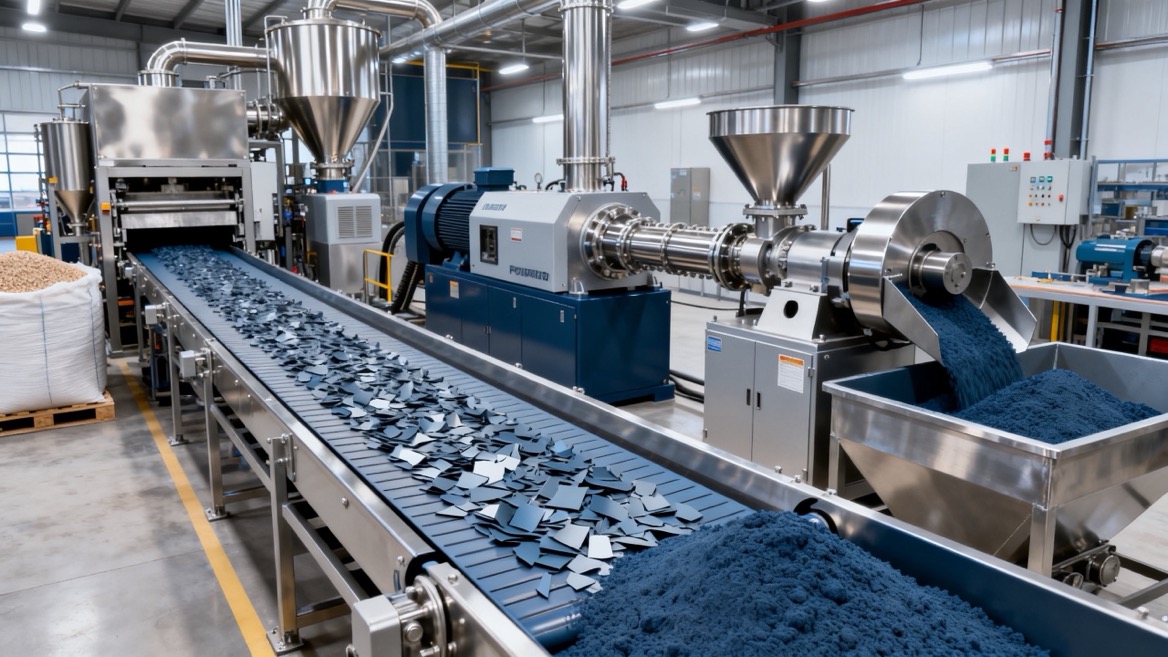
The premix enters an extruder, where controlled heat and mechanical shear melt and disperse the ingredients. This is one of the most important stages in powder coating manufacturing.
During extrusion:
1. The resin softens and melts.
2. Pigments and additives become dispersed throughout the resin matrix.
3. The material becomes a homogeneous molten mass.
4. Process settings are controlled to avoid under-dispersion, over-heating, or premature chemical reaction.
Extrusion temperature, screw speed, feed rate, and cooling conditions must be managed together. If the material is not dispersed well enough, the finished coating may show color variation, poor gloss, weak mechanical performance, or visible particles. If processing is too aggressive, it can negatively affect flow or curing response.
After extrusion, the hot material is cooled rapidly on cooling rollers or a cooling belt. It becomes a solid sheet or ribbon, which is then broken into chips.
These chips are easier to handle and prepare for the grinding process. At this stage, manufacturers can inspect the material for visible uniformity before converting it into fine powder.
The chips are ground into fine powder using a milling system. The powder is then classified or sieved to achieve the desired particle-size distribution.
Particle size matters because it affects:
- Powder flow in the feed hopper
- Electrostatic charging behavior
- Transfer efficiency
- Film thickness control
- Surface leveling
- Edge coverage
- Smoothness after curing
- Reclaim powder stability
A powder that is too coarse may create a rougher surface and uneven film build. A powder with excessive fine particles can generate dust, reduce fluidization quality, and create application instability. Industry testing also recognizes particle size as a key factor affecting flow, electrostatic application, film uniformity, and finish quality.
For many electrostatic spray applications, manufacturers commonly manage particle-size distribution within a practical range that supports consistent coating behavior. The precise target should be set according to the application equipment, film-thickness requirement, surface geometry, and desired finish.
Some products require post-blending after milling. This may include dry blending with metallic pigments, flow modifiers, or other effect materials that should not pass through extrusion.
The finished powder is then packed in moisture-protective packaging and labeled with essential product information, such as:
- Product name and code
- Color reference
- Batch number
- Net weight
- Recommended curing condition
- Storage guidance
- Production date
- Safety and handling information
A color card is useful, but it is not enough for a production project. The real challenge is repeatability: making sure that a customer receives a consistent shade across multiple batches, production cycles, factories, and coated parts.
A customer may provide one of the following:
- RAL, Pantone, NCS, or another recognized color reference
- A painted metal sample
- A plastic part
- A previous powder-coated panel
- A digital color value
- A brand color requirement
- An approved "golden sample"
Digital references are helpful for communication, but they should not be treated as the only approval standard. Screen brightness, lighting, camera settings, and display calibration can all alter perceived color.
For industrial powder coating projects, the best practice is to approve a cured metal test panel under agreed lighting conditions.
Professional color control combines visual evaluation with instrument measurement. A spectrophotometer can measure color values and help compare production panels with an approved standard.
Color difference is commonly represented by Delta E, written as \(\Delta E\). A lower Delta E generally indicates a closer match, but the acceptable tolerance must be agreed based on the product, color family, gloss level, surface texture, and end-use expectations.
For example, a small variation may be acceptable on a textured black fence panel but unacceptable on smooth white aluminum window profiles installed side by side on a high-end building façade.
A common source of customer concern is that two panels have the same color code but do not look identical. Often, the issue is not the pigment formula alone.
Perceived color can change because of:
- Gloss differences
- Texture differences
- Film-thickness variation
- Different substrate colors
- Surface pretreatment variation
- Curing temperature variation
- Oven dwell time
- Lighting conditions
- Viewing angle
- Metallic pigment orientation
Color approval should therefore include the full coating system, not only the powder code. The same product can look different on polished steel, galvanized steel, cast aluminum, aluminum extrusion, or a rough welded component.
Selecting a powder coating should begin with where and how the coated part will be used. The table below provides a practical starting point.
| Application Environment | Recommended Powder Coating Type | Typical Examples |
|---|---|---|
| Indoor, low UV exposure | Epoxy or epoxy-polyester hybrid | Electrical cabinets, office furniture, shelving, appliances |
| Outdoor general use | Polyester | Gates, fences, garden furniture, bicycle parts, metal fixtures |
| High-UV exterior exposure | Super-durable polyester | Window systems, aluminum profiles, exterior doors, façade components |
| Premium long-life architectural exposure | Fluoropolymer or specified high-weatherability system | Landmark buildings, coastal projects, premium façade systems |
| Chemical or corrosion-prone use | Project-specific epoxy, polyester, or multi-layer system | Machinery, industrial enclosures, selected infrastructure components |
| Hygiene-focused environments | Antimicrobial or specialized functional powder coating | Medical equipment, public facilities, selected appliance components |
For architectural aluminum, performance requirements may be linked to specifications such as AAMA 2603, AAMA 2604, or AAMA 2605. These specifications address exterior durability and use weathering, color-change, chalking, gloss-retention, humidity, and corrosion-related testing requirements. The appropriate category depends on the climate, building location, expected service life, and project specification.
The way powder is applied affects both appearance and material efficiency. Two common methods are electrostatic spray deposition and fluidized-bed coating.
| Method | How It Works | Best Use Cases | Main Consideration |
|---|---|---|---|
| Electrostatic spray deposition | Charged powder particles are sprayed toward a grounded metal part | Architectural profiles, automotive components, appliances, hardware, electrical products | Requires stable grounding, gun settings, air flow, and powder feed |
| Fluidized-bed coating | Heated parts are immersed in suspended powder particles | Thick protective coatings, wire goods, selected industrial parts | Produces heavier film builds and requires process-specific powder design |
Electrostatic spraying is widely used because it supports consistent application on complex metal parts. However, applicators should monitor grounding, gun voltage, powder output, booth air balance, reclaim ratio, and part geometry.
For difficult recessed areas, sharp edges, deep corners, and Faraday-cage zones, production teams may need to adjust gun settings or use specialized application procedures. A coating formula alone cannot solve every application problem; the powder, equipment, pretreatment, and operator settings must work as one system.
After application, the coated part enters an oven. Heat causes the powder particles to melt, flow together, and chemically crosslink into a continuous film.
The correct curing schedule depends on the product. It should be defined by metal temperature and time at temperature, rather than oven-air temperature alone.
A curing profile must account for:
- Part mass and thickness
- Metal type
- Oven design
- Conveyor speed
- Loading density
- Product geometry
- Powder chemistry
- Required film properties
Under-curing may reduce adhesion, chemical resistance, hardness, or durability. Over-curing can alter gloss, color, flexibility, and surface appearance—especially with some light colors, metallic finishes, and sensitive pigments.
In production, we recommend verifying curing through controlled process checks rather than relying only on oven settings. This may include oven profiling, solvent-rub testing where appropriate, impact testing, adhesion testing, and cured-panel inspection.
A reliable powder coating supplier should be able to explain not only the color but also how the product will perform and how it will be controlled.
Before approving a coating, ask for:
1. Technical data sheet with recommended curing schedule, gloss range, film thickness, and application guidance.
2. Color and appearance standard based on a cured approved panel.
3. Batch traceability for powders supplied to your production line.
4. Performance-test information relevant to your application, such as adhesion, impact, hardness, salt spray, humidity, or weathering.
5. Pretreatment recommendation based on the substrate and service environment.
6. Storage guidance to prevent caking, moisture exposure, or reduced fluidization.
7. Application support for issues involving electrostatic settings, reclaim powder, film build, or finish defects.
For aluminum windows installed in a hot, humid, or coastal environment, the coating decision should consider more than visual color.
A stronger project brief would include:
- Approved color and gloss level
- Smooth, sand texture, metallic, or matte finish
- Aluminum alloy and pretreatment method
- Interior or exterior use
- Local UV intensity and humidity
- Distance from the coast or industrial pollution sources
- Required weatherability specification
- Expected service life
- Film-thickness target
- Production-line curing capability
This information allows the manufacturer to recommend a coating system that is suitable for the project rather than offering a generic "outdoor powder coating."
Powder coatings are widely recognized for their low-solvent application model. They generally contain little to no solvent and can greatly reduce volatile organic compound emissions compared with many solvent-borne coating systems. The U.S. Environmental Protection Agency notes that powder coatings contain almost no VOCs, while the Powder Coating Institute describes powder coating as a solvent-free option with negligible VOC emissions in normal use.
Other practical benefits can include:
- High material utilization, especially where overspray is collected and reused under controlled conditions
- Durable finishes that can resist chipping, abrasion, fading, and corrosion when the right system is selected
- Efficient single-coat processes for many industrial applications
- Broad appearance options, including gloss, matte, texture, metallic, wrinkle, hammer, sand texture, and customized effects
- Reduced dependence on liquid coating solvents during application
These benefits should be evaluated at the full-system level. Energy use, pretreatment chemistry, curing-oven efficiency, powder recovery, waste management, and product lifetime all influence the environmental profile of a coating operation.
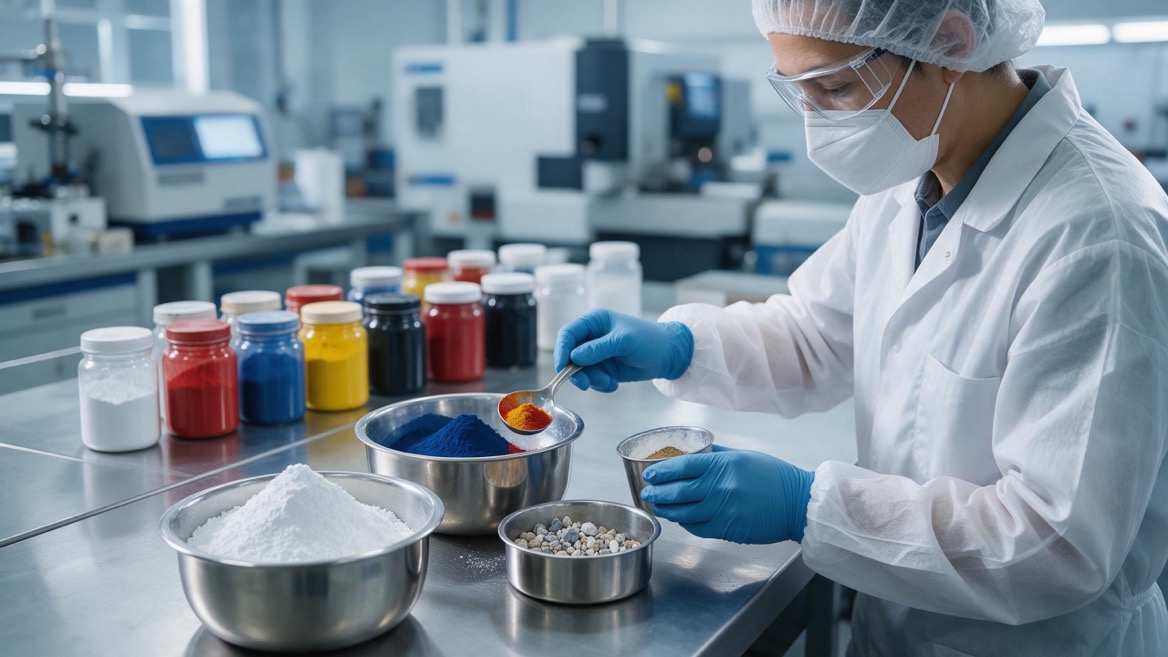
The right powder coating color is a balance of visual identity, product function, production efficiency, and long-term durability. Whether you need a stable RAL shade for aluminum profiles, a durable coating for new-energy vehicle components, a customized textured finish for hardware, or a functional solution for medical and electrical equipment, the coating should be engineered around the actual application conditions.
Yinda Technology supports customers with powder coating development, color customization, performance-oriented formulation, and technical communication across China, Indonesia, and Saudi Arabia.
Contact Yinda Technology with your substrate, target color, finish requirement, application method, and service environment to discuss a powder coating solution designed for your product.
Powder coating colors are made from a resin system, pigments, additives, curing agents, and fillers or extenders. The exact formulation depends on the required color, gloss, texture, curing condition, durability, chemical resistance, and end-use environment.
Manufacturers weigh and premix raw materials, melt-blend them through extrusion, cool the material into chips, grind the chips into fine powder, classify the particle size, inspect the finished product, and package it for shipment.
Yes. Powder coating manufacturers can develop custom colors based on a physical sample, a recognized color system, a brand standard, or an approved coated panel. Customization can also include gloss level, texture, metallic effect, sparkle, wrinkle finish, and special functional properties.
The appearance can change because of substrate type, surface roughness, pretreatment, coating thickness, curing conditions, gloss level, lighting, viewing angle, and metallic pigment orientation. For this reason, color should be approved on the actual substrate and finish configuration whenever possible.
For general outdoor applications, polyester powder coating is often used. For projects with higher UV exposure or more demanding long-term appearance requirements, super-durable polyester or fluoropolymer powder coating may be more suitable. The final selection should reflect local climate, building use, and project performance requirements.
Yes. Particle-size distribution affects powder flow, electrostatic charging, transfer efficiency, film build, surface leveling, and final appearance. Excessive fine particles can increase dusting and fluidization problems, while overly coarse powder can create a rough or uneven finish.
Powder coatings generally use a solvent-free or near-solvent-free application approach and can produce negligible VOC emissions compared with many solvent-borne coatings. The overall environmental outcome also depends on pretreatment, energy use, powder recovery, waste handling, and the service life of the finished product.
1. [Kroma Coatings — Making Powder Coating Colors: The Full Process]
2. [U.S. Environmental Protection Agency — AP-42: Other Metal Coating]
4. [Powder Coating Institute — Sustainability: VOC Elimination]
5. [Powder Coating Institute — Environmental Impact]
6. [Malvern Panalytical — Particle Size Analysis for Powder Coatings]
7. [Infinita Lab — ASTM D3451 Coating Powder Testing Guide]
8. [Katena Railings — AAMA 2603 vs 2604 vs 2605 Powder Coat Ratings]


