Language


Views: 238 Author: Yinda Powder Coating Publish Time: 2026-09-17 Origin: Site


Content Menu
● Why Deep Recesses Are Difficult to Powder Coat
● How Corona Spray Technology Works
>> The Corona Advantage: Strong Electrostatic Attraction
>> Corona Limitation: Edge Build-Up and Back Ionization
● How Electrostatic Friction (Tribo) Technology Works
>> Why Tribo Improves Deep-Recess Coverage
● Tribo vs. Corona: Direct Comparison
● When Tribo Is the Better Choice
>> Practical Example: Electrical Control Cabinet
● When Corona Is the Better Choice
● How to Improve Corona Coating in Deep Recesses
>> 4. Adjust Gun Angle and Distance
>> 5. Verify Grounding Before Changing Everything Else
● Powder Formulation Matters as Much as Gun Choice
● Quality-Control Plan for Deep Recess Coating
● Decision Framework for Manufacturers
● FAQ
>> 1. What is the Faraday cage effect in powder coating?
>> 2. Is tribo powder coating always better than corona powder coating?
>> 3. Can corona powder coating be used on deep metal enclosures?
>> 4. Why does powder build up around the opening of a recess?
>> 5. Does tribo powder coating require a special powder?
>> 6. What causes back ionization in powder coating?
>> 7. How should I inspect powder coating inside deep recesses?
Coating deep recesses in metal enclosures is one of the most demanding powder-application challenges. For manufacturers of electrical cabinets, medical-device housings, battery boxes, architectural profiles, metal doors, appliance panels, and new-energy vehicle components, insufficient coverage inside channels, corners, cavities, and undercuts can create corrosion risks, inconsistent appearance, and costly rework.
The central decision is often electrostatic friction (tribo) vs. corona spray technology. Both systems can produce durable, high-quality powder-coated finishes. However, they charge and deposit powder differently, which directly affects their ability to coat difficult Faraday areas. For deep recessed metal enclosures, tribo technology frequently provides a more forgiving route to internal coverage, while a well-configured corona system can remain highly productive and cost-effective for mixed or high-throughput production.
At Yinda Technology, we approach this choice as a complete finishing-system decision rather than simply a gun-selection question. Powder formulation, enclosure geometry, grounding, air settings, target film thickness, operating speed, color-change needs, and quality-control requirements must work together.
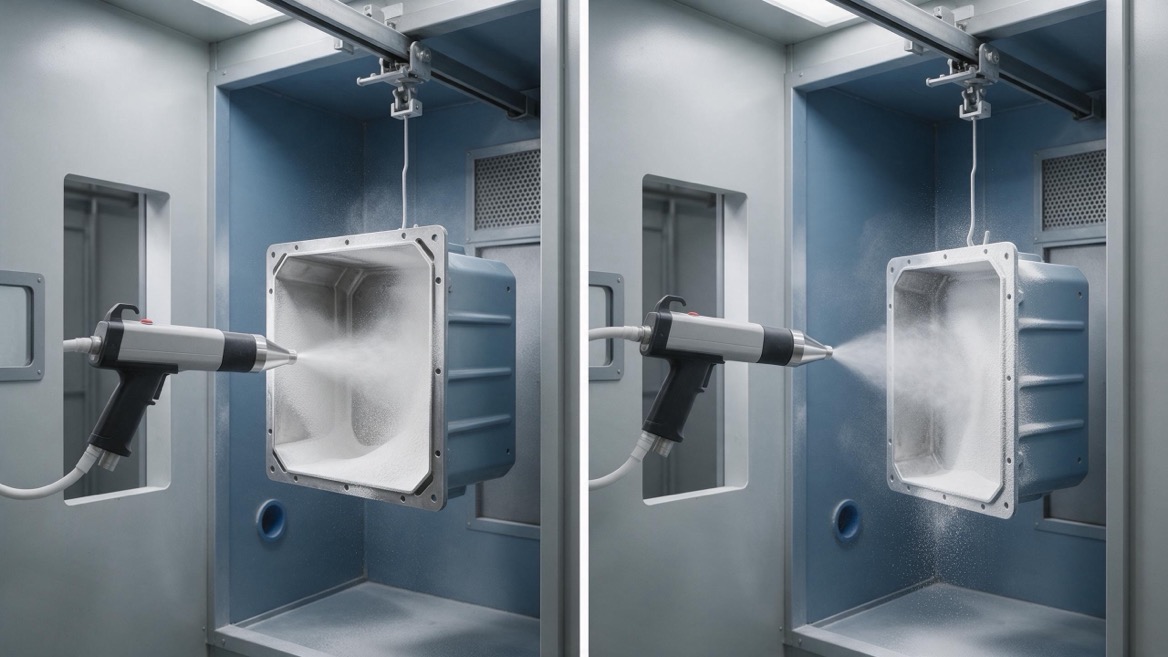
A deep recess is any area where the spray gun cannot maintain a direct, open line of sight to the substrate. Typical examples include:
- Internal corners in electrical cabinets
- Deep channels in aluminum profiles
- Welded frames and box sections
- HVAC housings
- Battery enclosures
- Metal furniture joints
- Medical-equipment covers
- Door and window frame cavities
- Appliance housings with narrow return flanges
The main challenge is called the Faraday cage effect. In electrostatic powder coating, powder particles are electrically charged while the metal workpiece is grounded. The particles are attracted to the grounded surface.
On a flat panel, this principle works extremely well. But inside a narrow channel or sharp internal corner, the electrical field is weaker. The strongest field lines tend to terminate on the nearest outside edges and faces. As a result, powder can build up rapidly on the opening of the recess while the bottom of the recess remains thinly coated or bare. The Powder Coating Institute describes Faraday areas as recesses, internal corners, channels, and other regions where the external electrical field does not penetrate effectively.
This is not only a visual problem. A poorly coated internal corner may become the earliest point of corrosion, especially in outdoor architectural products, industrial electrical enclosures, transport equipment, and humid-service environments.
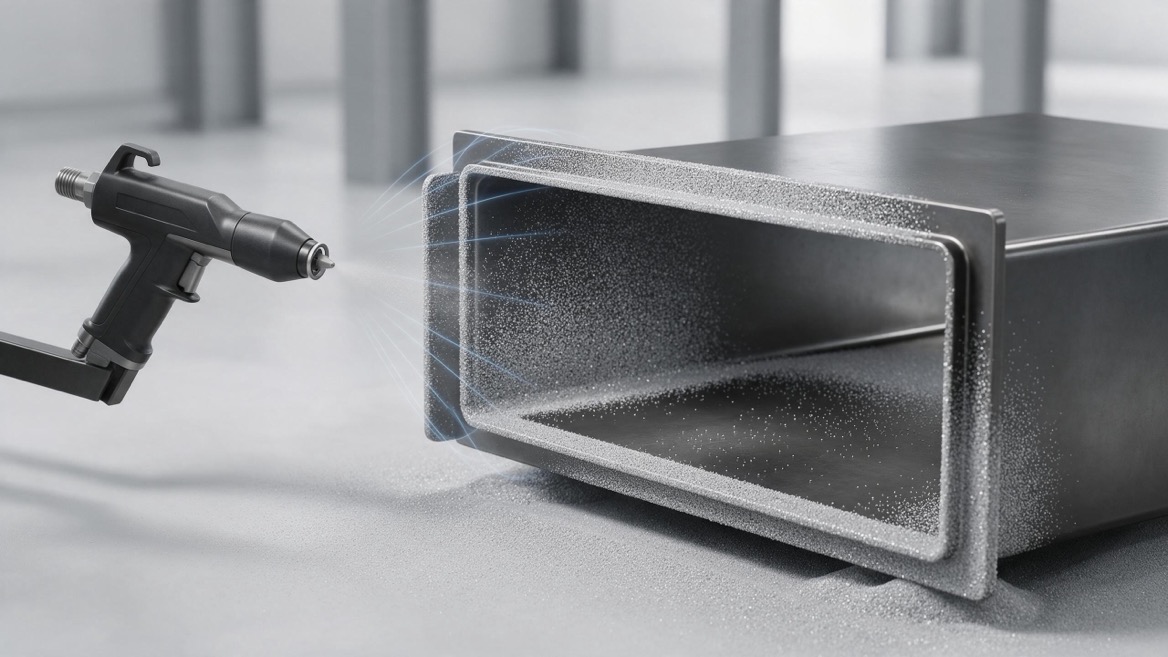
Corona powder coating is the most widely used electrostatic application method. In a corona system, a high-voltage electrode at the tip of the spray gun ionizes the surrounding air. The ions charge the powder particles as they leave the gun. The charged powder is then attracted to the grounded metal workpiece.
Corona systems are popular because they offer:
- High application speed
- Strong wraparound effect on open geometries
- Broad powder compatibility
- Reliable performance across many standard coating lines
- Flexible operation for manual and automatic systems
- Good suitability for flat panels, open frames, profiles, and exterior surfaces
For architectural aluminum, electrical panels, appliance shells, general hardware, and many fabricated steel products, corona application can be highly efficient. It is especially useful when production involves varied part sizes, frequent color changes, or a broad range of powder chemistries.
The major strength of corona technology is its powerful electrostatic field. Powder particles are strongly drawn toward grounded metal surfaces, which can improve transfer efficiency and help powder wrap around the sides of relatively open parts.
For external surfaces, corona often provides fast and predictable coverage. Automatic reciprocators and fixed-gun arrangements can coat large volumes of parts with stable results when part geometry and grounding are well controlled.
However, the same strong field that helps powder reach open surfaces can become a limitation when coating a deep cavity.
In deep recesses, corona-charged powder may deposit heavily on the outer edges before sufficient powder reaches the interior. Operators sometimes respond by increasing voltage or extending spray time. This often worsens the issue.
Excessive voltage can create back ionization, where accumulated free ions interfere with powder deposition. The visible result may include:
- Pinholes
- Craters
- Orange peel
- Uneven film build
- Edge overcoating
- Weak coverage in the deepest recesses
Technical guidance from TCI Powder Coatings identifies deep recess coating and thickness control as common corona-application difficulties. It also notes that edges can build rapidly and back-ionize before recessed areas receive adequate coating.
The practical lesson is simple: more voltage is not always better.
Electrostatic friction, commonly called tribo powder coating, charges powder through friction rather than through a high-voltage corona electrode.
Inside a tribo gun, powder moves through specially designed tubing and components. Contact and friction between the powder particles and the gun's internal surfaces create an electrical charge. The charged particles then travel toward the grounded workpiece.
Unlike corona application, tribo systems do not depend on a strong external ionization field between the gun and the part. This difference is especially important when coating difficult geometries.
Tribo charging reduces the strong external field that causes powder to accumulate at the entrance of a deep recess. The powder cloud is generally softer and more able to travel into channels, corners, and undercuts before depositing.
This can significantly reduce the Faraday cage effect in applications such as:
- Deep metal enclosures
- Radiator sections
- Wire goods
- Complex fabricated steel parts
- Interior cabinet corners
- Louvered components
- HVAC channels
- Multi-sided structural profiles
- Battery-module housings
- Narrow appliance cavities
Industry guidance explains that tribo guns charge powder through the gun rather than a charging electrode, producing far fewer free-ion issues and reducing Faraday cage formation in recessed areas.
For a powder coater dealing with repeated internal-corner defects, tribo technology can change the process from "difficult to control" to "repeatable at production speed."
| Comparison Factor | Electrostatic Friction (Tribo) | Corona Spray Technology |
|---|---|---|
| Charging method | Powder is charged through friction inside the gun | Powder is charged by high-voltage corona discharge |
| Deep-recess penetration | Excellent for deep corners, channels, cavities, and undercuts | More difficult in narrow or shielded recesses |
| Faraday cage effect | Significantly reduced | More likely, especially at high voltage |
| Free-ion generation | Very low or absent | Present and can contribute to back ionization |
| Edge build-up | Usually lower in difficult geometries | Can be high around cavity openings and sharp edges |
| Powder compatibility | Requires powders formulated for tribo charging | Works with a wider range of standard powders |
| Application flexibility | Best for complex, repeatable parts | Strong all-purpose option for diverse production |
| Film-build capability | Can be effective, but depends on powder and setup | Strong for normal to high film builds on open surfaces |
| Wraparound performance | Less aggressive on open geometry | Strong on accessible surfaces |
| Equipment familiarity | Requires specific setup knowledge and powder selection | Widely available and familiar to most coating operations |
| Best use case | Complex enclosures and difficult internal geometries | High-volume general finishing and open-shape components |
Neither method is universally superior. The correct technology depends on where coating failure occurs and what performance standard the finished product must meet.
Tribo is generally the stronger option when internal coverage is the critical quality requirement.
Choose tribo technology when your metal enclosure has:
- Narrow channels with limited gun access
- Deep internal corners
- Multiple undercuts
- Box-shaped cavities
- Complex welded structures
- Repeated Faraday cage defects
- High risk of corrosion inside hidden areas
- A requirement for more even thickness across internal and external surfaces
Tribo may also be preferable when the part cannot tolerate excess film build on its outside edges. For example, an electrical enclosure door may need a clean exterior appearance while also requiring reliable protection in the inner frame corners. A corona gun may load the frame edge quickly, while a tribo gun can improve powder movement into the recessed region.
Consider a fabricated steel control cabinet with deep internal seams, reinforced corners, door returns, and cable-entry channels.
With corona application, powder may accumulate on the front lip of the channel. The operator may see acceptable visual coverage from outside, but the deepest section can show low dry-film thickness after curing.
A tribo process can improve this outcome because powder is less strongly pulled toward the nearest exposed edges. The operator can direct a controlled powder cloud into the recess before coating the main flat surfaces.
For corrosion-sensitive cabinet applications, this can improve consistency and reduce the chance that a hidden low-film area becomes the first point of coating failure.
Corona technology remains the preferred choice for many powder coating operations. It is especially effective when parts are relatively open, the production line handles many powder types, or high-speed automatic application is required.
Corona is often the better option for:
- Flat metal panels
- Open aluminum profiles
- Appliance skins
- Outdoor furniture frames
- Large exterior cabinet faces
- General hardware
- Parts with limited deep recesses
- Production lines requiring broad powder flexibility
- Coating operations that rely heavily on rapid color changes
A corona system can also perform well on recessed parts when it is correctly tuned. The key is to treat deep recesses as a special coating zone rather than applying the same settings used for large flat surfaces.
Switching to tribo is not always necessary. Many coating lines can significantly improve internal coverage by adjusting corona settings, gun technique, and production sequence.
High voltage increases powder attraction to the closest grounded surfaces. In deep recesses, this usually means the powder builds on the outer edge rather than entering the cavity.
For difficult Faraday areas, reduce voltage and use a more controlled electrostatic field. Practical industry guidance commonly recommends lowering corona voltage from typical high settings when coating recessed features.
The objective is not to eliminate electrostatic attraction. It is to reduce the excessive pull toward the cavity entrance.
Lower current helps reduce free-ion accumulation and can reduce back-ionization risk. This is particularly useful when the opening edges already show heavy powder build.
A low-current or Faraday-mode setting can help operators place powder into the cavity without overloading the surrounding surfaces.
This is one of the most effective process changes.
Spray the deep recesses before coating large flat faces and outside edges. Once powder accumulates on the outer geometry, the electrostatic field becomes even less favorable for the recess.
A practical sequence is:
1. Inspect grounding and hanger contact
2. Apply powder to recesses at reduced voltage
3. Use a focused nozzle or targeted manual pass
4. Coat internal corners and channels
5. Complete the external faces with normal settings
6. Measure film thickness after curing at both visible and hidden locations
Do not spray only perpendicular to the part face. Directing the gun at an angle can help move the powder cloud into the cavity.
For deep channels, use an approach that aims into the recess rather than at the edges around it. A focused nozzle, reduced air velocity, and controlled powder output can improve penetration.
The Powder Coating Institute emphasizes that successful Faraday-area coating requires adequate powder charging, airflow sufficient to deliver powder into the recess, and controlled external field strength to prevent powder from depositing excessively at the edge.
Poor grounding can look like a gun-setting problem. It is not.
Every workpiece must have a reliable electrical path to ground through the hanger, conveyor, and coating system. Contamination, worn hooks, paint build-up, rust, or poor fixture contact can reduce powder attraction and make thickness inconsistent across the entire part.
Grounding affects transfer efficiency, Faraday cage performance, back-ionization behavior, and metallic powder application.
A common mistake is to evaluate tribo and corona equipment without evaluating the powder itself.
Not every powder coating formulation performs equally well in a tribo system. Tribo charging behavior depends on particle size, resin chemistry, additives, pigment selection, flow characteristics, and the interaction between the powder and the gun's internal charging surfaces.
For this reason, manufacturers should work with a powder supplier that can match coating formulation to the application method.
At Yinda Technology, powder selection should begin with the product's actual service conditions and production constraints:
- Indoor or outdoor exposure
- Corrosion-resistance target
- Required gloss and texture
- Desired color consistency
- Substrate type
- Cure schedule
- Coating line speed
- Reclaim system configuration
- Gun type
- Depth and geometry of the recessed area
For example, an enclosure used in an indoor electrical room may need a durable epoxy-polyester system. An exterior aluminum profile may require a weather-resistant polyester powder. A battery or new-energy component may need carefully controlled film build, chemical resistance, and coverage in complex internal features.
The powder should support the process, not fight against it.
Visual inspection alone is not enough. The most important defects often occur in locations that are difficult to see.
A reliable quality plan should include the following checkpoints:
| Inspection Point | What to Check | Why It Matters |
|---|---|---|
| Recess bottom | Dry-film thickness after cure | Identifies low coverage in the highest-risk area |
| Recess opening | Excessive film build | Helps detect edge loading and potential back ionization |
| Internal corner | Continuity and pinholes | Confirms protection at a corrosion-prone location |
| Exterior face | Appearance, gloss, texture, color | Protects visible product quality |
| Hangers and contacts | Clean electrical contact | Supports consistent grounding |
| Powder cloud | Stability, flow, charging behavior | Helps prevent variation during production |
| Cured panel or part | Adhesion and cure quality | Confirms the coating system is fully performing |
For metal enclosures, measure thickness at several defined positions. Do not use one measurement on the outside panel as proof that the internal cavity is protected.
A useful practice is to create a "recess map" for every critical product family. Mark the highest-risk locations, establish minimum thickness requirements, and include those locations in routine inspection plans.

Use this quick framework when deciding between electrostatic friction and corona spray technology.
Choose tribo powder coating if:
- Deep recess coverage is the primary issue
- The part geometry contains frequent internal corners and narrow cavities
- Corona application produces recurring edge build-up
- The coating specification requires stable film build inside hidden areas
- A compatible tribo-grade powder is available
- Product quality matters more than maximum application speed
Choose corona powder coating if:
- Parts are mostly open or flat
- You need broad powder compatibility
- The line processes many different part designs
- High output and automation are the leading priorities
- Faraday areas are limited or can be handled with optimized settings
- Your team can use low-voltage, low-current, and targeted spray techniques effectively
Choose a hybrid strategy if:
- The same plant coats both open and complex parts
- Most surfaces can be coated efficiently by corona
- Only selected product families have severe recess issues
- You need flexibility across multiple industries and part geometries
A hybrid approach may involve corona for general coverage and a targeted tribo station or manual tribo pass for difficult internal features.
For coating deep recesses in metal enclosures, electrostatic friction (tribo) technology usually offers the clearest advantage because it reduces the electrostatic shielding that makes Faraday areas difficult to coat. It can improve internal coverage, reduce edge overload, and lower the risk of back-ionization-related defects.
However, corona spray technology remains a highly capable solution when it is properly configured. Reduced voltage, lower current, controlled airflow, focused nozzles, improved gun angle, recess-first application, and strong grounding can substantially improve results.
The best decision should be based on your actual part geometry, powder formulation, coating specification, line speed, and quality targets. A successful powder coating system is not defined by one setting or one gun. It is built through controlled interaction between material, equipment, process discipline, and inspection.
Yinda Technology can help evaluate your metal enclosure design, coating requirements, and operating conditions to recommend a powder coating solution for architectural profiles, doors and windows, electrical equipment, medical devices, new-energy components, hardware, and appliances. Contact our technical team to discuss powder selection, trial panels, difficult-recess coating tests, and customized finishing support.
The Faraday cage effect occurs when electrostatic field lines do not penetrate effectively into deep recesses, internal corners, channels, or cavities. Powder deposits heavily on the nearest exposed edges while the deepest internal area receives too little coating.
No. Tribo is usually better for deep recesses, complex corners, and undercuts. Corona is often better for general-purpose coating, open parts, high-speed automated lines, and broad powder compatibility. The best choice depends on part geometry and production requirements.
Yes. Corona can coat deep enclosures when the process is optimized. Lower voltage, controlled current, reduced airflow, correct gun angle, focused nozzles, strong grounding, and coating the recesses before flat surfaces can improve performance significantly.
The opening is usually closer to the spray gun and has stronger electrostatic attraction. In a corona system, powder particles follow the strongest electrical field lines and deposit on exposed edges before reaching the deeper cavity.
Often, yes. Tribo systems work best with powders formulated to charge consistently through friction. Powder chemistry, particle-size distribution, additives, pigments, and flow behavior can all affect tribo performance.
Back ionization can occur when excessive free ions accumulate on the powder layer, commonly near heavily coated edges or corners. It can interfere with further deposition and may create surface defects such as pinholes, craters, or uneven texture.
Measure cured dry-film thickness at the recess bottom, inner corners, and cavity entrance. Combine thickness testing with visual inspection, cure verification, adhesion testing, and corrosion testing where required by the product specification.
1. [Powder Coating Institute — Frequently Asked Questions: Faraday Cage Areas]
2. [Powder Coating Institute — Optimizing Powder Coating: The Importance of Grounding]
3. [TCI Powder Coatings — Guide to the Application and Troubleshooting of Electrostatic Powder Coatings]
4. [SS Corporation — Technical Guides: Corona and Tribo Powder Coating]
5. [Sundial Powder Coating — Faraday Cage Effect in Powder Coating Solutions]
6. [Powder Coating Institute — Environmental Impact of Powder Coatings]


