Language


Views: 264 Author: Yinda Powder Coating Publish Time: 2026-10-17 Origin: Site


Content Menu
● What Is Epoxy Coating, and How Does It Work?
>> Epoxy Powder Coating vs. Liquid Epoxy Coating
● What Is Epoxy Coating Used For? Six Major Applications
>> 1. Corrosion Protection for Metal Components
>> 2. Industrial and Commercial Flooring
>> 3. Electrical Equipment and Components
>> 4. Automotive and New-Energy Vehicle Components
>> 5. Appliances, Hardware, and Medical Equipment Housings
>> 6. Pipes, Tanks, and Specialized Linings
● When Is Epoxy Coating the Wrong Choice?
>> Outdoor Exposure and Sunlight
>> High Temperatures or Severe Chemical Exposure
● Epoxy vs. Polyester vs. Hybrid Powder Coating
● A Practical Five-Step Epoxy Coating Specification
>> Step 1: Define the Service Environment
>> Step 2: Identify the Substrate and Preparation
>> Step 3: Set Measurable Acceptance Criteria
>> Step 4: Verify Application and Cure
>> Step 5: Approve Samples Before Volume Production
● Expert Insight: Salt-Spray Hours Are Not a Service-Life Guarantee
● Illustrative Selection Scenario: One Manufacturer, Three Different Finishes
● Environmental and Workplace Considerations
● Discuss Your Epoxy Coating Requirements with Yinda Technology
>> What is epoxy coating mainly used for?
>> Is epoxy coating waterproof?
>> Can epoxy coating be used outdoors?
>> Is epoxy coating the same as powder coating?
>> How long does epoxy coating last?
>> Is epoxy coating safe for medical or food-contact applications?
Epoxy coating is used to protect metal, concrete, and other compatible surfaces from corrosion, chemical exposure, moisture, and mechanical wear. Common applications include industrial equipment, factory floors, pipelines, electrical components, appliances, and automotive parts. When buyers ask, "What is epoxy coating for?" the practical answer is protection—but selecting the right formulation matters as much as choosing epoxy itself.
From a manufacturer's perspective, we start with the operating environment, not the color chart. An indoor electrical enclosure, an outdoor aluminum profile, and a chemical-processing component require different coating specifications.
This guide explains where epoxy coatings work, how epoxy powder coating differs from liquid systems, and what buyers should verify before approving a finish.
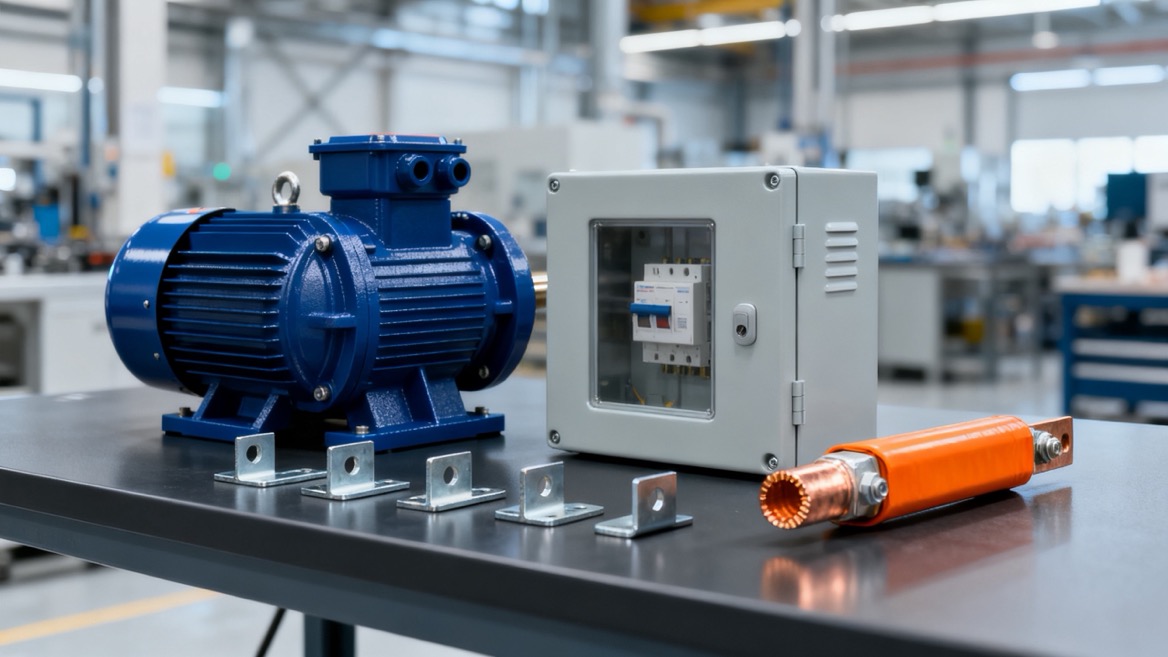
Epoxy coating is a protective finish made with epoxy resin and a compatible curing system. During curing, these ingredients react to form a cross-linked polymer network.
That network provides adhesion, mechanical strength, and resistance to many environmental exposures. However, performance depends on the formulation, substrate preparation, film thickness, and curing conditions.
Epoxy does not make the underlying material indestructible. Instead, an intact coating creates a barrier that limits contact between the substrate and damaging substances.
"Epoxy coating" describes a material family, not one application method.
| Coating type | How it is applied | Common uses | Main consideration |
|---|---|---|---|
| Epoxy powder coating | Dry powder is deposited and heat-cured | Metal components, appliances, electrical equipment | Parts must tolerate the specified curing process |
| Liquid epoxy coating | Applied by roller, brush, or spray | Concrete floors, maintenance work, large structures | Mixing, application conditions, and curing requirements vary |
| Fusion-bonded epoxy | Powder fuses and cures on heated components | Pipelines, fittings, reinforcing steel | Requires specialized application and inspection |
| Epoxy-polyester hybrid powder | Dry powder containing both resin types is heat-cured | Indoor furniture, cabinets, appliances | Not a substitute for an exterior-grade finish |
For procurement teams, this distinction prevents an important mistake: specifying an epoxy floor coating when the project actually requires an industrial powder finish.
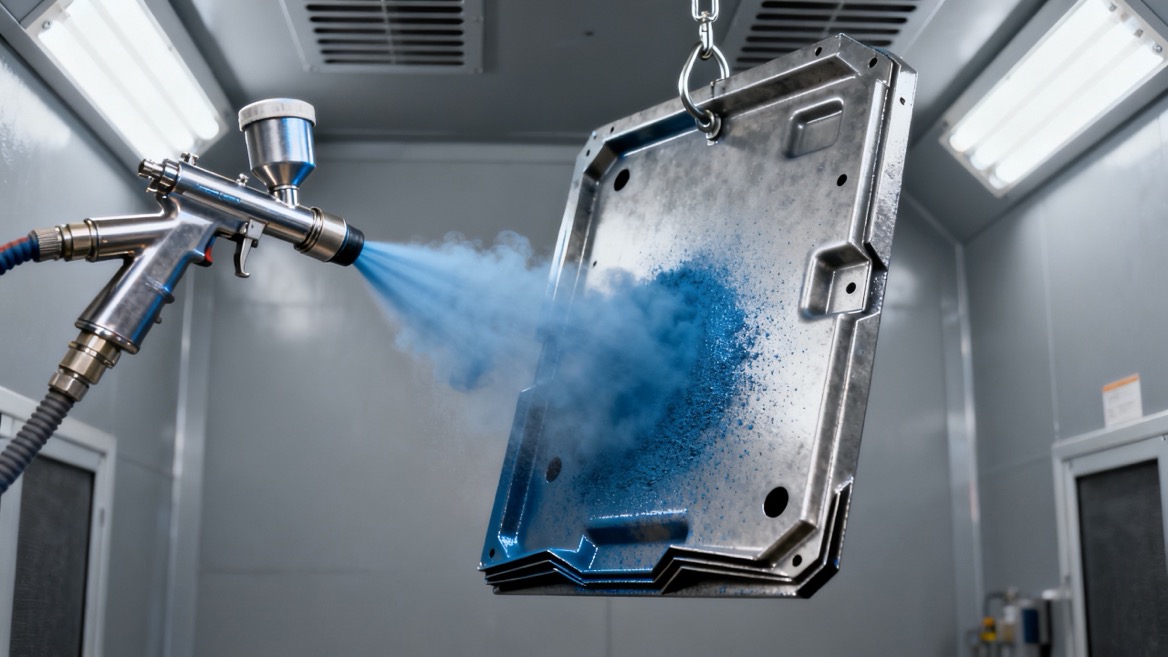
Epoxy coatings help protect steel and other compatible metals by restricting the movement of water, oxygen, and corrosive substances toward the surface.
Typical applications include:
- Machinery housings and equipment frames.
- Indoor electrical cabinets.
- Pumps, valves, and fittings.
- Metal brackets and hardware.
- Protective primers beneath compatible topcoats.
The coating must remain continuous and well bonded. Exposed edges, pinholes, and damaged areas can become starting points for corrosion.
Our specification principle is straightforward: evaluate the complete protective system, including pretreatment, rather than judging the powder alone.
Liquid epoxy systems are widely used on concrete floors in factories, warehouses, workshops, and similar facilities.
Depending on the system, they can provide a seamless surface, easier cleaning, and resistance to selected chemicals and traffic conditions.
Flooring selection requires separate attention to concrete moisture, surface preparation, slip resistance, and the intended load. A smooth finish may look attractive but may not provide suitable traction when wet.
Epoxy powder coating is generally not the process used to coat an existing concrete floor.
Specially formulated epoxy coatings can provide electrical insulation and environmental protection for components.
Potential applications include busbars, insulating components, and selected electrical assemblies.
However, an ordinary decorative epoxy powder should not automatically be treated as an electrical-insulation product. Buyers need application-specific evidence covering dielectric performance, coating thickness, operating temperature, and relevant equipment requirements.
Electrical insulation is a validated function, not a benefit that follows simply from the word "epoxy."
Epoxy-based coatings are used in automotive corrosion-protection systems and may be suitable for selected brackets, housings, and electrical components.
For new-energy vehicle projects, coating selection may involve several competing requirements:
- Corrosion protection.
- Electrical insulation or controlled conductivity.
- Adhesion around edges and complex geometries.
- Compatibility with adhesives and assembly processes.
- Resistance to specified fluids and temperature cycles.
These requirements are not interchangeable. An insulating finish, for example, may be unsuitable where an electrical grounding connection is required.
The complete component specification should determine the coating.
Epoxy and epoxy-polyester powder coatings can suit indoor metal products that need a durable, cleanable finish.
Examples include appliance components, cabinets, hardware, and selected medical equipment housings.
For medical applications, cleaning agents and disinfection procedures deserve particular attention. Resistance to one detergent does not establish resistance to every disinfectant.
Similarly, a coated housing is not automatically suitable for patient contact, implantation, or repeated sterilization. Those uses require separate material and regulatory evaluation.
Purpose-designed epoxy systems are used to protect pipelines, fittings, and selected containment equipment.
The specification must identify the actual exposure: fluid composition, concentration, temperature, immersion duration, and cleaning conditions.
A coating suitable for occasional chemical splashes may not withstand continuous immersion.
Drinking-water and food-contact applications also require documentation appropriate to the intended use and destination market. General corrosion resistance does not establish contact compliance.
Epoxy's main advantage is its combination of adhesion, barrier protection, and mechanical performance.
Depending on the formulation and application, benefits can include:
- Strong adhesion to properly prepared substrates.
- Resistance to specified chemicals.
- Protection against moisture-related corrosion.
- A hard, durable surface.
- Electrical insulation in qualified formulations.
- Compatibility with protective multilayer systems.
These benefits should be evaluated together. Increasing hardness, for example, does not automatically improve flexibility or performance under deformation.
For buyers, the useful question is not "Is epoxy strong?" It is "Does this specific epoxy system withstand our actual service conditions?"
Standard epoxy coatings have limited ultraviolet stability. Sunlight can cause chalking, discoloration, and gloss loss.
For visible exterior architectural profiles, doors, and windows, an appropriately qualified exterior polyester powder is generally a more suitable starting point than a standard epoxy finish.
Epoxy can still function as a primer beneath a compatible weather-resistant topcoat. In that arrangement, the layers perform different jobs: the primer supports adhesion and corrosion protection, while the topcoat provides exterior durability.
Epoxy is not universally heat-resistant or chemically resistant.
Continuous operating temperature, short-term peaks, thermal cycling, and chemical concentration can change the selection.
Obtain product-specific resistance information. Where exposure is demanding or unusual, test representative coated specimens before committing to production.
Conventional epoxy powder coating requires a controlled heating process.
Some plastics, assembled products, seals, and electronic components cannot tolerate that cycle. A liquid system or another coating technology may be more appropriate.
For manufacturers serving multiple industries, resin selection should follow exposure and performance requirements.
| Selection factor | Epoxy powder | Polyester powder | Epoxy-polyester hybrid |
|---|---|---|---|
| Typical selection priority | Indoor protection and specific functional properties | Exterior appearance and weatherability | Indoor decorative and functional balance |
| Sunlight exposure | Generally unsuitable as an exposed decorative finish | Exterior grades are available | Generally intended for indoor use |
| Chemical resistance | Often a selection strength; verify formulation | Depends on formulation and exposure | Depends on formulation and exposure |
| Common applications | Equipment, electrical parts, protective primers | Exterior profiles, outdoor components | Cabinets, furniture, appliances |
| Critical purchasing check | Exposure-specific test evidence | Required weathering classification | Indoor-use limits and performance data |
No resin category guarantees performance by itself. Pretreatment and process control can determine whether an otherwise suitable formulation succeeds.
Record whether the component faces indoor humidity, outdoor sunlight, chemical splash, immersion, abrasion, or electrical demands.
Include the destination and installation conditions. A sheltered indoor enclosure and an exposed coastal component need different specifications, even if their drawings look similar.
Specify the metal or other substrate, existing contamination, and suitable preparation.
Oil, rust, salts, and incompatible residues can undermine adhesion. Pretreatment must suit both the substrate and the required protection level.
Move beyond descriptions such as "premium quality."
Agree on relevant checks, including:
- Dry film thickness.
- Adhesion.
- Appearance and gloss.
- Impact or flexibility, where relevant.
- Chemical resistance.
- Corrosion performance under a defined test.
- Electrical properties, where required.
The method, test conditions, and acceptance limits should be clear.
For powder coating, follow the product's specified cure schedule and verify the temperature reached by the component itself.
Oven air temperature alone does not establish adequate cure. Thick and thin sections may heat at different rates.
Record the actual process conditions and validate representative production parts, not only convenient laboratory panels.
Use samples that represent the real substrate, geometry, pretreatment, and production line.
Edges, welds, recesses, and masked areas deserve inspection. A flat panel cannot reveal every challenge presented by a finished component.
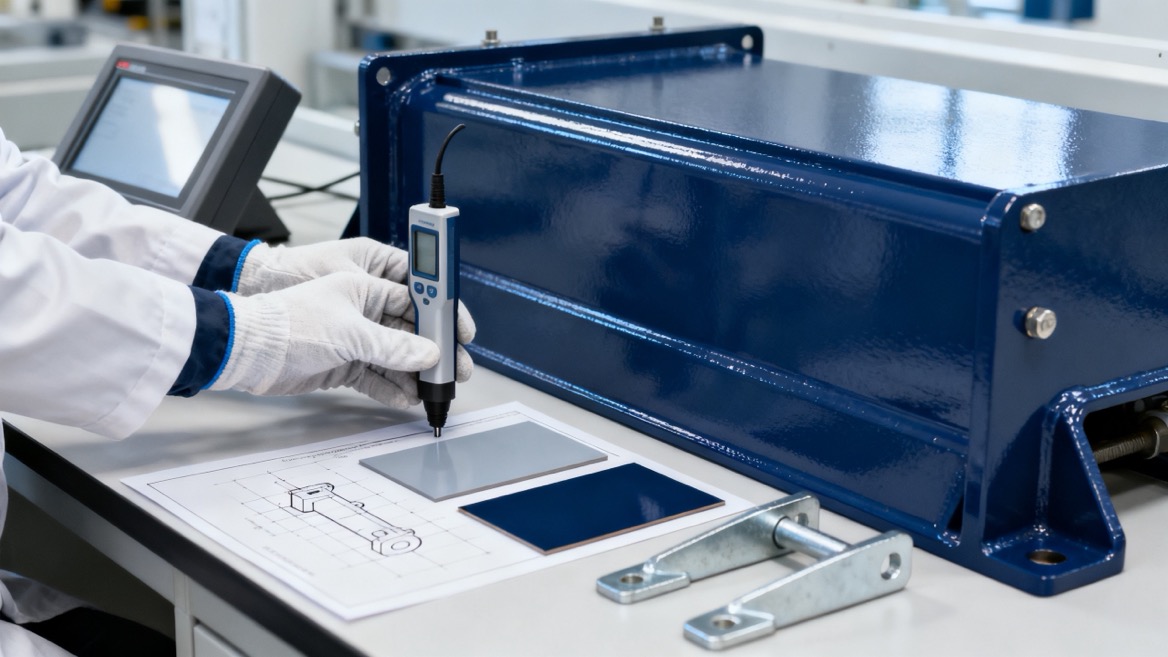
A common purchasing shortcut is to compare coatings only by reported salt-spray hours.
That number needs context.
ASTM B117 describes a controlled salt-fog exposure practice. It does not provide a universal conversion from laboratory hours to years in service.
When reviewing results, ask:
1. Was the substrate identical?
2. Was the pretreatment identical?
3. Were film thickness and curing conditions comparable?
4. Was the panel scribed?
5. What failure criteria were used?
A report without these details may offer little value for supplier comparison. Use laboratory testing alongside relevant exposure evidence and application-specific requirements.
Consider a manufacturer sourcing coatings for three products:
- An indoor control cabinet.
- A sun-exposed aluminum window frame.
- An electrically insulating vehicle component.
The cabinet may suit an epoxy or hybrid powder, depending on cleaning and corrosion requirements.
The window frame points toward an exterior-grade polyester system.
The vehicle component requires a qualified functional coating with documented electrical performance.
This is an illustrative selection exercise, not a reported customer case. Its lesson is practical: one supplier can support several applications without using one formulation for everything.
Powder coating avoids the liquid solvent carrier used in many solvent-borne coatings. Suitable recovery systems can also reclaim some overspray.
However, "solvent-free application" does not mean "impact-free manufacturing." Pretreatment, oven energy, reject rates, and powder recovery all affect environmental performance.
Epoxy ingredients may cause skin sensitization, and combustible powder dust requires appropriate controls. Follow the product safety data sheet and applicable workplace requirements.
Ventilation, grounding, housekeeping, exposure control, and protective equipment belong in the process specification—not as afterthoughts.
Yinda Technology develops, manufactures, and supplies powder coatings and environmentally focused materials, with subsidiaries in China, Indonesia, and Saudi Arabia.
For a focused product discussion, send your substrate details, application drawings, exposure conditions, required tests, desired finish, and available curing process.
Use those requirements to evaluate whether epoxy, an epoxy-polyester hybrid, or an exterior polyester system is the appropriate starting point. Request the relevant technical data, safety documentation, and sample-validation plan before final approval.
Epoxy coating mainly protects surfaces against corrosion, selected chemicals, moisture, and wear. Applications include industrial metal parts, concrete floors, pipelines, electrical components, and protective primers.
A properly specified and applied epoxy system can provide a water-resistant barrier. However, continuous immersion requires a formulation approved for that exposure. Defects, poor adhesion, and unsuitable substrates can compromise protection.
Standard exposed epoxy finishes are generally unsuitable where long-term color and gloss retention matter. A compatible exterior topcoat can protect an epoxy primer, while exterior polyester powder is another option for appropriate applications.
No. Epoxy identifies a resin family; powder coating identifies a dry application process. Epoxy coatings can be liquid or powder, and powder coatings can use other resins, including polyester.
There is no universal lifespan. Service life depends on formulation, substrate preparation, thickness, curing, exposure, damage, and maintenance. Laboratory test hours should not be converted directly into years of durability.
Only an appropriately evaluated product should be specified. A general-purpose epoxy coating does not automatically meet medical, food-contact, drinking-water, or sterilization requirements.
1. Powder Coating Institute. "Frequently Asked Questions." Guidance on pretreatment, epoxy weatherability, and resin selection. [powdercoating]
2. Powder Coating Institute. "What Is Powder Coating?" Overview of dry finishing and powder coating applications. [powdercoating]
3. European Agency for Safety and Health at Work, OSHwiki. "Occupational Exposure to Epoxy Resins." Applications and occupational exposure considerations. [oshwiki.osha.europa]
4. American Chemistry Council, Chemical Safety Facts. "Epoxy Resins." Industrial applications, flooring, and automotive protective systems. [chemicalsafetyfacts]
5. ASTM International. "ASTM B117-16: Standard Practice for Operating Salt Spray (Fog) Apparatus," Section 3. Limitations of extrapolating salt-spray results to natural exposure. This edition is cited for that principle, not specified as the project's required edition. [store.astm]
6. Occupational Safety and Health Administration. "29 CFR 1910.107—Spray Finishing Using Flammable and Combustible Materials." Powder application, ventilation, and housekeeping requirements. [osha]
7. Powder Coated Tough. "Ask the Experts—May/June 2024." Technical discussion of component temperature and curing conditions. [powdercoatedtough]
8. "A Review of High-Quality Epoxy Resins for Corrosion-Resistant Coatings." Journal of Coatings Technology and Research. Review of protective mechanisms and coating defects. [link.springer]


