Language


Views: 257 Author: Yinda Powder Coating Publish Time: 2026-11-04 Origin: Site


Content Menu
● Is Epoxy Powder Coating Suitable for Aluminum Window Frames?
>> Choose the Coating System by Exposure
● Why Powder Coating Adhesion Fails on Aluminum
● How to Improve Adhesion Through Aluminum Pretreatment
>> 1. Remove Oils Before Treating the Surface
>> 2. Control Etching, Deoxidizing, and Conversion Treatment
>> 3. Prevent Rinse Contamination and Retained Moisture
● Improve Surface Quality During Powder Application
>> Establish Reliable Grounding
>> Adjust Settings for Recesses and Channels
>> Control Thickness Instead of Chasing Coverage
● Cure Epoxy Powder Coating by Metal Temperature
>> Profile Representative Production Loads
>> Validate Primer and Topcoat Curing Together
● Troubleshooting Adhesion and Surface Defects
● A Practical Trial Plan for Better Aluminum Window Finishes
>> Step 1: Establish a Documented Baseline
>> Step 2: Change One Variable Group at a Time
>> Step 3: Evaluate Beyond Initial Appearance
● Build a Meaningful Quality-Control Plan
>> Use Adhesion Tests Correctly
>> Combine Thickness, Cure, and Exposure Checks
● Reduce Rework Without Sacrificing Performance
● Discuss Your Window-Frame Coating Requirements With Yinda Technology
>> Can epoxy powder coating be used on exterior aluminum window frames?
>> Does aluminum always need an epoxy primer before powder coating?
>> Why does powder coating peel even when aluminum looks clean?
>> Will a thicker coating improve adhesion?
>> How can manufacturers confirm that epoxy powder has cured correctly?
>> What should buyers request before approving a coating system?
Epoxy powder coating for aluminum window frames can provide strong adhesion, chemical resistance, and a smooth protective finish—but only when the coating system matches the exposure conditions. For exterior windows, the first decision is not how to spray epoxy better. It is whether epoxy should be the exposed finish at all.
Conventional epoxy powders are primarily suited to interior applications or use as primers beneath compatible, weather-resistant topcoats. They should not be treated as interchangeable with exterior architectural polyester powders.
At Yinda Technology, our manufacturing perspective starts with the complete system: aluminum preparation, powder selection, application, curing, and verification. Improving adhesion means controlling that chain rather than relying on one material to compensate for weaknesses elsewhere.

Epoxy powder coatings offer useful chemical and mechanical properties. However, their limited ultraviolet resistance creates an important boundary for window-frame applications.
Sunlight exposure can cause conventional epoxy finishes to chalk and lose their decorative appearance. A frame installed indoors is not automatically protected if its coated surfaces receive direct sunlight through glazing.
| Window-frame application | Practical coating approach | Main consideration |
|---|---|---|
| Interior components without sunlight exposure | Suitable epoxy powder, subject to specification | Adhesion, appearance, and chemical resistance |
| Exterior architectural frames | Qualified exterior-grade polyester system | Weathering, color retention, and corrosion performance |
| Frames requiring an epoxy primer | Compatible epoxy primer and exterior topcoat | Intercoat adhesion and validated processing |
| Coastal or persistently humid locations | Project-qualified pretreatment and coating system | Moisture resistance, edges, joints, and exposure severity |
An epoxy primer is not mandatory for every aluminum window frame. Properly pretreated aluminum can receive suitable architectural powder directly when the specified system permits it.
My recommendation is to define exposure and acceptance requirements before comparing powders. Otherwise, an excellent factory finish can still become the wrong finish in service.
Aluminum rapidly develops a natural oxide surface. Extruded profiles may also carry lubricants, handling contamination, dust, and residues from fabrication.
The objective is not simply to make the metal look clean. It is to create a controlled surface that supports bonding and resists moisture-driven deterioration.
Three failure locations deserve separate attention:
- Substrate-to-coating failure: the coating releases from the prepared aluminum.
- Intercoat failure: the topcoat separates from the primer.
- Cohesive failure: separation occurs within a coating layer.
These failures require different corrective actions. Increasing spray voltage, for example, will not repair an unsuitable conversion coating or an incompatible primer-topcoat combination.
Also distinguish electrostatic attraction from cured adhesion. Electrical charging helps deposit powder; pretreatment and curing determine whether the finished film remains attached.
Use a cleaning process selected for the aluminum alloy, fabrication residues, and production conditions.
Monitor the cleaner's concentration, temperature, contact time, and spray action. A bath can remain within one operating limit while still cleaning poorly because another variable has drifted.
A water-break check provides a useful screening tool. Continuous wetting generally indicates better removal of oily contamination than visible beading. However, it does not prove that every subsequent pretreatment stage is correct.
Avoid touching cleaned profiles with bare hands.
Where required by the selected process, etching and deoxidizing remove unsuitable surface material and prepare the aluminum for conversion treatment.
Use an aluminum-compatible conversion system approved for the intended coating and exposure. Chrome-free technologies are available, but their performance depends on correct processing rather than the label alone.
Record the chemical supplier's specified operating parameters. Do not transfer bath settings between different pretreatment technologies without validation.
Architectural profiles also require dimensional care. Excessive material removal is not a substitute for controlled treatment.
Carryover from one bath can disrupt the next stage. Maintain rinse quality and monitor final-rinse conductivity against the pretreatment supplier's requirements.
Hollow profiles, drainage channels, and joints can retain liquid. Position parts to drain and verify complete drying before powder application.
Keep the interval between pretreatment and coating controlled. Protect prepared profiles from dust, condensation, and handling contamination during that interval.
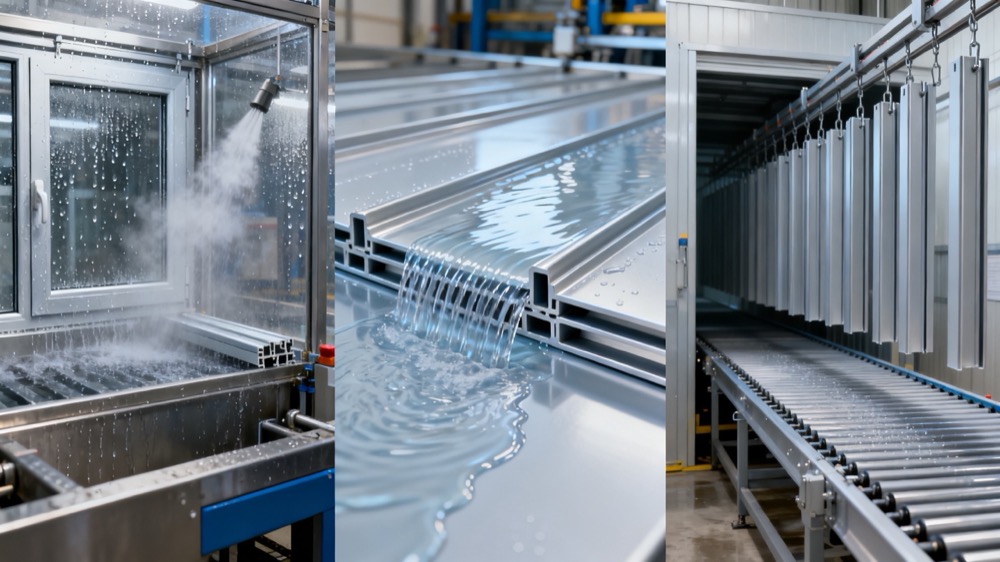
Clean contact points and suitable hanging arrangements support consistent powder deposition.
Coating buildup on hooks can interfere with electrical contact. This can produce uneven coverage and encourage operators to compensate with excessive powder output.
Maintain grounding according to the equipment manufacturer's instructions and applicable safety requirements. Treat it as both a process-control and safety issue.
Aluminum window profiles contain grooves, corners, and narrow channels. These features can be difficult to coat uniformly because electrostatic deposition favors more accessible surfaces.
Rather than applying one aggressive setting everywhere:
- Adjust gun position and angle.
- Evaluate lower voltage or current settings for difficult recesses.
- Balance powder delivery and transport air.
- Check coverage before adding more material to broad faces.
The correct settings depend on profile geometry, equipment, and powder behavior. Validate them on production-representative parts.
Excessive film thickness can worsen texture, dimensional interference, and application defects. Insufficient thickness can leave vulnerable areas inadequately protected.
Follow the selected product's thickness specification. For primer-and-topcoat systems, control each layer and the total build separately.
Measure flat faces, corners, and accessible recessed areas rather than relying on one convenient reading. Inspect gasket channels and assembly interfaces for unwanted buildup.
Oven air temperature does not establish whether the coating has received its required cure.
The relevant condition is the temperature reached by the coated substrate and the time it remains within the product's specified curing window.
Use a suitable temperature-recording system to evaluate representative profiles and loading arrangements.
For illustration, if a product requires ten minutes at a specified metal temperature, ten minutes inside the oven is not equivalent. Part of that residence time may be spent heating the aluminum.
Do not treat this example as a universal cure schedule. Follow the powder manufacturer's technical data sheet.
A two-coat system introduces additional variables:
- Whether the primer requires partial or full curing before overcoating.
- The permitted interval before topcoat application.
- The effect of the second bake on the primer.
- Compatibility between the two coating layers.
Excessive primer curing can impair intercoat adhesion in some systems. Conversely, inadequate curing can compromise performance. Use a validated sequence rather than a generic "bake twice" approach.
Visible defects provide clues, not definitive diagnoses. Confirm the cause before changing several settings simultaneously.
| Defect | Possible contributors | First checks |
|---|---|---|
| Peeling from aluminum | Contamination, pretreatment problems, inadequate cure | Cleaning records, conversion treatment, metal-temperature profile |
| Topcoat separation | Incompatible layers, contamination, unsuitable primer cure | System approval, overcoating interval, bake sequence |
| Orange-peel texture | Film build, powder condition, flow and cure behavior | Thickness map, storage history, curing profile |
| Pinholes or bubbles | Retained moisture, contamination, outgassing | Drying, compressed-air quality, substrate condition |
| Craters | Oil, silicone, or incompatible contamination | Air supply, lubricants, cleaning products, booth practices |
| Thin recessed coverage | Geometry, grounding, application settings | Contact points, gun angle, voltage/current settings |
Do not assume pinholes always require pre-baking. Identify whether the source is retained rinse water, contamination, substrate outgassing, or another process issue first.
A controlled trial can generate more useful information than repeatedly increasing powder thickness.
The following is a proposed diagnostic method, not a reported Yinda customer case.
Select representative profiles from one production batch. Record:
- Alloy and profile identification.
- Pretreatment conditions.
- Powder batch and storage history.
- Application settings and hanging arrangement.
- Film-thickness distribution.
- Actual metal-temperature history.
Keep an approved appearance sample under agreed lighting conditions.
If pretreatment is suspected, compare the existing process with a corrected process while keeping powder, thickness, and curing consistent.
If curing is suspected, verify the temperature profile before changing chemistry.
This approach helps separate root causes. Changing pretreatment, gun settings, and oven conditions together may improve the result without revealing why.
Compare appearance, dry adhesion, and the moisture-conditioning tests required by the project.
A smooth surface and a successful initial tape test do not establish long-term exterior durability. Moisture exposure can reveal weaknesses that remain hidden immediately after coating.
Inspection should connect production measurements with the intended service conditions.
ASTM D3359 provides tape-test methods for rating coating adhesion. Select the appropriate procedure for the coating thickness and system.
The result is a rating, not an absolute measurement of bond strength. In multilayer systems, identify where separation occurs.
Specify the method, conditioning, and acceptance criteria before production—not after a disagreement develops.
A practical control plan should include:
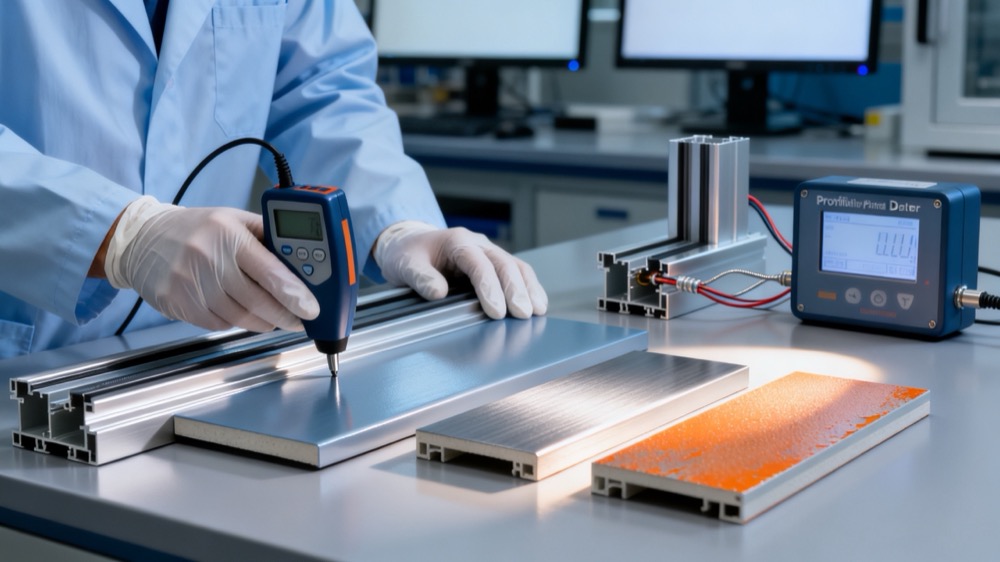
1. Dry-film thickness measurements using equipment suitable for aluminum.
2. Appearance comparison under defined viewing conditions.
3. Recorded metal-temperature profiles.
4. Adhesion testing using the agreed method.
5. Moisture or corrosion testing appropriate to the specification.
Solvent-rub testing can assess solvent resistance and support cure monitoring. However, solvent resistance alone does not demonstrate full cure.
Similarly, laboratory corrosion-test hours should not be converted directly into years of outdoor service.
Energy efficiency should come from a stable, validated process rather than an unverified reduction in oven temperature.
Potential improvements include consistent loading, maintained heating equipment, controlled film build, and fewer rejected profiles.
Lower-cure powders may offer opportunities, but they require confirmation of appearance, adhesion, mechanical properties, and production compatibility.
For window frames with thermal breaks or other heat-sensitive components, confirm the assembly's processing limits. Depending on the system, coating profiles before final assembly may be necessary.
Yinda Technology develops, manufactures, and supplies powder coatings and environmentally focused materials, with subsidiaries in China, Indonesia, and Saudi Arabia.
For an aluminum window-frame project, share your profile drawings, exposure conditions, pretreatment process, required finish, and available curing capability with our team.
Request a product-specific technical data sheet and arrange a representative coating trial before volume production. Define the required adhesion, appearance, weathering, and corrosion acceptance criteria together so the selected system addresses the actual application.
Conventional epoxy should generally not serve as the exposed exterior finish because of its limited UV resistance. A compatible epoxy primer beneath a suitable exterior topcoat may be appropriate when the complete system is validated.
No. Some architectural systems apply suitable powder directly to correctly pretreated aluminum. Primer requirements depend on the specified system, exposure, and performance targets.
Appearance does not reveal every contaminant or pretreatment defect. Residual oils, unsuitable conversion treatment, retained moisture, and inadequate curing can all contribute to adhesion failure.
Not necessarily. Thickness cannot correct contamination or poor pretreatment. Excessive build can also create texture problems and interfere with frame assembly.
Verify actual metal temperature and time against the product's curing schedule. Combine this record with the manufacturer's recommended performance checks; do not rely solely on surface hardness or solvent resistance.
Request the technical data sheet, substrate and pretreatment requirements, curing window, thickness limits, and relevant test evidence. Confirm the approved combination of primer and topcoat where applicable.
1. AkzoNobel Interpon — "Epoxy Technology." Explains epoxy powder properties, interior applications, primer use, and limitations under sunlight exposure. [interpon]
2. AkzoNobel Interpon — "Barrier Primer, AL117X." Provides a product-specific example of an epoxy primer suitable for aluminum and exterior use with an appropriate topcoat. Its curing schedule is not a universal epoxy recommendation. [interpon]
3. TIGER Coatings — "Powder Coating Pretreatment: A Complete Guide," October 15, 2024. Covers contamination, cleaning, rinsing, water-break screening, and aluminum pretreatment considerations. [tiger-coatings]
4. TIGER Coatings — "Tips & Tricks for Powder Coating." Technical troubleshooting guide addressing pretreatment failures, drying, grounding, curing, and coating defects. [tiger-coatings]
5. TIGER Coatings — "Processing Guidelines: Primer Series 270–273." Discusses aluminum-compatible pretreatment, primer processing, and the potential effect of overcuring on intercoat adhesion. [tiger-coatings]
6. ASTM International — "ASTM D3359: Standard Test Methods for Rating Adhesion by Tape Test." Defines test scope, thickness-related method selection, and limitations of adhesion ratings. [store.astm]
7. ASTM International — "ASTM D5402: Standard Practice for Assessing the Solvent Resistance of Organic Coatings Using Solvent Rubs." Explains solvent-resistance assessment and why it does not independently prove full cure. [store.astm]
8. QUALICOAT — "QUALICOAT Specifications." Establishes requirements for equipment, materials, and coated architectural products. Referencing these requirements does not imply that Yinda Technology holds certification. [qualicoat]


