Language


Views: 228 Author: Yinda Powder Coating Publish Time: 2026-10-12 Origin: Site


Content Menu
● Why Epoxy Powder Coating Is Attractive for Aluminum Profiles
● Why Pure Epoxy Powder Coating Performs Poorly Outdoors
>> UV Exposure Causes Chalking and Appearance Changes
>> Chemical Resistance Does Not Establish Weather Resistance
● Epoxy vs. Polyester Powder Coating for Outdoor Aluminum Profiles
>> Why Epoxy-Polyester Hybrids Need Careful Review
● Can an Epoxy Primer Be Used Beneath an Outdoor Topcoat?
>> Check Compatibility Before Specifying Two Coats
● How to Choose the Right Outdoor Aluminum Coating Standard
>> Understand the AAMA Performance Categories
>> Treat QUALICOAT as More Than a Powder Label
● Why Aluminum Pretreatment Matters as Much as Resin Selection
● Three Practical Exposure Scenarios for Export Projects
>> Scenario 1: Coastal Window Frames in Indonesia
>> Scenario 2: Sun-Exposed Facade Profiles in Saudi Arabia
>> Scenario 3: Indoor Equipment Profiles in China
● A Practical Approval Checklist for Outdoor Aluminum Profiles
>> Step 1: Define the Service Environment
>> Step 2: Identify the Complete Coating System
>> Step 3: Confirm Cure Using Part Temperature
>> Step 4: Inspect Representative Finished Profiles
>> Step 5: Retain Evidence and Samples
● Energy Efficiency Without Sacrificing Outdoor Durability
● Discuss Your Outdoor Aluminum Coating Requirements With Yinda Technology
>> Can Epoxy Powder Coating Stick to Aluminum?
>> Is Epoxy Powder Coating Waterproof?
>> Can Polyester Powder Be Applied Over an Epoxy Primer?
>> Is Epoxy-Polyester Powder Suitable for Outdoor Window Frames?
>> Does a Thicker Epoxy Coating Improve UV Resistance?
>> Does AAMA 2605 Mean a Ten-Year Warranty?
Epoxy powder coating can be applied to aluminum profiles, but pure epoxy is generally unsuitable as the exposed finish for outdoor architectural applications. It provides strong adhesion and useful chemical resistance, yet prolonged sunlight can cause chalking, fading, and gloss loss. For outdoor aluminum profiles, an exterior-grade polyester coating—or a validated system combining an epoxy primer with a weather-resistant topcoat—is usually the more appropriate choice.
At Yinda Technology, we approach this question from a practical manufacturing perspective: matching the coating to its service environment matters more than choosing a familiar resin name. With subsidiaries in China, Indonesia, and Saudi Arabia, and products serving architectural profiles, doors, windows, new-energy vehicles, medical equipment, hardware, and appliances, our business spans applications with very different coating requirements.
This guide explains where epoxy works, where it falls short, and how to specify a more dependable outdoor aluminum coating system.

Epoxy powder coating is a thermosetting finish. During curing, its resin and curing agent react to create a cross-linked film.
Manufacturers value epoxy for its adhesion, toughness, and resistance to many chemicals. These properties make it useful for indoor components, equipment, and selected protective primer applications.
However, aluminum compatibility and outdoor suitability are separate questions.
A coating may adhere well to a properly prepared aluminum extrusion and still perform poorly under sunlight. Likewise, a weather-resistant powder can fail prematurely if pretreatment or curing is inadequate.
When evaluating powder coating for aluminum profiles, we therefore separate three requirements:
- Adhesion to the prepared aluminum substrate.
- Protection against the expected corrosive environment.
- Retention of color, gloss, and film integrity outdoors.
Pure epoxy addresses the first two in suitable systems. Its main limitation is the third.
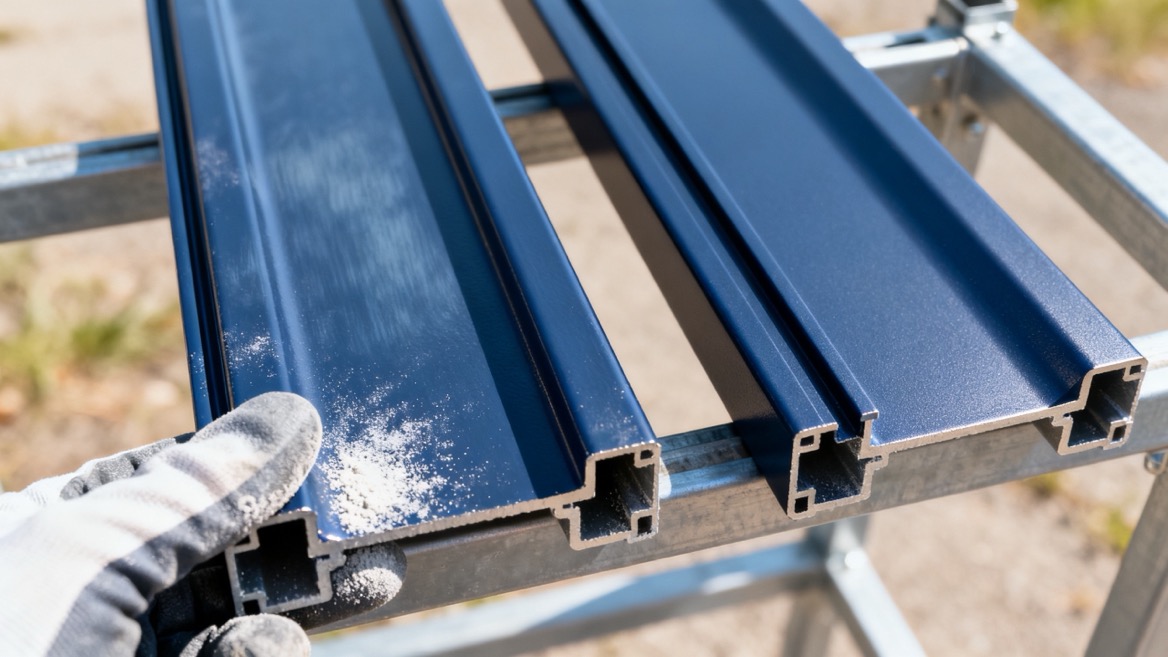
Sunlight contains ultraviolet radiation that can degrade an exposed epoxy coating. As its surface deteriorates, a chalk-like residue may develop.
The visible consequences can include:
- Reduced gloss.
- Fading or other color changes.
- A powdery surface.
- An increasingly uneven appearance.
For architectural aluminum profiles, appearance is part of performance. Window frames, entrance doors, facade elements, and balcony components must often maintain a consistent finish across large, highly visible installations.
A coating that remains attached but loses its intended appearance may still be unacceptable.
There is no universal timeline for epoxy chalking. Exposure, formulation, orientation, color, and local conditions influence the outcome. A blanket promise that every epoxy coating will last a particular number of months or years would be misleading.
A frequent specification mistake is assuming that a tough, chemically resistant coating must also withstand outdoor exposure.
These properties involve different mechanisms.
Chemical resistance concerns how a coating responds to substances such as cleaners or process chemicals. Weather resistance includes its response to sunlight, moisture, and changing outdoor conditions.
An indoor epoxy coating may satisfy a chemical-resistance requirement without meeting an exterior architectural weathering requirement. Buyers should request evidence for both properties when both matter.
The following comparison is a selection guide, not a substitute for product-specific test results.
| Coating type | Principal strength | Outdoor aluminum suitability | Important qualification |
|---|---|---|---|
| Pure epoxy | Adhesion, toughness, chemical resistance | Generally unsuitable as an exposed architectural finish | Limited resistance to prolonged sunlight |
| Epoxy-polyester hybrid | Interior appearance and balanced mechanical properties | Generally intended for indoor use | Polyester content alone does not establish exterior suitability |
| Exterior-grade polyester | Weather resistance and decorative performance | Common choice for outdoor profiles | Select the appropriate performance grade |
| Superdurable polyester | Higher weathering performance than standard polyester formulations | Useful for demanding architectural exposure | Verify the exact product and color |
| Epoxy primer with exterior topcoat | Separate corrosion-protection and weathering functions | Potentially suitable as a validated system | Confirm compatibility and complete-system performance |
"Epoxy-polyester" can sound like a compromise between indoor toughness and outdoor durability. That wording can lead to incorrect purchasing decisions.
Many hybrid powders are primarily interior products. Their performance may improve on pure epoxy in certain respects, but their UV resistance remains insufficient for exposed outdoor service.
Do not approve a hybrid coating for exterior aluminum simply because its formulation contains polyester. Request an explicit exterior-use recommendation and supporting performance documentation.
Yes. An epoxy primer can be part of an exterior coating system when a suitable weather-resistant topcoat protects it.
The intended division of functions is straightforward:
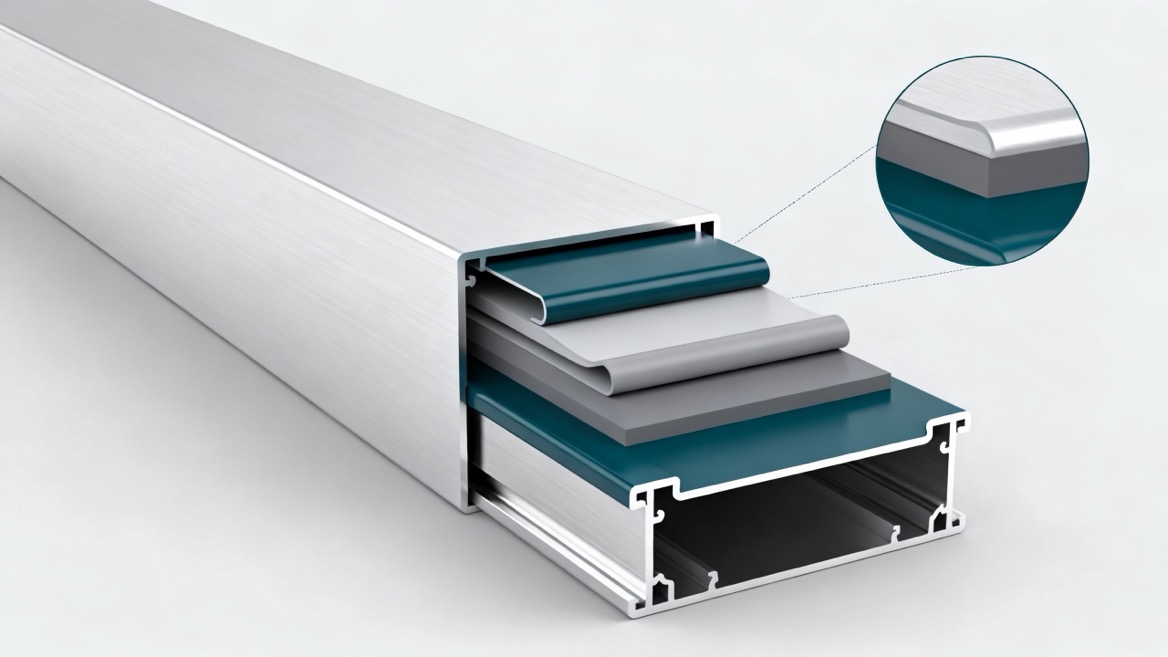
1. Pretreatment prepares and protects the aluminum surface.
2. The primer contributes adhesion and barrier protection.
3. The exterior topcoat provides the visible finish and weather resistance.
However, adding a second layer does not automatically improve performance. The complete system must be designed and validated for the substrate and exposure.
Ask the coating supplier to confirm:
- Suitability of the primer for aluminum.
- Compatibility between primer and topcoat.
- Required film thickness for each layer.
- Primer curing or partial-curing instructions.
- Permitted recoating conditions.
- Complete-system adhesion and corrosion results.
Also assess coverage around grooves, corners, and recessed areas. A successful flat-panel test does not eliminate the need to inspect the actual extrusion geometry.
Not every outdoor profile needs an epoxy primer. A properly specified single-coat architectural polyester system may be sufficient. Additional layers should solve a defined requirement rather than simply increase coating thickness.
AAMA 2603, 2604, and 2605 define progressively higher performance requirements for organic coatings on architectural aluminum.
Industry guidance identifies natural weathering evaluation periods of one, five, and ten years, respectively.
| Specification | General performance category | Natural weathering evaluation period |
|---|---|---|
| AAMA 2603 | Pigmented organic coatings | 1 year |
| AAMA 2604 | High-performance organic coatings | 5 years |
| AAMA 2605 | Superior-performing organic coatings | 10 years |
These periods describe testing requirements. They are not automatic service-life predictions or warranties.
AAMA 2605 also does not mean "any polyester powder." The proposed formulation must demonstrate compliance with the specified requirements.
FGIA announced updated editions of this specification suite in May 2026. Procurement documents should identify the applicable edition instead of relying on an unspecified reference.
QUALICOAT specifications address coating materials, application facilities, processes, and finished products.
For buyers, this distinction is important. Selecting an approved powder does not, by itself, establish that a particular applicator or production batch satisfies every relevant requirement.
Verify the proposed product, applicator status, pretreatment route, and finished-part controls.
QUALICOAT classes and AAMA categories should not be treated as interchangeable labels. They belong to different specification frameworks.
An exterior-grade coating cannot compensate for an inadequately prepared substrate.
Architectural aluminum may carry oils, fabrication residues, or surface contamination. Pretreatment must address these conditions before powder application.
A controlled process generally includes:
1. Cleaning and degreasing.
2. Appropriate etching and rinsing.
3. A specified conversion treatment or approved alternative.
4. Controlled drying.
5. Protection from contamination before coating.
For coastal applications, enhanced pretreatment deserves particular attention.
QUALICOAT's Seaside guidance describes increased aluminum removal during etching: at least 2 g/m² rather than the ordinary minimum of 1 g/m². This deeper preparation addresses contaminants associated with corrosion risk.
Seaside is an enhanced pretreatment designation, not proof that an epoxy finish becomes UV resistant. Weathering performance and corrosion protection must still be specified separately.
The following scenarios illustrate specification decisions. They are not claims about completed Yinda projects.
For a humid coastal installation, the evaluation should consider both sunlight and chloride exposure.
A suitable proposal would investigate:
- An exterior architectural topcoat.
- Enhanced pretreatment where required.
- Drainage and moisture-trapping details.
- Corrosion testing appropriate to the project.
- Cleaning access and maintenance instructions.
Replacing polyester with exposed epoxy would not resolve the combined weathering and corrosion requirements.
For strongly sun-exposed profiles, color and gloss retention become central selection criteria.
The buyer should request documented weathering performance for the proposed formulation and finish, rather than relying on a general "outdoor grade" description.
Evaluate standard polyester, superdurable polyester, or another qualifying coating technology against the project specification.
Shade should not be treated as proof that an interior epoxy coating is suitable outdoors.
For indoor equipment without sustained sunlight exposure, epoxy or an epoxy-polyester hybrid may be appropriate.
Selection can then prioritize chemical resistance, handling durability, finish quality, and curing compatibility.
For medical equipment, any additional hygiene or regulatory requirements require separate verification. Resin chemistry alone does not establish suitability.
Before approving production, we recommend a documented review covering the environment, coating, and application process.
Record whether profiles face direct sunlight, coastal salts, industrial pollutants, frequent wetting, or aggressive cleaning.
Include appearance expectations and the applicable contractual specification.
Specify the exact powder product, color, gloss, texture, pretreatment, and any primer.
Avoid approving a system solely through generic terms such as "epoxy," "polyester," or "premium powder."
The relevant curing condition is the aluminum's temperature, not simply the oven-air setting.
Different profile sizes and loading arrangements can heat at different rates. Follow the product data sheet and verify the production cure profile.
Review film thickness, adhesion, appearance, and coverage on actual production geometry.
Include recessed surfaces, edges, and difficult-to-coat areas.
Keep approved samples, batch details, inspection records, and the agreed specification.
These records support later troubleshooting and make comparisons between suppliers more meaningful.
Lower-curing powder technologies can support energy-saving objectives, but cure temperature and exterior suitability are independent selection criteria.
An interior low-cure epoxy-polyester powder does not become an outdoor product because it reduces oven-temperature requirements.
For outdoor aluminum profiles, evaluate energy improvements only after confirming weathering suitability.
Ask suppliers for product-specific curing conditions and assess potential savings against the actual oven, line speed, loading, and quality requirements. Avoid claiming a fixed energy reduction without production evidence.
Yinda Technology develops, manufactures, and supplies powder coatings and environmentally oriented materials while promoting energy-saving technologies.
For an outdoor aluminum profile project, send our team:
- Installation location and exposure conditions.
- Profile drawings or representative samples.
- Required color, gloss, and texture.
- Applicable coating specification.
- Existing pretreatment and curing conditions.
- Appearance expectations and maintenance requirements.
This information creates a practical basis for reviewing exterior polyester options, higher-weathering formulations, or a compatible primer-and-topcoat system. Request product-specific documentation before approving the final coating.
Yes. Epoxy powder can adhere to properly prepared aluminum. However, adhesion does not establish suitability for prolonged outdoor sunlight exposure.
It can provide a moisture-resistant barrier, but "waterproof" is too broad a guarantee. Protection depends on film integrity, pretreatment, curing, damage, and the service environment.
Potentially, yes. Use a supplier-approved combination with defined preparation, curing, recoating, and film-thickness requirements. Validate the complete system.
Standard epoxy-polyester hybrids are generally intended for interior use. Do not specify one for outdoor frames without explicit exterior approval and supporting evidence.
Greater thickness does not remove epoxy's inherent sunlight limitation. Follow the specified thickness and select an appropriate exterior-facing chemistry.
No. Its weathering evaluation requirements are not a warranty. Warranty terms depend on the supplier, system, application conditions, location, and maintenance obligations.
1. [PPG — Powder Coating Process Specifics]. Explains epoxy's sunlight-related chalking limitation and the use of polyester where UV resistance matters. [ppg]
2. [AkzoNobel Interpon — Hybrid Technology in Powder Coatings]. Describes epoxy-polyester hybrids as primarily interior coatings and identifies limited outdoor UV resistance. [interpon]
3. [PPG — Envirocron Powder Coatings]. Identifies separate product categories for epoxy primers, indoor hybrids, and exterior polyester coatings. [ppg]
4. [QUALICOAT — Specifications]. Provides the framework covering coating materials, facilities, processes, and finished products. [qualicoat]
5. [QUALICOAT UK & Ireland — Powder Coating & Seaside Class]. Explains ordinary and enhanced etching requirements and Seaside licensing controls. [qualicoatuki]
6. [Powder Coated Tough — The Evolution of Powder Coatings in Fenestration Systems Over 60 Years]. Summarizes AAMA performance categories and natural weathering evaluation periods. [powdercoatedtough]
7. [FGIA — Updated Suite of Finishes Documents for Aluminum Extrusion]. Reports the May 2026 specification updates. [fgiaonline]
8. [TIGER Coatings — Drylac Series 89]. Illustrates why low-cure capability does not establish outdoor suitability and why substrate temperature governs curing. [tiger-coatings]


