Language


Views: 227 Author: Yinda Powder Coating Publish Time: 2026-06-27 Origin: Site


Content Menu
● Introduction: Why Coating Complex Geometries Is Hard
● Understanding Electrostatic Spray Powder Coating
>> How Electrostatic Spray Works (Corona / Tribo)
>> Typical Film Thickness and Applications
● Understanding Fluidized Bed Powder Coating
>> How Fluidized Bed Coating Works
>> Typical Film Thickness and Applications
● Key Process Comparison for Complex Geometric Parts
>> Technology Comparison for Complex Geometries
● Expert Perspective: Electrostatic Spray on Complex Geometries
>> Advantages for Complex Geometric Metal Parts
● Expert Perspective: Fluidized Bed on Complex Geometries
>> Advantages for Complex Geometric Metal Parts
>> Limitations for Truly Complex Shapes
● Advanced Section: Electrostatic Fluidized Bed and Hybrid Strategies
>> Electrostatic Fluidized Bed Basics
>> Hybrid Lines in Modern Manufacturing
● Practical Selection Framework for OEMs and Fabricators
>> Step‑by‑Step Selection Guide
● Case‑Style Insight: Complex EV Brackets vs. Bus Bars
● Operator Experience and Line Integration
>> Electrostatic Spray UX Highlights
>> Fluidized Bed UX Highlights
● Strategic Recommendation and CTA
● FAQs
Electrostatic spray and fluidized bed powder coating each offer distinct advantages for complex geometric metal parts, and the optimal choice depends on your part design, performance requirements, and production context within modern powder coating lines.
Coating complex metal geometries—battery trays, medical frames, architectural profiles, precision hardware—is challenging because sharp edges, deep recesses, blind holes and weld seams all interfere with powder deposition, film build control and defect prevention. [chinapowdercoating]
For manufacturers like Yinda Technology, operating integrated powder coating chains in China, Indonesia and Saudi Arabia, the decision between electrostatic spray and fluidized bed is no longer just a process choice; it is a strategic lever for quality, cost and sustainability across global production. [linkedin]
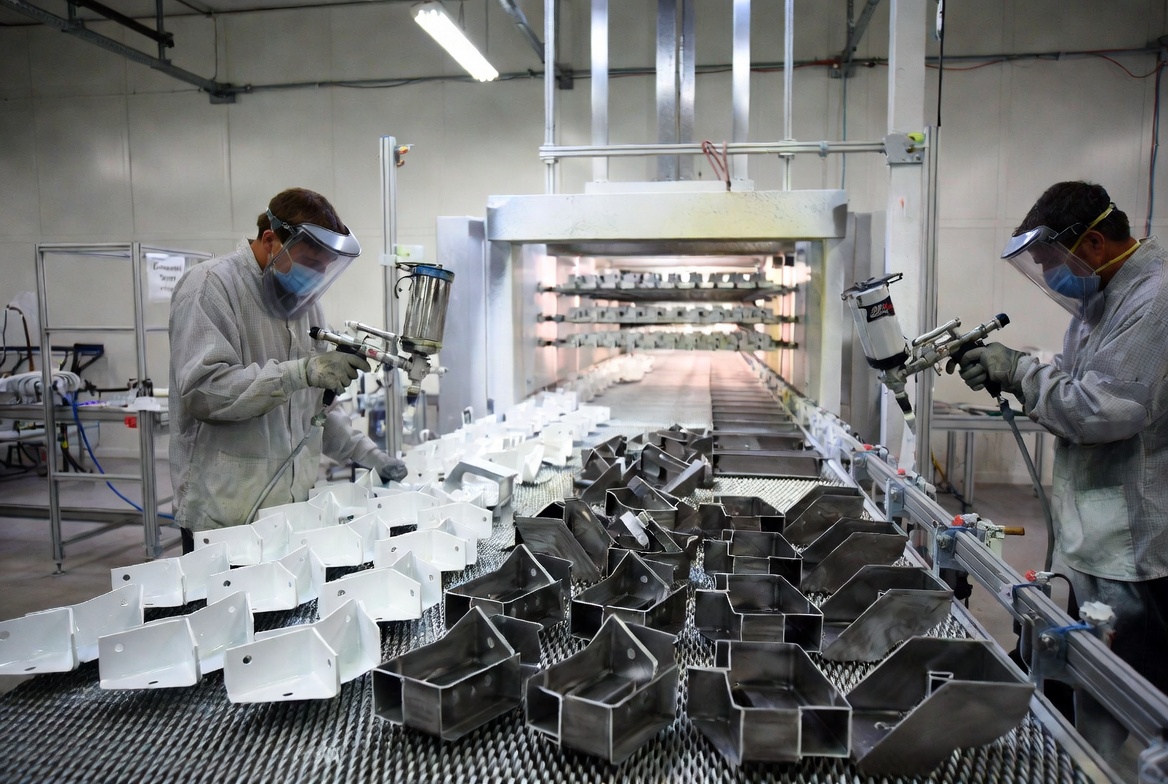
Electrostatic spray is the dominant method in industrial powder coating lines for metal parts with varied shapes and sizes. [zhenxintl]
In a standard electrostatic powder spray system, powder particles are conveyed to a spray gun and charged either by corona discharge or tribo (friction) charging. [appropedia]
- The gun disperses negatively charged powder into a spray cloud. [chinapowdercoating]
- The metal part is grounded, creating an electrostatic field. [zhenxintl]
- Charged particles are attracted to the part surface, forming a uniform layer. [chinapowdercoating]
- The coated part is then heated; the powder melts, flows and cures into a continuous thermoset film. [zhenxintl]
For complex geometries, the electrostatic field lines bend around the part, which supports coverage of edges and external surfaces while still posing challenges for deep recesses and Faraday cage areas.
Electrostatic spray typically delivers 60–120 μm film thickness in a single pass, depending on chemistry, gun setting and line speed. [appropedia]
Common applications include:
- Architectural aluminum profiles and window frames
- Metal furniture and office systems
- Automotive components including EV brackets, battery housings and suspension parts
- Electrical enclosures and appliance housings [chinapowdercoating]
These thickness ranges and flexible application parameters make electrostatic spray especially suitable for visible surfaces where aesthetics, color flexibility and smoothness are high priorities. [appropedia]
Fluidized bed powder coating is widely used where very high film build, durable insulation or impact resistance are required. [techinfo.misumi.com]
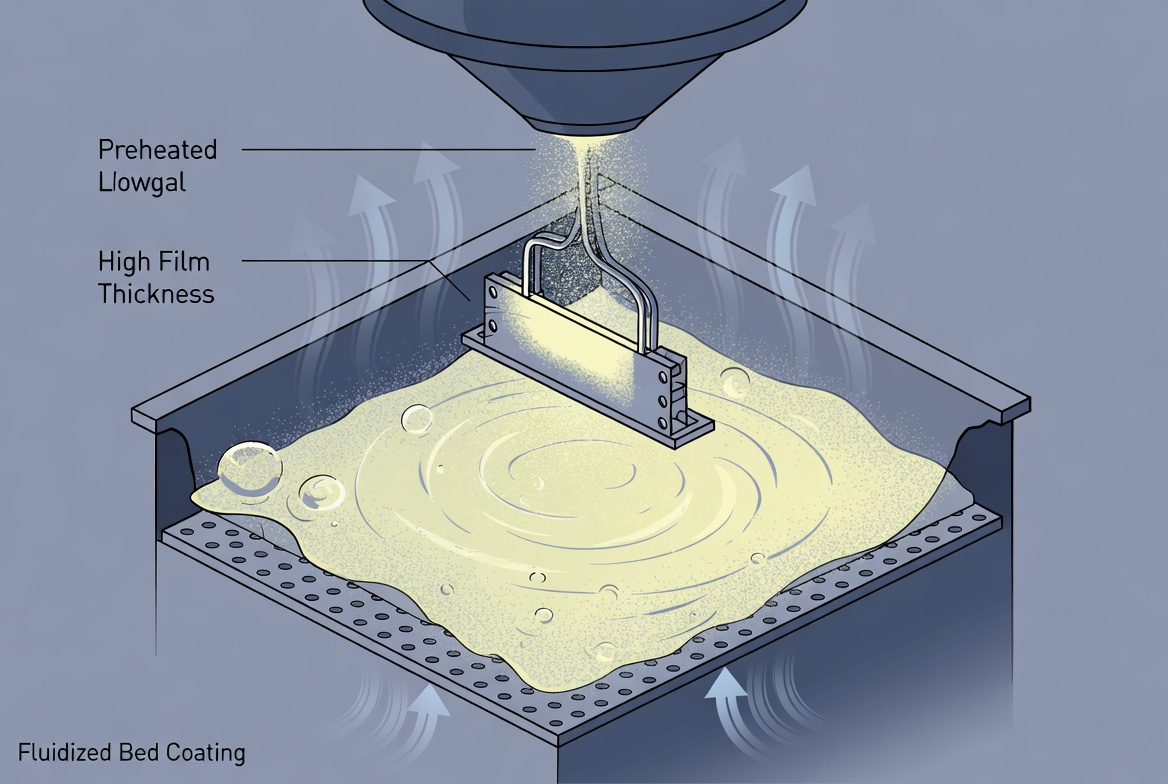
In a fluidized bed system, powder is placed in a tank with a porous plate at the bottom. [techinfo.misumi.com]
- Compressed air or inert gas is introduced through the porous plate. [techinfo.misumi.com]
- Powder particles are suspended, creating a "fluid-like" bed with uniform powder distribution. [techinfo.misumi.com]
- The metal part is preheated above the powder's melting point, often to 180–230 °C. [techinfo.misumi.com]
- The hot part is immersed in the fluidized bed; powder melts and adheres on contact, forming a thick coating. [chinapowdercoating]
- If necessary, a post‑heat step completes film formation and cure. [techinfo.misumi.com]
This immersion process is inherently different from spray: rather than relying on the electric field, it uses thermal energy and fluidized powder to build high film thickness in one dip.
Fluidized bed processes routinely deliver 250–1500 μm and can reach up to 3170 μm film thickness, depending on part temperature and dip time. [chinapowdercoating]
They are widely applied to:
- Bus bars and electrical conductors needing robust insulation [chinapowdercoating]
- Transformers and raceways
- Wire forms, metal furniture frames and grids
- Heavy‑duty components subject to abrasion or impact [techinfo.misumi.com]
For complex metal assemblies, fluidized beds excel when thick, protective shells are more important than precise aesthetic control or ultra‑fine details. [techinfo.misumi.com]
The table below summarizes core differences between electrostatic spray and fluidized bed technology for complex geometries.
| Factor | Electrostatic Spray | Fluidized Bed Coating |
|---|---|---|
| Core mechanism | Charged powder attracted to grounded part in an electrostatic field. (chinapowdercoating) | Preheated part dipped into fluidized powder; film builds from residual heat. (techinfo.misumi.com) |
| Typical film thickness | Approx. 60–120 μm per pass; multi‑coat for higher build. (chinapowdercoating) | Approx. 250–1500 μm; up to 3170 μm in one dip. (techinfo.misumi.com) |
| Film control on details | Very good on external profiles; Faraday areas may be starved. (chinapowdercoating) | Very high build on all immersed surfaces; sharp corners and deep holes may see over‑thickness. (techinfo.misumi.com) |
| Suitability for complex shapes | Strong for mixed geometry production lines with gun angle and flow optimization. (chinapowdercoating) | Best when parts can be fully immersed without trapped air or severe shadow zones. (techinfo.misumi.com) |
| Color change flexibility | Fast color change; ideal for multi‑SKU, short runs. (chinapowdercoating) | Less flexible; requires sufficient powder inventory and careful cleaning. (techinfo.misumi.com) |
| Equipment complexity | Spray booths, recovery systems, guns and control units. (chinapowdercoating) | Fluidized bed tanks, air systems and preheat ovens; no spray booth. (techinfo.misumi.com) |
| Typical industries | Architecture, EV, medical devices, white goods, hardware. (chinapowdercoating) | Power transmission, heavy equipment, wire forms, protective coatings. (techinfo.misumi.com) |
From a UX and production perspective, electrostatic spray offers finer control for visible complex parts, while fluidized beds offer unparalleled thickness and robustness where immersion is feasible.
From an industry expert viewpoint, electrostatic spray has evolved into a highly tunable process for complex parts, particularly in integrated lines like those operated by Yinda Technology. [linkedin]
Electrostatic spray provides several critical benefits:
- Flexible gun positioning and motion to target recessed areas and multi‑angle surfaces. [zhenxintl]
- Variable flow rates and voltage to minimize Faraday cage effects and reduce back‑ionization on edges. [appropedia]
- Automated and manual touch‑up capabilities for weld seams, behind ribs and internal corners. [zhenxintl]
In practice, a well‑engineered spray line can achieve highly consistent coverage on complex battery frames, EV chassis components, medical equipment structures and architecturally exposed steel. [zhenxintl]
However, electrostatic spray also has inherent constraints:
- Powder deposition decreases in deep cavities where the electric field is weak, creating under‑film areas. [zhenxintl]
- Very sharp edges can attract excessive powder, leading to orange peel and runs after cure. [appropedia]
- Very thick films require multiple passes or dual‑coat systems, raising cycle time and material use. [appropedia]
For manufacturers, this means process parameters must be carefully tuned, and part designs should consider coating‑friendly geometry where possible.
Fluidized bed technology excels when functional performance outweighs cosmetic requirements, particularly in high‑duty and insulating applications. [chinapowdercoating]
Key strengths of fluidized beds include:
- Single‑dip high‑thickness coatings, ideal for heavy wear, corrosion resistance or dielectric strength. [techinfo.misumi.com]
- Minimal overspray loss and no need for recovery equipment, improving material efficiency. [techinfo.misumi.com]
- Simple mechanical equipment, with the main control variables being air flow, powder grade, part temperature and dip time. [chinapowdercoating]
For complex geometries that can be fully immersed—wire baskets, tubular frames, bus bar assemblies—fluidized beds build a robust shell that tolerates mechanical damage and environmental stress. [chinapowdercoating]
On the other hand, fluidized beds have notable limitations:
- Parts must be preheated, which may not be compatible with heat‑sensitive assemblies or multi‑material systems. [techinfo.misumi.com]
- Deep hollow sections or closely spaced ribs can trap air and limit effective powder contact. [chinapowdercoating]
- Very high film thickness can blur fine details or create excessive buildup on sharp corners and threads. [techinfo.misumi.com]
For precision hardware, medical devices or EV components with tight tolerance requirements, fluidized bed coatings can be too thick or inconsistent for critical interfaces.
Electrostatic fluidized bed technologies attempt to combine the high film build of immersion with the targeting advantages of electrostatics. [patents.google]
In an electrostatic fluidized bed process:
- Powder is fluidized, as in a conventional bed. [misumi-techcentral]
- An electrostatic field is applied so that particles carry charge within the fluidized zone. [patents.google]
- The heated, grounded part draws powder to its surface more selectively, improving coverage control. [misumi-techcentral]
Patent literature shows that particle size distribution and charging conditions are critical for stable film build and controllable deposition. [patents.google]
Some modern manufacturing facilities configure hybrid lines where:
- Electrostatic spray is used for visible surfaces and intricate assemblies. [zhenxintl]
- Fluidized beds or electrostatic fluidized beds are applied to sub‑assemblies demanding very high thickness or insulation. [misumi-techcentral]
For a global powder coating manufacturer with integrated equipment and technical support, this opens strategic options: design the coating system holistically, matching each part family to the process that delivers the best balance of performance, efficiency and UX for operators.
From a user experience and decision‑making standpoint, OEMs and fabricators benefit from a clear, step‑by‑step framework when choosing between electrostatic spray and fluidized bed technology.
1. Define functional performance
- Required film thickness (e.g., 80 μm vs. 800 μm). [chinapowdercoating]
- Corrosion resistance, dielectric strength, abrasion resistance.
2. Assess part geometry and tolerance
- Can the part be fully immersed without trapping air? [techinfo.misumi.com]
- Are threads, tight fits or precision surfaces present?
3. Evaluate production mode
- High‑mix, low‑volume vs. dedicated high‑volume. [appropedia]
- Required color change frequency and SKU variability. [chinapowdercoating]
4. Check thermal constraints
- Is preheating to 180–230 °C acceptable for the part and upstream processes? [techinfo.misumi.com]
5. Estimate total cost of ownership
- Equipment complexity, floor space and maintenance. [zhenxintl]
- Powder utilization and waste management.
Using this framework, many complex geometric metal parts in architectural, EV, medical and hardware sectors will point toward electrostatic spray as the primary technology, while fluidized bed remains the go‑to for specialized high‑thickness or insulating applications.
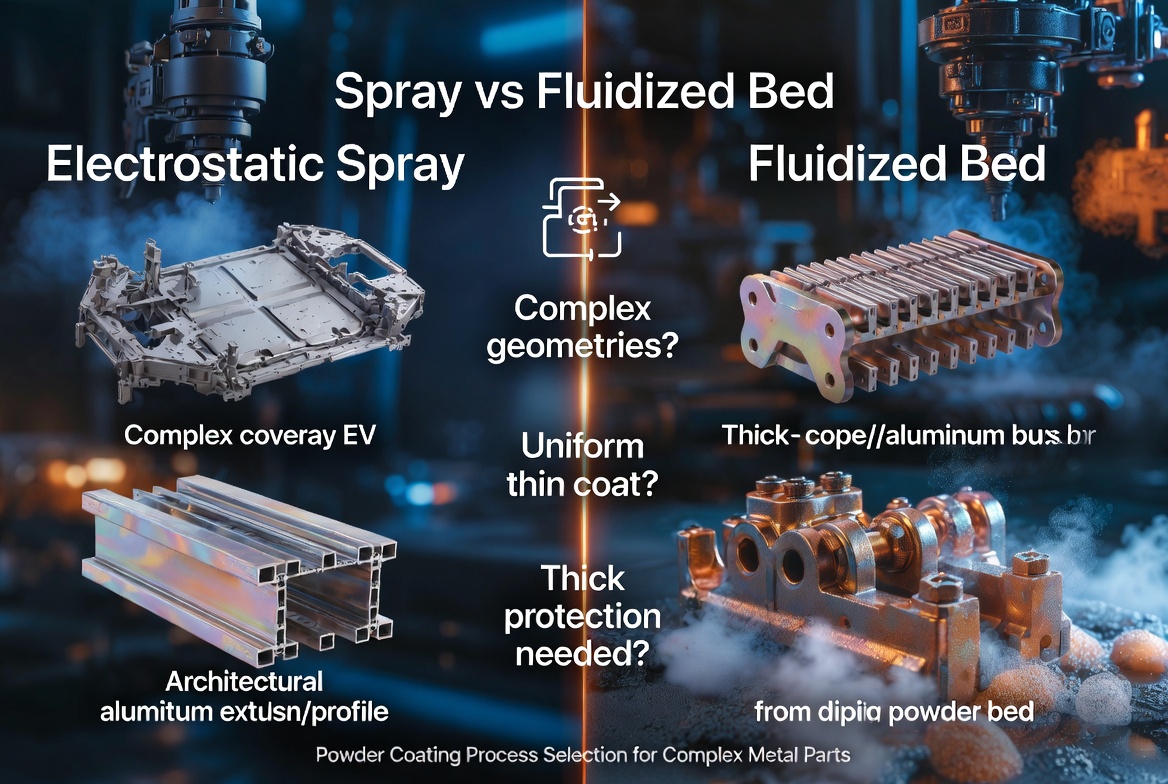
To illustrate how this decision plays out in real industrial contexts, consider two typical part families:
- EV chassis brackets and battery module frames
- Complex geometry, visible surfaces and mixed materials.
- Target thickness often in the 70–120 μm range with aesthetic and corrosion requirements. [appropedia]
- Preferred technology: electrostatic spray with optimized gun paths and cure profile.
- High‑voltage bus bars and transformer components
- Functional surfaces with demanding insulation requirements and high operating stresses. [chinapowdercoating]
- Target thickness in the 250–1500 μm range or higher. [techinfo.misumi.com]
- Preferred technology: fluidized bed or electrostatic fluidized bed, with carefully controlled preheat and dip times.
For a coating partner offering full‑chain solutions, the value lies in guiding customers to the process‑part fit that maximizes performance while simplifying line design and operator workflows.
Beyond technical performance, the user experience for operators and engineers plays a decisive role in long‑term process success.
- High visibility and control: operators see the spray pattern and can adjust gun angle in real time. [zhenxintl]
- Flexible automation: robots and reciprocators integrate well into complex lines. [chinapowdercoating]
- Clear feedback loops: defects such as orange peel or thin spots can be visually identified and corrected. [zhenxintl]
This makes electrostatic spray particularly attractive in multi‑plant global networks, where standardized training and repeatable procedures are essential.
- Simple sequence: preheat, dip, post‑heat if required. [techinfo.misumi.com]
- Stable material environment: powder remains in the bed; housekeeping is simpler without overspray booths. [techinfo.misumi.com]
- Focus on thermal control: operators primarily manage preheat and immersion time, rather than gun tuning. [chinapowdercoating]
For dedicated product lines with limited geometry variation, fluidized beds provide a straightforward, operator‑friendly method once parameters are locked in.
For manufacturers and OEMs dealing with complex geometric metal parts across architecture, EV, medical, hardware and electrical sectors, a strategic approach is essential:
- Use electrostatic spray as the default for visible, high‑precision parts where film thickness is moderate and color flexibility is important. [appropedia]
- Deploy fluidized bed or electrostatic fluidized bed for high‑thickness or insulating components that can be fully immersed and tolerate high preheat temperatures. [misumi-techcentral]
If you are assessing or upgrading your coating technology portfolio, a practical next step is to audit your part families by geometry, function and thickness, then map each category to the process that delivers the best balance of performance, cost and operator experience.
For organizations seeking an integrated partner for powder coatings, equipment and technical consultancy, working with a full‑chain provider capable of both spray and immersion technologies can significantly reduce decision risk and accelerate implementation.
Q1: Is electrostatic spray suitable for very deep recesses and blind holes?
Electrostatic spray can struggle in deep recesses because the electric field lines are weaker, leading to reduced powder deposition and thinner films. Optimization of gun settings and part design can mitigate but not fully eliminate this limitation. [zhenxintl]
Q2: When should I choose fluidized bed over electrostatic spray?
Fluidized bed is preferable when you need very high film thickness, such as heavy corrosion protection or electrical insulation, and when the part can be fully immersed and tolerate high preheat temperatures. [chinapowdercoating]
Q3: Can I use both technologies in one factory?
Yes. Many manufacturers configure separate lines or hybrid systems, using electrostatic spray for aesthetic and precision parts, and fluidized bed for specialized high‑thickness or insulating applications. [misumi-techcentral]
Q4: How does film thickness affect coating selection?
Moderate thickness (around 60–120 μm) aligns well with electrostatic spray and multi‑pass strategies, while very high thickness (250–1500 μm or more) is more efficiently achieved with fluidized bed immersion. [appropedia]
Q5: Are electrostatic fluidized bed systems widely used?
Electrostatic fluidized bed systems exist and offer hybrid benefits, but their adoption depends on specific application requirements and the complexity of controlling particle size distribution and charging conditions. [patents.google]
1. Misumi Tech Info – "Fluidized Bed Powder Coating" – detailed explanation of fluidized bed process, parameters and film thickness range. https://techinfo.misumi.com.cn/exportarticle/article/3245/
2. China Powder Coating – "Powder Coating Application Method" – overview of electrostatic spray, fluidized bed and typical applications and film thickness. https://www.chinapowdercoating.com/technicals/powder-coating-method/
3. Zhenxin Paint – Electrostatic powder spraying principle description – charging, attraction to grounded parts and film formation. https://www.zhenxintl.com/doc_28641268.html
4. Appropedia – "Electrostatic Powder Coating" – technical overview of electrostatic spray powder coating processes and film characteristics. https://www.appropedia.org/Electrostatic_Powder_Coating/zh
5. Misumi Technical Tutorial – "187 Powder Painting (Air Electrostatic Fluidized-bed Coating Method)" – electrostatic fluidized bed process description and design considerations. https://www.misumi-techcentral.com/tt/en/surface/2014/06/187-powder-painting-air-electrostatic-fluidized-bed-coating-method.html
6. Google Patents – CN101262956A "Electrostatic Fluidized Bed Coating Method" – electrostatic fluidized bed coating method and particle size distribution requirements. https://patents.google.com/patent/CN101262956A/zh
7. Guangzhou Yinda Powder Coatings Co., Ltd. – company introduction and description of integrated powder coating industrial chain. https://www.linkedin.com/pulse/brief-introduction-gaungzhou-yinda-powder-coatings-co-winnet-guo


