Language


Views: 268 Author: Yinda Powder Coating Publish Time: 2026-11-01 Origin: Site


Content Menu
● How Epoxy Powder Coating Bonds to Aluminum Extrusions
● Main Causes of Poor Epoxy Powder Coating Adhesion
>> 1. Residual Oil, Silicone, and Handling Contamination
>> 2. Inadequate Aluminum Pretreatment
>> 3. Rinse Residues and Incomplete Drying
>> 4. Undercuring or Excessive Thermal Exposure
>> 5. Unsuitable Film Build or Difficult Profile Geometry
>> 6. A Coating System Unsuitable for Outdoor Exposure
● Troubleshooting Poor Bonding: Match the Symptom to the Investigation
● A Practical Six-Step Adhesion Recovery Plan
>> Step 1: Contain the Affected Production
>> Step 2: Identify the Failure Plane
>> Step 3: Confirm Surface Preparation
>> Step 4: Measure Thickness and Actual Cure
>> Step 5: Make One Controlled Correction
>> Step 6: Requalify Before Releasing Production
● How to Test Epoxy Powder Coating Adhesion Correctly
● Expert Insight: Use a Controlled Trial to Separate Powder and Process Problems
● Improve Energy Efficiency Without Compromising Adhesion
● Discuss Your Aluminum Extrusion Coating Requirements With Yinda Technology
>> Can epoxy powder coating adhere reliably to aluminum extrusions?
>> Why does powder coating peel despite looking smooth?
>> Is blasting enough before powder coating aluminum?
>> What curing temperature should epoxy powder use?
>> Can epoxy powder coating be used on outdoor window frames?
>> Does excellent dry adhesion guarantee corrosion resistance?
Epoxy powder coating adhesion on aluminum extrusions depends on three connected factors: surface preparation, coating compatibility, and verified curing. When one falls outside its operating window, an attractive finish can still peel, chip, or blister.
For manufacturers of architectural profiles, door frames, electric vehicle components, medical equipment housings, and appliances, poor bonding creates more than cosmetic problems. It can interrupt assembly, expose aluminum to corrosion, and generate expensive field returns.
At Yinda Technology, our approach to this challenge starts with the complete coating system—not simply the powder. As a powder coating and environmental materials manufacturer with subsidiaries in China, Indonesia, and Saudi Arabia, we recognize that product selection must reflect both manufacturing conditions and the intended service environment.
The central principle is verification: investigate the substrate, pretreatment, application, and actual metal temperature before changing the formulation.

During curing, thermosetting epoxy powder melts, flows across the prepared surface, and crosslinks into a protective film. Successful adhesion requires intimate contact with a clean, compatible substrate.
Aluminum complicates this process because its surface rapidly develops an oxide layer. Extruded profiles may also carry lubricants, handling contamination, or residues from storage and fabrication.
A suitable pretreatment process cleans and conditions this surface, then establishes an interface that supports adhesion and corrosion resistance.
Two distinctions matter:
- Electrostatic attraction holds uncured powder on the component during application.
- Adhesion keeps the cured coating attached throughout service.
Strong powder attraction in the spray booth does not prove that the finished coating will bond reliably. Likewise, smooth appearance does not establish complete cure.
Extrusion lubricants, machining fluids, fingerprints, and silicone-containing products can prevent the molten coating from wetting aluminum uniformly.
Contamination may produce craters or localized peeling, but some contaminated surfaces initially look acceptable.
Check cleaner concentration, temperature, exposure time, and spray coverage. Pay particular attention to recessed channels and areas shielded by racks.
A water-break check can help screen for residual hydrophobic contamination. However, it does not confirm conversion coating quality or replace adhesion testing.
The practical correction is to restore cleaning performance—not automatically increase cleaner strength beyond the chemical supplier's limits.
A pretreatment line that performs well on steel is not automatically suitable for aluminum extrusions.
Simply removing visible dirt or mechanically roughening a profile may not provide the interface needed for moisture-resistant adhesion. For demanding applications, use an aluminum-compatible conversion treatment selected with the pretreatment supplier.
Chrome-free systems can be suitable, but chemistry selection alone does not guarantee performance. Bath condition, rinsing, application consistency, and drying remain critical.
Monitor the parameters specified for the actual system. Avoid transferring control limits from a different chemistry or production line.
Cleaner carryover and poor rinse control can leave residues between the aluminum and powder film. Water retained inside channels or hollow sections can also disrupt subsequent coating operations.
Inspect:
- Rinse-water quality and carryover.
- Drainage from hollow profiles.
- Rack orientation and contact points.
- Dry-off performance under full production loads.
Follow the pretreatment supplier's final-rinse requirements. Some processes require a controlled rinse; others use designated no-rinse treatments.
More heat is not always the correct drying solution. First examine drainage, airflow, exposure time, and the treatment's temperature limitations.
Oven air temperature is not the same as aluminum surface temperature.
A thick extrusion section can heat differently from a thin wall. Consequently, a coating may look fully flowed while the coldest location has not received the required curing exposure.
Use a temperature profiler with thermocouples attached to representative locations. Compare the recorded metal-temperature history with the powder's technical data sheet.
For illustration, a hypothetical requirement of 10 minutes at 180°C metal temperature does not mean 10 minutes inside an oven set to 180°C. That example is not a Yinda product specification.
Excessive thermal exposure can also alter appearance or mechanical performance. Stay within the formulation's approved curing window rather than assuming additional baking always improves bonding.
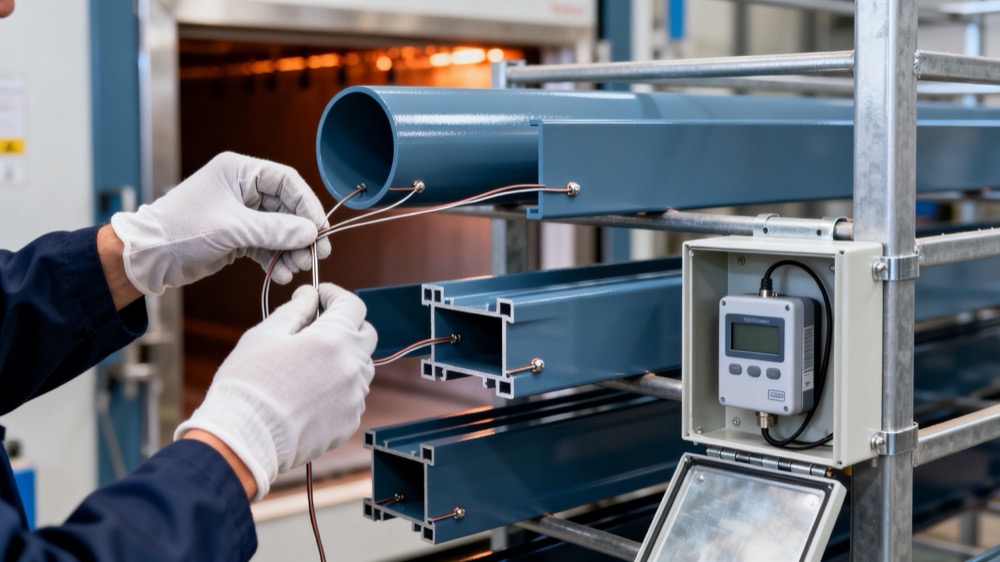
Deep channels, internal corners, and closely spaced surfaces can produce uneven powder deposition. Increasing gun output may thicken exposed faces without adequately coating recessed areas.
Check dry film thickness at several locations, not just the easiest accessible surface.
Corrective adjustments may include:
- Cleaning racks and restoring reliable grounding.
- Optimizing gun position, voltage, current, and powder flow.
- Changing profile orientation.
- Applying controlled manual touch-up where necessary.
Film thickness should follow the product specification. Excessive thickness is not a reliable remedy for poor pretreatment or incomplete cure.
Epoxy powders provide useful adhesion, chemical resistance, and mechanical properties. However, conventional epoxy coatings have limited resistance to prolonged ultraviolet exposure.
This matters when aluminum extrusions serve outdoor windows, doors, or architectural assemblies.
An epoxy finish may chalk or lose appearance outdoors even when its initial adhesion is satisfactory. Weathering and adhesion failure are related performance concerns, but they are not identical.
For exposed architectural surfaces, consider an appropriately specified exterior polyester system. Where an epoxy primer is proposed beneath a weather-resistant topcoat, validate the complete system, including intercoat adhesion and curing compatibility.
Failure appearance provides useful clues, but it should guide testing rather than replace it.
| Observed symptom | Possible explanation | Priority investigation |
|---|---|---|
| Large sheets peel from aluminum | Contamination or unsuitable pretreatment | Examine the exposed surface and pretreatment records |
| Dry adhesion passes; wet adhesion fails | Moisture-sensitive interface | Review conversion treatment, rinsing, and wet-test results |
| Failures concentrate on heavy sections | Insufficient curing exposure | Profile metal temperature at thick locations |
| Channels show weak or inconsistent coverage | Deposition and geometry problems | Measure local thickness and review gun settings |
| Blistering develops after moisture exposure | Residues or corrosion beneath the film | Investigate rinse control and pretreatment |
| Separation occurs between coating layers | Intercoat incompatibility or contamination | Review both products and their application sequence |
White material beneath a failed coating may indicate aluminum corrosion products. Do not identify an unknown residue by appearance alone; laboratory examination may be necessary.
Separate suspect batches and record the powder lot, extrusion source, pretreatment conditions, rack arrangement, line speed, and oven settings.
Retain both failed components and acceptable comparison samples.
Determine whether separation occurred:
- Between aluminum and pretreatment.
- Between the prepared surface and coating.
- Within the coating film.
- Between primer and topcoat.
This distinction prevents an intercoat problem from being treated as a substrate-cleaning problem.
Review bath-control records and inspect cleaning coverage. Check whether the problem coincided with chemical replenishment, maintenance, a new extrusion lot, or a production interruption.
Investigate differences between acceptable and rejected parts before changing several variables simultaneously.
Map film thickness across the profile. Run an oven profile using a representative loaded rack.
Flat laboratory panels are useful controls, but they cannot fully reproduce an extrusion's thermal behavior or geometry.
Change the variable supported by the evidence. Examples include correcting cleaner exposure, restoring rinse quality, adjusting profile orientation, or revising the oven cycle.
Document the original condition and the correction so the trial produces actionable information.
Repeat the required adhesion tests and application-specific performance checks.
Passing a single test on one flat panel should not release every profile design or service condition.
ASTM D3359 provides methods for rating adhesion using cuts through the coating and pressure-sensitive tape.
Select the method according to coating thickness and the standard's requirements. For example, Method B is primarily intended for coating systems below 125 μm; thicker systems require appropriate method selection.
The result is a rating, not an absolute bond-strength measurement. Consistent cutting, tape selection, removal technique, and operator training are essential.
Do not treat ASTM D3359 and ISO 2409 classifications as interchangeable without checking the specified procedure.
Moisture exposure can reveal weaknesses that dry testing misses.
For architectural applications, follow the wet-adhesion procedure in the applicable project specification, such as the relevant AAMA requirements. Confirm the required edition, conditioning, exposure, and acceptance criteria.
A wet-adhesion pass does not independently establish outdoor weatherability or compliance with an entire architectural specification.
ASTM D4541 evaluates pull-off strength using a bonded loading fixture.
Record both the measured result and the failure location. Separation in the fixture adhesive does not directly establish the coating-to-aluminum bond strength.
Profile curvature, limited test area, and substrate flexibility may affect suitability. Agree on the test arrangement before comparing results.
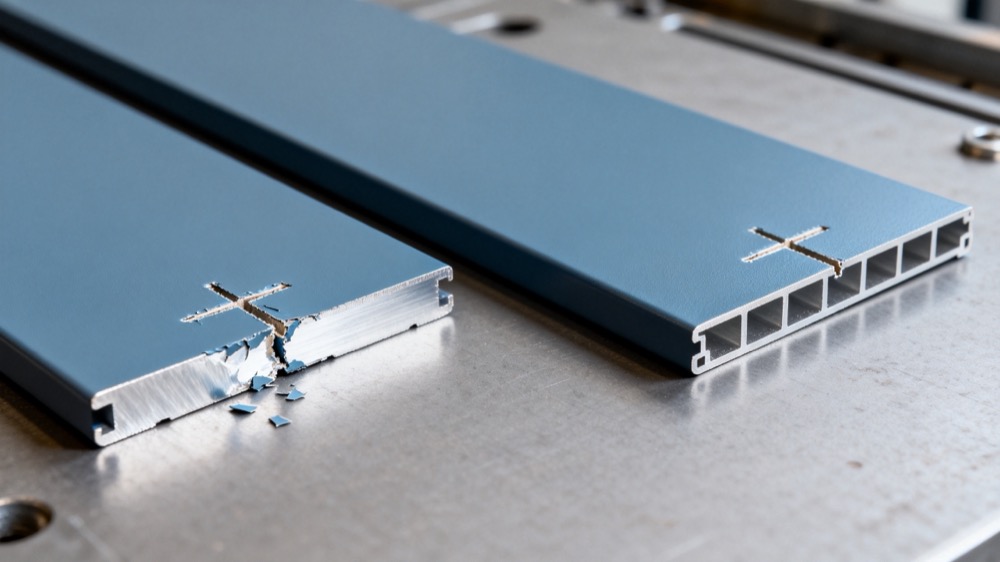
When production teams disagree about whether the powder or pretreatment caused failure, a small comparative trial can clarify the next step.
Use the same extrusion lot, controlled film thickness, and verified curing conditions:
| Trial | Surface preparation | Powder |
|---|---|---|
| A | Current production process | Current powder |
| B | Validated reference process | Current powder |
| C | Current production process | Qualified comparison powder |
| D | Validated reference process | Qualified comparison powder |
If both powders improve after reference preparation, pretreatment deserves priority. If only one powder fails under otherwise matched conditions, investigate its suitability, storage, batch condition, and curing requirements.
Repeat the comparison before drawing conclusions. This is a proposed diagnostic framework, not a reported Yinda customer case.
Energy reduction should begin with measured oven performance.
A lower-temperature powder may offer opportunities, but the complete process must still deliver the specified metal-temperature exposure. Merely reducing the oven setpoint can create undercured production.
Evaluate rack loading, unnecessary idle operation, and process consistency alongside formulation options.
Compare accepted production per unit of energy—not oven temperature alone. A nominally cooler cycle offers little value if rejection and recoating increase.
For a targeted technical discussion, send Yinda Technology your extrusion alloy, profile drawing, pretreatment sequence, powder specification, measured film thickness, oven profile, and failure photographs.
Include the intended exposure conditions and customer acceptance requirements. These details provide the basis for evaluating a suitable coating system and a controlled validation plan.
Yes. Reliable results require an appropriate epoxy formulation, compatible surface treatment, controlled film thickness, and verified curing. Qualification should reflect the actual component and service environment.
Appearance does not confirm surface cleanliness, pretreatment quality, or crosslinking. A smooth film can still have a weak interface or insufficient cure.
Not as a universal specification. Blasting can clean and texture a surface, but demanding moisture-exposed applications generally require an appropriate aluminum pretreatment system.
Use the specific product's technical data sheet. Required time and temperature depend on formulation and refer to defined substrate conditions, not simply the oven display.
Conventional epoxy is generally unsuitable as an exposed decorative finish under prolonged sunlight. Select a qualified exterior system or validate an appropriate multilayer alternative.
No. Dry adhesion evaluates only part of performance. Moisture resistance, pretreatment quality, coating continuity, geometry, and application-specific corrosion testing also matter.
1. [ASTM International — ASTM D3359-23: Standard Test Methods for Rating Adhesion by Tape Test]. Source for tape-test scope, thickness considerations, interpretation, and procedural limitations. [store.astm]
2. [ASTM International — ASTM D4541: Standard Test Method for Pull-Off Strength of Coatings Using Portable Adhesion Testers]. Source for pull-off testing; the published D4541 scope also explains weakest-plane failure and measurement limitations. [astm]
3. [Products Finishing — "Powder Coating Chipping on Aluminum Extrusion"]. Technical commentary attributed to Rodger Talbert on aluminum oxide, conversion treatment, and wet-adhesion investigation. [pfonline]
4. [Products Finishing — "Powder on Aluminum Extrusion"]. Source for the relationship between pretreatment, coating selection, application, curing, and component design. [pfonline]
5. [TIGER Coatings — "Powder Coating Resins and their Properties"]. Source for epoxy adhesion, chemical resistance, and ultraviolet-weathering limitations. [tiger-coatings]
6. [TIGER Coatings — "What Is Powder Coating?"]. Source for the general pretreatment, electrostatic application, drying, and curing sequence. [tiger-coatings]
7. [TIGER Coatings — "TIGER Drylac® Series 89 – Low-Cure Interior Powder"]. Product-specific illustration of substrate-temperature curing requirements and interior epoxy-polyester limitations; its curing schedules are not specifications for Yinda products. [tiger-coatings]


