Language


Views: 257 Author: Yinda Powder Coating Publish Time: 2026-10-28 Origin: Site


Content Menu
● Epoxy vs Epoxy-Polyester Powder Coating: Comparison at a Glance
● What Is Epoxy Powder Coating?
>> Where Pure Epoxy Makes Sense
● What Is Epoxy-Polyester Powder Coating?
>> Where Hybrid Powder Coating Makes Sense
● Comparing Performance in Electrical Enclosure Applications
>> Chemical Resistance: Specify the Exposure, Not the Label
>> Corrosion Resistance: Preparation Can Decide the Winner
>> Appearance, Yellowing, and Mechanical Performance
● Indoor vs Outdoor Electrical Enclosures: A Critical Distinction
● Cure Temperature, Film Thickness, and Energy Use
>> Validate Part Temperature, Not Just Oven Settings
>> Low-Cure Performance Is Product-Specific
● Three Selection Scenarios for Enclosure Buyers
>> Scenario 1: Indoor Distribution Cabinet
>> Scenario 2: Indoor Cabinet Near Chemical Processing
>> Scenario 3: Outdoor EV Charging Enclosure
● A Practical Qualification Workflow Before Mass Production
● Electrical Function: Separate Surface Protection from Insulation
● Compare Cost per Accepted Enclosure, Not Powder Price Alone
● Discuss Your Electrical Enclosure Specification with Yinda Technology
>> Is epoxy powder coating better than epoxy-polyester for electrical enclosures?
>> Can epoxy-polyester powder coating be used outdoors?
>> Which coating provides better corrosion resistance?
>> Does epoxy-polyester powder coating always cure at a lower temperature?
>> Can ordinary epoxy enclosure powder be used as busbar insulation?
>> What should buyers send when requesting coating samples?
Choosing between epoxy powder coating vs epoxy-polyester powder coating for electrical enclosures starts with a practical question: what must the cabinet withstand? Chemical exposure, condensation, cleaning, sunlight, and production conditions matter more than the resin name alone.
For many indoor electrical cabinets, epoxy-polyester powder coating offers a useful balance of appearance, mechanical performance, and processing flexibility. Pure epoxy powder coating deserves closer consideration when chemical resistance is the overriding requirement. Neither is the default choice for prolonged outdoor exposure.
From a manufacturer's perspective, I would treat this as a system decision: coating chemistry, substrate preparation, enclosure design, and curing must work together.
Yinda Technology develops, manufactures, and supplies powder coatings and environmentally friendly materials, with subsidiaries in China, Indonesia, and Saudi Arabia. This guide connects coating selection with the practical requirements of electrical enclosure manufacturing.

The following comparison describes typical tendencies, not guaranteed performance for every formulation.
| Selection factor | Epoxy powder coating | Epoxy-polyester powder coating |
|---|---|---|
| Binder chemistry | Epoxy-based thermoset system | Epoxy and polyester hybrid system |
| Main selection driver | Chemical protection and adhesion | Balanced indoor protection and appearance |
| Chemical resistance | Often preferred for demanding exposure; verify the grade | Suitable for many industrial exposures; verify chemicals individually |
| Corrosion protection | Strong potential with appropriate preparation and cure | Strong potential with appropriate preparation and cure |
| Appearance stability | More susceptible to yellowing and chalking | Generally improved color and overbake stability |
| Mechanical performance | Formulation-dependent | Often a useful balance of hardness, flexibility, and impact resistance |
| Prolonged outdoor exposure | Generally unsuitable as an exposed finish | Generally unsuitable as an exposed finish |
| Typical enclosure use | Chemically exposed indoor cabinets | Indoor control panels and distribution cabinets |
| Purchasing priority | Validate resistance to actual chemicals | Validate finish consistency and production performance |
Neither column replaces a product technical data sheet or testing on the intended enclosure.
Epoxy powder coating forms a crosslinked thermoset film when its epoxy resin reacts with a suitable curing agent during baking.
Its attraction lies in adhesion, barrier protection, and chemical resistance. These properties make epoxy a candidate for indoor metal components exposed to oils, industrial contaminants, or specified cleaning agents.
For electrical enclosures, the important question is not whether epoxy is "chemical resistant." It is whether the selected formulation withstands the exact chemical, concentration, temperature, and contact duration involved.
Consider epoxy powder coating for electrical enclosures when:
- The cabinet operates indoors without significant sunlight exposure.
- Chemical resistance takes priority over long-term decorative appearance.
- The required formulation passes representative cleaning and contamination tests.
- Pretreatment and curing conditions can be controlled consistently.
Its main limitation is weatherability. Sunlight can cause chalking and color deterioration, making exposed outdoor applications a poor default fit.
Epoxy-polyester powder coating, also called hybrid powder coating, combines epoxy and polyester binder chemistry.
The hybrid approach balances protective and decorative properties. Compared with pure epoxy, suitable hybrid formulations generally offer improved color stability, heat stability, and resistance to yellowing during overbaking.
These advantages help explain their use on indoor appliances, machinery, furniture, and electrical cabinets.
However, "contains polyester" does not mean "outdoor durable." The epoxy component still limits prolonged ultraviolet exposure.
Epoxy-polyester powder coating for electrical enclosures is a practical candidate when manufacturers need:
- A consistent indoor decorative finish.
- Good resistance to handling, scratching, and routine cleaning.
- Suitable corrosion protection on properly prepared metal.
- A validated processing window for their coating line.
The resin balance and additives matter. Two hybrid powders can differ substantially in appearance, chemical resistance, and curing requirements.
Pure epoxy is often the stronger starting point for demanding chemical service. Nevertheless, a generic resin-family comparison cannot establish compatibility.
A cabinet exposed to occasional hydraulic-oil splashes faces a different challenge from one repeatedly cleaned with an aggressive disinfectant.
Before choosing either powder, document:
1. Chemical identity and concentration.
2. Surface temperature during exposure.
3. Contact time and cleaning frequency.
4. Whether liquid remains around seams or fasteners.
5. Acceptable changes in gloss, color, hardness, and adhesion.
For medical equipment housings, test the actual cleaning procedure. General industrial chemical resistance does not establish disinfectant compatibility or suitability for a medical application.
Both systems can provide effective corrosion protection. Neither compensates for oil contamination, unsuitable pretreatment, exposed edges, or incomplete curing.
On fabricated steel cabinets, vulnerable locations include welds, cut edges, recessed corners, and areas around hardware.
My purchasing priority would be a documented coating system rather than an isolated salt-spray figure. Ask what substrate, pretreatment, film thickness, cure conditions, and acceptance criteria produced the result.
A result measured on pretreated flat panels should not automatically become a performance promise for an assembled enclosure with seams and complex geometry.
Hybrid coatings generally provide better color and overbake stability than pure epoxy. This can matter when doors, bodies, and removable panels must match.
However, improved overbake tolerance is not permission to ignore the curing schedule.
Mechanical performance also requires grade-specific comparison. Hardness alone does not establish resistance to impact, bending, scratching, or installation damage.
Test representative parts after curing. Include door edges, mounting areas, and surfaces handled during assembly.
An indoor control panel and an outdoor charging cabinet should not receive the same coating specification simply because both contain electrical equipment.
Standard epoxy and epoxy-polyester finishes are primarily indoor choices. Hybrid coatings may resist appearance deterioration better than pure epoxy, but that relative improvement does not establish long-term outdoor suitability.
For exposed outdoor enclosures, evaluate a weather-resistant polyester finish or a qualified multilayer system. An epoxy primer beneath a suitable exterior topcoat is a different proposition from an exposed epoxy finish.
Also distinguish geographical location from actual exposure. A climate-controlled cabinet in Saudi Arabia may have different needs from a coastal outdoor cabinet in Indonesia. Installation conditions, not country names, should drive selection.
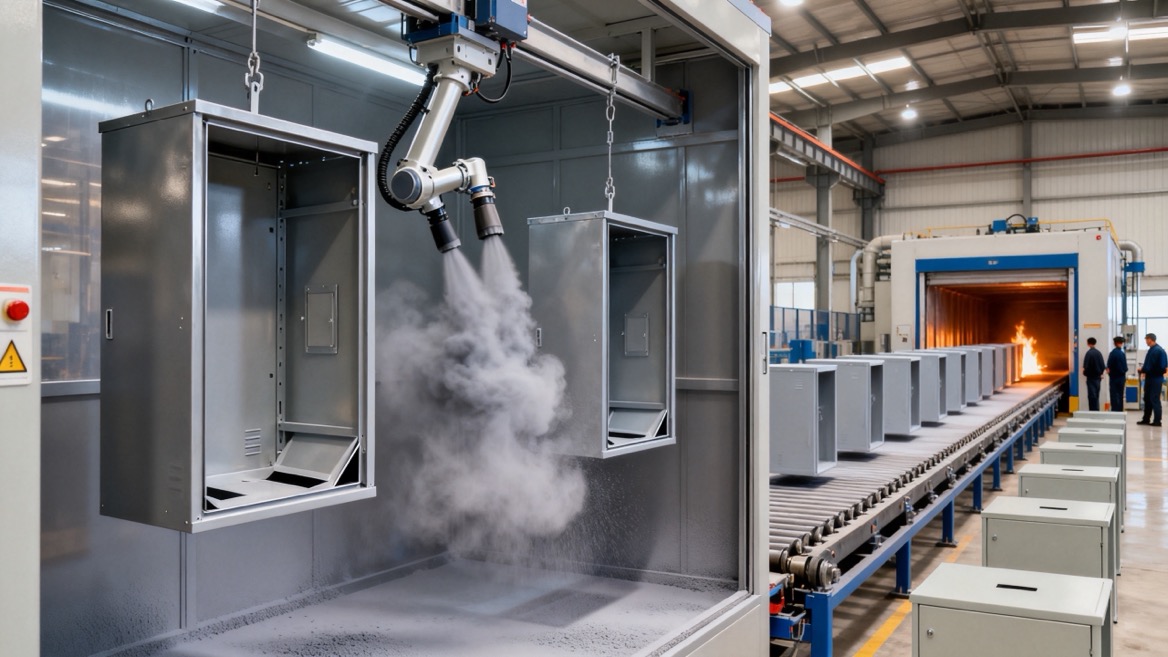
The curing schedule applies to the coating and the metal component under defined conditions. Oven-air temperature alone does not establish that every part received the required cure.
A heavy enclosure body and a thin door can heat differently. Mixed production loads therefore deserve particular attention.
Use temperature profiling on representative components, then compare the recorded metal-temperature history with the powder supplier's instructions.
Under-curing can compromise performance. Excessive heat exposure can affect appearance, particularly with sensitive colors and formulations.
Low-cure hybrid powders exist, including commercial products specified from a substrate temperature of 160°C. This is a formulation example, not a universal hybrid curing requirement.
Lower-temperature curing may support energy-saving objectives, but savings should be measured on the actual line. Throughput, dwell time, oven loading, and reject rates affect the outcome.
Likewise, do not prescribe one film thickness for every enclosure. Follow the selected product's validated range and inspect difficult geometry, not only accessible flat surfaces.
The following scenarios illustrate decision-making; they are not reported Yinda customer projects.
A manufacturer needs a consistent light-gray finish, resistance to assembly handling, and protection in a controlled indoor environment.
An epoxy-polyester hybrid is a sensible starting point. Validate color matching, impact performance, adhesion, and the production curing window.
A cabinet encounters repeated chemical splashes and scheduled cleaning.
Begin by screening epoxy formulations against the exposure list. Compare a hybrid only if it meets the same acceptance criteria. Select the tested formulation, not the chemistry with the strongest marketing description.
An enclosure faces sunlight, rain, and changing temperatures.
Neither standard epoxy nor standard epoxy-polyester should be the automatic exposed-finish choice. Evaluate an exterior-grade coating system and test the complete construction, including edges, joints, and hardware interfaces.
A controlled trial is more useful than approving a color sample alone.
1. Define the service environment. Record indoor or outdoor placement, moisture, chemicals, cleaning, and appearance requirements.
2. Confirm the substrate. Identify steel, galvanized steel, or aluminum, together with welds and fabrication residues.
3. Agree on pretreatment. Match cleaning and conversion treatment to the substrate and required protection.
4. Select candidate formulations. Obtain current technical data sheets, safety data sheets, and relevant test information.
5. Coat representative parts. Include the deepest recesses, sharpest edges, and heaviest sections.
6. Verify film build and cure. Record thickness distribution and component temperature history.
7. Test against written criteria. Assess adhesion, impact, appearance, corrosion, and relevant chemical exposures.
8. Lock the process. Record powder identification, pretreatment controls, application settings, and approved curing conditions.
Retain approved samples and trial records. They provide a useful baseline when production appearance or performance changes.
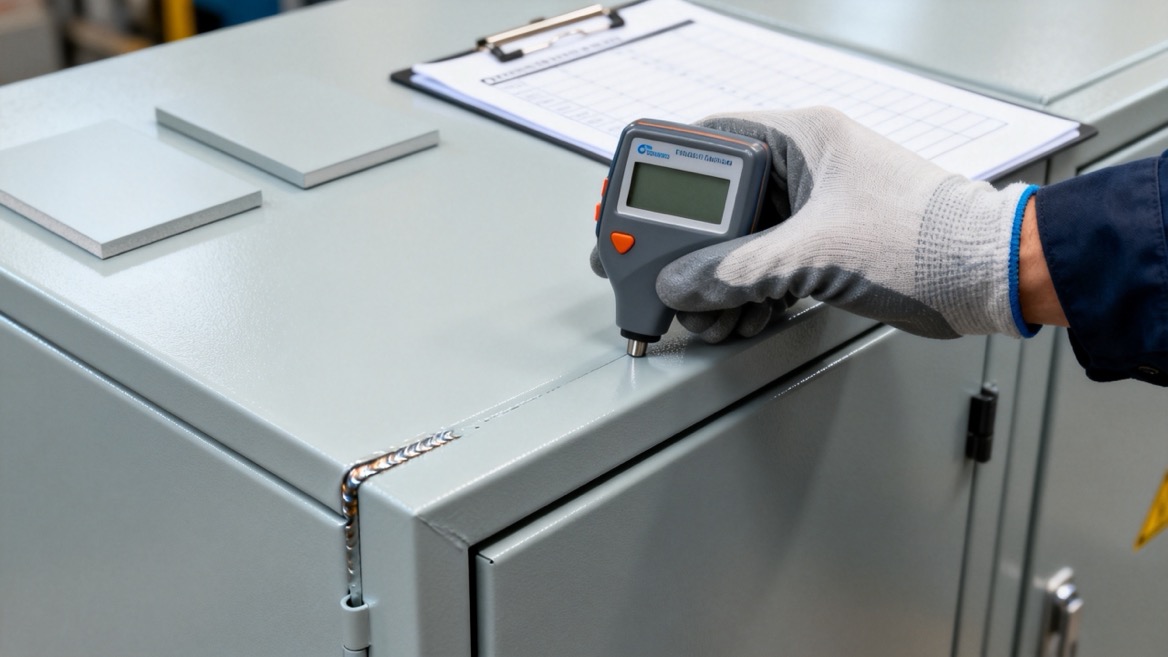
A protective enclosure finish and a purpose-designed electrical insulation coating serve different functions.
Do not assume that an ordinary epoxy cabinet powder qualifies as insulation for busbars or other electrically stressed components. Dedicated insulation products have their own specifications and qualification requirements.
Similarly, coating selection alone does not establish enclosure compliance. The completed design, assembly, sealing, and electrical requirements must be assessed separately.
Review bonding and grounding interfaces during design approval rather than discovering coating-related contact issues during final assembly.
A lower powder price can be offset by poor coverage, inconsistent appearance, rework, or a narrow processing window.
Use a practical purchasing measure:
Total coating-related production cost divided by the number of accepted enclosures.
Include:
- Powder consumption and usable reclaim.
- Pretreatment and curing costs.
- Application and masking labor.
- Rejects, recoating, and color-change losses.
- Inspection and field-repair exposure.
Neither epoxy nor hybrid is universally cheaper in service. The better purchase is the qualified formulation that meets requirements consistently on your production line.
Yinda Technology's activities span powder coatings, environmentally friendly materials, and energy-saving technology promotion. Its manufacturing-market background includes electrical appliances, hardware, medical equipment, and new energy vehicles.
To begin a focused coating discussion, send Yinda your enclosure drawings, substrate details, installation environment, cleaning chemicals, color target, and curing-line conditions.
Request candidate technical data sheets and propose a representative trial before approving production. This creates a clearer basis for comparing epoxy and epoxy-polyester powder coatings than requesting a quotation by color alone.
Not universally. Epoxy is often considered for demanding chemical exposure, while hybrid coatings offer a useful balance for indoor decorative and protective applications. Validate the actual formulation.
Standard hybrid coatings are generally unsuitable for prolonged outdoor exposure. Improved stability compared with pure epoxy does not make them equivalent to exterior-grade polyester coatings.
The answer depends on formulation, substrate preparation, coverage, curing, and test conditions. Compare complete coating systems under equivalent conditions rather than resin names alone.
No. Low-cure hybrid products exist, but curing requirements are product-specific. Follow the technical data sheet and verify the metal temperature on representative components.
Do not assume so. Busbar insulation requires a purpose-designed coating with appropriate electrical performance and qualification evidence.
Provide substrate and pretreatment details, enclosure geometry, exposure conditions, cleaning chemicals, color and texture requirements, curing capability, and written acceptance criteria.
1. AkzoNobel Interpon. "Hybrid Technology in Powder Coatings." Explains epoxy-polyester chemistry, indoor applications, protective properties, and improved stability relative to pure epoxy. Supports the chemistry comparison and outdoor-use limitations. [interpon]
2. AkzoNobel Interpon. "Interpon 700 — Product Data Sheet." Provides product-specific information on epoxy-polyester coating performance, test-panel preparation, chemical resistance, and exterior appearance limitations. Its results are formulation-specific, not universal benchmarks for Yinda products. [powdercoatings.brand.akzonobel]
3. TIGER Coatings. "TIGER Drylac® Series 09 — Interior Powder Coating with High Mechanical and Chemical Resistance." Supports the discussion of hybrid applications, mechanical properties, appearance, and ultraviolet limitations. [tiger-coatings]
4. TIGER Coatings. "TIGER Drylac® Series 89 — Low-Cure Interior Powder Coating." Provides the commercial example of a hybrid system curing from 160°C substrate temperature. No equivalent curing specification or energy-saving result is claimed for Yinda products. [tiger-coatings]
5. AkzoNobel Interpon. "Electrical Panels and Power Distribution Units." Distinguishes exterior enclosure finishes, epoxy primers, indoor hybrid finishes, and dedicated electrical insulation coatings for busbars and components. [interpon]
6. ChemQuest. "Is Underbody Powder Coating a Viable Alternative to E-Coat?" Provides technical context on pretreatment, powder-film coverage, recessed geometry, and corrosion vulnerabilities. Used for general application principles, not enclosure-specific performance guarantees. [chemquest]


