Language


Views: 298 Author: Yinda Powder Coating Publish Time: 2026-11-12 Origin: Site


Content Menu
● Epoxy Powder Coating vs Liquid Epoxy Coating: Quick Comparison
● How Epoxy Powder Coating and Liquid Epoxy Coating Work
>> Epoxy powder coating: a heat-cured protective film
>> Liquid epoxy coating: flexibility through reactive chemistry
● Which Epoxy Coating Provides Better Salt Spray Protection?
>> Why surface preparation often decides the result
>> Why thickness alone cannot guarantee protection
>> Why edges and recesses deserve separate inspection
● How to Interpret Salt Spray Test Results Correctly
>> Salt spray hours are not service-life years
>> What a useful corrosion report should include
>> When additional testing adds value
● Outdoor Durability, Chemicals, and Environmental Trade-Offs
>> Pure epoxy needs protection from sunlight
>> Chemical resistance must match the exposure
>> Lower solvent emissions do not settle every sustainability question
● Practical Selection Scenarios for Industrial Buyers
>> Factory-made appliance housings
>> Large equipment requiring field maintenance
>> Coastal architectural components
● A Six-Step Qualification Plan Before Production
>> 1. Define the real exposure
>> 2. Document both complete systems
>> 3. Test production-representative geometry
>> 4. Agree on acceptance criteria beforehand
>> 5. Investigate failure patterns
>> 6. Validate production and repair
● Compare Total Cost, Not Just Coating Price
● Discuss Your Salt Spray Protection Requirements With Yinda Technology
>> Is epoxy powder coating always better than liquid epoxy for salt spray protection?
>> Can salt spray hours predict outdoor service life?
>> Can epoxy powder coating be used outdoors?
>> Does liquid epoxy always require an oven?
>> Is powder coating completely environmentally harmless?
>> What information should I send a coating supplier?
Epoxy powder coating vs liquid epoxy coating for salt spray protection is not a contest with one universal winner. Both can protect metal effectively, but their performance depends on surface preparation, formulation, film thickness, curing, and the conditions the finished component will face.
For manufacturers, the practical difference is often production fit. Epoxy powder coating suits repeatable factory finishing of heat-tolerant parts. Liquid epoxy coating offers greater flexibility for large structures, site application, and maintenance.
At Yinda Technology, our focus spans powder coatings, environmentally conscious materials, and energy-saving technologies, with subsidiaries in China, Indonesia, and Saudi Arabia. Our approach to this comparison is straightforward: select a complete protective system, not simply a coating format or an impressive salt spray number.
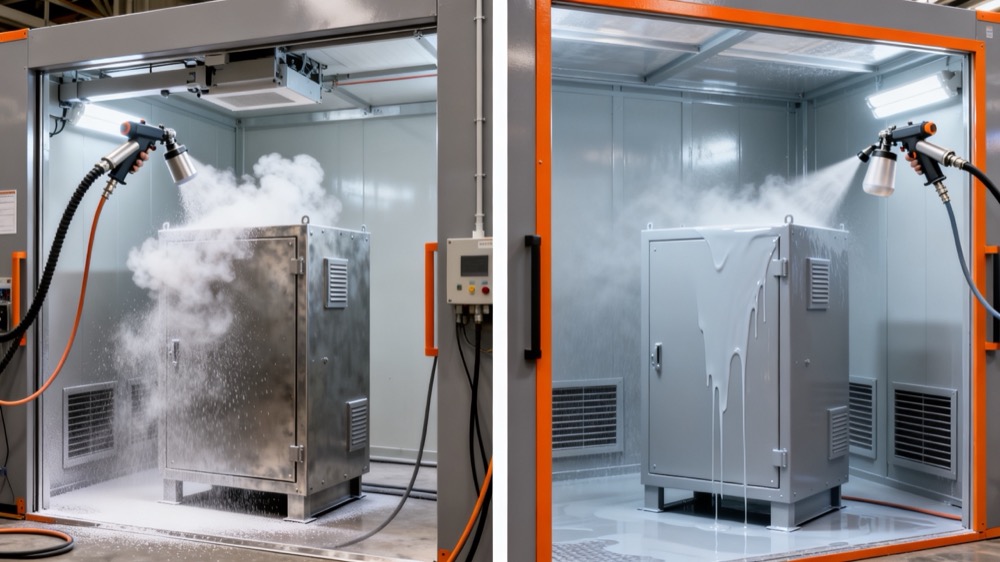
| Selection factor | Epoxy powder coating | Liquid epoxy coating |
|---|---|---|
| Application | Dry powder, commonly electrostatically sprayed | Liquid material applied using suitable spray or manual methods |
| Curing | Typically requires an oven | Many two-component systems cure without baking |
| Production fit | Repeatable factory production | Factory work, large structures, and field maintenance |
| Corrosion protection | Strong when preparation and cure are controlled | Strong when preparation, mixing, and application are controlled |
| Application constraints | Oven size, part temperature, recessed geometry | Pot life, environmental conditions, recoat intervals |
| Solvent emissions | Generally negligible | Depend on solvent-borne, waterborne, or solvent-free formulation |
| Outdoor exposure | Pure epoxy needs protection from sunlight | Exposed epoxy generally needs a weather-resistant finish |
| Repair | Usually requires a qualified repair procedure | Often more practical for localized field repairs |
Neither coating type deserves a higher salt spray rating without comparable test evidence.
Epoxy powder coating contains solid resin, curing agents, pigments, and additives. During conventional application, charged powder particles deposit onto a grounded component. Heating allows the material to melt, flow, and crosslink into a protective film.
This process supports controlled factory finishing without an evaporating solvent carrier. However, successful curing depends on the component reaching the specified temperature for the required time.
An oven setting is not proof of cure. Thick sections and heavy assemblies can heat more slowly than thin test panels.
Many industrial liquid epoxies use two components: a resin base and a curing agent. Once mixed, they react to form a protective film.
Formulations include solvent-borne, waterborne, high-solids, and solvent-free products. These categories should not be treated as environmentally or operationally identical.
Liquid epoxy can suit equipment that cannot enter an oven. Its flexibility comes with additional controls, including mixing ratio, pot life, surface temperature, and the interval between coats.
Both formats can provide strong corrosion resistance. The better choice is the system that maintains adhesion and limits corrosion on the actual component.
Oil, rust, soluble contamination, and unsuitable pretreatment can undermine either coating.
Preparation must match the substrate. Carbon steel, aluminum, and galvanized steel do not require identical treatment. A process that performs well on one should not be assumed suitable for another.
For powder coating, cleaning, pretreatment, rinsing, and drying require consistent control. For liquid epoxy, cleanliness, surface profile, and application conditions are equally important.
From a specification standpoint, I would question an undocumented preparation process before debating powder versus liquid.
Dry-film thickness matters, but "thicker" does not automatically mean "better."
Insufficient thickness can leave weak coverage. Excessive thickness may fall outside the product's qualified application range and introduce other defects.
Follow the selected product's technical data sheet. Compare the complete coating build, including primers and topcoats, rather than assuming one generic thickness suits every application.
Flat panels do not reproduce every feature of a manufactured part.
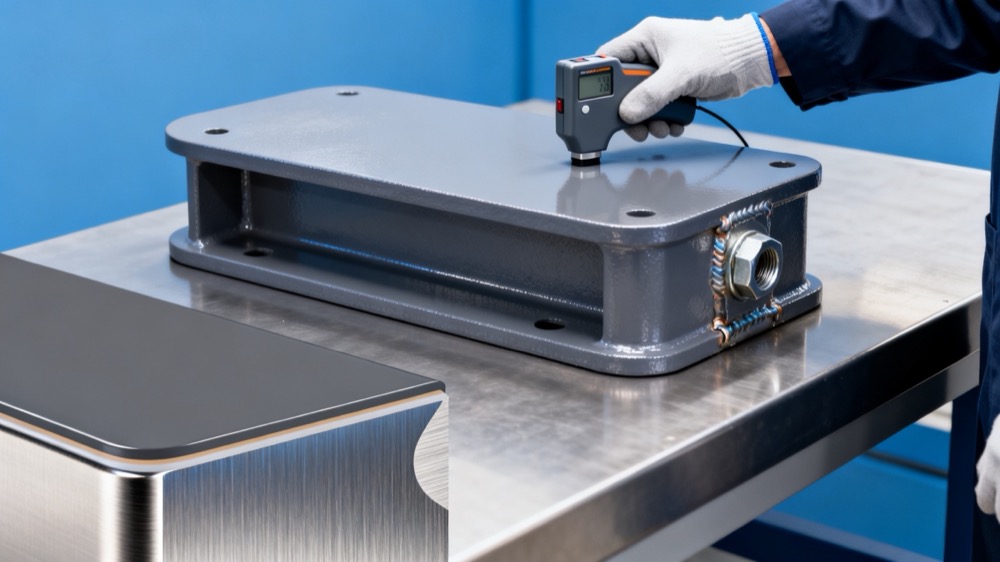
Corners, welds, holes, and recessed areas may receive different coverage. Electrostatic powder application can struggle in deep recesses. Liquid coatings also require careful application around difficult geometry; stripe coating may be specified for vulnerable details.
A coating that performs well on a flat panel still needs validation on representative components.
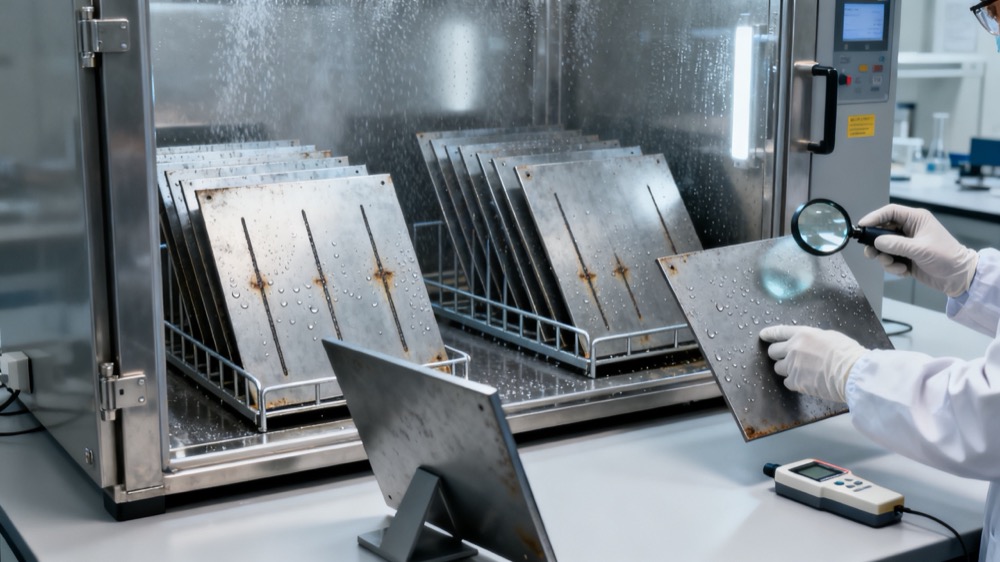
ASTM B117 provides controlled salt fog exposure conditions. It does not establish a universal product acceptance period or convert laboratory hours into years outdoors.
A "1,000-hour" result therefore needs context. It does not automatically establish suitability for a coastal building, vehicle component, or industrial enclosure.
Natural exposure introduces sunlight, drying, condensation, temperature changes, contamination, and mechanical damage. Continuous salt fog cannot reproduce every combination.
Before comparing epoxy powder coating salt spray resistance with liquid epoxy performance, request:
- Substrate material and preparation.
- Product identification and complete layer sequence.
- Measured coating thickness.
- Cure and conditioning details.
- Test method and exposure duration.
- Scribed or unscribed specimen condition.
- Blistering, rusting, adhesion, and corrosion-creep results.
- Acceptance criteria, photographs, and replicate information.
Hours without assessment criteria tell only part of the story.
For exposed industrial components, salt spray testing may need support from humidity, adhesion, chemical resistance, or cyclic ageing evaluations.
ISO 12944-6 provides laboratory assessment methods for protective paint systems on specified steel substrates. Its results support system selection, not exact service-life prediction.
Its scope also matters: it should not be presented as blanket qualification for every aluminum profile, appliance, or automotive component.
Epoxy chemistry offers useful corrosion and chemical resistance, but pure epoxy powder is generally intended for interior applications or primer service because of limited ultraviolet resistance.
Do not select an exposed pure epoxy finish for architectural doors, windows, or profiles solely because it performs well in salt spray testing.
Liquid epoxy systems also require attention to weathering. For outdoor service, specify a compatible, qualified weather-resistant topcoat where needed.
"Chemical resistant" is not a complete specification.
Identify the actual cleaner, oil, disinfectant, or process chemical, together with its concentration, temperature, and contact duration. Occasional splashing and continuous immersion are different exposures.
For medical equipment, corrosion performance does not establish biocompatibility or suitability for every disinfection procedure. For new-energy vehicle components, separate electrical, thermal, and mechanical requirements may also apply.
Powder coatings generally contain no solvent carrier and produce negligible solvent emissions during application.
However, environmental assessment should also consider oven energy, pretreatment, rejected parts, material recovery, and expected maintenance.
Liquid epoxy performance varies by formulation. Comparing powder only with conventional solvent-borne paint overlooks high-solids, waterborne, and solvent-free alternatives.
For either route, review the safety data sheet and provide appropriate exposure controls. Low solvent emissions do not remove dust, chemical-handling, or other workplace risks.
The following scenarios illustrate selection logic; they are not reported Yinda customer case studies.
For repeat production of heat-tolerant housings, epoxy powder coating can be a practical candidate.
The key checks are pretreatment consistency, coverage around openings, and verified cure across different part masses.
If the housing will receive direct sunlight, reconsider the finish chemistry or specify an appropriate protective topcoat.
Liquid epoxy can be more practical where equipment is too large for available ovens or needs repairs after installation.
The specification should address site preparation, application conditions, mixing, and return-to-service time.
Convenient application does not compensate for inadequate cleaning or premature exposure.
For coastal doors, windows, and profiles, evaluate corrosion protection together with ultraviolet stability and appearance retention.
The decision may involve a complete primer-and-topcoat system rather than exposed epoxy alone.
Also verify the substrate. Evidence from prepared steel panels cannot automatically establish performance on aluminum extrusions.
Record indoor or outdoor use, salt exposure, wetting frequency, cleaning chemicals, temperature, and expected damage.
Specify appearance requirements separately from corrosion requirements.
Identify preparation, primer, finish, thickness, cure conditions, and repair method.
Compare commercially realistic systems rather than forcing both formats into unsuitable application conditions.
Include edges, welds, recesses, and the intended substrate.
Use sufficient replicate specimens to understand variability rather than relying on one attractive panel.
Define permitted corrosion creep, blistering, rusting, and adhesion loss before exposure begins.
A test becomes less useful when the definition of "pass" changes after results arrive.
Inspect where failure begins.
Edge corrosion may indicate coverage or design problems. Underfilm corrosion may require investigation of preparation, adhesion, contamination, or cure. Treat these as diagnostic possibilities, not automatic conclusions.
Confirm that normal production can reproduce laboratory preparation and cure.
Qualify the repair procedure separately. A liquid touch-up over damaged powder coating should not automatically inherit the original system's test performance.
A useful comparison is cost per accepted, service-ready component.
For powder coating, include ovens, energy, handling, color changes, recovery, and rejects.
For liquid epoxy, include mixing losses, application labor, ventilation, equipment cleaning, recoat delays, and curing space.
For both, include inspection, packaging damage, repair, and maintenance.
High-volume production may favor powder, while oversized structures or field repairs may favor liquid epoxy. Actual economics depend on the production line and service requirements.
Send Yinda Technology your substrate details, component geometry, exposure conditions, and required corrosion acceptance criteria.
With operations in China, Indonesia, and Saudi Arabia, we welcome discussions about powder coating requirements across architectural, automotive, medical equipment, hardware, and appliance applications.
Our recommended starting point is a documented specification and representative sample evaluation—not an unsupported promise based on salt spray hours alone.
No. Either can perform well. Compare qualified systems with documented substrates, preparation, thickness, cure, and acceptance criteria rather than ranking the application formats alone.
Not directly. Salt spray provides comparative laboratory information. Outdoor durability also depends on weathering, moisture cycles, component design, damage, and maintenance.
It can serve as part of a qualified outdoor system, particularly as a primer. Pure epoxy is generally unsuitable as an exposed decorative finish where sunlight resistance matters.
No. Many two-component industrial liquid epoxies cure without baking. Required temperature, cure time, and environmental limits remain product-specific.
No. Its low solvent emissions are an advantage, but responsible assessment must include energy use, pretreatment chemicals, dust control, waste, and the product's safety requirements.
Provide substrate, part drawings, service environment, target test requirements, chemical exposure, available equipment, and appearance expectations. These details support a technically meaningful recommendation.
1. ASTM International. [ASTM B117 — Standard Practice for Operating Salt Spray (Fog) Apparatus]. Source for test scope, reproducibility considerations, and limitations on predicting natural exposure performance. [store.astm]
2. International Organization for Standardization. [ISO 12944-6:2018 — Laboratory Performance Test Methods]. Source for protective-system assessment, covered substrates, and limits on durability prediction. [iso]
3. AkzoNobel Interpon. [Epoxy Technology in Powder Coatings]. Source for epoxy powder corrosion protection, chemical resistance, interior applications, and ultraviolet limitations. [interpon]
4. AkzoNobel Interpon. [Interpon 100 Product Data Sheet]. Product-specific evidence supporting the importance of preparation, object-temperature curing, and specified thickness; not a universal specification. [powdercoatings.brand.akzonobel]
5. Jotun. [Penguard Express]. Manufacturer example of a two-component, amine-cured, high-solids liquid epoxy primer. [jotun]
6. Powder Coating Institute. [Environmental Impact]. Source for solvent-free powder formulation and negligible solvent-related emissions. [powdercoating]
7. Institute of Corrosion. [ISO 12944-6: Laboratory Testing Methods]. Source for specimen assessment, reporting, reference systems, and test documentation. [icorr]
8. KTA-Tator. [ISO Testing Specifications According to ISO 12944-6 and ISO 12944-9]. Technical explanation of coating preparation, curing, defect assessment, and cyclic ageing.


