Language


Views: 298 Author: Yinda Powder Coating Publish Time: 2026-10-29 Origin: Site


Content Menu
● Epoxy vs Polyester Powder Coating: Cost and Performance at a Glance
● What Makes Epoxy and Polyester Powder Coatings Different?
>> Epoxy Powder Coating: Value Through Chemical Protection
>> Polyester Powder Coating: Value Through Exterior Durability
● Epoxy Powder Coating vs Polyester Powder Coating Price: Why There Is No Universal Winner
>> What Changes the Price per Kilogram?
>> Why Cheap Powder Can Produce Expensive Parts
● Calculate Powder Coating Cost per Square Meter
>> Worked Example: A Higher Kilogram Price Can Still Win
● Hidden Costs That Change the Better-Value Decision
>> Pretreatment and Corrosion Protection
>> Curing Energy and Production Throughput
>> Rework, Logistics, and Inventory
● Lifecycle Cost: When Does a More Expensive Coating Pay Back?
● Which Coating Offers Better Value for Your Industry?
>> Architectural Profiles, Doors, and Windows
>> New-Energy Vehicles and Outdoor Electrical Hardware
>> Medical Equipment, Appliances, and Indoor Hardware
● A Five-Step Purchasing Process for Better Powder Coating Value
>> 1. Define the Exposure Before Requesting Prices
>> 2. Normalize Supplier Quotations
>> 3. Trial the Actual Component
>> 4. Measure Cost per Accepted Part
>> 5. Verify the Dominant Failure Risk
● Request a Project-Specific Comparison from Yinda Technology
● FAQ
>> Is Epoxy Powder Coating Cheaper Than Polyester?
>> Which Powder Coating Offers Better Value Outdoors?
>> Does Epoxy Always Provide Better Corrosion Protection?
>> Is Epoxy-Polyester Hybrid Suitable for Exterior Applications?
>> Can an Epoxy Primer and Polyester Topcoat Work Together?
>> Which Coating Uses Less Curing Energy?
Epoxy powder coating vs polyester powder coating cost is not simply a comparison of price per kilogram. Epoxy can offer better value for indoor components requiring strong chemical resistance, while polyester usually provides better value for exterior products exposed to sunlight. The right choice depends on coverage, processing costs, service conditions, and the consequences of coating failure.
At Yinda Technology, our work spans powder coatings, environmentally focused materials, and energy-saving technology promotion, with subsidiaries in China, Indonesia, and Saudi Arabia. Across architectural profiles, doors, windows, new-energy vehicles, medical equipment, hardware, and appliances, the purchasing question should be the same: which coating delivers the required performance at the lowest defensible lifetime cost?
This guide separates established coating characteristics from illustrative calculations, helping buyers compare quotations without mistaking a cheaper powder for a cheaper finished product.

Neither chemistry is automatically the lowest-cost option. Formulation, color, purchasing volume, qualification requirements, and delivery terms all influence the quotation.
| Comparison factor | Epoxy powder coating | Polyester powder coating |
|---|---|---|
| Typical value proposition | Interior chemical resistance and protective performance | Exterior weatherability and appearance retention |
| Purchase price | Depends on formulation and specification | Depends on formulation and durability grade |
| Sunlight exposure | Poor UV resistance; generally unsuitable as an exposed decorative finish | Exterior grades offer substantially better UV resistance |
| Chemical resistance | Often preferred for demanding chemical exposure | Suitable for many routine exposures; verify specific chemicals |
| Corrosion protection | Strong potential in a correctly designed system | Strong potential with suitable pretreatment and system design |
| Main economic risk | Outdoor chalking and appearance-related rework | Paying for an unnecessary grade or choosing insufficient durability |
| Best comparison metric | Cost per accepted coated area and service requirement | Cost per accepted coated area and service requirement |
My recommendation is to treat value as a measurable relationship between coating expenditure and verified performance—not as a synonym for the lowest quotation.
Epoxy powder coatings are recognized for adhesion, chemical resistance, and protective performance. They are commonly considered for interior industrial components and primers.
Their principal limitation is sunlight exposure. Epoxy finishes can chalk, discolor, and lose gloss outdoors. A coating may therefore become visually unacceptable even before its underlying protective function is completely lost.
For indoor equipment exposed to oils, cleaning agents, or process chemicals, epoxy deserves consideration. However, "chemical resistant" is not a universal guarantee. Buyers must specify the chemical, concentration, temperature, contact duration, and cleaning frequency.
Exterior-grade polyester powder coatings are designed for weather exposure and better color and gloss retention than epoxy.
That makes polyester a logical starting point for architectural profiles, exterior doors, window frames, outdoor hardware, and exposed equipment housings.
Standard and superdurable polyester grades are not interchangeable purchasing categories. Where appearance retention matters, request documented weathering performance rather than relying on the word "polyester."
Mechanical properties also depend on the complete formulation. Do not assume every epoxy is harder, or every polyester more flexible, without comparing product-specific test results.
A reliable comparison needs matched specifications. A stocked smooth polyester and a custom epoxy with specialized chemical resistance are not equivalent products.
Important quotation variables include:
- Resin and curing-agent selection.
- Pigment choice and color consistency requirements.
- Gloss, texture, metallic effects, and hiding power.
- Standard versus enhanced exterior durability.
- Order quantity, packaging, and production scheduling.
- Testing, documentation, transport, and delivery terms.
Without comparable, current supplier quotations, a universal epoxy-versus-polyester price range would create false precision.
Ask suppliers to identify exactly what their quoted formulation is designed to achieve. A higher price may purchase useful durability—or features your application does not need.
A low-priced powder may require greater film thickness to achieve hiding or deliver less coated area per kilogram because of its density.
Difficult application behavior can also increase overspray losses, touch-up work, or rejected parts.
For that reason, the useful purchasing unit is not merely kilograms. It is accepted coated area at the specified finish quality.
A practical comparison begins with powder density, dry-film thickness, and effective material utilization.
For a uniform film:
Theoretical coverage (m²/kg)=1000/[density (g/cm³)×film thickness (µm)]
Then:
Effective coverage=theoretical coverage×effective utilization
Powder material cost per m²=price per kg/effective coverage
Effective utilization here means the proportion of purchased powder ultimately incorporated into acceptable coating. It is not simply first-pass transfer efficiency; a reclaim system changes the relationship.
The following figures are hypothetical purchasing scenarios—not Yinda quotations, market averages, or measured product results.
| Calculation input | Illustrative epoxy | Illustrative polyester |
|---|---|---|
| Powder price | US$4.00/kg | US$4.40/kg |
| Density | 1.50 g/cm³ | 1.40 g/cm³ |
| Target film thickness | 80 µm | 70 µm |
| Effective utilization | 90% | 90% |
| Theoretical coverage | 8.33 m²/kg | 10.20 m²/kg |
| Effective coverage | 7.50 m²/kg | 9.18 m²/kg |
| Powder material cost | US$0.53/m² | US$0.48/m² |
In this example, polyester costs 10% more per kilogram but approximately 10% less per coated square meter.
The different thicknesses are assumptions, not recommended minimums or inherent chemistry requirements. Both systems must first satisfy the same project requirements. Otherwise, the calculation compares unlike outcomes.
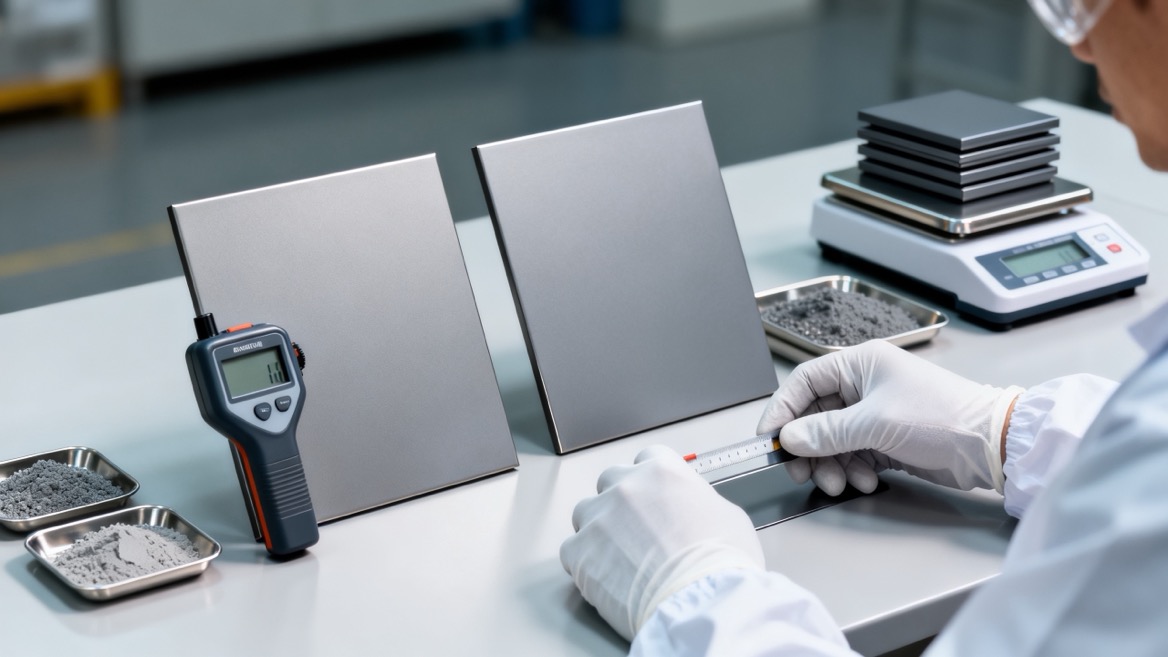
Neither resin compensates for contaminated metal or unsuitable pretreatment.
Substrate preparation, conversion treatment, rinsing, drying, film continuity, and cure quality all affect system performance. Architectural coating specifications therefore address more than the powder itself.
For coastal or corrosive service, compare complete systems on the intended substrate. Do not convert laboratory salt-spray hours directly into guaranteed years outdoors.
Compare each product's technical data sheet and validate its cure schedule on your actual parts.
The relevant temperature is the metal temperature maintained for the specified period—not merely the oven air setting. Thick components and lightweight profiles heat differently.
A lower-temperature or faster-curing formulation may improve economics, but savings depend on oven design, loading, line speed, and verified cure. Neither epoxy nor polyester is automatically the energy-saving winner.
A realistic total-cost model also includes:
- Color-change losses and unrecoverable powder.
- Inspection, rejects, stripping, and recoating.
- Packaging, freight, duties, and inventory carrying costs.
- Delivery variability and production interruptions.
For cross-border projects, compare landed cost and technical support alongside powder price. Apply the same delivery terms to every quotation.
The most expensive coating failure may occur after installation, when access, removal, replacement, and customer disruption cost more than the original powder.
A useful model is:
Lifecycle cost=initial installed cost+maintenance+expected failure and replacement costs
For a simple illustration, suppose a suitable polyester system adds US$0.12/m² to initial cost. On 10,000 m², that premium totals US$1,200.
If a future corrective operation would cost US$6/m², the premium equals the correction cost for just 200 m², or 2% of the project area.
This is a break-even illustration, not a predicted failure rate. It excludes discounting and assumes the stated correction cost.
Its lesson is practical: a small initial saving can disappear quickly when the selected coating does not suit the exposure.
For exterior aluminum profiles and visible building components, begin with an appropriate exterior polyester system.
Match the durability grade to exposure, appearance expectations, and project specifications. Where architectural approvals are required, verify the exact product and applicable approval—not merely the supplier's general capability.
Separate exposed housings from protected internal components.
Exterior parts may benefit from polyester weatherability. Internal components may prioritize chemical resistance, electrical properties, or another specialized requirement.
Neither chemistry should be assumed suitable for battery-system safety or electrical insulation without application-specific validation.
For interior parts, compare actual cleaning protocols, abrasion requirements, appearance, and chemical exposure.
Epoxy may be attractive where chemical resistance dominates. Polyester or an epoxy-polyester hybrid may also meet the specification economically.
Do not infer medical suitability, sterilization resistance, or antimicrobial performance from the resin family alone.
Record the substrate, indoor or outdoor location, UV exposure, chemicals, operating temperature, and required appearance life.
Replace vague phrases such as "high durability" with measurable acceptance criteria.
Request the same color, gloss, texture, order volume, delivery terms, and performance targets.
Collect technical data sheets, safety data sheets, density information, recommended thickness, cure conditions, and relevant test documentation.
Flat test panels are useful, but production parts reveal practical difficulties.
Run representative components, including recesses, edges, welds, and varying metal thicknesses. Measure coating distribution, cure, finish quality, and rejects.
Record net powder consumption, accepted output, energy use, line speed, and rework.
When reclaim is used, measure net consumption over a representative production period. Do not count recovered powder as new consumption every time it recirculates.
For exterior products, prioritize relevant weathering evidence. For chemical exposure, test the actual agents and contact conditions.
Document agreed acceptance limits before production approval. This turns a purchasing preference into a repeatable qualification decision.
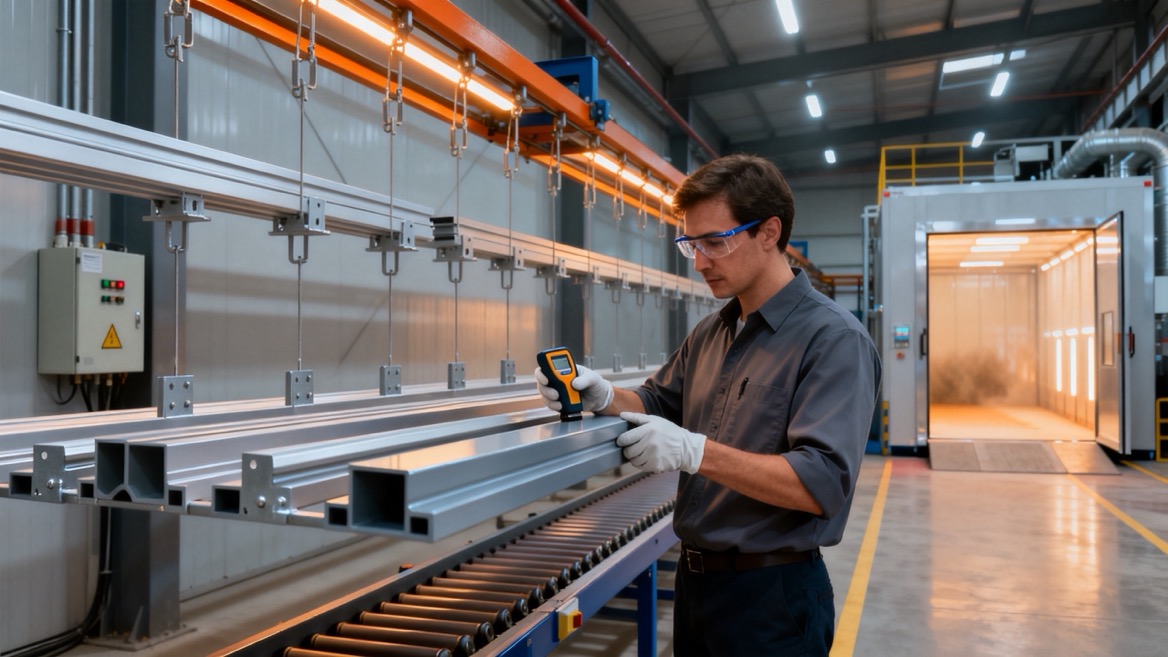
Send Yinda Technology your substrate, component drawings or coated area, exposure conditions, color and finish requirements, annual demand, destination market, and current curing conditions.
Request a comparison covering suitable formulations, recommended film thickness, cure requirements, supporting test documentation, and estimated material cost per square meter.
That approach makes the decision commercially useful: select the coating system that meets the application reliably, then optimize its total cost.
Not necessarily. Either can have the lower quotation depending on formulation, finish, order size, and specification. Compare cost per accepted square meter after confirming equivalent performance.
An appropriately specified exterior polyester generally offers better value than exposed epoxy because it provides substantially better UV resistance. The required durability grade still depends on the project.
No. Epoxy has valuable protective properties, but corrosion performance depends on the complete coating system, substrate preparation, application quality, exposure, and cure.
Conventional epoxy-polyester hybrids are primarily intended for interior applications because of limited UV resistance. They should not automatically replace exterior-grade polyester.
Yes, compatible systems can combine an epoxy primer's protective role with an exterior polyester topcoat. Validate intercoat adhesion, cure schedules, total thickness, and suitability with the supplier.
The answer depends on the particular formulation and production line. Compare validated metal-temperature cure schedules and measured energy per accepted part rather than choosing by resin name.
1. [AkzoNobel Interpon — Epoxy Technology in Powder Coatings]. Technical basis for epoxy's chemical resistance, protective characteristics, and limitations under sunlight. [interpon]
2. [AkzoNobel Interpon — Hybrid Technology in Powder Coatings]. Explains epoxy-polyester hybrid chemistry, interior applications, and limited UV resistance. [interpon]
3. [QUALICOAT — Specifications]. Architectural coating requirements covering equipment, coating materials, and finished products. [qualicoat]
4. [Powder Coating Institute — Coatings Comparison Calculator]. Supports evaluating coating economics through operating variables such as film thickness and transfer efficiency rather than material price alone. [powdercoating]
5. [AkzoNobel Interpon — Interpon 700 Technical Data Sheet]. Product-specific evidence illustrating hybrid chemical resistance and outdoor-use limitations; not a specification for all formulations. [powdercoatings.brand.akzonobel]
6. [Protech Group — Z-Series Super-Durable Polyester]. Manufacturer example of superdurable polyester for exterior applications, with stated architectural performance classifications. [theprotechgroup]


