Language


Views: 298 Author: Yinda Powder Coating Publish Time: 2026-11-05 Origin: Site


Content Menu
● Epoxy vs Polyester Powder Coating: Quick Comparison
● What Makes Electrical Control Cabinet Coatings Different?
● Epoxy Powder Coating for Electrical Control Cabinets
>> Where Epoxy Provides Practical Advantages
>> Where Epoxy Becomes the Wrong Choice
● Polyester Powder Coating for Electrical Control Cabinets
>> Why Exterior-Grade Polyester Usually Wins Outdoors
>> Can Polyester Also Work Indoors?
● Corrosion Resistance: The Complete System Matters More Than the Resin
>> Pay Special Attention to Edges, Welds, and Recesses
● Electrical Safety: Do Not Confuse Cabinet Paint with Qualified Insulation
● Cabinet Ratings: What the Powder Coating Cannot Guarantee
● Three Illustrative Cabinet Selection Scenarios
>> Indoor Production Cabinet with Chemical Cleaning
>> Outdoor Cabinet at a Hot, Sunny Installation
>> Cabinet in a Humid Industrial Facility
● A Practical Qualification Plan for Cabinet Manufacturers
>> Step 1: Define the Service Conditions
>> Step 2: Compare Equivalent Coating Systems
>> Step 3: Verify Actual Metal Temperature
>> Step 4: Test Relevant Failure Modes
>> Step 5: Approve the Production Process
● Cost and Energy: Compare Accepted Cabinets, Not Powder Prices
● Specify Your Electrical Cabinet Coating with Yinda Technology
>> Is Epoxy or Polyester Powder Coating Better for Outdoor Electrical Cabinets?
>> Can Epoxy Powder Coating Be Used Inside a Control Cabinet?
>> Does Polyester Powder Coating Prevent Rust?
>> Is Epoxy-Polyester Hybrid Powder the Same as Pure Epoxy?
>> Can Powder Coating Replace Electrical Grounding?
>> What Film Thickness Should Electrical Cabinets Use?
Epoxy powder coating vs polyester powder coating for electrical control cabinets is primarily a question of exposure. Epoxy is often a strong candidate for indoor cabinets requiring chemical resistance and adhesion. Exterior-grade polyester is generally the better choice for cabinets exposed to sunlight and weather. However, neither resin name alone guarantees corrosion protection, electrical safety, or enclosure compliance.
The deciding factor is exposure: where the cabinet operates, what contacts its surface, and how the complete coating system performs.
At Yinda Technology, our focus spans powder coatings, environmentally focused materials, and energy-saving technologies. For cabinet manufacturers, our recommended starting point is a clear service specification—not simply a preferred resin or price per kilogram.
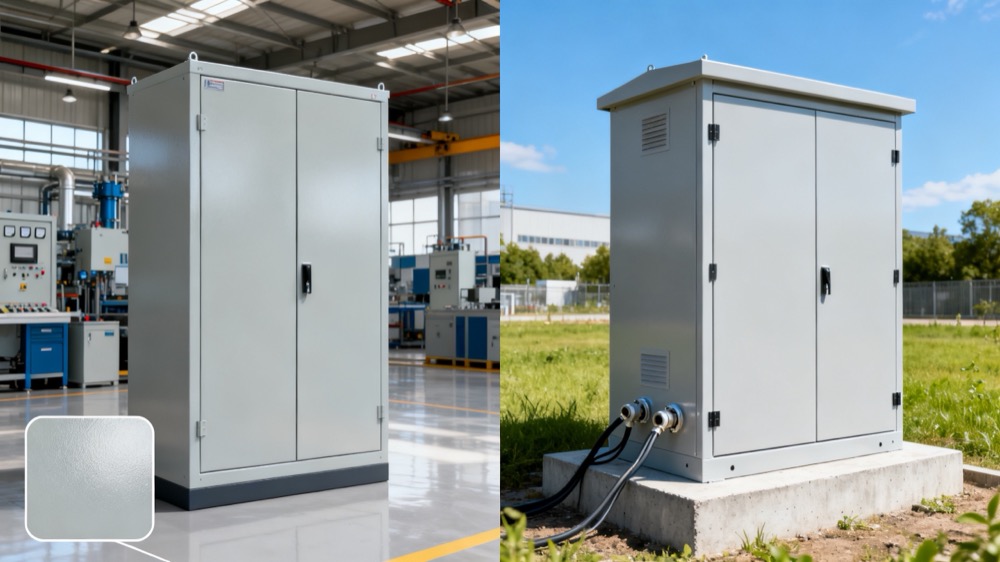
The following comparison describes general tendencies. Final performance depends on formulation, substrate preparation, film thickness, and curing.
| Selection factor | Epoxy powder coating | Polyester powder coating |
|---|---|---|
| Typical application | Indoor industrial cabinets and protected components | Indoor cabinets and exterior enclosures |
| Sunlight resistance | Generally poor; chalking and appearance changes are concerns | Exterior grades provide better UV stability |
| Chemical resistance | Often preferred for demanding indoor chemical exposure | Application-specific; verify against actual chemicals |
| Corrosion protection | Strong potential in a properly prepared system | Strong potential in a properly prepared system |
| Appearance outdoors | Usually unsuitable as an exposed decorative finish | Better suited to outdoor color and gloss retention |
| Electrical insulation | Specialized grades are available | Do not assume general-purpose grades meet insulation requirements |
| Main purchasing priority | Chemical compatibility and complete cure | Weathering class and exposure-specific durability |
The practical conclusion is straightforward: compare qualified coating systems, not generic resin labels.
An electrical control cabinet is more than a painted metal box. Its doors, seams, ventilation openings, mounting plates, and cable entries must work together while protecting sensitive equipment.
Coating failure can create several problems:
- Corrosion around door edges, welds, and mounting holes.
- Reduced appearance quality on customer-facing equipment.
- Additional maintenance and cabinet replacement costs.
- Poor electrical contact where coating covers a required bonding interface.
Cabinet manufacturers must therefore consider corrosion protection, assembly tolerances, electrical bonding, and environmental ratings together.
An attractive finish cannot compensate for unsuitable gaskets, poorly protected cut edges, or an unverified grounding arrangement.
Epoxy powder coating is worth evaluating for indoor electrical cabinets exposed to industrial contamination or demanding cleaning conditions.
Its potential advantages include adhesion, protective barrier performance, and chemical resistance. However, "chemical resistant" is not a complete specification.
A coating exposed to occasional lubricating-oil splashes faces a different challenge from one repeatedly cleaned with a concentrated alkaline solution.
Before selecting an epoxy powder coating for electrical enclosures, identify:
1. The chemical name and concentration.
2. Surface temperature during exposure.
3. Contact duration and frequency.
4. Whether exposure involves splashing, wiping, or immersion.
5. Acceptable changes in gloss, color, hardness, and adhesion.
The coating supplier should evaluate the proposed formulation against these conditions. A general compatibility statement is not enough for a demanding application.
Conventional epoxy coatings generally have limited resistance to ultraviolet exposure. Outdoors, they can chalk and lose gloss or color stability.
This does not mean corrosion begins immediately when appearance changes. Nevertheless, chalking can undermine customer acceptance and increase maintenance requirements.
For a control cabinet installed beside an outdoor production line, solar equipment, or exposed utility infrastructure, an epoxy-only decorative finish is usually not the preferred starting point.
A roof or canopy also does not automatically eliminate sunlight exposure. Actual installation conditions still matter.
Exterior-grade polyester powder coating offers better resistance to sunlight than conventional epoxy systems.
This makes it a logical candidate for:
- Outdoor automation cabinets.
- External power-distribution enclosures.
- Charging-infrastructure cabinets.
- Exposed industrial control boxes.
- Equipment requiring sustained exterior appearance.
However, polyester is a broad product category. Standard exterior and higher-weatherability formulations should not be treated as interchangeable.
Ask suppliers to identify the intended exposure category and provide relevant weathering evidence. A color designation alone says nothing about outdoor durability.
Yes. Polyester powder coating can be a practical option for indoor electrical control cabinets, particularly when appearance consistency and production standardization are priorities.
A manufacturer producing both indoor and outdoor cabinets may benefit from qualifying a polyester system across selected product families.
However, production convenience should not override chemical compatibility. Where aggressive cleaners or process chemicals are present, compare the proposed polyester directly with an appropriate epoxy formulation.
Neither coating family wins every indoor application.
A common purchasing mistake is asking whether epoxy or polyester "has better corrosion resistance" without defining the substrate and preparation process.
Corrosion performance depends on the whole system:
- Base metal and its condition.
- Removal of oil, rust, and fabrication residues.
- Suitable pretreatment.
- Rinse-water quality.
- Coverage at vulnerable features.
- Correct curing.
- Handling and assembly damage.
A poorly cleaned epoxy-coated cabinet can perform worse than a properly prepared polyester-coated cabinet.
Electrical cabinets contain folded channels, door returns, corners, and recessed areas that complicate powder deposition.
Electrostatic application can produce uneven coverage in these locations. A good reading on a flat door panel does not prove adequate protection everywhere.
Inspect representative production cabinets, not only laboratory panels. Include welded seams, latch openings, lower edges, and internal corners in the inspection plan.
For severe exposure, evaluate a compatible primer-and-topcoat system. An epoxy primer beneath an exterior polyester topcoat is one option, but intercoat adhesion and curing compatibility must be verified rather than assumed.
Powder coatings can provide electrical insulation, and specialized epoxy formulations serve applications such as busbars and electrical components.
However, a decorative cabinet coating is not automatically a qualified electrical insulation system.
Likewise, a protective coating can obstruct electrical contact at a bonding interface.
Cabinet drawings should identify:
- Protective-earth connection locations.
- Door-bonding arrangements.
- Contact surfaces requiring masking or another approved treatment.
- Hardware and assembly requirements.
- Finished-assembly verification procedures.
Do not rely on ordinary painted hinges to establish protective bonding unless the enclosure design has specifically validated that arrangement.
The important distinction is between protecting a metal surface and demonstrating electrical safety. These are related, but separate, engineering tasks.
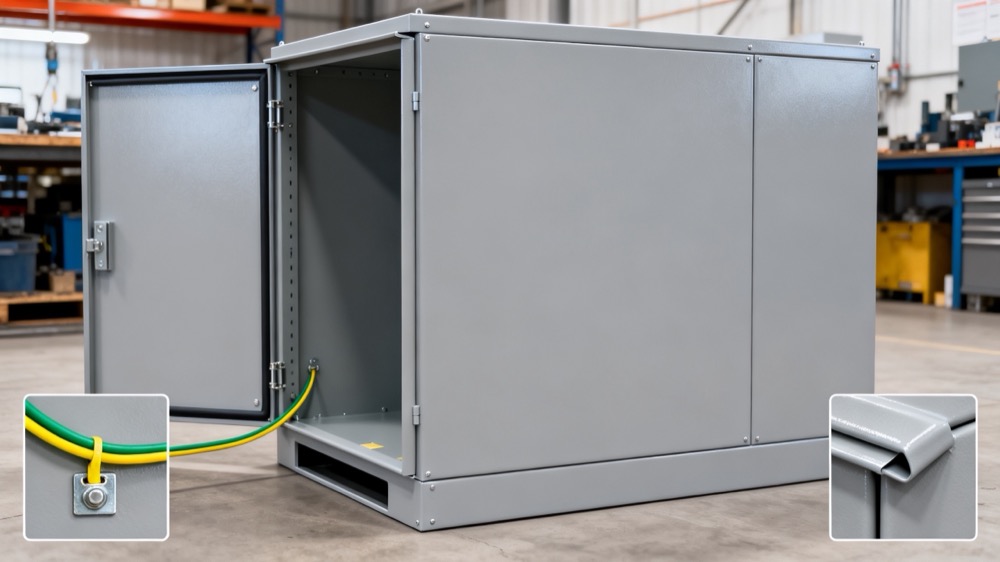
A powder described as suitable for electrical enclosures does not independently establish an IP or NEMA Type rating.
IP classifications address ingress protection. North American enclosure Type classifications cover defined environmental conditions and can include corrosion-related requirements.
The finished enclosure—not simply its coating—must satisfy the applicable requirements.
Gaskets, fasteners, windows, ventilation accessories, cable entries, and installation methods can affect the result.
When comparing epoxy powder coating vs polyester powder coating for electrical control cabinets, treat coating qualification as one part of enclosure qualification. Avoid purchasing language such as "IP66 powder," which confuses a coating material with an assembled enclosure's performance.
The following scenarios are selection examples, not reported Yinda customer projects or proprietary test results.
Consider a steel cabinet installed inside a manufacturing facility. Sunlight exposure is negligible, but operators regularly wipe the enclosure with a process-specific cleaner.
An epoxy system deserves evaluation because chemical resistance may be more important than weatherability.
The next step is testing the actual cleaner at its working concentration. Confirm appearance and adhesion after exposure rather than selecting on resin reputation alone.
For an exposed installation in Saudi Arabia, exterior-grade polyester is generally the more appropriate starting point.
Nevertheless, UV resistance does not resolve every environmental challenge. Surface temperature, dust, moisture, and any coastal salt exposure require separate consideration.
Specify the actual site conditions rather than assuming all installations within one country face identical risks.
For a cabinet operating in Indonesia, establish whether the location involves condensation, chemical contamination, coastal exposure, or controlled indoor conditions.
Polyester may suit the application, while demanding corrosion conditions may justify evaluating additional substrate protection or a multi-layer system.
The useful lesson is that geography informs the investigation; it does not replace a service specification.
A disciplined trial helps purchasing, engineering, and production compare candidates fairly.
Record indoor or outdoor placement, sunlight exposure, expected moisture, cleaning chemicals, operating temperatures, and appearance expectations.
Include the required enclosure classification and intended maintenance practices.
Use the same substrate and controlled pretreatment when comparing formulations.
Document color, texture, film-thickness requirements, and cure schedule. Otherwise, differences in processing can be mistaken for differences in resin performance.
Powder curing depends on the specified time at metal temperature, not simply the oven's air-temperature setting.
Heavy mounting plates and thin cabinet doors may heat at different rates. Record representative production profiles and check them against the product technical data sheet.
Do not apply one universal curing schedule to every epoxy or polyester powder.
A useful qualification package may include:
- Film-thickness mapping.
- Adhesion testing.
- Impact or bend testing where relevant.
- Chemical exposure using actual service fluids.
- Corrosion and humidity testing suited to the application.
- Weathering evaluation for exterior finishes.
- Bonding verification on the completed assembly.
Set acceptance criteria before testing. Salt-spray hours should not be presented as a direct prediction of years in service.
Record the approved powder, pretreatment, application settings, curing window, and inspection requirements.
Reassess changes in substrate supplier, cleaning chemistry, oven loading, or coating formulation. Approval of one sample does not automatically qualify every future process variation.
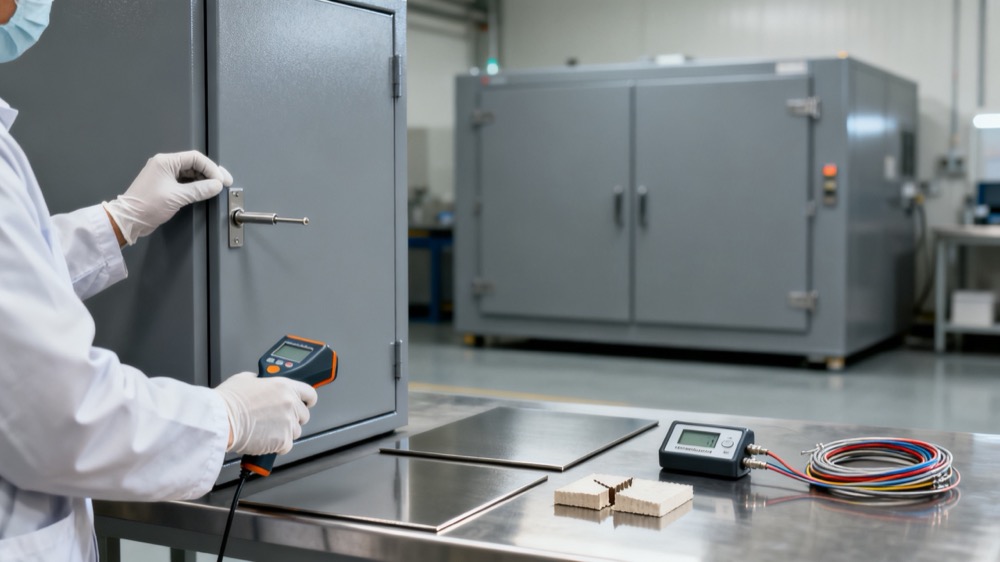
The lowest powder price does not necessarily produce the lowest finishing cost.
A more useful comparison includes powder consumption, first-pass acceptance, rework, curing energy, inspection, and expected maintenance.
Low-temperature-curing options may offer benefits, but these are product-specific. Verify the required metal-temperature profile and the resulting performance before claiming savings.
For multi-country manufacturing, share one performance specification while validating each production line separately. Identical powder can produce different results when cleaning, application, or curing conditions differ.
Yinda Technology researches, manufactures, and supplies powder coatings and environmentally focused materials, with subsidiaries in China, Indonesia, and Saudi Arabia.
Send our team your cabinet substrate, installation environment, cleaning chemicals, required enclosure classification, color and texture, and available curing conditions.
Request a formulation recommendation, technical documentation, sample panels, and a production-trial plan. This creates a more reliable basis for choosing epoxy or polyester than comparing resin names or quotations alone.
Exterior-grade polyester is generally the better exposed finish because it provides better UV stability. Corrosion protection still depends on substrate preparation, formulation, coverage, and curing.
Yes. Epoxy can suit protected indoor components, particularly where chemical resistance matters. Confirm compatibility with the service environment and preserve all required electrical bonding interfaces.
It can provide an effective protective barrier, but it does not make steel permanently rustproof. Damage, inadequate pretreatment, thin coverage, and unsuitable exposure conditions can allow corrosion.
No. Hybrid coatings combine epoxy and polyester chemistry. They are commonly used indoors and should not automatically be treated as substitutes for exterior-grade polyester.
No. A decorative coating is not a substitute for protective grounding or bonding. The completed cabinet needs the electrical connections and verification required by its design and applicable requirements.
Use the selected product's technical data sheet and validated enclosure specification. There is no universal thickness suitable for every resin, substrate, geometry, and exposure condition.
1. Powder Coating Institute — "Frequently Asked Questions." Guidance on pretreatment, curing, adhesion, recessed-area coverage, weatherability, and coating selection. [powdercoating]
2. nVent HOFFMAN — "Industrial/Commercial Specifier's Guide," Chapter 13. Explanation of enclosure rating systems, environmental protection, and the relationship between enclosure finishes and rated products. [nvent]
3. nVent HOFFMAN — "Industrial/Commercial Specifier's Guide," Chapter 8. Examples of electrical enclosures using polyester powder finishes over specified metal surfaces. [nvent]
4. AkzoNobel Interpon — "Electrical Panels and Power Distribution Units." Distinction between enclosure-coating applications and specialized epoxy insulation for internal electrical components. [interpon]
5. AkzoNobel Interpon — "Interpon 700." Interior epoxy-polyester hybrid applications, formulation-specific properties, and lower-temperature-curing options. [interpon]
6. AkzoNobel Interpon — "EN245N: New Matt Black." Example of product-specific chemistry, interior-use designation, and curing requirements. [interpon]


