Language


Views: 210 Author: Yinda Powder Coating Publish Time: 2026-08-13 Origin: Site


Content Menu
● Why Underground Aluminum Conduit Needs Extra Protection
● What Is Fusion-Bonded Epoxy Coating?
>> Key FBE Strengths for Buried Service
>> FBE Limitations to Consider
● What Is Heavy-Duty Polyester Powder Coating?
>> Key Polyester Powder Coating Strengths
>> Polyester Limitations Underground
● FBE vs. Heavy-Duty Polyester: Technical Comparison
● The Most Important Factor: The Complete Coating System
● Soil Conditions That Should Change Your Specification
>> Specify FBE When These Conditions Apply
>> Specify Heavy-Duty Polyester When These Conditions Apply
● A Practical Hybrid Strategy for Mixed Environments
● Testing and Acceptance Criteria Buyers Should Request
● Expert Recommendation for Underground Aluminum Conduit
● FAQ
>> Is FBE suitable for aluminum conduit?
>> Is polyester powder coating waterproof?
>> Which coating is better for coastal underground conduit?
>> Can FBE be used on conduit exposed to sunlight?
>> What is the most common cause of underground coating failure?
>> Should fittings and couplings use the same coating system?
Selecting a protective finish for underground aluminum conduit is not simply a question of color, film thickness, or coating cost. It is a long-term corrosion-control decision that affects electrical-system reliability, installation risk, inspection requirements, and the total cost of ownership.
For buried conduit projects, the practical comparison is often Fusion-Bonded Epoxy (FBE) vs. heavy-duty polyester powder coating. Both technologies can form durable protective films, but they respond very differently to soil chemistry, installation damage, moisture exposure, ultraviolet light, and aggressive chemical environments.
From our experience supporting industrial coating specifications for construction, electrical infrastructure, new-energy equipment, and metal fabrication, the right coating should be selected only after reviewing the actual service environment—not only a generic "underground use" label.
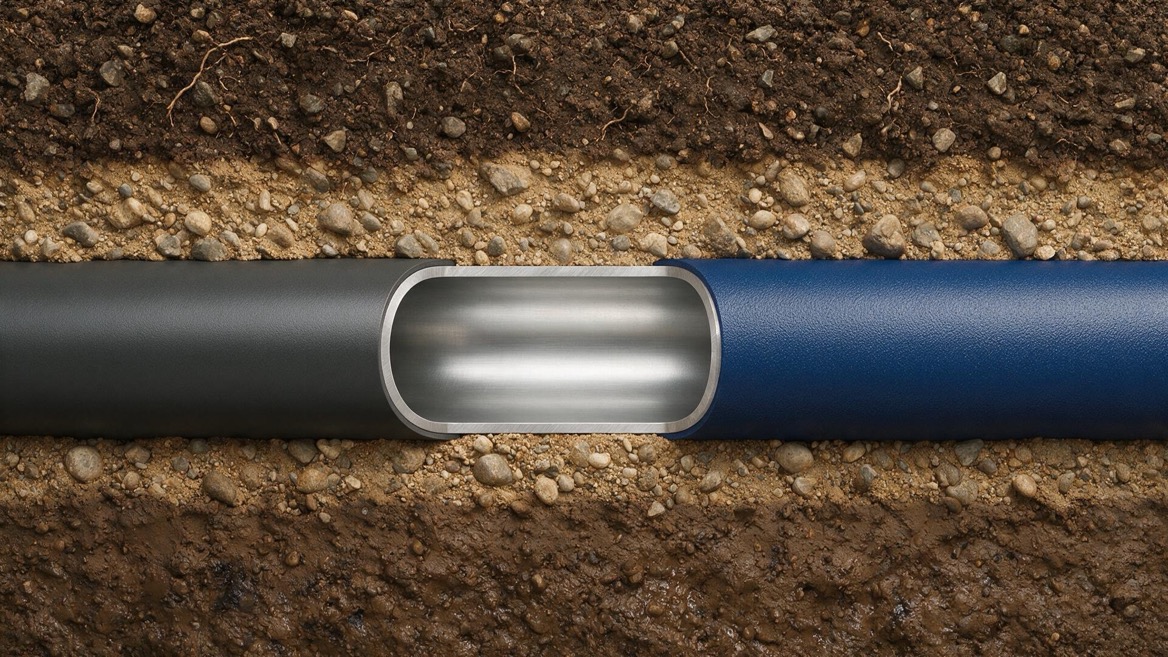
Aluminum naturally creates a thin oxide layer that helps resist corrosion in many normal environments. However, direct burial creates conditions that can quickly overwhelm this natural protection.
Underground conduit may be exposed to:
- Wet or poorly drained soil
- Chlorides from coastal soil, de-icing salts, or groundwater
- Acidic or alkaline soil conditions
- Fertilizers, sulfates, and industrial contaminants
- Concrete contact and alkaline moisture
- Dissimilar-metal contact at fittings, clamps, or grounding points
- Abrasion from pulling, backfilling, settlement, and stone contact
A protective coating must therefore do more than make the conduit look finished. It must provide a continuous barrier, maintain adhesion to aluminum, resist moisture penetration, and survive handling damage.
For aluminum conduit intended for concrete, direct burial, or severely corrosive service, a protective coating is required under UL 6A guidance. The project team should also verify the applicable local electrical code, installation method, and approval requirements before selecting a coating system.
Fusion-Bonded Epoxy (FBE) is a thermoset epoxy powder coating that melts, flows, and chemically crosslinks when applied to a heated metal surface. It is widely recognized in buried and submerged pipeline protection because epoxy chemistry offers strong adhesion, low permeability, and high resistance to many corrosive environments.
For a typical FBE process, the substrate is cleaned and prepared, heated to the specified temperature, electrostatically coated with epoxy powder, and cured into a continuous film. The final coating is tightly bonded to the metal rather than simply resting on its surface.
FBE is especially attractive where the conduit will remain hidden from sunlight and may contact moisture, aggressive soil, or chemical contaminants.
Its main advantages include:
- Strong adhesion to a properly prepared metal substrate
- High resistance to water and moisture migration
- Good resistance to many acids, alkalis, salts, and soil chemicals
- Excellent barrier performance at relatively controlled film thicknesses
- Strong performance in buried, submerged, and chemically demanding environments
- Suitability for systems where cathodic-protection considerations apply to adjacent metallic infrastructure
FBE has a long history in external pipeline applications. This matters because pipelines and underground conduit share several threats: moisture exposure, soil stress, coating holidays, handling damage, and difficult post-installation access.
FBE is not automatically the best answer for every aluminum conduit project. It is a specialized system that requires careful control of surface preparation, heat profile, powder formulation, film build, and inspection.
Important limitations include:
- Poor ultraviolet durability when the coating remains exposed above ground
- Potential brittleness or cracking if the product, thickness, cure, or bend requirement is poorly matched
- More demanding processing than conventional powder-coating lines
- Possible challenges on complex fittings, threads, sharp edges, and field-cut sections
- Need for a coating supplier to demonstrate compatibility with the aluminum alloy, conduit geometry, and required regulatory approvals
For an aluminum conduit that transitions from underground to exposed outdoor areas, FBE may need an additional UV-resistant topcoat, a protected enclosure, or a different coating strategy for exposed sections.
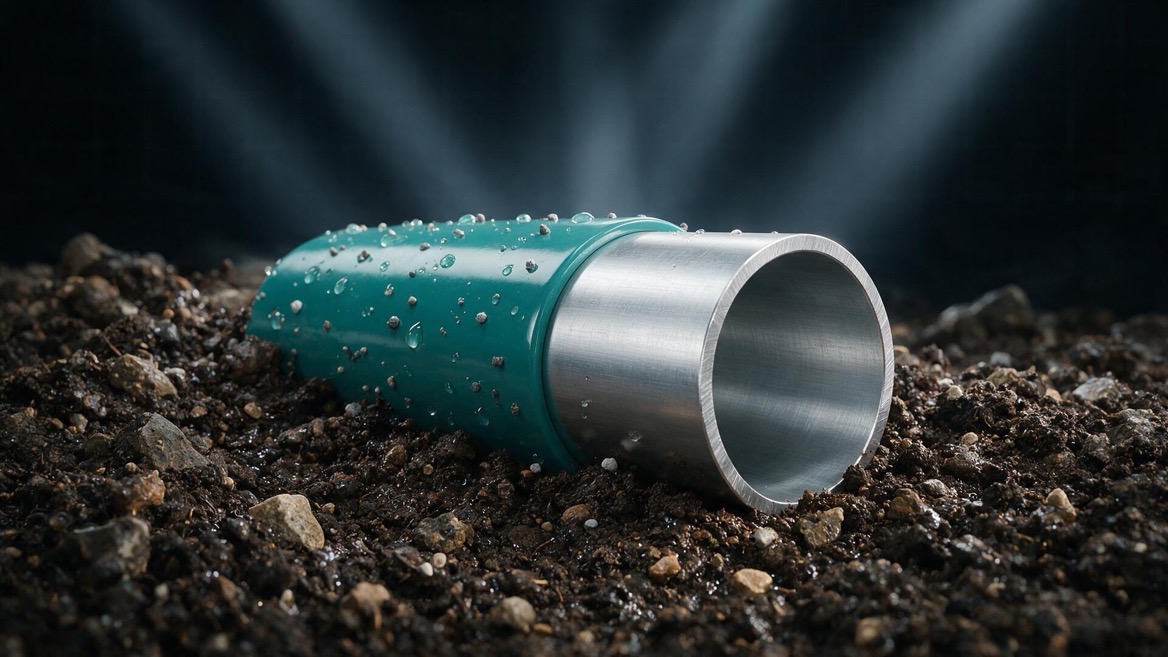
A heavy-duty polyester powder coating is a durable thermoset finish designed to provide weather resistance, color retention, mechanical protection, and corrosion resistance. Polyester powder coatings are widely used for aluminum profiles, doors, windows, automotive components, electrical enclosures, machinery, and architectural products.
The term "heavy-duty" should not be treated as a universal technical standard. It may describe a higher-build film, a super-durable polyester resin, reinforced pigments, corrosion-resistant additives, or a multi-layer system. Buyers should always request measurable performance data instead of relying on the label alone.
Heavy-duty polyester powder coating is often a strong choice when a conduit system includes both buried and visible sections, or when appearance and outdoor durability are important.
Its principal benefits include:
- Excellent UV resistance compared with standard epoxy systems
- Better gloss and color retention in exterior exposure
- Broad color, texture, and gloss options
- Good resistance to scratching, impact, and routine handling
- Efficient application on established powder-coating lines
- Strong suitability for architectural, electrical, and fabricated aluminum products
A high-quality polyester system can be highly effective when combined with disciplined pretreatment, sufficient film thickness, good edge coverage, and proper curing. For visible transition areas, surface-mounted conduit, outdoor electrical installations, and building-related aluminum components, this can be a decisive advantage.
Polyester is generally optimized for outdoor weathering rather than the most severe buried chemical environments. It can perform well underground, but only when the entire coating system is designed for the soil conditions and installation stresses involved.
Potential limitations include:
- Lower chemical resistance than a purpose-designed FBE system in aggressive soils
- Greater dependence on pretreatment quality and complete film coverage
- Risk of moisture entry at scratches, cut ends, threads, and thin edges
- Variable performance between standard polyester, super-durable polyester, and reinforced heavy-duty formulations
- Less proven use than FBE for deeply buried, chemically aggressive pipeline-style service
In short, a heavy-duty polyester powder coating should not be assumed equivalent to FBE merely because it has a thick film or high hardness.
| Performance Factor | Fusion-Bonded Epoxy (FBE) | Heavy-Duty Polyester Powder Coating |
|---|---|---|
| Primary strength | Buried corrosion and chemical resistance | Outdoor durability and appearance retention |
| Adhesion to prepared metal | Excellent | Good to excellent, depending on pretreatment |
| Soil moisture resistance | Excellent | Good to very good with the right system |
| Chemical resistance | Generally excellent | Good, but formulation dependent |
| UV exposure resistance | Weak without a topcoat | Excellent, especially super-durable grades |
| Color and gloss retention | Limited outdoors | Strong outdoor retention |
| Mechanical flexibility | Must be engineered carefully | Often favorable for fabrication and handling |
| Film-build flexibility | Controlled, application-specific | Broad practical range |
| Best use case | Permanently buried or chemically demanding sections | Outdoor-visible, mixed-use, or appearance-sensitive conduit |
| Main risk | UV degradation or coating damage from poor processing | Underperformance in severe soil if specified too generally |
The correct decision depends on the actual exposure profile. A conduit that is permanently buried in chloride-rich soil has a different coating requirement from a conduit that is buried for one meter and then exposed on a commercial façade for 20 years.
The coating resin is only one part of the protection strategy. In field failures, the root cause is often not "epoxy versus polyester." It is incomplete pretreatment, insufficient edge coverage, poor curing, damaged threads, incompatible fittings, or a failure to repair coating holidays before burial.
A reliable underground aluminum conduit coating system should include:
1. Substrate verification: Confirm aluminum alloy, conduit condition, welding, threading, and surface contamination.
2. Surface preparation: Remove oils, oxides, and contaminants; use a pretreatment designed specifically for aluminum.
3. Coating selection: Match resin chemistry to soil, moisture, UV exposure, mechanical stress, and local compliance requirements.
4. Film-thickness control: Establish a target thickness and minimum acceptance level for straight sections, edges, threads, bends, and fittings.
5. Cure verification: Confirm that the film has achieved the required crosslinking without under-curing or over-baking.
6. Holiday inspection: Check for pinholes, voids, thin areas, and handling damage before shipment or installation.
7. Field-repair procedure: Specify approved repair materials for threads, cut ends, scratches, and installation damage.
A high-performance powder is not a substitute for process control. A less sophisticated coating system applied correctly can outperform a premium powder applied over poor pretreatment or with inadequate inspection.
Before choosing FBE or heavy-duty polyester powder coating, request a soil assessment where project risk justifies it. This is particularly important for industrial plants, coastal zones, petrochemical sites, wastewater facilities, ports, agricultural land, and underground transport infrastructure.
FBE is usually the stronger technical choice when the project involves:
- Permanently buried conduit with little or no UV exposure
- High moisture content or poor drainage
- Chloride-rich, saline, acidic, or alkaline soil
- Chemical-contaminated ground
- Long design life with limited access for replacement
- High consequence of electrical-system interruption
- A project team that can define surface preparation, inspection, and repair requirements clearly
For these applications, FBE should be tested and qualified specifically for the aluminum substrate and conduit configuration. A coating proven on carbon-steel pipeline does not automatically prove performance on aluminum conduit.
Heavy-duty polyester powder coating is often more suitable when the application includes:
- Above-ground or exposed outdoor sections
- Architectural color and appearance requirements
- Strong ultraviolet exposure
- Frequent handling, fabrication, or visual inspection
- Moderate soil-corrosion conditions
- A need to coordinate the conduit finish with doors, windows, cabinets, façades, or electrical enclosures
For buried sections, consider a higher-performance polyester formulation, a corrosion-resistant primer plus polyester topcoat, or a transition design that uses different systems for underground and exposed zones.
Many real projects do not fit neatly into one category. The conduit may travel from a buried trench through concrete, enter a plant room, pass through an exterior wall, and continue along a sunlit building elevation.
In these situations, a zoned coating specification can offer better long-term value than forcing one coating to handle every exposure.
For example:
- Use a qualified epoxy-based system or FBE for the buried and concrete-contact zone.
- Protect threads, fittings, joints, and cut ends with a compatible approved repair system.
- Use heavy-duty polyester or a UV-resistant topcoat on visible outdoor sections.
- Define the transition point clearly on drawings and installation instructions.
This approach prevents a common mistake: selecting FBE for its underground strength, then accepting premature chalking on exposed portions; or selecting polyester for appearance, then expecting it to perform like a pipeline-grade epoxy in aggressive soil.
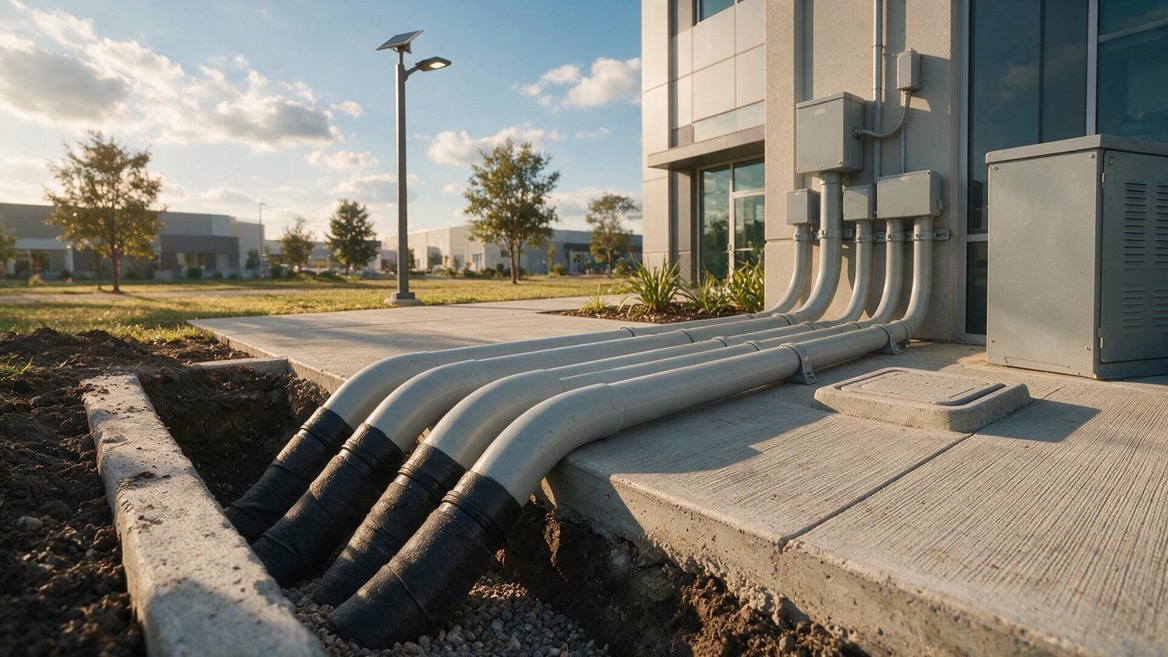
A product data sheet alone is not enough for high-risk underground projects. Manufacturers, contractors, and buyers should agree on performance tests that reflect the actual environment.
Useful evaluation areas include:
- Adhesion testing after cure and after environmental exposure
- Film thickness measurement across straight sections, bends, threads, and edges
- Holiday or porosity testing for continuous barrier integrity
- Salt-spray or cyclic-corrosion testing where relevant
- Water-immersion resistance
- Chemical-resistance testing against project-specific contaminants
- Impact and flexibility testing after cure
- Accelerated weathering for exposed polyester-coated sections
- Soil-burial or soil-simulation testing for critical projects
Do not compare test hours without understanding the test method, substrate, pretreatment, film thickness, scribe condition, and pass/fail criteria. A result from one laboratory method cannot independently predict every field condition.
For deeply buried aluminum conduit in corrosive, wet, or chemically aggressive soil, FBE is generally the more technically appropriate starting point because its epoxy chemistry is designed around adhesion and barrier protection in buried service.
For conduit that is partly buried and partly exposed, a heavy-duty polyester powder coating may offer better long-term outdoor appearance and weatherability. However, the buried section still needs a corrosion strategy that matches local soil conditions.
The strongest specification is usually not a one-word coating request. It should define substrate preparation, pretreatment, powder chemistry, film thickness, curing, inspection, repair materials, fittings, and the exact exposure zones.
Yinda Technology can help evaluate powder-coating options for aluminum conduit, electrical infrastructure, construction profiles, new-energy systems, hardware, and industrial equipment. Send us your substrate details, service environment, required standards, and target service life to develop a coating recommendation tailored to your project.
FBE can be suitable for aluminum conduit when the formulation, pretreatment, process temperature, adhesion performance, and compliance requirements have been verified for the specific aluminum substrate. It should not be selected solely based on its use on steel pipelines.
Polyester powder coating forms a protective barrier, but no coating system should be described as permanently waterproof under all conditions. Its protection depends on surface preparation, film continuity, thickness, curing, damage resistance, and the severity of the buried environment.
For chloride-rich or saline soil, FBE is generally the more suitable starting point because of its strong buried-service and chemical-resistance profile. A final decision should still be based on soil testing, conduit design, installation conditions, and required approvals.
FBE should not normally be left exposed to strong sunlight without considering UV protection. Epoxy coatings can chalk and lose appearance outdoors, so a UV-resistant topcoat or a polyester-based exposed-zone coating may be preferable.
Common causes include poor surface preparation, insufficient coating thickness, pinholes, damage during transport or backfilling, unprotected threads and cut ends, incompatible repair materials, and a coating chemistry that does not match the soil environment.
Yes. Couplings, elbows, threads, clamps, and transition points are often the most vulnerable locations. They should receive the same level of corrosion planning as straight conduit sections, including compatible coating or repair protection.
1. AMPP, "FBE Stand-Alone, Dual, and Multilayer External Coatings." Discusses FBE performance in underground service, including soil-stress, chemical, and cathodic-disbondment resistance. [Link]
2. AMPP, "Application, Performance, and Quality Control of Plant-Applied Single-Layer Fusion-Bonded Epoxy External Pipe Coating." Covers qualification, application, inspection, and repair principles for plant-applied FBE coatings. [Link]
3. AMPP, "NACE TM0115-2022: Cathodic Disbondment Test for Coated Steel Structures Under Cathodic Protection." Describes cathodic-disbondment test procedures for buried or submerged coated structures. [Link]
4. Penn Conduit, "Corrosion Protection & Dissimilar Metals in Conduit Usage." Summarizes UL 6A guidance on protective coating for aluminum conduit used in concrete, direct burial, or severely corrosive environments. [Link]
5. PCI Magazine, "Improving Corrosion Resistance of Powder Coating Systems for ACE Applications." Discusses corrosion-resistant polyester powder formulations and the durability characteristics of powder coatings. [Link]
6. National Library of Medicine, "Study on the Influence of Surface Treatment Process on the Corrosion Resistance of 6061 Aluminum Alloy." Examines how different surface treatments influence corrosion performance of coated aluminum alloy. [Link]


