Language


Views: 210 Author: Yinda Powder Coating Publish Time: 2026-09-22 Origin: Site


Content Menu
● Why Infrared Curing Fits Aluminum Extrusion Lines
● Gas-Catalytic IR Curing Explained
>> How Gas-Catalytic IR Heats Powder-Coated Profiles
>> Strengths of Gas-Catalytic IR Curing
>> Limitations of Gas-Catalytic IR
● Electric IR Curing Explained
>> How Electric IR Supports High-Speed Curing
>> Limitations of Electric IR for Aluminum Profiles
● Gas-Catalytic IR vs. Electric IR Curing Comparison
● The Most Important Metric: Part Metal Temperature
>> Practical Temperature-Validation Method
● Powder Chemistry Changes the Equipment Decision
● When Gas-Catalytic IR Is the Better Choice
● When Electric IR Is the Better Choice
● Expert Recommendation: Use a Hybrid Design When Product Mix Is Broad
● A Buyer's Checklist for Aluminum Extrusion Curing Lines
● FAQs
>> 1. Is gas-catalytic IR curing faster than electric IR curing?
>> 2. Can infrared curing replace a convection oven for aluminum extrusion powder coating?
>> 3. Which system costs less to operate: gas-catalytic IR or electric IR?
>> 4. Why is part metal temperature more important than oven temperature?
>> 5. Are electric IR systems better for environmentally responsible production?
>> 6. Can gas-catalytic IR cure complex architectural aluminum profiles?
>> 7. How can a plant confirm that an IR-cured powder coating is fully cured?
For high-speed aluminum extrusion powder coating lines, the choice between gas-catalytic infrared curing and electric infrared curing affects more than oven speed. It shapes coating consistency, line footprint, operating cost, energy strategy, maintenance planning, and the ability to handle different aluminum profile geometries.
At Yinda Technology, we work with powder coating applications across architectural aluminum profiles, doors and windows, new-energy vehicles, medical equipment, hardware, and electrical products. From a practical manufacturing perspective, the best infrared curing system is not automatically the fastest heater. It is the system that delivers stable part metal temperature, uniform film formation, reliable crosslinking, and predictable economics at the actual production speed of the extrusion line.
For relatively uniform aluminum profiles running at high and stable speeds, electric IR curing can offer exceptional response speed and tight zone-by-zone control. For long, complex, variable, or high-mass profile production, gas-catalytic IR curing often provides a more forgiving heat profile, broader coverage, and a stronger operating-cost position where gas is competitively priced. In many extrusion plants, the most robust solution is not a strict "either/or" choice, but a hybrid IR-plus-convection design.

Aluminum extrusion powder coating is fundamentally a heat-transfer process. Powder is electrostatically applied to the profile, then heated so the particles melt, flow into a continuous film, and chemically crosslink into a durable protective finish.
Conventional convection ovens heat a large volume of air first. That hot air then transfers heat to the aluminum profile. Infrared systems work differently: they radiate energy directly toward the coated substrate and coating surface. This can reduce ramp-up time, shorten cure sections, and improve line responsiveness.
For aluminum extrusion operations, the attraction is clear:
- Fast heating of aluminum profiles
- Potentially shorter cure ovens
- Higher available line speeds
- Lower thermal mass than a large convection oven
- Rapid response to production stoppages or gaps
- More compact layouts for constrained factory space
- Potential energy reduction when properly engineered
However, infrared is not a universal shortcut. Aluminum is reflective, profile geometry varies, wall thickness changes, and some architectural sections include deep channels, thermal-break designs, grooves, corners, and concealed surfaces. These factors make emitter selection, distance, zoning, shielding, conveyor speed, and profile orientation critical.
The benchmark is always the same: the coating must receive the full cure schedule required by the powder formulation after the part metal temperature reaches its target. The cure clock does not start simply because the oven air is hot or because the profile has entered an infrared zone.
Gas-catalytic infrared curing uses natural gas or propane together with oxygen and a catalyst. Instead of an open flame directly contacting the workpiece, the fuel oxidizes across a catalyst surface and generates infrared radiation. This process is often described as flameless catalytic combustion.
Gas-catalytic IR emitters commonly produce medium- to longer-wavelength radiation. Their heat is generally considered gentler and broader than high-intensity electric short-wave systems. That matters when coating complex aluminum extrusion profiles, because the process is less aggressive and can be more tolerant of normal variation in profile shape, thickness, and line loading.
A gas-catalytic panel radiates heat toward the aluminum extrusion. The powder film absorbs energy, the aluminum substrate warms, and heat moves through the profile by conduction. Once the substrate reaches the specified cure temperature, the powder must remain at that condition for the required dwell period.
The main process advantage is not merely heat output. It is the combination of:
- Broad radiant coverage
- Moderate, controllable heat intensity
- Good suitability for long profiles
- A comparatively forgiving response on shaped surfaces
- Useful integration with convection finishing zones
Catalytic IR is typically capable of curing complex components more quickly than convection alone, while being less dependent on direct line-of-sight exposure than very high-intensity electric IR systems. One industry source describes catalytic IR as a softer heat that can cure complex parts in roughly one-third of the time required by a comparable convection process, although real results depend on part geometry, powder chemistry, and oven design.
For aluminum extrusion manufacturers, gas-catalytic IR is often attractive when the product mix is broad and the line must process long profiles with changing cross-sections.
Key strengths include:
- Lower energy cost potential in regions where natural gas costs substantially less than electricity
- Broad radiation pattern that can better accommodate profile variation
- Good fit for medium-wave and long-wave heating strategies
- Fast warm-up compared with full convection systems
- High usable heat output for industrial-scale lines
- Suitability for complex geometry, including channels, returns, and variable sections
- Practical hybrid integration with convection zones for cure equalization
Industry guidance reports that gas-catalytic IR can achieve high energy-conversion efficiency and, when engineered correctly, can reduce total energy consumption compared with conventional convection-based curing.
Gas-catalytic IR is not automatically the correct solution for every plant.
Potential limitations include:
- It requires a reliable gas supply and compliant gas-safety infrastructure.
- Combustion-related ventilation and exhaust design require careful engineering.
- Emitter cleanliness and gas-air ratio management affect long-term consistency.
- Zone response is generally less instantaneous than electric element modulation.
- Heat distribution still depends on distance, angle, reflector design, and profile movement.
- Local carbon-management targets may favor electrification, depending on the plant's electricity source and regional policies.
For export-oriented aluminum profile plants, the decision must also consider the local energy market. A system that is financially attractive in Saudi Arabia may have a different operating-cost structure in Indonesia, China, Europe, or North America.
Electric infrared curing produces radiant heat by passing electrical current through an emitter. Depending on the emitter technology, electric IR can deliver short-, medium-, or long-wavelength output. Tungsten-based systems generally produce short-wave radiation at very high emitter temperatures, while nichrome and similar systems are commonly associated with medium-wave output.
Electric IR systems are valued for their rapid response, compact control architecture, and precise zoning. A well-designed electric IR oven can increase or decrease output quickly, which makes it highly suitable for stable, automated lines producing consistent aluminum extrusion sections.
Electric IR can supply intense radiant energy directly to accessible coated surfaces. This makes it especially effective for profiles with repeatable dimensions, stable spacing, consistent orientation, and a narrow product range.
For a high-volume aluminum extrusion line producing the same window frame, curtain-wall profile, solar-frame component, or standardized industrial section every day, electric IR can provide highly repeatable process control.
Its core advantages include:
- Fast on/off response
- Precise control by heating zone
- No direct combustion products at the point of heating
- Compact equipment layout
- Strong suitability for automated process recipes
- Good integration with line-speed control and temperature feedback
- Potential compatibility with renewable electricity procurement
Electric IR can be the fastest infrared option. However, the same intensity that creates speed can also increase sensitivity to distance, profile orientation, surface reflectivity, and shadowing. Industry guidance notes that electric IR can deliver much faster curing than convection, but its line-of-sight characteristics can make it better suited to a consistent range of smaller or similarly configured parts.
Aluminum is not an easy substrate for poorly designed infrared systems. Its reflective surface can reduce energy absorption, particularly before the powder fully melts and changes the optical behavior of the surface. Complex profiles also create shaded areas that may receive less direct radiant energy.
Electric IR can therefore create risk when:
- Profiles have deep cavities, tight corners, or hidden surfaces.
- Product cross-sections change frequently.
- Wall thickness varies significantly across the product mix.
- The coating line runs mixed architectural and industrial profiles.
- Power demand charges are high.
- Electricity prices are much higher than industrial gas prices.
- The oven relies only on high-intensity direct radiation without a balancing zone.
A high-output electric IR system can overheat exposed edges while underheating recessed surfaces if reflector geometry, emitter placement, and conveyor speed are not validated through actual profile testing.
The following comparison focuses on high-speed aluminum extrusion powder coating lines rather than small batch coating operations.
| Evaluation Factor | Gas-Catalytic IR Curing | Electric IR Curing |
|---|---|---|
| Primary energy source | Natural gas or propane | Electricity |
| Typical radiation profile | Medium- to longer-wave, broader output | Can use short-, medium-, or long-wave emitters |
| Heating character | Softer, broader, more forgiving | Fast, intense, highly responsive |
| Start-up response | Fast, but generally slower than direct electric element control | Very fast zone response |
| Best profile type | Long, complex, mixed, and variable extrusion sections | Uniform, repeatable, consistently oriented profiles |
| Line-of-sight sensitivity | Moderate | Often higher, especially with high-intensity emitters |
| Handling of recessed geometry | Better when properly positioned and combined with airflow or convection | Requires careful emitter layout and validation |
| Operating-cost potential | Often favorable where industrial gas is economical | Depends heavily on electricity price and demand charges |
| Local combustion emissions | Present and must be managed | None at the heating point |
| Renewable-energy alignment | Depends on renewable gas availability | Strong potential when powered by low-carbon electricity |
| Control precision | Strong, especially with zoned burner management | Excellent, with rapid power modulation |
| Maintenance focus | Gas train, catalyst panels, combustion safety, ventilation | Elements, controls, electrical infrastructure |
| Common line strategy | Catalytic IR preheat plus convection cure equalization | Electric IR boost zones or fully electric IR plus convection balance |
Neither system should be evaluated only by nominal kilowatts or oven length. The correct comparison must be based on energy per cured meter of extrusion, coating quality, production uptime, maintenance exposure, utility pricing, and the plant's actual product mix.
In technical discussions, one mistake appears repeatedly: operators focus on oven setpoint temperature rather than the actual temperature of the aluminum profile.
For powder coating, the relevant condition is the part metal temperature. If a powder specification states a cure schedule such as 10 minutes at 200°C, the aluminum substrate must reach 200°C and remain there for the specified period. The total travel time inside the curing system includes both the heat-up period and the dwell period at the required substrate temperature.
This distinction matters even more for high-speed extrusion powder lines because the line may appear stable while actual cure quality varies by profile mass.
A thin decorative trim profile and a thick curtain-wall mullion may travel through the same oven at the same speed, but they do not heat at the same rate.
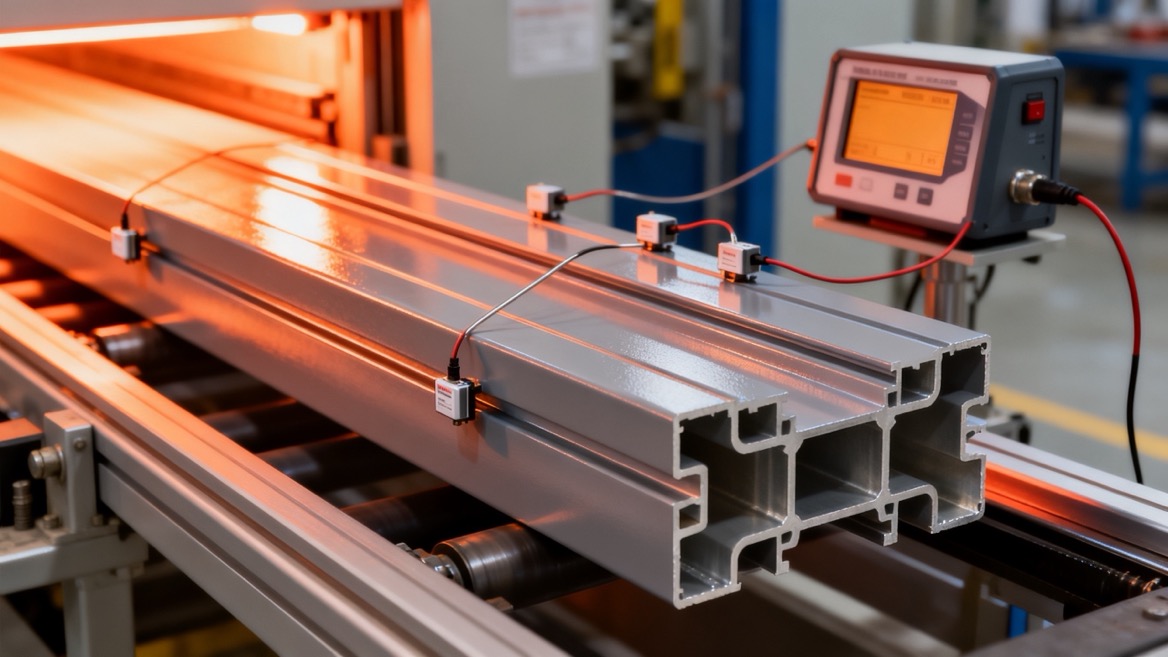
Before selecting gas-catalytic IR or electric IR, complete a profile-specific thermal survey.
1. Select representative profiles from the real production range.
2. Include thin-wall, thick-wall, open-channel, closed-box, and thermal-break sections.
3. Attach temperature sensors to high-mass and low-mass locations.
4. Record the metal-temperature rise through every heating zone.
5. Confirm dwell time after the target metal temperature is reached.
6. Inspect coating appearance, adhesion, impact resistance, gloss, color, and solvent resistance.
7. Repeat the test at minimum, normal, and maximum line speeds.
8. Establish approved process recipes for each profile family.
A simple timer is not enough. A valid curing process needs temperature data, line-speed data, profile-mass information, and coating test verification.
Not all powder coatings respond identically to infrared energy. Cure performance depends on resin system, pigment package, color, film thickness, substrate mass, and target durability.
Typical industrial powder systems may include:
- Standard polyester powders for general architectural and outdoor applications
- Super-durable polyester powders for higher weathering performance
- Epoxy-polyester hybrid powders for indoor equipment and electrical products
- Epoxy powders for corrosion protection and functional coatings
- Polyurethane powders where appearance and chemical resistance are important
- Low-temperature cure powders designed to reduce thermal load or energy demand
Typical powder cure schedules may range from approximately 160°C to 200°C or higher at metal temperature, with dwell times often around 10 to 25 minutes depending on chemistry. The powder supplier's technical data sheet must always override a generic oven setting.
For Yinda Technology customers, this means that an IR oven should not be selected only according to aluminum profile dimensions. The system must also match the specific powder chemistry, target film thickness, gloss level, color family, outdoor durability requirement, and line throughput.
Gas-catalytic infrared curing is usually a strong candidate when a powder coating line has a large production range and needs a balance between speed, flexibility, and energy economics.
Choose or prioritize gas-catalytic IR when the plant has:
- A stable and economical industrial natural-gas supply
- Long aluminum extrusion profiles with variable cross-sections
- Architectural profile production with channels, returns, and complex geometry
- Frequent changes between profile families
- A need to increase throughput without creating an excessively aggressive heat profile
- Existing gas-convection infrastructure that can be upgraded with an IR boost section
- A requirement for a more forgiving preheat stage before final cure equalization
A common practical configuration is a gas-catalytic IR preheat zone followed by a convection finishing zone. The IR section rapidly raises the aluminum profile temperature, while the convection stage helps equalize temperature across hidden surfaces, thick sections, and complex geometry.
This arrangement can be particularly effective for architectural aluminum extrusion powder coating, where visual consistency and complete cure matter as much as rapid line speed.
Electric IR curing is often the stronger option when speed, automation, and precise response matter more than broad geometry flexibility.
Choose or prioritize electric IR when the plant has:
- Reliable, competitively priced electricity
- A low-carbon electricity strategy or renewable-power procurement plan
- A stable product mix with repeatable profile shapes
- Tight automation requirements
- Short production runs requiring rapid startup and shutdown
- Limited access to gas infrastructure
- High demand for zone-by-zone recipe control
- A controlled production environment with accurate profile spacing and orientation
Electric IR is especially attractive for specialized aluminum components, standardized extrusion products, automotive-related aluminum parts, and repeatable industrial profiles where the heating process can be precisely engineered around one profile family.
However, a fully electric system should not be chosen simply because it is "cleaner" at the point of use. The complete evaluation should include local grid emissions, electricity tariffs, demand charges, equipment capacity, and the plant's ability to manage line-of-sight heating.
For many high-speed aluminum extrusion powder lines, the most reliable answer is a hybrid solution rather than a single-source cure system.
A hybrid configuration can combine:
- Gas-catalytic IR for rapid, broad preheating
- Electric IR for highly responsive boost zones or edge correction
- Convection finishing for temperature equalization and complete cure confirmation
- Closed-loop controls based on profile temperature, line speed, and product recipe
This approach allows the plant to use infrared where it performs best while avoiding the common weaknesses of relying solely on direct radiation.
For example, a high-speed curtain-wall profile line may use catalytic IR to bring the profile rapidly toward cure temperature, then use a controlled convection zone to ensure that internal channels and high-mass regions reach the required metal temperature. If the line produces a narrow range of identical solar-frame profiles, electric IR may be used as a high-speed primary heat source with a short equalization section.
The objective is not to choose the most advanced-looking oven. The objective is to produce a fully cured, consistent, durable coating at the lowest practical total cost per meter.
Before investing in gas-catalytic IR curing or electric IR curing, ask equipment suppliers these questions:
- Can you provide a thermal profile based on our actual aluminum extrusion samples?
- How will the system handle deep channels, box sections, and concealed surfaces?
- What is the predicted energy use per meter at our target line speed?
- How is part metal temperature measured and verified?
- Can the oven maintain cure performance during line stops and restart conditions?
- What profiles require separate process recipes?
- How are emitters zoned and controlled?
- What are the maintenance intervals and spare-parts requirements?
- How will the system prevent edge overheating and under-cure in recesses?
- Can the design accommodate future low-temperature powder coating technologies?
- What coating test protocol will be used during factory acceptance?
- Can the system integrate with our existing pretreatment, spraying, and conveyor controls?
A supplier that cannot demonstrate curing performance on representative profiles is offering a heat source, not a validated production solution.
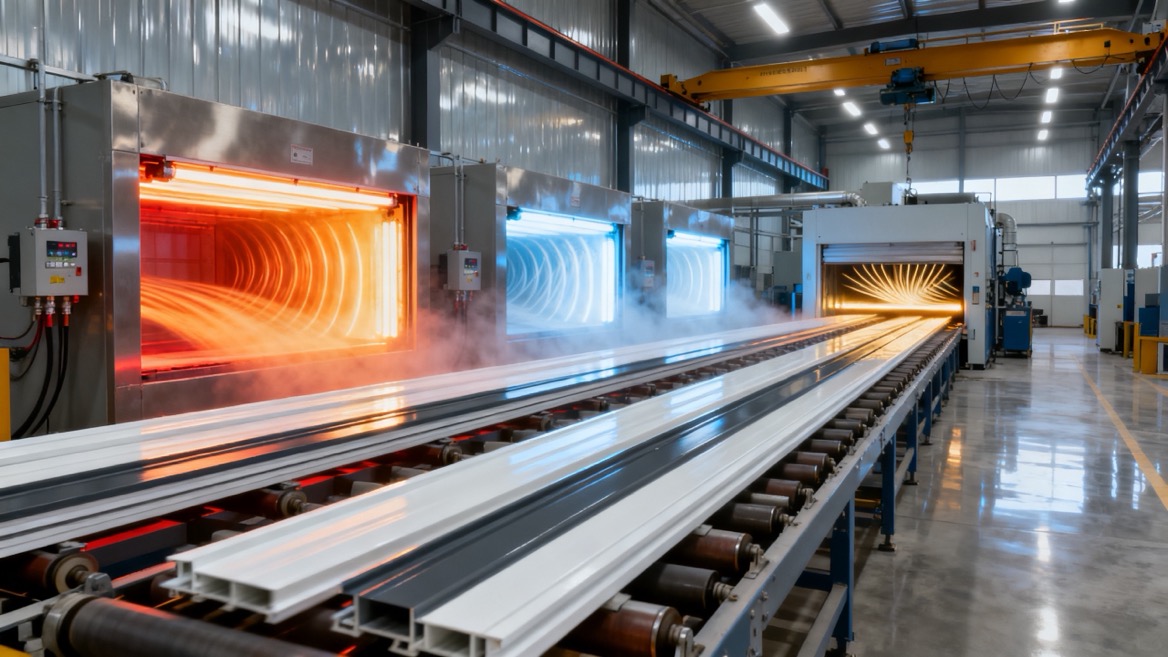
Gas-catalytic IR curing and electric IR curing can both improve the performance of high-speed aluminum extrusion powder coating lines. The better option depends on profile geometry, powder chemistry, utility cost, production stability, sustainability goals, and required line flexibility.
Gas-catalytic IR curing is generally the more adaptable choice for long, complex, mixed-profile extrusion production. It offers broad and forgiving heat distribution, favorable economics in many gas-priced markets, and strong compatibility with convection finishing zones.
Electric IR curing is generally the more precise and responsive choice for repeatable profiles, automated lines, rapid recipe changes, and facilities pursuing an electrified energy strategy. It can deliver impressive speed, but it needs more disciplined control of profile geometry, exposure, and heating uniformity.
For manufacturers seeking higher throughput without sacrificing coating performance, the best next step is a thermal validation trial using actual aluminum profiles, actual powder coatings, and actual target line speeds.
Contact Yinda Technology to discuss powder coating selection, aluminum extrusion curing requirements, and a customized infrared-curing evaluation for your production line.
Not always. Electric IR can provide extremely fast heating and rapid control response, especially for consistent, directly exposed profiles. Gas-catalytic IR is often less aggressive but more forgiving for complex or variable aluminum extrusion shapes. Actual line speed depends on profile mass, geometry, powder chemistry, emitter layout, and required cure schedule.
It can in some applications, especially when profiles are consistent and the IR system is carefully engineered. However, many extrusion plants use IR together with convection because convection helps equalize temperature across shaded surfaces, thick walls, deep channels, and complex cross-sections.
The answer depends on local utility prices, production hours, demand charges, gas availability, and system efficiency. Gas-catalytic IR often has a cost advantage where industrial natural gas is inexpensive. Electric IR may be attractive where electricity is competitively priced or sourced from low-carbon generation.
The powder coating only cures correctly after the aluminum substrate itself reaches the required temperature and remains there for the specified dwell time. Oven air temperature or emitter temperature alone does not prove that the thickest or most shaded part of the profile has received a full cure.
Electric IR produces no combustion emissions at the heating point. However, the overall environmental result depends on how the electricity is generated. If the plant uses renewable or low-carbon electricity, electric IR may offer a strong pathway toward lower operational emissions. Gas-catalytic IR may still reduce total energy use compared with a conventional convection oven in suitable applications.
Yes, provided the emitter layout, reflector system, profile spacing, line speed, and cure-validation program are properly designed. Gas-catalytic IR's broader and softer heat profile can be advantageous for complex extrusion sections, especially when combined with a convection equalization zone.
Use a combination of thermal profiling and coating-performance testing. The process should verify part metal temperature and dwell time, then confirm coating quality through tests such as solvent resistance, adhesion, hardness, impact resistance, gloss measurement, and other tests specified by the powder coating system or customer standard.
1. [Industrial Heating Equipment Association — Lean Powder Coating with a Focus on Curing Technology]
2. [Industrial Heating Equipment Association — Infrared Heating for Industrial Applications]
3. [Powder Coated Tough — Building a Better Powder Coating System: Oven Design]
4. [Finishing and Coating — Curing Polyester-Based Powder Coatings by Catalytic Infrared Radiation]
5. [Powder Finishing / National Metal Finishing Resource Center — Understanding Infrared Curing]
6. [Reliant Finishing Systems — Understanding Powder Coating Cure Times and Temperature Settings]
7. [SPIE — Optical and Thermal Simulations for Infrared Powder Coating Processes]
8. [ScienceDirect — The Curing of Powder Coatings Using Gaseous Infrared Heaters]


