Language


Views: 263 Author: Yinda Powder Coating Publish Time: 2026-09-20 Origin: Site


Content Menu
● Start With the Real Service Environment
>> Expert tip: Match the powder chemistry to the exposure
● Define the Color's Job in Your Product
>> Use color to strengthen product positioning
>> Brand color requires technical control
● Choose the Right Gloss, Texture, and Effect
>> Gloss changes how color is perceived
>> Texture is more than decoration
● Consider the Substrate and Surface Preparation
>> Aluminum profiles and architectural systems
>> Steel, galvanized steel, and fabricated parts
>> Film thickness affects appearance and protection
● Test Color Samples Under Real Conditions
>> A practical sample-approval workflow
>> Measure color instead of relying only on visual judgment
● Avoid the Most Common Color-Selection Mistakes
>> Mistake 1: Choosing from a screen
>> Mistake 2: Specifying a color but not a performance level
>> Mistake 3: Ignoring installation location
>> Mistake 4: Approving only one small sample
>> Mistake 5: Treating curing as a fixed oven setting
● Powder Coating Color Selection by Industry
>> Architectural aluminum, doors, and windows
>> New energy vehicles and charging equipment
>> Hardware, furniture, and appliances
● Work With a Powder Coating Partner Early
>> What is the best powder coating color for outdoor use?
>> Does powder coating color fade in sunlight?
>> Can Yinda Technology match a custom brand color?
>> Why does the same powder coating color look different on different products?
>> Should I choose matte, satin, or gloss powder coating?
>> How do I prevent powder coating color mismatch between batches?
>> Can powder coating be used on aluminum, steel, and galvanized steel?
>> What information should I provide when requesting a powder coating color?
Choosing the right powder coating color is not simply a design decision. For architectural aluminum, doors and windows, EV components, medical equipment, hardware, and electrical appliances, color selection directly affects perceived quality, brand consistency, outdoor durability, production efficiency, and long-term maintenance.
At Yinda Technology, we work with manufacturers that need more than an attractive color card. They need a coating system that performs reliably across different substrates, climates, production lines, and markets. With operations in China, Indonesia, and Saudi Arabia, we understand that a color selected for an indoor product in one region may require a very different resin system, finish, pretreatment process, and performance target when used outdoors in a hot, humid, coastal, or high-UV environment.
This guide explains how to select powder coating colors with the mindset of an experienced product designer, project engineer, and powder coating specialist.
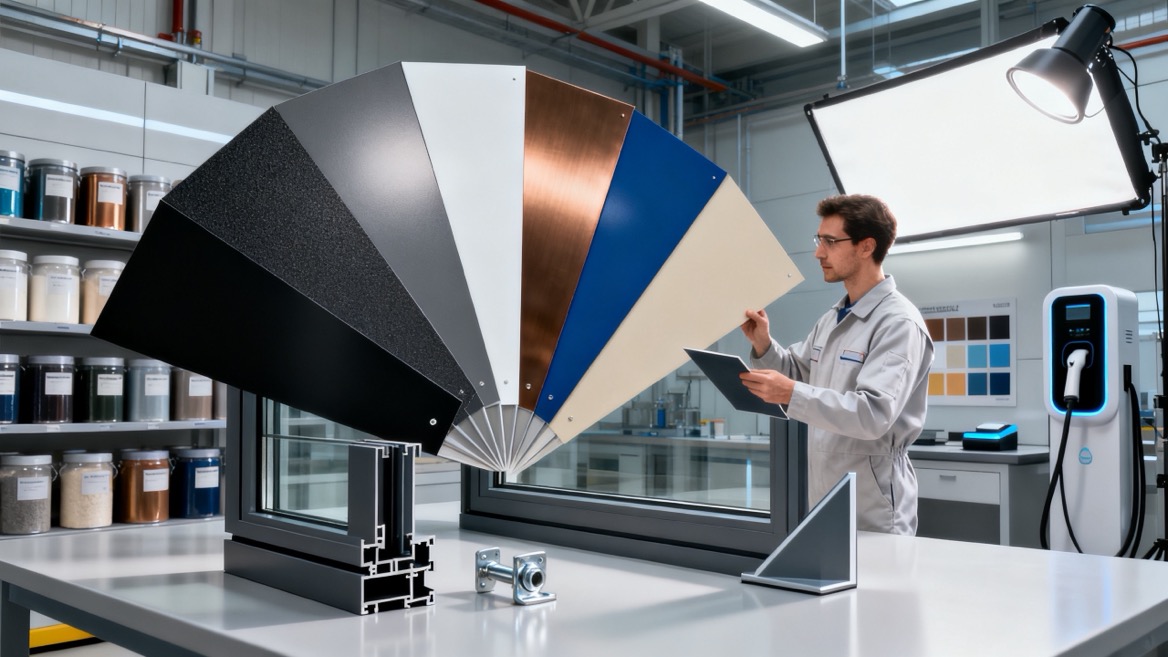
The first question should not be, "Which color looks best?" It should be, "Where will this coated product be used, and what will it face every day?"
A powder-coated aluminum window frame in a sunny coastal area faces very different risks from a powder-coated electrical enclosure used indoors. The visible color is important, but the resin chemistry behind that color often determines whether the coating remains attractive over time.
Consider the following environmental factors before approving a color and coating system:
- UV exposure: Strong sunlight can gradually reduce gloss, fade pigments, and change the surface appearance.
- Humidity and rain: Moisture can accelerate corrosion if the pretreatment, film thickness, curing process, or powder formulation is unsuitable.
- Salt exposure: Coastal construction, ports, offshore equipment, and marine-adjacent applications require greater protection from salt-laden air.
- Industrial pollution: Chemicals, dust, oils, and airborne contaminants may affect color retention and cleanability.
- Temperature: High temperatures, thermal cycling, and heat-sensitive substrates influence the appropriate powder system and curing schedule.
- Physical contact: Handrails, appliance housings, door hardware, tools, and EV parts may require additional scratch, impact, or abrasion resistance.
For demanding exterior architectural applications, project teams often distinguish between intermediate and high-performance specifications. AAMA 2604 is generally associated with five-year South Florida weathering requirements, while AAMA 2605 is designed for more demanding long-term exterior exposure and includes more stringent weathering expectations. In practical terms, a project in a coastal, high-UV, or landmark architectural environment should not be specified in the same way as an indoor metal cabinet.
Color alone does not provide protection. The recommended powder coating chemistry should follow the project environment.
| Application Environment | Common Powder Coating Direction | Key Selection Priority |
|---|---|---|
| Indoor appliances and office furniture | Epoxy or epoxy-polyester hybrid | Appearance, chemical resistance, economy |
| General outdoor furniture and hardware | Durable polyester | Weather resistance, color options, value |
| Doors, windows, and architectural profiles | Super-durable polyester or specified architectural system | UV resistance, gloss retention, color stability |
| Coastal buildings and high-UV projects | High-performance architectural coating system | Long-term color retention, corrosion resistance |
| EV components and industrial equipment | Application-specific polyester, hybrid, or polyurethane system | Durability, impact resistance, chemical exposure |
| Medical equipment and technical enclosures | Low-VOC, application-specific system | Cleanability, appearance, controlled quality |
Do not select an exterior color only from a digital image. Confirm the required coating system, substrate, pretreatment, film thickness, and performance specification before approving a shade.
A successful powder coating color should perform a commercial and functional role. It may reinforce a brand, make equipment safer to operate, reduce visible dirt, improve visual consistency across product lines, or help a product fit into an architectural environment.
For B2B buyers, the best color is not always the most fashionable one. It is the color that supports the product's intended use, target market, and lifecycle expectations.
For example, an EV charging enclosure may use a clean white, neutral grey, or branded blue to communicate technology, safety, and cleanliness. A premium aluminum door system may use fine-texture black, dark bronze, or anodic-effect grey to create a modern architectural appearance. Medical equipment may require calm, clean, low-glare shades that support a professional environment.
Before selecting a powder coating color, ask:
1. What should the finished product communicate?
Premium quality, technical precision, sustainability, safety, durability, or visual simplicity?
2. Who will see the product?
Homeowners, architects, OEM buyers, industrial operators, doctors, facility managers, or consumers?
3. How close will people stand to the surface?
A coating on a high-rise façade is viewed differently from a metal handle, appliance panel, or medical device housing.
4. Will the product be part of a larger visual system?
Consider adjacent glass, stone, wood, flooring, wall panels, plastic components, labels, and packaging.
5. Does the product need safety identification?
High-visibility colors may be necessary for machinery, emergency controls, protective barriers, or electrical equipment.
Many companies request a "custom blue," "brand red," or "signature green." However, an approved brand color should not rely only on a name or a screen image.
A reliable custom color approval process normally includes:
- A physical standard panel or approved reference sample.
- Defined color values or a recognized color system where applicable.
- A specified gloss range.
- Agreed texture and metallic effect.
- Defined substrate and pretreatment conditions.
- A measured color tolerance.
- Visual evaluation under more than one light source.
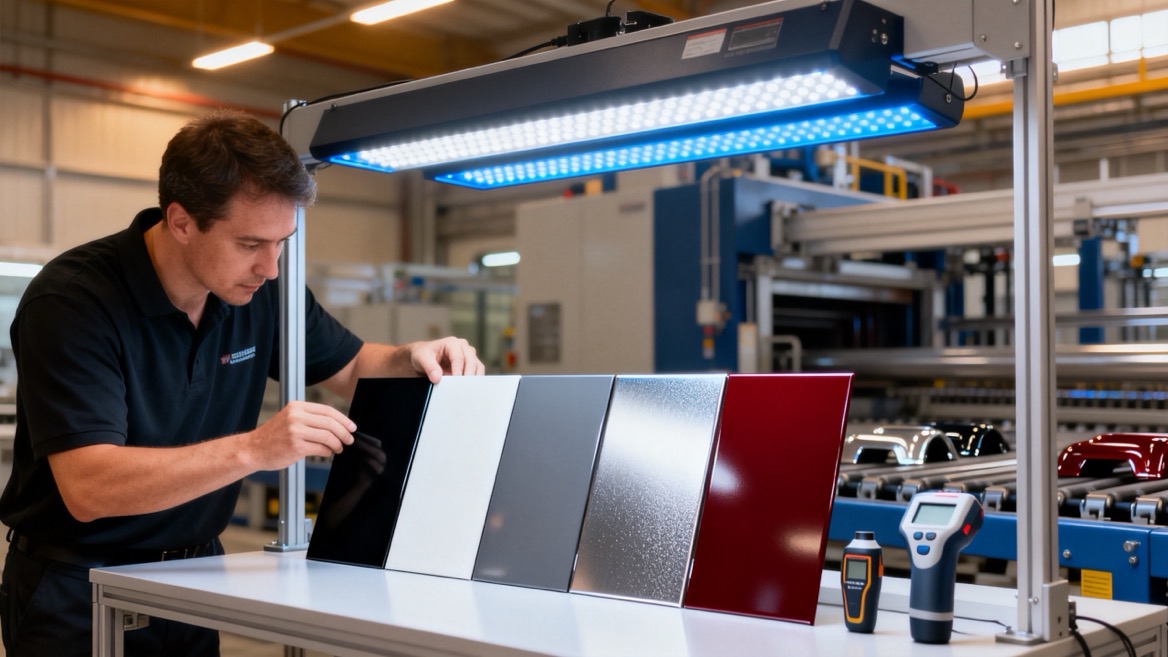
This matters because two samples can look similar under daylight but visibly different under warm indoor lighting, retail lighting, or LED lighting. This phenomenon is called metamerism. It is especially relevant when coated metal must match plastic, paint, printed graphics, glass, or another material made with different pigments. Evaluating color under multiple light sources helps identify these mismatches before mass production.
The same powder coating color can look completely different when produced in matte, satin, semi-gloss, high gloss, fine texture, sand texture, metallic, wrinkle, or bonded metallic finishes.
This is one of the most common causes of disappointment during color approval. A customer may approve "dark grey" from a small chip, only to find that the finished product looks lighter, darker, warmer, smoother, or more reflective when applied to a larger part.
Gloss influences brightness, depth, reflectivity, and surface visibility.
| Finish Type | Typical Visual Effect | Suitable Applications | Important Consideration |
|---|---|---|---|
| Matte | Low reflection, soft and modern | Architectural profiles, equipment, furniture | Can hide minor visual variation but may show marks depending on formulation |
| Satin | Balanced reflection and practical appearance | Doors, windows, metal furniture, enclosures | Often provides a versatile premium appearance |
| Semi-gloss | Brighter and cleaner visual impact | Appliances, electrical products, hardware | Surface preparation becomes more visible |
| High gloss | Strong reflection and vivid color | Decorative parts, consumer products, selected automotive components | Highlights scratches, waviness, dust, and substrate defects |
| Fine texture | Tactile, technical, defect-masking surface | Outdoor furniture, cabinets, equipment | May affect cleanability and color perception |
| Metallic | Reflective, premium, dynamic appearance | Architecture, appliances, decorative products | Requires careful batch and application control |
Industry specifications commonly categorize gloss using a 60-degree measurement. Qualicoat identifies matt finishes as 0–30 gloss units, satin as 31–70, and gloss as 71–100, with permitted variation ranges that differ by category. This is why a project specification should state a gloss target rather than simply requesting "matte" or "shiny.".pdf)
Texture can offer practical benefits:
- Fine texture can reduce the visibility of minor surface irregularities.
- Textured finishes can improve the perceived robustness of industrial products.
- Low-gloss textures may reduce fingerprints and glare.
- Certain textures can support a premium architectural or tactile design language.
- A texture may influence cleanability, film build, and the visual consistency of metallic effects.
For high-touch products such as door handles, appliance panels, control enclosures, and public equipment, a finish should be evaluated not only for appearance but also for fingerprints, cleaning behavior, scratch visibility, and maintenance requirements.
A beautiful powder coating color cannot compensate for poor substrate preparation. The material beneath the coating affects adhesion, corrosion resistance, final appearance, and consistency.
Common substrates include aluminum profiles, galvanized steel, cold-rolled steel, stainless steel, cast aluminum, cast iron, and fabricated metal assemblies. Each may require a different pretreatment strategy and process control plan.
Aluminum is widely used for windows, doors, curtain walls, solar frames, architectural façades, railings, and decorative profiles. For these applications, the visual finish must often remain consistent over large areas and multiple production batches.
When selecting a powder coating color for aluminum, evaluate:
- Alloy type and extrusion quality.
- Surface condition and handling marks.
- Pretreatment method.
- Required corrosion-resistance level.
- Film thickness target.
- Exterior exposure category.
- Gloss and texture tolerance.
- Color consistency between batches and production sites.
Steel products may include machinery frames, cabinets, gates, shelves, racks, appliances, hardware, and EV-related components. Weld seams, sharp edges, laser-cut areas, and complex geometry can affect powder coverage and final appearance.
For these parts, color approval should include representative production geometry rather than only flat laboratory panels. A color that looks excellent on a flat sample may perform differently around corners, recesses, welds, deep cavities, or areas with uneven film thickness.
Film thickness should be controlled because it can influence coverage, gloss, color, edge protection, and cure quality. Thickness should not be judged visually alone. A coating thickness gauge is a practical way to confirm readings at multiple points across a part. Uneven thickness can result from gun distance, powder delivery, electrostatic settings, grounding, part geometry, or operator technique.
For critical projects, approve a production-representative sample. It should use the actual substrate, actual pretreatment, target film thickness, curing schedule, and expected finish.
One of the most valuable steps in powder coating color selection is also one of the most frequently skipped: testing a sample in the real environment.
A color card, monitor, printed brochure, or small swatch is useful for initial selection. It is not enough for final approval.
1. Select preliminary colors and finish levels.
Start with a recognized color reference, brand standard, or physical sample.
2. Request coated sample panels.
Specify the required gloss, texture, metallic effect, substrate, and expected film thickness.
3. Review samples under multiple lighting conditions.
Check daylight, indoor LED lighting, warm lighting, showroom lighting, and the project's actual operating environment where possible.
4. Compare against adjacent materials.
Place the coated panel beside glass, plastic, stone, fabric, wood, labels, printed graphics, and other components.
5. Evaluate at different distances.
Inspect the sample from close range for defects and from normal viewing distance for total visual impact.
6. Confirm performance requirements.
Verify the resin system, curing conditions, corrosion resistance, weathering expectations, and applicable project requirements.
7. Approve a signed reference sample.
Keep the approved panel as the production benchmark for future batches and quality inspections.
Human vision is essential, but it can vary with lighting, fatigue, viewing angle, and surrounding colors. For important projects, instrumental color measurement gives the approval process greater consistency.
Color difference is often expressed as Delta E, which quantifies the difference between a sample and a reference. ISO/CIE 11664-6 describes a method for calculating color differences using the CIEDE2000 formula.
A Delta E target should be agreed according to the application. Tight tolerance may be critical for branded products, architectural installations, automotive components, and components assembled side by side. A less visible industrial component may allow a different practical tolerance.
The key point is simple: define the tolerance before production, not after a complaint occurs.
Many coating problems begin before the powder is even applied. They start with an incomplete color request or an approval process based on appearance alone.
Digital screens vary in brightness, calibration, color profile, and ambient light. A website image should be treated as inspiration, not as a final color standard.
Better approach: Approve physical coated panels.
"Black powder coating" is not a complete specification. It does not identify resin chemistry, gloss, texture, weathering resistance, film thickness, substrate, or pretreatment.
Better approach: Specify color, finish, gloss range, powder system, substrate, pretreatment, thickness, curing requirement, and performance target.
A white or grey sample may look excellent in a showroom but become difficult to maintain in a dusty industrial setting. A dark exterior color may absorb more heat and show dust or scratches differently from a textured mid-tone finish.
Better approach: Consider sunlight, temperature, dirt, fingerprints, cleaning methods, and the expected viewing distance.
Small panels do not always show the effect of texture, metallic distribution, gloss variation, or large-surface visual uniformity.
Better approach: Review larger panels or representative finished parts for high-visibility products.
The oven air temperature is not necessarily the same as the part temperature. Cure performance depends on powder chemistry, part mass, geometry, coating thickness, and time at the required metal temperature. Under-curing can reduce adhesion and corrosion resistance, while excessive heat exposure can affect gloss and color.
Better approach: Follow the powder supplier's technical data sheet and verify actual part temperature where necessary.
Different industries need different balances of aesthetics, durability, regulation, and cost.
For façades, window profiles, doors, railings, and curtain-wall systems, the most important factors are outdoor durability, color consistency, gloss retention, corrosion resistance, and compatibility with the overall building design.
Popular choices include:
- Fine-texture black for contemporary architecture.
- Grey and anthracite shades for modern residential and commercial buildings.
- White for clean, versatile façades and window systems.
- Bronze, champagne, and anodic-effect finishes for premium projects.
- Earthy shades for projects seeking a natural or regional design connection.
For coastal or high-UV projects, confirm that the selected coating system is appropriate for the specified exterior exposure level.
EV components, charging cabinets, battery-related enclosures, and associated metal structures often require a technical appearance plus strong durability.
Useful considerations include:
- Brand-color matching across metal and plastic parts.
- Scratch and impact resistance.
- Outdoor weathering for charging infrastructure.
- Clear safety-color differentiation where required.
- Low-glare finishes for displays, housings, and operator-facing surfaces.
- Consistency across suppliers and manufacturing locations.
Medical and laboratory equipment commonly requires surfaces that look clean, stable, and professional. The color selection process should consider cleaning procedures, visibility of contaminants, glare control, and compatibility with adjacent plastics or stainless-steel components.
Neutral whites, soft greys, cool blues, and controlled low-gloss finishes often support a clean visual environment. However, the final choice should always match the equipment's cleaning, chemical-exposure, and regulatory needs.
For metal furniture, hardware, shelving, kitchen products, appliances, and consumer goods, the balance often shifts toward touch experience, scratch visibility, fingerprint resistance, and design trend alignment.
Fine textures and satin finishes are frequently practical because they provide a premium look while helping conceal small surface imperfections.
The most cost-effective time to solve color and finish problems is before mass production. A powder coating manufacturer should be involved during product development, especially when the project requires custom colors, large production volumes, multiple facilities, high outdoor durability, or strict visual consistency.
At Yinda Technology, our approach begins with the real application rather than a color name alone. We help customers evaluate coating chemistry, substrate, finish, curing requirements, physical samples, color consistency, and practical production conditions.
For products supplied across China, Southeast Asia, the Middle East, or other international markets, a coordinated approval process can reduce the risk of batch variation, mismatched components, premature fading, or costly rework.
Need a powder coating color that performs as well as it looks? Share your substrate, application environment, target color, gloss level, and performance requirements with Yinda Technology. Our technical team can help develop and validate a coating solution for your architectural, industrial, EV, medical, hardware, or appliance application.
The best color depends on the environment, desired appearance, cleaning requirements, and coating system. For outdoor use, prioritize a weather-resistant powder coating chemistry and confirm UV and corrosion performance. Dark, light, metallic, and textured colors can all work outdoors when the full coating system is selected correctly.
Yes, prolonged UV exposure can affect color and gloss over time. The level of change depends on the resin system, pigments, exposure conditions, surface orientation, and geographic location. For demanding exterior projects, choose a coating system designed for long-term weathering performance.
Yes. Custom color development typically begins with a physical reference panel, approved standard, or measurable color target. The final approval should also define gloss, texture, metallic effect, substrate, lighting conditions, and allowed color tolerance.
Color appearance can change because of substrate type, surface texture, coating thickness, gloss level, curing conditions, part geometry, lighting, and viewing angle. Metallic and textured finishes can show greater visual variation than smooth solid colors.
Choose matte when you want low reflection and a modern surface. Choose satin for a balanced, versatile appearance. Choose gloss when a bright, highly reflective finish is desired. Consider cleaning, scratch visibility, texture, lighting, and the product's viewing distance before deciding.
Use a signed physical reference panel, defined color tolerance, agreed gloss range, controlled raw materials, consistent application parameters, and inspection under standardized lighting. For critical components, use instrumental color measurement in addition to visual inspection.
Yes. Powder coating is widely used on these substrates, but each material requires suitable cleaning, pretreatment, grounding, application settings, curing conditions, and performance validation. The recommended process should be confirmed for the specific part and service environment.
Provide the substrate, final application, indoor or outdoor environment, location, desired color reference, finish type, gloss level, texture, performance standard, expected film thickness, curing capability, annual volume, and any adjacent materials that require color matching.
1. [Kroma Coatings — How to Choose the Right Powder Coating Color for Projects]
2. [ASTM International — Paint Standards and Related Coating Standards]
3. [Linetec — AAMA Paint Specifications]
4. [AAMA 2604 and AAMA 2605 Testing Protocols]
5. [Qualicoat — Specifications for Coaters, 2025].pdf)
6. [ISO — ISO/CIE 11664-6:2014 Colorimetry and CIEDE2000 Colour Difference Formula]
7. [PCI Magazine — Using Light to Determine Quality]
8. [Powder Coated Tough — Color Matching in Powder Coatings]
9. [IFS Coatings — Quality Control for Powder Coating]
10. [Tiger Coatings — AAMA Powder Coating Requirements in Architectural Design]


