Language


Views: 242 Author: Yinda Powder Coating Publish Time: 2026-06-30 Origin: Site


Content Menu
● Understanding Thick-Gauge Powder Coating Context
● How Infrared (IR) Curing Works for Industrial Metals
● How Convection Oven Curing Works for Thick-Gauge Metals
● Core Comparison: IR vs. Convection for Thick-Gauge Industrial Metals
>> Process Characteristics and Performance
● Real-World Pros and Cons for Thick-Gauge Industrial Applications
>> Key Advantages of Infrared Curing
>> Key Advantages of Convection Curing
● Special Challenges: Thick-Gauge Metal and Heat Transfer
● Hybrid IR–Convection Systems: A Practical Expert Perspective
● Practical Selection Framework for Plant Engineers
● Expert Insights from Thick-Gauge Case Applications
● Operational Best Practices for IR and Convection Curing
>> Best Practices for Infrared Curing of Thick-Gauge Metals
>> Best Practices for Convection Curing of Thick-Gauge Metals
● UX and Production Management Considerations
● Strategic Recommendations for Thick-Gauge Industrial Metal Powder Coating
● Recommended Action for Industrial Powder Coating Decision-Makers
● FAQ
Infrared (IR) curing and convection oven curing each offer distinct advantages and limitations for thick-gauge industrial metal powder coating, and the best choice often depends on your part geometry, line speed, energy strategy, and quality requirements. Both technologies can deliver robust, durable finishes when correctly engineered, but their heat transfer mechanisms, process windows, and UX for operators differ significantly. [chinapowdercoating]

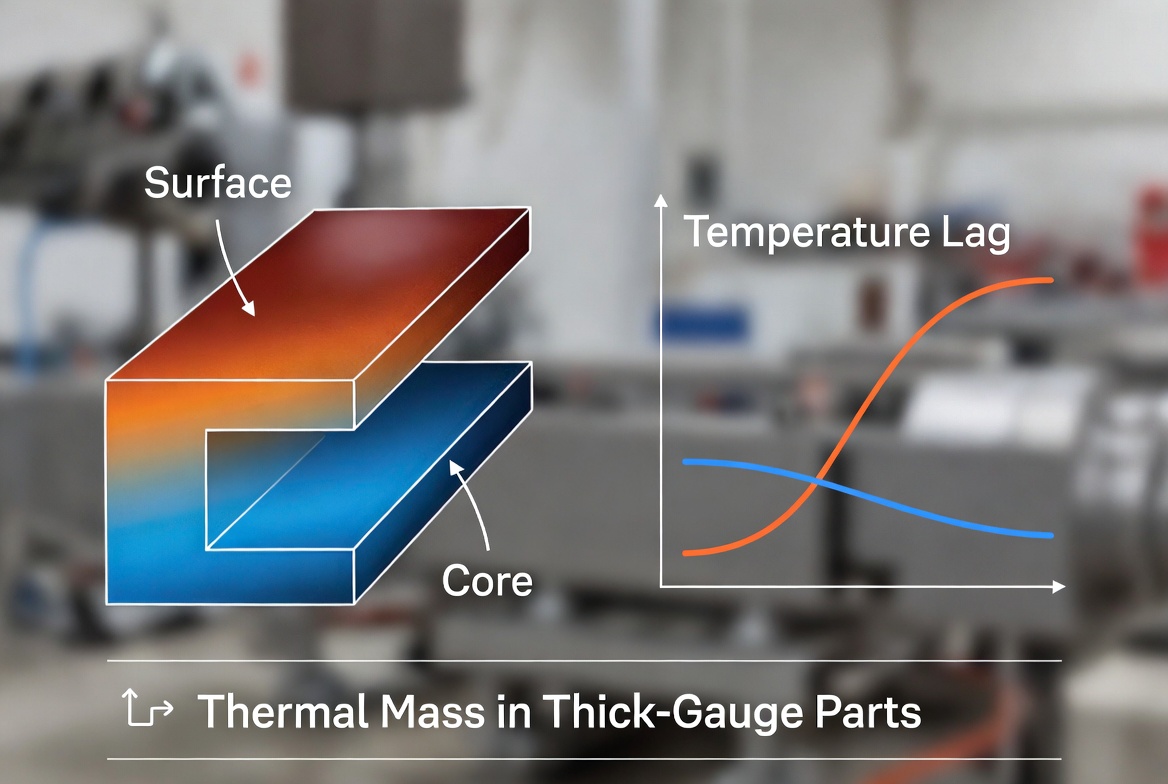
Thick-gauge industrial metal parts—structural beams, heavy brackets, chassis components, pressure vessels—behave very differently in the oven than thin panels or profiles. The thermal mass of these parts slows down temperature rise, increases dwell time requirements, and amplifies the risk of under‑cure at the core even when the surface looks perfect. [solarproducts]
For a manufacturer like Yinda Technology, supplying coatings to sectors such as construction, automotive (including NEVs), medical equipment, and heavy hardware, curing method selection directly impacts throughput, energy cost per part, and long-term coating performance in demanding environments. This makes a strategic comparison between IR and convection curing essential rather than optional. [chinapowdercoating]
Infrared curing uses radiant energy to heat the coated part surface directly, rather than heating the surrounding air first. IR emitters (short-, medium- or long‑wave) project electromagnetic energy that the powder film and metal substrate absorb and convert to heat. [pfonline]
For thick-gauge metals, IR tends to:
- Deliver rapid surface heating, bringing the outer layer to cure temperature quickly. [p2infohouse]
- Reduce time spent heating oven air, which can cut overall cycle times by 50–75% compared with pure convection in many powder applications. [pfonline]
- Demand precise control and monitoring to avoid steep thermal gradients between the part surface and core. [p2infohouse]
From an operator UX standpoint, IR systems are highly responsive: they heat up and cool down quickly, which suits flexible batch lines and mixed production schedules. However, this responsiveness also means process discipline—correct emitter distance, angle, and power—is non‑negotiable for consistent quality. [chinapowdercoating]
Convection curing relies on heated air circulating around the part, transferring heat from the air to the surface and then gradually inward via conduction through the metal. Burners or electric heaters generate hot air, and fans move that air across all exposed surfaces. [solarproducts]
For thick-gauge metal powder coating, convection ovens:
- Provide excellent temperature uniformity within the mass of the part when properly designed and profiled. [solarproducts]
- Are more forgiving of variations in part thickness, complex geometries, and mixed loads—such as assemblies with brackets, tubes, and plates. [solarproducts]
- Require longer dwell times and larger oven footprints to bring heavy sections to full cure at the part core. [chinapowdercoating]
From a UX and maintenance perspective, convection systems are familiar, widely deployed, and supported by established best practices for airflow design, burner tuning, and oven profiling. Their main challenge in modern plants is energy intensity and slower response to product mix changes. [solarproducts]
| Aspect | Infrared (IR) Curing | Convection Oven Curing |
|---|---|---|
| Heat transfer mode | Radiant energy directly to surface (chinapowdercoating) | Hot air convection, then conduction into metal (solarproducts) |
| Typical cure speed | 50–75% faster for many powder systems (chinapowdercoating) | Slower; extended dwell needed for thick sections (solarproducts) |
| Energy efficiency | High; less energy wasted heating air (chinapowdercoating) | Lower; significant energy used to heat air volume (solarproducts) |
| Uniformity on complex parts | Sensitive to shadowing and line of sight (chinapowdercoating) | Strong; airflow can reach recesses and contours (solarproducts) |
| Sensitivity to color and surface | Dark colors cure faster; light colors may need adjustment (chinapowdercoating) | Largely color-independent; stable across formulations (solarproducts) |
| Suitability for thick-gauge cores | Needs careful control to avoid surface‑core temperature gaps (chinapowdercoating) | Naturally suited for deep, even heating of heavy masses (solarproducts) |
| Footprint and layout | Compact ovens, ideal for space-constrained plants (chinapowdercoating) | Longer ovens with larger floor space requirement (solarproducts) |
| Startup flexibility | Fast heat-up and cool-down; good for batch lines (chinapowdercoating) | High thermal inertia; optimized for continuous high-volume lines (solarproducts) |
For thick-gauge industrial metal powder coating, IR curing brings compelling advantages when used correctly:
- High throughput: Faster curing enables more parts per shift, critical for NEV chassis components or construction profiles in high-volume programs. [pfonline]
- Energy savings: Direct heat transfer can significantly cut kWh per part, supporting sustainability targets and lowering operating costs. [alokinternational]
- Compact design: Shorter ovens free up floor space for additional processes such as pretreatment, inspection, or packaging. [pfonline]
However, these advantages are conditional on robust process engineering. IR systems require:
- Accurate power sizing and emitter selection (short‑wave vs medium‑wave) based on coating type and substrate thickness. [p2infohouse]
- Optimized part orientation to reduce shadowing and ensure all critical surfaces, including weld zones and flanges, see sufficient radiant energy. [p2infohouse]
- Reliable temperature monitoring using pyrometers or thermocouples to validate that the core of thick parts actually reaches cure temperature. [chinapowdercoating]
For heavy industrial metals, convection ovens remain the workhorse solution:
- Excellent uniformity across complex geometries, including frames, housings, and assemblies with mixed thicknesses. [solarproducts]
- Strong process robustness when part mixes change, because air circulation is less sensitive to color or local surface properties. [chinapowdercoating]
- Well-documented best practices and support from equipment suppliers and coating formulators.
The trade-off is that:
- Energy use is higher, as large volumes of air must be heated and kept at stable temperatures. [solarproducts]
- Oven lines are longer and less flexible for rapid program changes or tight floor plans. [chinapowdercoating]
- Thermal inertia makes frequent stop‑start operation less efficient and can complicate batch production of specialized heavy parts. [solarproducts]
Thick-gauge industrial parts present specific curing challenges, regardless of method:
- Core temperature lag: The center of beams, castings, and heavy brackets lags behind the surface, so "visual cure" is not enough to guarantee mechanical performance. [chinapowdercoating]
- Stress and distortion risk: Aggressive surface heating can create temperature gradients that lead to localized stress or coating defects such as micro‑cracking. [p2infohouse]
- Variable geometry: Parts may combine thick anchor points with thinner flanges or brackets, making uniform heating difficult. [solarproducts]
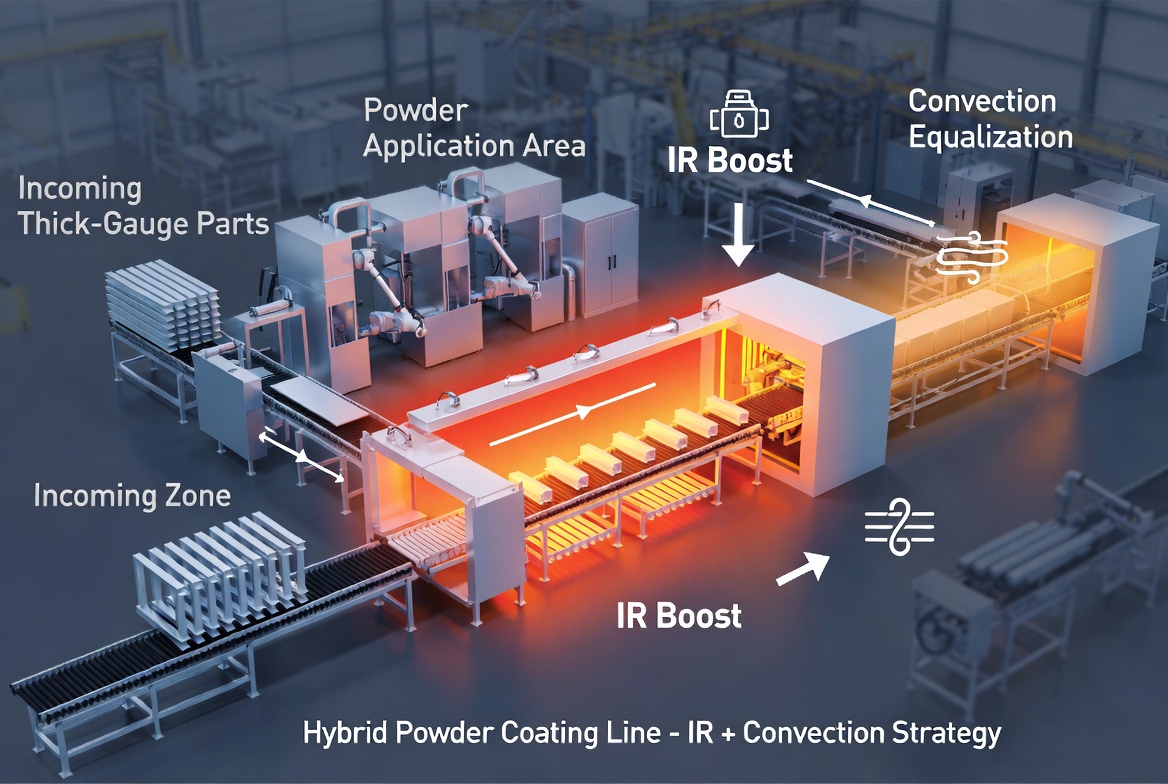
In practice, manufacturers increasingly use hybrid oven concepts—IR preheat followed by convection finishing—to stabilize these factors. This dual-stage approach allows rapid surface melt and film flow, while ensuring slow, even temperature equalization through the entire part mass. [powdercoatingonline]
From an industry expert standpoint, hybrid systems are becoming a strategic compromise for thick-gauge powder operations:
- An IR boost zone at the oven entrance quickly brings the surface into the melting range, reducing total cure time. [powdercoatingonline]
- A follow‑on convection zone equalizes temperature in shadowed and heavy areas, minimizing under‑cure and improving adhesion and impact resistance. [powdercoatingonline]
- Zoned IR (different wavelengths or intensities by zone) further fine-tunes response for varying part shapes and coatings. [chinapowdercoating]
For a multinational powder coating player like Yinda Technology, with customers across construction, NEV, medical, and hardware sectors, this hybrid approach supports:
- Flexible lines able to handle both high‑volume lighter components and lower‑volume thick-gauge industrial parts.
- Enhanced energy profile, where IR preheat reduces overall oven dwell time and associated gas or electricity consumption. [alokinternational]
- Improved UX for operators, who deal with more predictable cure windows and fewer borderline quality decisions on heavy parts.
When deciding between IR curing and convection oven curing (or hybrid) for thick-gauge industrial metal powder coating, plant engineers and coating specialists can walk through a structured decision path:
1. Define part mix and geometry.
If most parts are thick, simple shapes (e.g., beams, heavy brackets), IR plus short convection may be ideal. If parts feature deep recesses or complex assemblies, convection or hybrid is safer. [powdercoatingonline]
2. Set throughput and takt time goals.
High-volume NEV or building profile lines may justify IR to reach aggressive takt times, while lower-volume project‑based work may tolerate longer convection cycles. [pfonline]
3. Quantify energy and sustainability targets.
Rising energy costs and ESG commitments often shift the balance toward IR or IR‑assisted concepts. [alokinternational]
4. Evaluate floor space and investment constraints.
Brownfield plants with limited space gain strong value from IR's compact footprint, whereas greenfield facilities may allocate space for long convection tunnels with energy recovery. [pfonline]
5. Consult powder suppliers and run trials.
Many modern powders are formulated for faster IR response; coordinated trials with thermocouples embedded in thick parts offer data‑driven validation. [p2infohouse]
This criteria-driven approach reflects best practices recommended by both oven manufacturers and powder suppliers across global industrial markets. [pfonline]
Industry case studies show that carefully tuned IR or hybrid systems can deliver robust results for heavy-duty sectors:
- In metal fabrication lines processing structural components, IR preheat zones of 30–60 seconds effectively melted powder and leveled films before convection equalization, cutting total cure time without sacrificing mechanical properties. [powdercoatingonline]
- Independent analyses of IR processing for coatings report significant energy savings and cycle time reductions while meeting demanding quality requirements—provided temperature profiling is rigorously implemented. [p2infohouse]
For medical equipment housings and NEV battery frames, where thermal distortion or coating failure could have safety implications, experts emphasize verification via temperature logging and destructive testing when switching from pure convection to IR or hybrid systems. [p2infohouse]
To harness IR's strengths while protecting coating performance:
- Use multi-point pyrometer monitoring or embedded thermocouples on thick parts during trials to understand surface–core delta. [p2infohouse]
- Adjust line speed and emitter power so that core temperature meets the powder's specified cure schedule, not just the surface. [solarproducts]
- Segment IR zones with tailored wavelengths for different part areas or coating colors when necessary. [p2infohouse]
To optimize convection ovens for heavy industrial components:
- Conduct regular oven profiling to map temperature uniformity throughout the chamber and across part load positions. [chinapowdercoating]
- Maintain airflow hardware—fans, ducts, and filters—to avoid cold spots and ensure stable heat transfer across line speed ranges. [solarproducts]
- Consider longer ramp-up profiles for very thick parts to reduce thermal stress and support consistent film properties. [chinapowdercoating]
Beyond pure technical performance, IR vs. convection choices influence operator experience, maintenance routines, and process visibility:
- IR systems demand closer attention to emitter condition, alignment, and cleanliness, as degraded panels can rapidly impact cure quality. [p2infohouse]
- Convection systems concentrate UX around airflow, burner performance, and insulation integrity; faults tend to show up as global temperature drift rather than localized under‑cure. [solarproducts]
- Hybrid lines must coordinate controls and recipes, ensuring consistent transitions between IR and convection zones for each part family. [powdercoatingonline]
For multinational coating manufacturers serving diverse industries, investing in operator training and clear SOPs for each oven type is crucial to maintain repeatable performance and protect brand reputation.
From both a technical and business perspective, the strategic takeaway for thick-gauge industrial metal powder coating is:
- Pure IR curing shines where part geometry is relatively open, throughput targets are aggressive, and energy efficiency is a priority, but it must be engineered carefully to protect core cure and coating integrity. [pfonline]
- Pure convection curing remains the most forgiving and universally applicable solution for highly complex, heavy assemblies and mixed loads, albeit with higher energy and space requirements. [chinapowdercoating]
- Hybrid IR–convection systems increasingly represent the practical optimum for plants balancing speed, energy, and quality on thick-gauge industrial parts. [powdercoatingonline]
For manufacturers like Yinda Technology, a portfolio approach—aligning oven technologies with part families and customer sectors—can yield superior overall performance and competitive differentiation in global markets.
For engineering managers, production leaders, and technical buyers evaluating curing technologies for thick-gauge industrial metal powder coating, the next steps are:
- Map your current and future part mix and classify parts by thickness, geometry complexity, and critical performance requirements.
- Benchmark energy consumption and takt time using existing convection lines, then model IR or hybrid scenarios using supplier data and pilot trials. [pfonline]
- Collaborate with oven OEMs and powder suppliers to design trial protocols with embedded thermocouples in the thickest sections and structured destructive testing of coating properties. [p2infohouse]
By treating curing method selection as a strategic investment decision rather than a simple equipment choice, you align your powder coating operation with long-term efficiency, sustainability, and quality goals.
Q1: Can infrared curing fully replace convection ovens for all thick-gauge industrial parts?
IR can technically cure many thick-gauge parts, but for highly complex geometries or extreme thicknesses, hybrid IR–convection or pure convection often provides more robust core cure and uniformity. [p2infohouse]
Q2: Is IR curing more energy-efficient than convection for powder coatings?
Yes, IR generally offers higher energy efficiency by directly heating the part rather than large air volumes, often reducing total energy use per cured part when properly configured. [alokinternational]
Q3: How do I verify that thick-gauge parts are fully cured with IR?
Use embedded thermocouples and surface pyrometers during trials to confirm core temperature reaches the powder's cure specification, then correlate with mechanical and chemical performance tests. [solarproducts]
Q4: What is the main risk of using IR on heavy industrial components?
The primary risk is surface‑dominated heating that leaves internal sections under‑cured, especially in shadowed areas or massive cross-sections, which can compromise durability. [chinapowdercoating]
Q5: When is a hybrid IR–convection oven most appropriate?
Hybrid systems are ideal when you need faster cycles and better energy performance than pure convection, but still require strong uniformity and reliable cure in thick or complex parts. [powdercoatingonline]
1. National Renewable Energy Laboratory – Progressive Powder Coating: New Infrared Curing Oven at Metal Finishing Facility. https://docs.nrel.gov/docs/fy03osti/33095.pdf
2. Heat Processing Handbook for Paint & Powder Applications. https://solarproducts.com/wp-content/uploads/2020/12/THE-HEAT-PROCESSING-HANDBOOK-FOR-PAINT-POWDER-APPLICATIONS-1st-Edition.pdf
3. Decoding Infrared vs. Convection Curing for Peak Powder Performance. https://www.chinapowdercoating.com/decoding-infrared-vs-convection-curing-for-peak-powder-performance/
4. Powder Coating Infrared Curing. https://www.powdercoatingonline.com/powder-coating-ir-ovens/
5. Infrared Ovens Offer Speed with Control for Liquid, Powder Coatings. https://www.pfonline.com/articles/infrared-ovens-offer-speed-with-control-for-liquid-powder-coatings
6. Use of Infrared in Paint Baking and Powder Coating Curing. https://www.alokinternational.in/applications/paint-baking.htm
7. Powder Curing Using Infrared Heating – P2 InfoHouse. https://p2infohouse.org/ref/25/24276.pdf
8. Infrared Processing of Coatings – P2 InfoHouse. https://p2infohouse.org/ref/09/08980.pdf


