Language


Views: 224 Author: Yinda Powder Coating Publish Time: 2026-09-19 Origin: Site


Content Menu
● Why Heavy Castings Challenge Curing Lines
● How the Two Cure Methods Work
>> Infrared Pre-Heating Plus Convection Curing
● IR Pre-Heating + Convection vs. Pure Convection
● Why Hybrid Systems Can Improve Heavy Casting Output
● Where Pure Convection Still Wins
>> Highly Variable Part Families
>> Deep Recesses and Complex Geometry
>> Limited Process-Control Resources
● A Practical Thermal-Profiling Method
>> Step 1: Define the heaviest and most difficult part
>> Step 2: Identify critical measurement locations
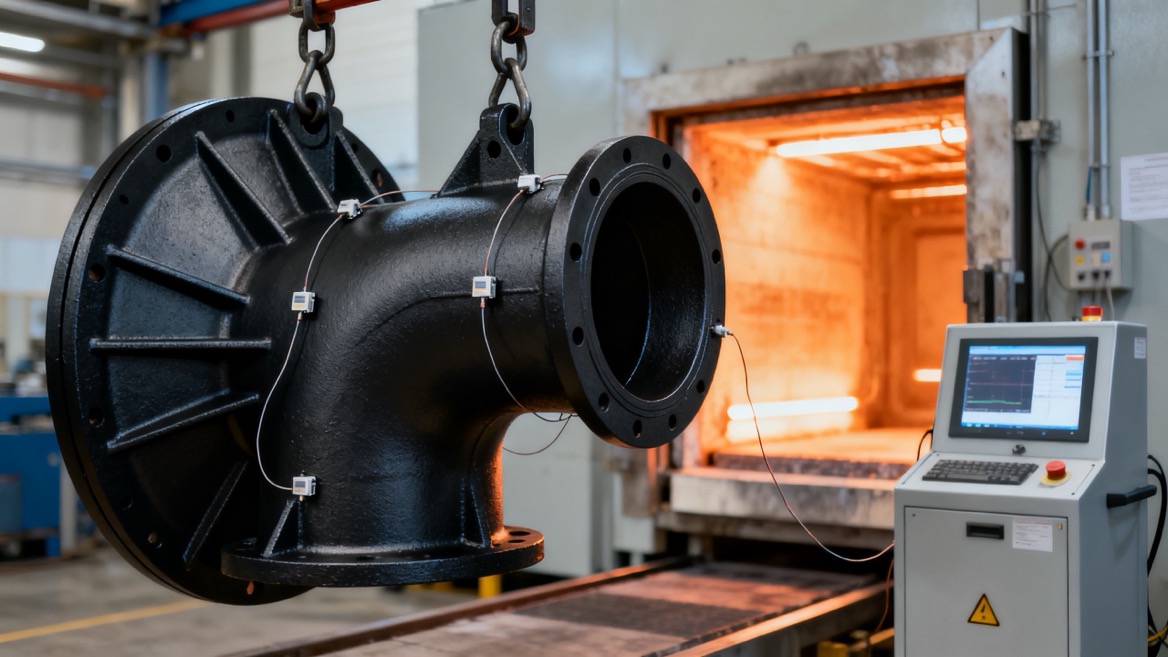
>> Step 3: Record part-metal temperature
>> Step 4: Verify the coating after cure
>> Step 5: Test production variation
● Common Failure Modes and Solutions
● FAQ
>> 1. Is infrared pre-heating suitable for all heavy metal castings?
>> 2. Can infrared curing replace a convection oven for heavy castings?
>> 3. Why does a thick casting need so much oven time?
>> 4. Does a higher oven temperature always increase throughput?
>> 5. How can we confirm whether powder coating is fully cured?
>> 6. What powder coatings work best with an IR-enhanced convection system?
>> 7. What is the most important measurement in a heavy-casting curing line?
For massive heavy-gauge metal castings, Infrared (IR) pre-heating plus convection curing can substantially shorten the time required to bring the coating and substrate to an effective cure profile, while pure convection curing remains the more forgiving choice for highly irregular parts, deep recesses, and changing production mixes. The best solution is rarely decided by oven temperature alone; it depends on part mass, geometry, powder chemistry, line speed, cure-window control, and the quality requirements of the finished component.
For manufacturers coating heavy castings used in construction hardware, new-energy vehicles, electrical equipment, medical devices, doors and windows, and industrial machinery, the curing stage is often the line's main capacity constraint. Yinda Technology develops powder coatings and environmentally responsible material solutions for these demanding markets, with operations in China, Indonesia, and Saudi Arabia. From a practical finishing perspective, the goal is not simply to heat parts faster. It is to achieve a repeatable metal temperature, complete crosslinking, stable appearance, reliable adhesion, and efficient energy use on every production batch.

Massive heavy-gauge castings are difficult to cure because they act as large thermal reservoirs. A thin sheet-metal part may rise to cure temperature quickly, but a thick iron, steel, or aluminum casting absorbs heat slowly and unevenly. Its surface can become hot while its core remains far below the intended temperature.
This creates a basic production problem:
- The powder coating must melt, flow, and crosslink at the required part-metal temperature.
- Heavy castings need significant energy before the substrate reaches thermal equilibrium.
- If line speed is increased too early, the coating may be under-cured.
- If oven time is extended excessively, thinner sections, edges, or low-mass accessories may become over-baked.
- Deep ribs, cavities, holes, and hidden faces may receive heat differently from exposed surfaces.
In real production, oven air temperature is not the same as part-metal temperature. A convection oven may be set at 200°C, but a thick casting entering at ambient temperature does not instantly become 200°C. The part requires time to absorb heat through its surface and distribute that energy through the metal mass.
This is why a curing schedule must be built around the full thermal cycle:
Total oven dwell time=heat-up time+time at required part-metal temperature
For a high-mass casting, the heat-up phase can be far longer than the actual powder curing dwell requirement.
A pure convection powder coating oven transfers heat through circulated hot air. The heated air contacts the part surface, then the heat conducts into the metal and coating film.
Convection is widely used because it is stable, flexible, and capable of reaching areas that infrared radiation cannot directly see. Heated air circulates around complex geometries, into recesses, behind flanges, and around internal features.
For heavy castings, pure convection typically provides these benefits:
- Broad heat coverage across exposed and partially enclosed surfaces
- Better tolerance for mixed product sizes and uneven wall thicknesses
- Easier processing of components with deep cavities, ribs, or occluded areas
- A consistent final holding environment for powder crosslinking
- Familiar operation and relatively straightforward process control
However, convection heating is inherently slower because it first heats air, then transfers energy from the air to the part. Large castings can require long dwell times before the powder coating reaches its specified cure condition.
A major limitation appears when manufacturers try to compensate by increasing air temperature or air velocity. Faster, hotter air can accelerate heating, but it may create unwanted process risks:
- Powder can be disturbed before it gels.
- Surface heating can outpace internal heat transfer.
- Edges and thin sections can overheat.
- Dust and airborne particles can increase surface contamination.
- Long ovens may consume valuable factory floor space.
An IR pre-heating + convection curing system uses a staged thermal profile. The coated casting first enters a lower-air-velocity infrared zone, where radiant energy rapidly heats the powder film and exposed metal surfaces. It then enters convection zones that equalize temperatures across the part and maintain the required cure dwell.
This arrangement is often called a hybrid powder coating cure system or IR-enhanced convection curing system.
The process commonly follows three functional stages:
| Cure stage | Primary heat method | Main objective |
|---|---|---|
| Pre-heat / pre-gel | Infrared with low air movement | Rapidly raise coating and surface temperature; begin powder melt and gel |
| Equalization | Infrared plus controlled convection | Reduce temperature differences between thick, thin, exposed, and hidden areas |
| Final hold | Convection | Maintain required part-metal temperature for complete crosslinking |
The first stage is especially important for freshly coated heavy castings. Before the powder melts and gels, strong air movement can disturb loosely deposited powder. A controlled infrared "quiet zone" allows the powder to begin fusing before it encounters higher-velocity circulating air.
Once the coating is gelled, convection becomes highly valuable. It heats the areas that infrared cannot directly reach and creates a more uniform thermal condition around complicated three-dimensional casting shapes.
The correct choice depends on the part family and operating priorities. The following comparison is most relevant for massive castings, counterweights, machinery housings, structural brackets, valve bodies, electric-equipment castings, and thick industrial hardware.
| Evaluation factor | IR pre-heating + convection curing | Pure convection curing |
|---|---|---|
| Initial heat-up rate | Fast on surfaces exposed to IR radiation | Slower because heat transfers through circulating air |
| Heavy-part throughput | Often higher when the IR stage reduces convection heat-up demand | Often limited by long heat-up time for high-mass parts |
| Hidden surfaces and cavities | Requires convection finishing for shadowed areas | Heated more uniformly by circulating air |
| Geometry sensitivity | Requires thoughtful emitter layout and process validation | More forgiving for complex and highly variable shapes |
| Powder stability before gel | Low-air IR pre-gel zone helps reduce powder disturbance | High air movement may disturb powder if poorly managed |
| Temperature equalization | Strong when a dedicated equalization and hold zone is used | Strong, but typically slower |
| Risk of localized overheating | Higher if IR intensity, distance, angle, or dwell is not controlled | Lower in many mixed-load applications |
| Oven footprint | Can increase capacity without simply extending the convection section | Higher capacity often requires a longer oven |
| Best use case | Repetitive heavy casting families with a validated process window | Diverse product mix, highly irregular shapes, deep recesses |
The important conclusion is that IR is not a replacement for convection in every heavy casting application. Infrared is line-of-sight energy. If a casting contains hidden pockets, deep internal cavities, undercuts, or shaded back surfaces, those areas do not receive the same direct radiant exposure as outward-facing surfaces.
Convection provides the thermal coverage needed to finish the cure more consistently across the entire part.
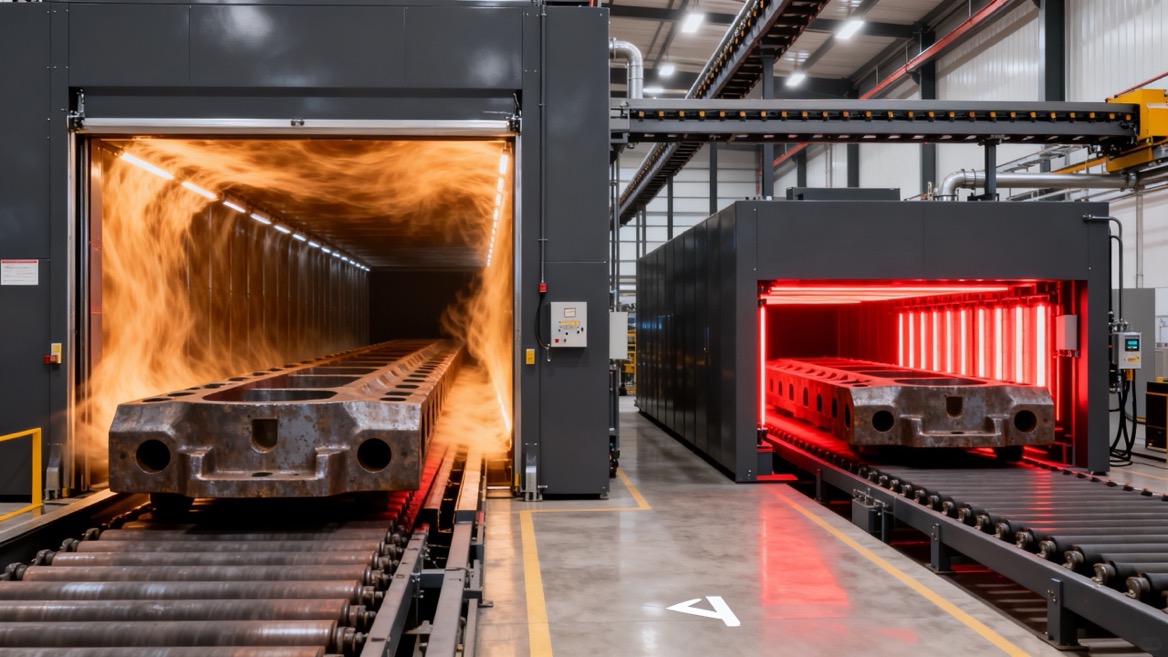
In a pure convection oven, much of the cycle is spent heating a large amount of surrounding air and then gradually transferring energy into the casting. By contrast, infrared delivers radiant energy directly to the coating and the visible metal surface.
For a heavy casting, this can create a useful production advantage: the IR zone quickly starts the thermal process at the coating–substrate interface, while the convection section completes the thermal equalization and cure.
A U.S. Department of Energy case study illustrates this principle in production. A metal finishing plant added a 40-foot catalytic IR oven between its powder booth and convection oven. The facility increased conveyor speed from 4 to 6 feet per minute, improving production by just over 50%. It also reported a 25% reduction in overall natural-gas consumption, although actual savings will vary substantially by part mix, oven condition, powder chemistry, local energy prices, and production scheduling.
The same case demonstrates an important operational point: an IR booster can pre-gel or partially cure thick components before they enter the convection section. This reduces the time that the part must occupy the longer convection oven and can reduce powder loss caused by vibration or turbulence before the coating reaches gel condition.
For very heavy steel components, published industry examples have reported dramatic cycle-time differences. One technical discussion described heavy steel parts between 5 and 8 inches thick being fully cured in less than 50 minutes with an IR-enhanced convection process, compared with more than 2.5 hours in a convection-only system. These figures should be treated as application-specific benchmarks, not universal specifications. Actual performance depends on coating formulation, substrate thickness, initial part temperature, load spacing, emitter design, and the required cure profile.
Despite the speed advantage of IR pre-heating, pure convection is often the better investment for certain production conditions.
If one line regularly processes small brackets, thick castings, thin fabricated frames, large assemblies, and products with many colors, geometries, and material thicknesses, a properly designed convection oven may provide more stable results with less frequent adjustment.
IR response depends on several variables:
- Surface color and reflectivity
- Emitter wavelength
- Emitter-to-part distance
- Part orientation
- Surface angle
- Shadowing from ribs, flanges, and fixtures
- Powder absorption characteristics
- Exposure duration
A polished, reflective metal surface may absorb infrared energy differently from a dark, textured, or previously heated surface. Similarly, a casting with a deep pocket may heat very differently from a flat plate positioned beside it.
Convection transfers heat around a part rather than relying on direct exposure. This makes it especially suitable for castings with:
- Deep channels
- Internal chambers
- Large flanges
- Dense reinforcing ribs
- Underhangs
- Multi-sided assemblies
- Variable wall thickness
Infrared can still be used successfully, but the system must be engineered around emitter placement, part orientation, fixture design, and a convection equalization stage.
An IR-enhanced system gives manufacturers more tuning capability, but it also requires more disciplined validation. Operators must understand line speed, emitter output, surface temperature response, powder gel behavior, and final cure verification.
A pure convection system may be easier to manage when the production team lacks reliable thermal profiling tools or when product changes occur frequently.
The oven cannot be selected independently of the powder coating. Powder chemistry determines the required cure schedule, flow behavior, gel time, film build, color stability, and tolerance for rapid heating.
For Yinda Technology's industrial powder coating applications, the cure design should be developed jointly by the coating supplier, finishing-line engineering team, and plant quality personnel. This is especially important for coatings used on automotive components, architectural profiles, medical equipment, electrical enclosures, and high-performance industrial hardware.
Key coating considerations include:
- Standard polyester powders: Frequently used for exterior durability and broad industrial applications; their cure windows must be matched to actual part-metal temperature.
- Epoxy powders: Often selected where chemical resistance and corrosion protection are priorities, but they may not be ideal for all exterior UV-exposed applications.
- Epoxy-polyester hybrids: Common for indoor equipment, appliances, and general metalwork.
- Low-temperature cure powders: Can reduce required thermal energy or support heat-sensitive substrates, but still need validation on heavy castings.
- Fast-cure powders: Can shorten the dwell requirement after the part reaches target temperature, though they do not eliminate the time needed to heat a massive substrate.
- Textured and special-effect powders: May have tighter appearance-control requirements because rapid or uneven heating can affect texture development, gloss, and flow.
The most common mistake is assuming that a fast-cure powder will automatically solve a heavy-casting bottleneck. Fast-cure chemistry reduces the time at cure temperature; it does not remove the thermal inertia of a 100-kilogram casting.
Before choosing between hybrid curing and pure convection, conduct a structured thermal trial on representative parts. Do not make the decision from oven setpoint temperature, theoretical heat calculations, or one small test coupon alone.
Choose the casting with the greatest combination of mass, wall thickness, deep geometry, and coating-quality risk. Include the normal production fixture and hanger because they influence heat absorption and airflow.
Attach thermocouples to locations that represent the real thermal challenge:
- Thickest wall section
- Thin edge or flange
- Deep recess
- Area hidden from direct IR exposure
- Surface nearest the IR emitters
- High-visibility cosmetic surface
- Region near a heavy fixture contact point
Track the thermal profile from oven entry through the final hold zone. The goal is to confirm when each critical location reaches the coating manufacturer's required metal temperature.
Do not rely only on non-contact infrared thermometers. Surface emissivity, reflectivity, viewing angle, and line-of-sight access can affect readings, especially on metallic or reflective areas.
A proper cure assessment should include more than visual inspection. Depending on the product specification, assess:
- Film thickness
- Appearance, gloss, texture, and color consistency
- Adhesion
- Impact resistance
- Flexibility
- Solvent resistance where applicable
- Corrosion resistance
- Edge coverage
- Cure completeness using an appropriate validated method
Repeat the trial with realistic variables:
- Different casting temperatures at line entry
- Light and heavy production loads
- Different hanger density
- Different powder colors
- Morning start-up versus steady-state production
- Mixed part spacing
- Powder reclaimed versus virgin blend, where relevant
This validation process reveals whether a hybrid system is genuinely stable or merely fast under ideal trial conditions.
This typically occurs when high-velocity air reaches loosely deposited powder before it has melted and adhered to the substrate.
Practical response: Use a low-air-velocity IR pre-gel zone before stronger convection airflow. Maintain stable conveyor movement and reduce vibration between the booth and first heating stage.
Thin fins, corners, or outward-facing surfaces can heat much faster than thick central sections under intense IR.
Practical response: Reduce radiant intensity, change emitter distance or angle, improve part rotation or orientation, and use convection equalization before the final hold stage.
Recesses and hidden faces may not see sufficient IR energy.
Practical response: Use convection as the finishing heat source, reposition emitters if appropriate, and validate cure with thermocouples in the most shaded locations.
Uneven heat-up can alter powder flow, texture development, or gloss, especially when coating thickness varies.
Practical response: Confirm spray-film thickness consistency, use a staged temperature ramp, and review whether the selected powder has a suitable gel and flow profile for rapid IR exposure.
A high oven setpoint can create false confidence when the casting itself has not reached cure temperature.
Practical response: Build every operating recipe around measured part-metal temperature and confirmed dwell time, not only air temperature.
A practical decision framework is shown below.
| Your production condition | More suitable approach |
|---|---|
| Repetitive large castings with consistent geometry | IR pre-heating + convection curing |
| Severe bottleneck caused by slow heat-up of thick parts | IR pre-heating + convection curing |
| Need to increase output without greatly extending oven length | IR pre-heating + convection curing |
| Complex castings with cavities and hidden surfaces | Hybrid system with a strong convection equalization and hold stage |
| Constantly changing shapes, sizes, and thicknesses | Pure convection or a highly flexible hybrid design |
| Small batches with frequent product changeovers | Pure convection may be simpler and more stable |
| Limited temperature-profiling capability | Pure convection may reduce operational risk until controls improve |
| High appearance requirements on visible industrial components | Either system, but only after full thermal and finish validation |
For many large-scale industrial coating lines, the strongest long-term answer is not "IR versus convection." It is a carefully engineered combination: IR for rapid and controlled pre-heating, followed by convection for temperature equalization and complete cure.
For massive heavy-gauge metal castings, Yinda Technology should generally evaluate Infrared (IR) pre-heating + convection curing when the product family is repetitive, production capacity is constrained by long convection heat-up times, and the plant can validate thermal profiles carefully. The hybrid approach can shorten the bottleneck phase, reduce the required convection dwell, stabilize powder after application, and increase throughput without relying only on a longer oven.
However, pure convection remains a sound choice for plants with highly variable loads, deep and irregular geometries, or limited process-control capability. Its slower heating profile is often more forgiving, particularly when every batch includes different casting sizes, wall thicknesses, and shadowed surfaces.
The decisive factor is not the oven label. It is whether every critical surface reaches the specified part-metal temperature for the required dwell time, without creating over-bake, under-cure, powder disturbance, gloss variation, or wasted energy.
Contact Yinda Technology to discuss your casting material, part weight, wall thickness, geometry, coating performance target, current oven profile, and desired line speed. A controlled trial using your actual production parts can identify the most reliable curing route and help build a powder coating system that balances finish quality, productivity, and energy efficiency.
No. It is particularly useful for repeatable casting families where exposed surfaces can receive controlled radiant energy. Parts with deep recesses, hidden surfaces, or highly variable geometry still need a convection stage to equalize temperature and complete the cure.
In some uniform applications, infrared can provide significant heating and even complete cure. For most massive and complex castings, however, infrared alone is less reliable because it is a line-of-sight process. A convection finishing zone is usually needed for shadowed areas and uniform final cure.
The coating may reach a high surface temperature quickly, but the metal substrate absorbs heat slowly. The entire thermal mass of the casting affects how fast the coated surface reaches and maintains the required part-metal temperature.
Not necessarily. Excessive temperature or airflow can cause powder blow-off, edge overheating, discoloration, poor flow, pinholes, gloss variation, or over-bake. A measured thermal profile is safer than simply increasing oven setpoint temperature.
Use measured part-metal temperature and validated dwell time first. Then verify the cured coating through tests appropriate to the specification, such as visual inspection, film-thickness testing, adhesion testing, impact testing, solvent resistance, flexibility, and corrosion-performance assessment.
The best powder depends on the required performance and cure profile. Polyester, epoxy, epoxy-polyester hybrid, low-temperature-cure, and fast-cure powders can all be considered, but the coating must be tested on the actual substrate and line conditions.
The most important measurement is part-metal temperature at the most difficult locations, combined with confirmed time at the coating's required cure condition. Oven air temperature alone cannot prove that a thick casting has cured correctly.
1. U.S. Department of Energy, Office of Energy Efficiency and Renewable Energy. "[Progressive Powder Coating: New Infrared Curing Oven at Metal Finishing Plant Increases Production by 50%]." Case study covering productivity, gas-use reduction, and IR booster oven implementation in powder coating operations.
2. PCI Magazine. "[Curing with Infrared and Combination Ovens]." Technical overview of infrared wavelengths, convection heat transfer, hybrid oven zones, thermal equalization, and cure-cycle considerations.
3. Powder Coated Tough. "[Which Oven Technology Is Right for You?]." Industry guidance by finishing consultant Rich Saddler on convection, infrared, powder behavior, geometry, and hybrid cure design.
4. Powder Coated Tough. "[IR/Convection Oven Combo Ups Production]." Discussion of staged infrared and convection heating for powder fusion and final curing.
5. Industrial Heating Equipment Association. "[Improving Your Powder Curing Process: Convection Efficiencies and Infrared]." Technical resource discussing useful heat, setpoint requirements, dwell time, and infrared integration with convection ovens.


