Language


Views: 246 Author: Yinda Powder Coating Publish Time: 2026-08-11 Origin: Site


Content Menu
● Why Aluminum Cages Need a Purpose-Built Finish
● Isocyanate-Free Polyurethane for Veterinary Cages
>> Key Strengths of Isocyanate-Free Polyurethane
>> Where Isocyanate-Free Polyurethane Fits Best
● Antimicrobial Epoxy for Veterinary Cages
>> What Antimicrobial Epoxy Can Do
>> The Important Limitation: It Is Not a Disinfectant Substitute
● Isocyanate-Free Polyurethane vs. Antimicrobial Epoxy
● How to Specify the Right Coating System
>> Step 1: Map Cage Exposure Zones
>> Step 2: Confirm Aluminum Pretreatment
>> Step 3: Test Against Real Clinic Chemicals
● Antimicrobial Claim Verification Checklist
● Lifecycle Value: Look Beyond Initial Powder Cost
● Recommendation for Veterinary Caging Projects
● FAQ
>> 1. Is antimicrobial epoxy safe for veterinary clinic aluminum cages?
>> 2. Does antimicrobial epoxy eliminate the need to disinfect cages?
>> 3. Which coating is more resistant to disinfectants?
>> 4. Can isocyanate-free polyurethane be used as a powder coating?
>> 5. What test standard should support an antimicrobial coating claim?
>> 6. Why does aluminum pretreatment matter before powder coating?
Selecting a finish for veterinary clinic aluminum caging systems is not simply a color or cost decision. Isocyanate-free polyurethane and antimicrobial epoxy can both protect aluminum enclosures, yet they solve different operational problems: one prioritizes flexible, lower-emission durability, while the other can add a targeted layer of microbial-load control.
For cage manufacturers, veterinary equipment distributors, and clinic designers, the correct choice depends on the cage's cleaning routine, animal species, contact frequency, corrosion exposure, visual requirements, and the performance evidence available for the exact coating system. At Yinda Technology, our perspective as a powder coating manufacturer serving medical equipment, new-energy vehicles, architectural profiles, hardware, and electrical products is clear: a coating should be specified as part of a complete cage-design and maintenance system—not as an isolated material claim.

Veterinary caging is exposed to conditions that are harsher than those encountered by ordinary indoor furniture. Aluminum is lightweight, corrosion resistant, and practical for modular cage construction, but its surface still requires a robust finish to maintain appearance, simplify cleaning, and resist mechanical damage.
A veterinary clinic aluminum caging system may face:
- Frequent disinfection with detergents, oxidizing agents, quaternary-ammonium products, and other approved cleaners
- Moisture and organic contamination from wash-down, animal waste, food, and bedding
- Abrasion and impact from cage doors, latches, trays, carriers, and cleaning tools
- High-touch contact on handles, door frames, locks, and feeding-access areas
- Aesthetic expectations that support a clean, professional clinical environment
The coating must adhere reliably to pretreated aluminum, form a continuous film, and retain its performance after repeated cleaning. Equally important, it must support the facility's actual hygiene program. No coating replaces proper cleaning, disinfection, drying, inspection, and staff training.
Isocyanate-free polyurethane, often described in technical discussions as non-isocyanate polyurethane or NIPU, is a polyurethane family designed without conventional isocyanate chemistry. Depending on the formulation and curing mechanism, it can be developed for protective, decorative, and industrial applications where lower-emission material choices and durable film properties are valued.
For aluminum caging, an isocyanate-free polyurethane finish is most compelling when the buyer's priorities are surface flexibility, visual quality, chemical resistance, and responsible material selection.
A well-engineered isocyanate-free polyurethane coating can offer several benefits for veterinary enclosure manufacturers:
- Flexible film behavior: This helps the coating tolerate minor substrate movement, handling stress, and localized impact better than some more brittle finish types.
- Smooth decorative appearance: It can support consistent colors, matte or semi-gloss effects, and a refined visual finish for premium veterinary environments.
- Lower-emission positioning: Isocyanate-free and low-VOC coating technologies can align with projects that emphasize worker safety, indoor-environment considerations, and reduced environmental impact.
- Resistance to routine cleaning: A properly cured system can withstand regular cleaning chemicals, provided the final specification is validated against the clinic's actual products and dwell times.
- Comfort-focused use cases: Its balanced finish can be well suited to cage bodies, external panels, cabinetry interfaces, and areas where visual comfort matters alongside protection.
However, "isocyanate-free" is not a universal performance guarantee. Film thickness, resin chemistry, pigments, curing schedule, pretreatment, and aluminum alloy all influence the finished cage. A supplier should provide data for the complete coating system rather than relying on a general chemistry label.
From a practical specification perspective, this option is usually strongest for:
1. Premium companion-animal clinics seeking a polished, durable visual environment
2. Dry or moderately wet cage zones with disciplined cleaning and drying procedures
3. Visible aluminum panels where color consistency and scratch appearance matter
4. Projects with sustainability-oriented material requirements
5. Cage systems requiring a slightly more forgiving protective film around doors, exterior frames, and service panels
For caging that experiences extremely aggressive disinfection or persistent impact at latch points, the coating should be tested as a system under realistic use conditions before approval.
Antimicrobial epoxy combines epoxy resin performance with an antimicrobial additive or active technology. The epoxy matrix is valued for adhesion, film hardness, chemical resistance, and protective performance. The antimicrobial component is intended to reduce microbial growth or survival on the treated coating surface under defined test conditions.
This makes antimicrobial epoxy particularly relevant for veterinary clinic aluminum caging systems with high-contact surfaces, intensive cleaning schedules, and strong hygiene-management expectations.
A properly designed antimicrobial epoxy coating can provide:
- Strong adhesion to correctly pretreated aluminum
- Hard, durable films that resist handling wear and cleaning damage
- Good resistance to many common cleaning chemicals
- An additional antimicrobial surface function when supported by recognized testing
- A practical option for high-touch areas such as cage doors, handles, latch surrounds, and feeding access panels
Silver, copper, zinc, titanium dioxide, and combinations of active technologies are among the approaches studied for antimicrobial surfaces. Their performance can vary significantly with additive type, concentration, particle size, surface exposure, humidity, contact time, temperature, and the microorganism tested.
This variation matters. A coating that performs well in a laboratory assessment against one bacterial strain cannot automatically be assumed to deliver the same reduction against every organism or under every clinic condition.
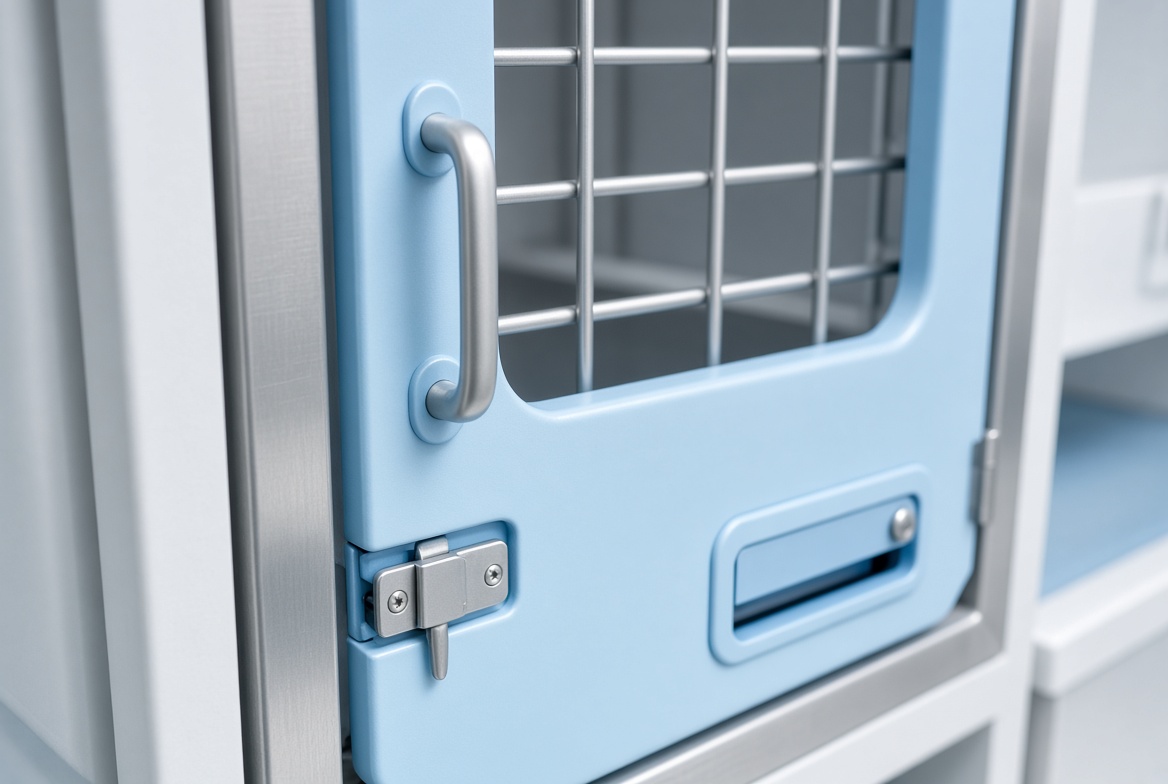
An antimicrobial epoxy finish should never be positioned as a replacement for routine cage sanitation. In veterinary clinics, animal hair, organic residue, moisture, biofilm formation, and cleaning inconsistency can all reduce the practical benefit of any treated surface.
The correct message for end users is straightforward:
- Clean first to remove visible soil and organic matter
- Disinfect according to the facility protocol
- Allow the required contact time for the disinfectant
- Rinse or dry where required
- Inspect coating condition, especially around seams, latches, and damaged edges
The antimicrobial feature is best viewed as a supplementary control layer between cleaning cycles, not a stand-alone infection-control solution.
| Selection Factor | Isocyanate-Free Polyurethane | Antimicrobial Epoxy |
|---|---|---|
| Primary value | Flexible, decorative, lower-emission protective finish | Hard protective finish with an added antimicrobial function |
| Surface appearance | Often excellent for consistent color and refined aesthetics | Can deliver smooth, professional finishes; formulation affects appearance |
| Mechanical profile | Often better suited to applications needing flexibility | Typically valued for hardness, adhesion, and robust film build |
| Chemical-cleaning resistance | Must be validated against the clinic's disinfectants | Often a strong candidate for repeated cleaning exposure; validation remains essential |
| Microbial-load support | Not inherently antimicrobial unless specifically formulated | Can provide antimicrobial activity when the full system is tested |
| Best use area | Cage bodies, visible panels, exterior frames, premium clinic furniture | High-touch doors, handles, latch zones, intensive-use cage surfaces |
| Sustainability considerations | Attractive where isocyanate-free and lower-emission criteria matter | Depends on resin, additive, manufacturing process, and service life |
| Specification risk | Assuming "isocyanate-free" automatically means high chemical resistance | Making broad antimicrobial claims without test evidence |
Neither technology is automatically superior. The better choice is the one that matches the cage design, site environment, cleaning protocol, and required documentation.
The most reliable projects begin with a clear performance brief. Rather than asking only for "white antimicrobial powder coating" or "eco-friendly polyurethane," define how the veterinary caging system will actually be used.
Divide the cage assembly into functional zones:
- High-touch zones: handles, pull bars, latches, door frames
- High-moisture zones: lower panels, drainage-adjacent surfaces, wash-down areas
- High-abrasion zones: tray supports, sliding interfaces, door edges
- Visible zones: external panels, reception-facing kennel banks, cabinet fronts
- Low-contact structural zones: concealed brackets, rear frames, mounting parts
An antimicrobial epoxy may be strategically valuable on high-touch components, while isocyanate-free polyurethane may be more appropriate for visible panels requiring a premium finish. This selective approach can optimize performance and project cost.
The coating is only as reliable as the substrate preparation. Aluminum cage components should be cleaned, converted, rinsed, dried, and processed under controlled conditions before powder application.
Ask suppliers to document:
- Aluminum alloy and surface condition
- Pretreatment type and process controls
- Adhesion test method and acceptance criteria
- Coating thickness range
- Cure temperature, metal temperature, and cure time
- Batch traceability for powder and coated parts
For aluminum veterinary cages, poor pretreatment can lead to blistering, edge corrosion, adhesion loss, and early coating failure—even when the powder formulation itself is high quality.
Do not approve a coating based only on a generic chemical-resistance statement. Create a chemical test panel using the cleaners and disinfectants the clinic will actually use.
The test should assess:
- Color change
- Gloss change
- Softening or tackiness
- Blistering
- Cracking
- Loss of adhesion
- Staining
- Corrosion at scratches and cut edges
Include repeated exposure, not only a single wipe test. This reflects the true lifetime challenge of veterinary clinic aluminum caging systems.
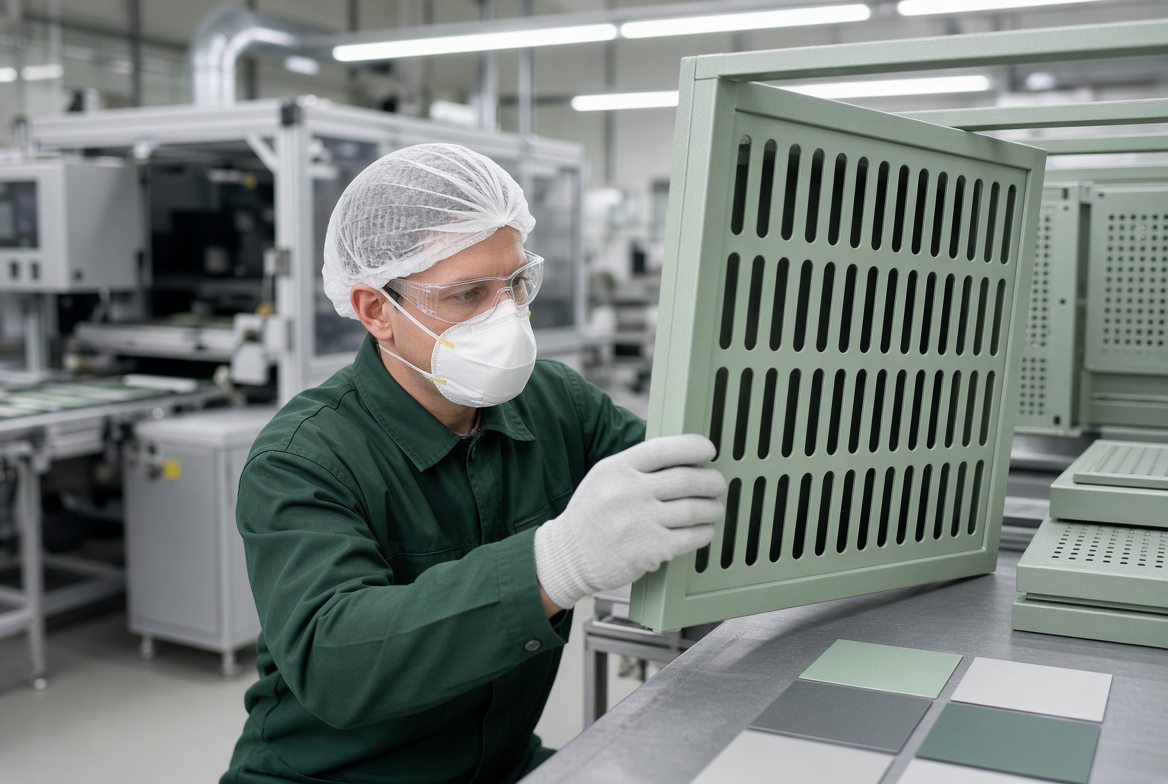
For an antimicrobial epoxy coating, buyers should require clear and specific documentation. The relevant evidence should identify the exact coating, curing conditions, test method, microorganisms, and exposure period.
A credible evaluation package should include:
1. The coating product identification, including color and finish where relevant
2. The active antimicrobial technology, where disclosure is permitted
3. The test standard used, such as ISO 22196 for antibacterial activity on treated non-porous surfaces
4. Named test organisms and the reported reduction result
5. Test duration and environmental conditions
6. Confirmation that production parts receive the validated cure profile
7. Clear limitations on the claim, including that routine cleaning remains necessary
ISO 22196 provides a method for evaluating antibacterial activity on treated plastics and other non-porous product surfaces. It does not establish that a surface prevents infection, eliminates all microorganisms, or replaces disinfection procedures. That distinction protects both cage manufacturers and veterinary clinics from overclaiming.
For veterinary cage manufacturers, the lower-priced coating is not always the lower-cost decision. The real cost includes application yield, reject rate, cleaning durability, repair frequency, warranty exposure, appearance retention, and the possibility of cage downtime.
Powder coating can support efficient material use because overspray may be collected and reused in suitable production systems. Its solvent-free application format also makes it a practical fit for manufacturers pursuing cleaner production processes.
When comparing isocyanate-free polyurethane and antimicrobial epoxy, evaluate the following questions:
- Will the surface remain acceptable after hundreds of cleaning cycles?
- Does the coating resist scratching around door and latch interfaces?
- Can the supplier reproduce the finish across multiple manufacturing locations?
- Are antimicrobial claims supported for the exact product and cure cycle?
- Does the finish support the clinic's visual standard over its expected service life?
- Can damaged parts be touched up or replaced without obvious color mismatch?
A durable system with fewer recoating events can reduce disruption, material consumption, and long-term maintenance burden.
Choose isocyanate-free polyurethane when your priority is an attractive, flexible, lower-emission protective finish for visible and moderately demanding aluminum cage components. It is especially relevant for premium clinical interiors where appearance, comfortable visual design, and responsible material selection are important.
Choose antimicrobial epoxy when the project requires a hard, chemical-resistant protective coating with a validated antimicrobial function for high-touch veterinary caging surfaces. It is particularly relevant for cage doors, handles, latch areas, and high-turnover clinical environments.
For many projects, the strongest answer is not an either-or decision. A zoned coating strategy can combine antimicrobial epoxy on the most frequently touched components with an isocyanate-free polyurethane system on visible exterior panels and less demanding cage sections.
Yinda Technology can help assess your aluminum substrate, cage design, cleaning chemicals, target finish, and required documentation to develop a practical powder coating specification for veterinary clinic caging systems. Contact our technical team to request coating samples, test-panel planning, and application guidance for your project.
Safety depends on the complete, cured coating formulation, the intended use, and applicable local requirements. Request technical documentation, chemical information, and evidence for the specific coating system rather than relying on a general antimicrobial label.
No. It is an additional surface feature, not a replacement for cleaning and disinfection. Cages still need a documented sanitation process that removes soil, applies the correct disinfectant, and follows the required contact time.
Antimicrobial epoxy is often selected for strong chemical resistance, but actual performance depends on the coating formulation, cure quality, chemical concentration, exposure time, and cleaning frequency. Always test with the clinic's real disinfectants.
The answer depends on the specific resin technology and manufacturer formulation. Buyers should confirm whether the proposed system is a powder coating, its curing profile, its film properties, and its compatibility with aluminum pretreatment.
ISO 22196 is commonly used to evaluate antibacterial activity on treated non-porous surfaces. The report should identify the exact coating, test organisms, test conditions, and reduction results.
Pretreatment improves cleanliness, adhesion, and corrosion resistance. Without it, even a high-performance powder coating can suffer from early adhesion loss, blistering, edge corrosion, and inconsistent long-term appearance.
1. Birkett, M. et al. "Recent Advances in Metal-Based Antimicrobial Coatings for High-Touch Surfaces." *International Journal of Molecular Sciences*, 2022. [Read the full study]. [pmc.ncbi.nlm.nih]
2. International Organization for Standardization. "ISO 22196:2011—Measurement of Antibacterial Activity on Plastics and Other Non-Porous Surfaces." [View the standard overview]. [iso]
3. Powder Coating Institute. "Sustainability." [Read the industry guidance]. [powdercoating]
4. Sherwin-Williams. "A Guide to Sustainable Pharmaceutical Facility Design." [Read the technical article]. [industrial.sherwin-williams]
5. Birkett, M. et al. "Recent Advances in Metal-Based Antimicrobial Coatings." PubMed record and publication details. [View the record]. [pubmed.ncbi.nlm.nih]
6. ISO. "ISO 8130-1:2019—Coating Powders: Determination of Particle Size Distribution by Sieving." [View the standard overview]. [iso]


