Language


Views: 258 Author: Yinda Powder Coating Publish Time: 2026-09-24 Origin: Site


Content Menu
● Why Cure Temperature Matters for Assembled Parts
● Low-Temperature Cure Powder: 130°C Overview
>> Main advantages of 130°C curing
>> The engineering reality behind 130°C powder
● Standard Cure Powder: 180°C Overview
>> Why 180°C remains widely used
● 130°C vs. 180°C: Side-by-Side Comparison
● The Most Important Distinction: Oven Temperature vs. Metal Temperature
● Risk Assessment for Aluminum-Plastic Assemblies
>> Components that need special attention
● When 130°C Powder Is the Better Choice
● When 180°C Powder Is the Better Choice
● Energy Consumption: The Opportunity and the Limitation
>> Factors that determine actual savings
● Quality-Control Plan for Low-Temperature Curing
>> Recommended validation workflow
● Expert Perspective: Avoid the "Lowest Temperature" Trap
● How Yinda Technology Supports Coating Decisions
● FAQs
>> 1. Can powder coating cure fully at 130°C?
>> 2. Is 130°C powder coating suitable for plastic parts?
>> 3. Is 180°C powder coating always stronger than 130°C powder coating?
>> 4. What is the difference between oven temperature and part temperature?
>> 5. Can low-temperature powder coating reduce energy costs?
>> 6. What problems can occur when curing aluminum-plastic assemblies at 180°C?
>> 7. Should aluminum-plastic components be assembled before or after powder coating?
For assembled aluminum-plastic components, the curing schedule is not simply a production setting—it determines whether the finished product keeps its shape, adhesion, appearance, and functional integrity. Low-temperature cure powder coating at 130°C is often the safer choice for assemblies containing heat-sensitive plastics, seals, adhesives, electronics, or engineered inserts, while standard cure powder coating at 180°C remains a proven option for all-metal parts and applications requiring a conventional, widely established curing process.
At Yinda Technology, we work with powder coating applications across architectural aluminum profiles, doors and windows, new-energy vehicles, medical equipment, hardware, and electrical products. From a coating-engineering perspective, the correct choice should never be based on oven temperature alone. The real decision requires an evaluation of substrate materials, assembled-part design, curing window, coating performance target, production speed, energy consumption, and quality-control capability.

Powder coating becomes a continuous, protective film only after it melts, flows, chemically crosslinks, and reaches its designed cure condition. The oven setting is important, but the actual part temperature and the amount of time that temperature is maintained are even more important.
For a simple aluminum extrusion, a 180°C cure schedule may be straightforward. However, assembled aluminum-plastic components are more complex. These products may include:
- Aluminum frames with plastic corner connectors
- Aluminum housings with plastic covers
- Door and window systems with thermal-break strips
- EV battery-related enclosures with polymer inserts
- Medical equipment with plastic fittings or cable-routing elements
- Electrical cabinets with wire insulation, gaskets, labels, clips, or electronic assemblies
- Hardware products with adhesive-bonded or polymer-coated components
In these assemblies, aluminum and plastic do not respond to heat in the same way. Aluminum conducts heat rapidly. Plastic components may absorb heat more slowly, but they can also soften, deform, discolor, release volatiles, shrink, or lose mechanical strength when exposed to excessive temperature.
That is why low-temperature cure powder coating has become increasingly relevant for manufacturers processing pre-assembled products. Low-bake powder systems can operate at significantly lower cure conditions than conventional formulations, helping coaters reduce thermal stress on sensitive assemblies.
A 130°C powder coating system is designed to form a durable cured film at a lower metal temperature than traditional 180°C powders. In practical terms, the coating chemistry must melt, level, and crosslink efficiently at lower heat input.
This technology is particularly useful when the component cannot safely tolerate a conventional high-temperature curing cycle.
- Lower thermal load on plastic, rubber, adhesive, foam, sealant, wiring, and composite components
- Reduced risk of warpage, shrinkage, gloss change, cracking, or distortion in plastic inserts
- Potentially lower oven energy use, depending on oven design, part mass, loading density, exhaust rate, and production schedule
- Better compatibility with pre-assembled products
- Potentially shorter heat-up time for some lightweight or thin-wall components
- Opportunity to coat more complex assemblies without disassembly and reassembly
Low-temperature powder technologies are often used where coatings need to cure below approximately 149°C, especially for heat-sensitive substrates and assemblies. Formulations capable of curing around 121–135°C have been developed for applications where standard high-bake conditions are unsuitable.
A 130°C low-temperature cure powder is not simply a standard powder placed in a cooler oven. It requires a different formulation approach.
The resin, curing agent, pigment dispersion, flow behavior, melt viscosity, and reaction kinetics must be designed to work together. If the powder melts but does not fully crosslink, the coating may look acceptable immediately after curing but later show weak solvent resistance, reduced hardness, poor adhesion, insufficient corrosion resistance, or premature failure in service.
For this reason, manufacturers should evaluate the complete cure window rather than request only "130°C powder coating."
A technical cure window should define:
- Minimum metal temperature
- Maximum metal temperature
- Minimum hold time
- Maximum hold time
- Required film thickness
- Approved substrate and pretreatment conditions
- Performance tests after curing
For architectural and other performance-critical applications, cure time and temperature should match the coating supplier's technical specification. A curing-index approach may be used, but the finished part must still meet the powder supplier's defined curing window.
Standard cure powder coatings commonly operate around 180°C metal temperature, frequently with a hold period such as 10 to 20 minutes depending on formulation, substrate mass, coating type, and oven performance.
For decades, 180°C has been a widely used industrial curing condition in many powder coating operations, particularly for aluminum and steel components.
Standard cure powder systems remain highly relevant because they are familiar, robust, and available across many coating chemistries and performance grades.
Common benefits include:
- Broad product availability
- Mature and well-understood processing conditions
- Reliable film flow and appearance when the cure process is controlled
- Strong availability of colors, textures, gloss levels, metallic effects, and special finishes
- Suitable options for indoor, outdoor, architectural, industrial, appliance, and transportation uses
- Easier integration into many existing high-temperature powder coating lines
- Established inspection methods and operating experience
For all-metal components, a standard cure powder can offer excellent performance without the formulation constraints associated with ultra-low-bake systems.
However, standard cure is not automatically the best option for every product. If the assembly contains temperature-sensitive plastics or adhesives, the coating process may damage a component that was otherwise correctly designed.
| Evaluation Factor | Low-Temperature Cure Powder at 130°C | Standard Cure Powder at 180°C |
|---|---|---|
| Typical application | Heat-sensitive or pre-assembled aluminum-plastic parts | All-metal parts or assemblies built to tolerate higher heat |
| Thermal risk to plastics | Lower | Higher |
| Suitability for seals and adhesives | Often better, subject to compatibility testing | May cause softening, aging, movement, or adhesive failure |
| Oven energy demand | Can be lower, but depends on line design and production conditions | Usually higher due to higher setpoint and heat loss |
| Coating chemistry | Specialized low-bake formulation | Broad range of established formulations |
| Process flexibility | Requires disciplined control of cure window | Usually familiar to conventional powder coating lines |
| Film performance | Can be excellent when fully cured and correctly selected | Often highly robust and broadly proven |
| Appearance control | Requires careful film-build and oven control | Usually strong flow and leveling under standard conditions |
| Production line conversion | May require recipe, oven, and QA adjustments | Often compatible with existing conventional lines |
| Best fit | Aluminum-plastic assemblies, thermal-break systems, sensitive inserts | Aluminum profiles, metal hardware, steel fabrications, heat-resistant assemblies |
The key takeaway is simple: 130°C reduces assembly risk; 180°C offers conventional processing strength. The correct choice depends on the least heat-resistant component, not only on the aluminum substrate.
One of the most common mistakes in powder coating is confusing oven air temperature with actual part temperature.
A conveyor oven may be set at 180°C, but the aluminum surface and the plastic insert do not necessarily reach 180°C at the same time. Thick aluminum sections may need a long heat-up period. Thin aluminum sheet may reach temperature quickly. Plastic components can heat differently depending on their thickness, color, material grade, location within the assembly, and exposure to airflow or infrared energy.
This creates a major risk for assembled products.
For example, a powder coating line may appear to operate successfully at 180°C because the aluminum panel is fully cured. Yet a polypropylene clip, nylon insert, EPDM seal, adhesive tape, or wire harness may experience local overheating that is not visible during a basic visual inspection.
A reliable curing study should include:
1. Part-temperature profiling across the actual assembly
2. Measurement points on both aluminum and heat-sensitive components
3. A cure profile for the heaviest and lightest product variants
4. A comparison of start-up, normal production, and high-load conditions
5. Post-cure performance testing, not visual inspection alone
6. Documentation of acceptable temperature limits for each non-metal component
The temperature difference during polymerization should be controlled carefully. QUALICOAT guidance recommends keeping the metal-temperature difference during the polymerization phase below 20°C and requires curing conditions to align with the powder manufacturer's technical recommendations.
Before choosing 130°C or 180°C powder coating, the coating team should identify the lowest-temperature-tolerance item in the assembly.
- Polyamide thermal-break strips
- PVC covers and edge trims
- Polypropylene and polyethylene inserts
- ABS housings
- Nylon clips and fasteners
- Silicone, EPDM, and rubber seals
- Acrylic foam tapes
- Structural adhesives
- Labels, printed markings, and protective films
- Cable insulation
- Sensors and electronic modules
- Battery-related polymer components
- Foam insulation materials
Each material has a different heat tolerance. A plastic may survive a short exposure at 130°C but deform during a longer dwell. Another material may tolerate 180°C briefly but lose strength after repeated thermal cycles. Therefore, product qualification should consider the complete thermal history, including heat-up, time at peak temperature, cool-down, and subsequent service environment.
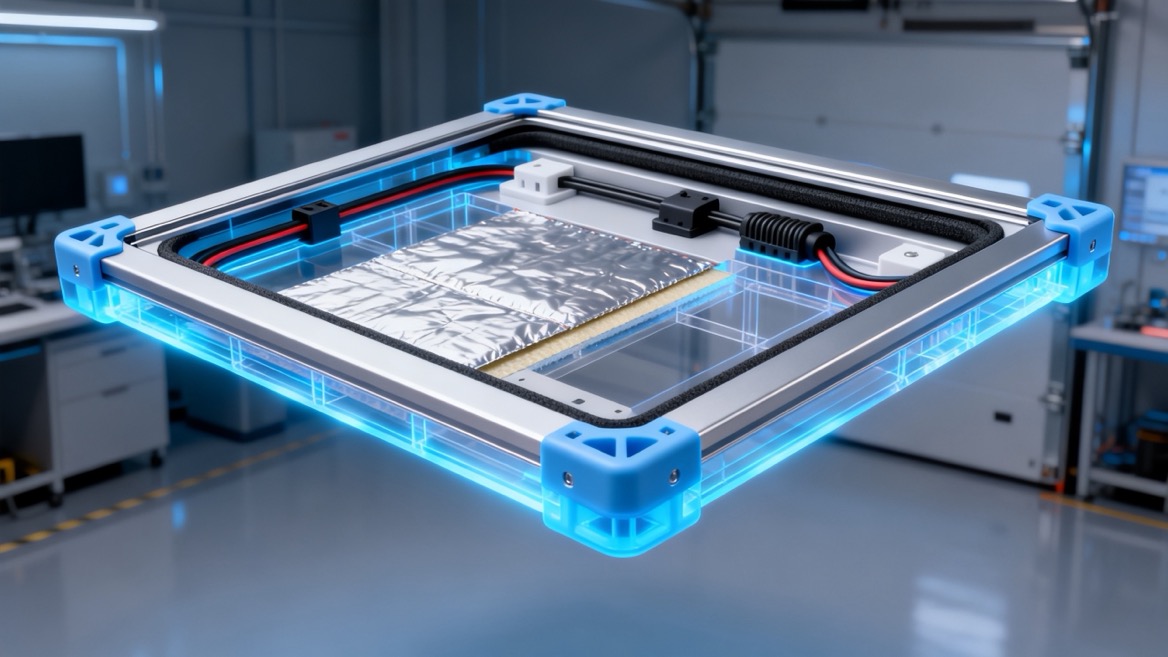
Low-temperature cure powder coating is generally the stronger option when the product is already assembled and cannot be exposed safely to standard high-bake temperatures.
- Thermal-break aluminum doors and windows: Plastic insulating strips, gaskets, and accessories can be vulnerable to high-temperature exposure
- New-energy vehicle components: Lightweight mixed-material assemblies may contain plastic clips, protective covers, seals, wiring, or adhesive-bonded elements
- Medical equipment: Surface finish requirements are high, while polymer fittings, labels, handles, and cable systems may limit cure temperature
- Electrical enclosures: Internal plastic components and electrical insulation may make high-temperature curing impractical
- Consumer hardware: Pre-installed plastic decorative pieces can be protected from distortion or color change
- Aluminum-plastic furniture and equipment frames: Components may be difficult or expensive to disassemble before coating
A 130°C system may also create operational advantages when a production line handles multiple part types. Instead of separating metal-only and mixed-material products into different finishing routes, a properly validated low-temperature powder coating process can help consolidate production.
Standard 180°C powder remains the preferred choice when the part is entirely metallic or when all assembly components have been confirmed to withstand the cure schedule.
It is particularly appropriate for:
- Architectural aluminum profiles coated before final assembly
- Aluminum panels without heat-sensitive inserts
- Steel hardware and brackets
- Metal appliance components
- Metal electrical housings before internal assembly
- Industrial equipment frames
- Metal medical-device structures prior to installation of plastics and electronics
- Components requiring a coating formulation available only in a standard cure range
For these parts, 180°C curing may deliver efficient flow, predictable coating performance, and easy integration into existing production processes.
The important point is that a standard cure coating should be selected because it fits the part and process—not simply because it is familiar.
Lower cure temperature can reduce the amount of energy needed to heat oven air, oven walls, exhaust air, hangers, fixtures, and workpieces. Low-bake powder technologies are often promoted for their potential to reduce energy use and associated emissions compared with conventional higher-temperature cure systems.
However, a 130°C cure does not automatically guarantee a lower total energy cost.
- Oven insulation quality
- Oven length and chamber volume
- Burner or electric heating efficiency
- Exhaust rate
- Conveyor speed
- Product mass
- Fixture mass
- Production loading density
- Start-stop frequency
- Air leakage
- Heat-recovery systems
- Required dwell time at 130°C compared with 180°C
For example, if a 130°C powder requires a very long dwell time, the line may need a slower conveyor speed or a longer oven. In some situations, this can offset part of the energy advantage. Conversely, if the low-temperature coating reaches full cure rapidly and enables faster throughput, the operational benefit can be substantial.
A meaningful comparison should therefore calculate energy per coated square meter or energy per finished part, rather than comparing oven setpoints alone.
Low-temperature powder coating requires disciplined process validation. The coating should not be approved solely because it looks smooth and glossy after leaving the oven.
1. Confirm assembly material limits
Obtain temperature limits from suppliers for plastics, adhesives, seals, wires, labels, and other non-metal components.
2. Define the coating requirement
Clarify whether the product needs indoor durability, exterior durability, corrosion protection, chemical resistance, electrical insulation, antimicrobial performance, or a decorative finish.
3. Select the correct powder chemistry
Match the powder system to the target application. Exterior aluminum components may require a different chemistry and weathering level than indoor electrical hardware.
4. Run temperature profiling
Use a data logger and thermocouples on representative aluminum and plastic locations. Record the full heating and cooling cycle.
5. Verify film thickness
Measure dry-film thickness on representative areas. Excessive film thickness can affect appearance, edge coverage, cure behavior, and material cost.
6. Test the cured coating
Use appropriate checks such as adhesion, impact resistance, hardness, bend resistance, solvent resistance, gloss, color, corrosion resistance, and weathering where required.
7. Inspect assembly function
Check door movement, clips, seals, electrical connections, dimensional fit, adhesive integrity, and visual condition of plastic components.
8. Document the approved process window
Record powder batch, pretreatment method, spray settings, film thickness, oven profile, production speed, inspection results, and corrective actions.
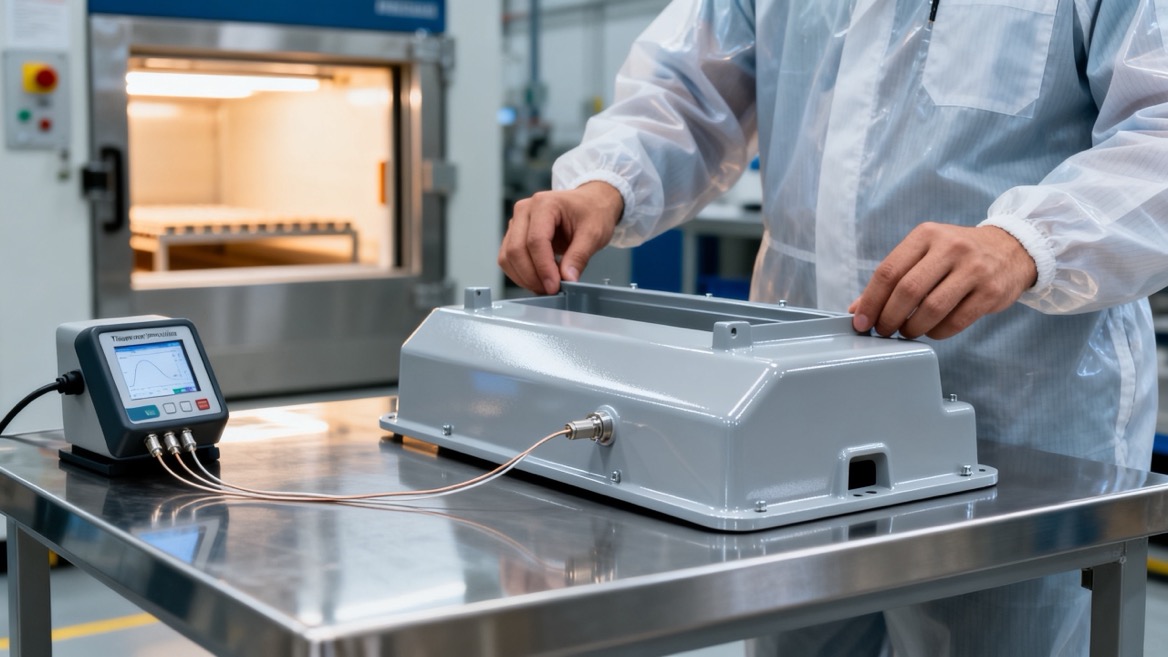
From an engineering viewpoint, the goal is not to choose the lowest possible curing temperature. The goal is to select the lowest validated temperature that delivers complete cure and protects the full assembly.
A poorly selected 130°C powder can produce under-cure. A poorly controlled 180°C process can damage the assembled component. Both failures can be expensive.
The best process is the one that balances:
- Coating durability
- Assembly safety
- Product appearance
- Production efficiency
- Energy performance
- Regulatory and customer requirements
- Long-term field reliability
For high-value aluminum-plastic components, it is often more cost-effective to perform complete cure and compatibility validation early than to manage later failures involving peeling, cracking, discoloration, seal damage, dimensional instability, or customer returns.
Yinda Technology develops and manufactures powder coatings and environmentally responsible material solutions for industrial applications. With operations in China, Indonesia, and Saudi Arabia, we support customers serving architectural aluminum, doors and windows, new-energy vehicles, medical equipment, hardware, electrical products, and other demanding sectors.
For assembled aluminum-plastic components, our technical approach begins with the real part—not a generic oven recipe. We assess the substrate, assembly design, performance target, application method, line conditions, and cure limitations before recommending a suitable powder coating solution.
Whether your product needs a low-temperature cure powder around 130°C or a conventional 180°C powder coating system, the priority is the same: a stable process and a durable finish that protects the product throughout its service life.
Contact Yinda Technology to discuss your assembled aluminum-plastic component, share your cure limitations, and arrange a coating-selection and process-validation review.
Yes, specially formulated low-temperature cure powders can fully cure at around 130°C when the required metal temperature, hold time, film thickness, and formulation-specific cure window are achieved. The exact schedule must follow the powder supplier's technical data and be confirmed through testing.
It can be suitable for heat-sensitive assemblies, but not every plastic can tolerate 130°C. The part must be evaluated based on plastic type, thickness, stress condition, exposure time, assembly design, and proximity to heat sources within the oven.
No. Coating strength depends on the chemistry, complete cure, pretreatment, film thickness, application quality, and end-use requirement. A fully cured, correctly selected 130°C coating can perform very well. An under-cured 180°C coating can fail.
Oven temperature is the air temperature inside the oven. Part temperature is the actual temperature reached by the coated component. Powder curing should be controlled using the real part-temperature profile and required dwell time, not oven setpoint alone.
Potentially, yes. Lower operating temperature can reduce heating demand, but actual savings depend on oven efficiency, dwell time, line speed, product mass, loading rate, exhaust volume, and production schedule.
Potential problems include plastic deformation, shrinkage, discoloration, loss of mechanical strength, seal damage, adhesive failure, label damage, cable-insulation degradation, and assembly misalignment.
It depends on the assembly materials and product design. If plastics, seals, adhesives, or electronics cannot tolerate the cure cycle, coating aluminum components before final assembly may be preferable. If disassembly is impractical, a validated low-temperature powder system may be the better solution.
1. [PPG: Low-Bake Powder Coatings—Efficiency and Sustainability Benefits]
2. [PPG: Short-Cure, Ultra-Durable Powder Coating for Improved Line Speed]
3. [ChemQuest: Low-Temperature Cure Powder Coating Technology Concepts]
4. [QUALICOAT: Specifications for Coaters and Powder Coating Materials]
5. [QUALICOAT Specifications 2024 PDF]
6. [Powder Coated Tough: Emerging Trends in Powder Coating Technology]


