Language


Views: 222 Author: Yinda Powder Coating Publish Time: 2026-06-15 Origin: Site


Content Menu
● Understanding Offshore Powder Coating Demands
● Epoxy‑Polyester Hybrid Powder Coatings: Fundamentals
● Pure Epoxy Industrial Powder Coatings: Fundamentals
● Hybrid vs. Pure Epoxy: Offshore‑Relevant Performance
>> Offshore Performance Dimensions
● Offshore Scenario 1: Topsides and Semi‑Exposed Equipment
● Offshore Scenario 2: Subsea and Splash Zone Protection
● Expert Insight: Balancing System Design vs. Single‑Layer Choice
● Process Considerations: Surface Preparation and Application
● Environmental and Regulatory Perspective
● Case‑Style Illustration: Offshore OEM Decision Path
● Practical Selection Framework for Offshore Projects
● How a Global Powder Coating Supplier Can Add Value
● Action Steps for Engineers and Buyers
● Frequently Asked Questions (FAQ)
Offshore equipment manufacturers and asset owners increasingly face a strategic choice: epoxy‑polyester hybrid powder coatings or pure epoxy powder coatings for long‑term corrosion protection in harsh marine environments. Both systems deliver robust performance, but they differ in chemistry, durability profile, lifecycle cost, and offshore application suitability, which makes a structured comparison essential for critical decisions. [kgecoating]
Offshore structures and equipment—such as wind turbines, drilling platforms, subsea frames, and coastal energy infrastructure—operate in environments where salt spray, UV exposure, mechanical impact, and temperature cycling combine to accelerate coating failure. These conditions make coating selection far more demanding than standard industrial or indoor applications. [marketresearchintellect]
Offshore asset owners typically aim to:
- Extend inspection and maintenance intervals
- Minimize unplanned shutdowns and corrosion‑related failures
- Comply with regional and international environmental and safety regulations
In this context, powder coatings offer a VOC‑free, high‑efficiency, and highly controllable finishing solution compared with solventborne systems, making them attractive for global offshore supply chains. [evercoatings.en.made-in-china]
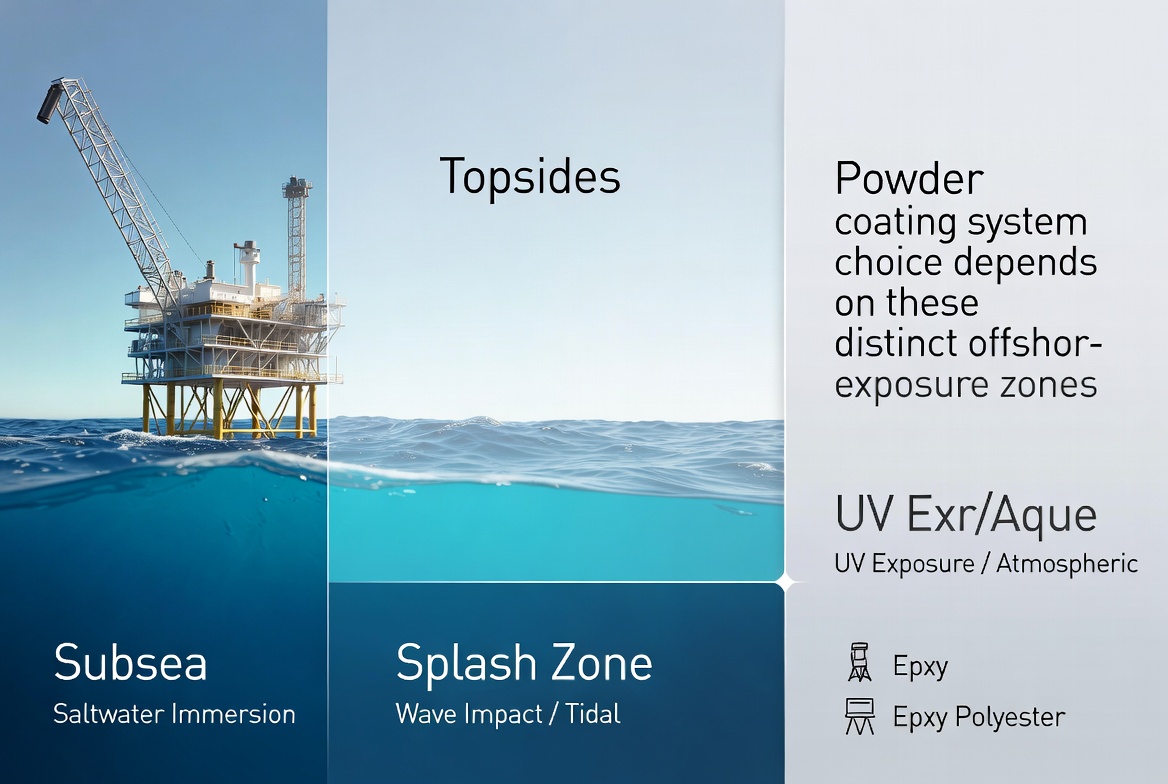
Epoxy‑polyester hybrid powder coatings blend epoxy resins with polyester resins to optimize mechanical and aesthetic performance while achieving better weathering stability than pure indoor epoxies. The epoxy component provides strong chemical resistance and adhesion, while the polyester portion contributes improved UV resistance and gloss retention. [dameipc]
Key characteristics of epoxy‑polyester hybrids include:
- Balanced mechanical properties such as impact resistance and flexibility
- Good chemical and solvent resistance suitable for many industrial environments
- Enhanced decorative appearance with a wide color and gloss range, often used on appliances, tools, cabinets, and metal furniture
These hybrids are widely used for indoor and semi‑outdoor applications, although they may still have limitations under long‑term, direct UV exposure typical of offshore topside structures. [huacaipowdercoating]
Pure epoxy powder coatings are based on epoxy resins cured with suitable hardeners, forming a dense, crosslinked network with high chemical and corrosion resistance. They are often used as functional, protective layers rather than purely decorative finishes. [huacaipowdercoating]
Their main attributes include:
- Excellent adhesion and barrier properties on properly prepared steel and other metals
- Outstanding resistance to chemicals, moisture, and salt environments, especially for immersion or splash zones
- Common usage in pipeline coatings, valves, fittings, and reinforcement bars (rebar), including fusion‑bonded epoxy and related technologies for infrastructure. [marketresearchintellect]
The main trade‑off is that pure epoxies generally exhibit lower UV resistance, leading to chalking and color changes when exposed to sunlight over time. [huacaipowdercoating]
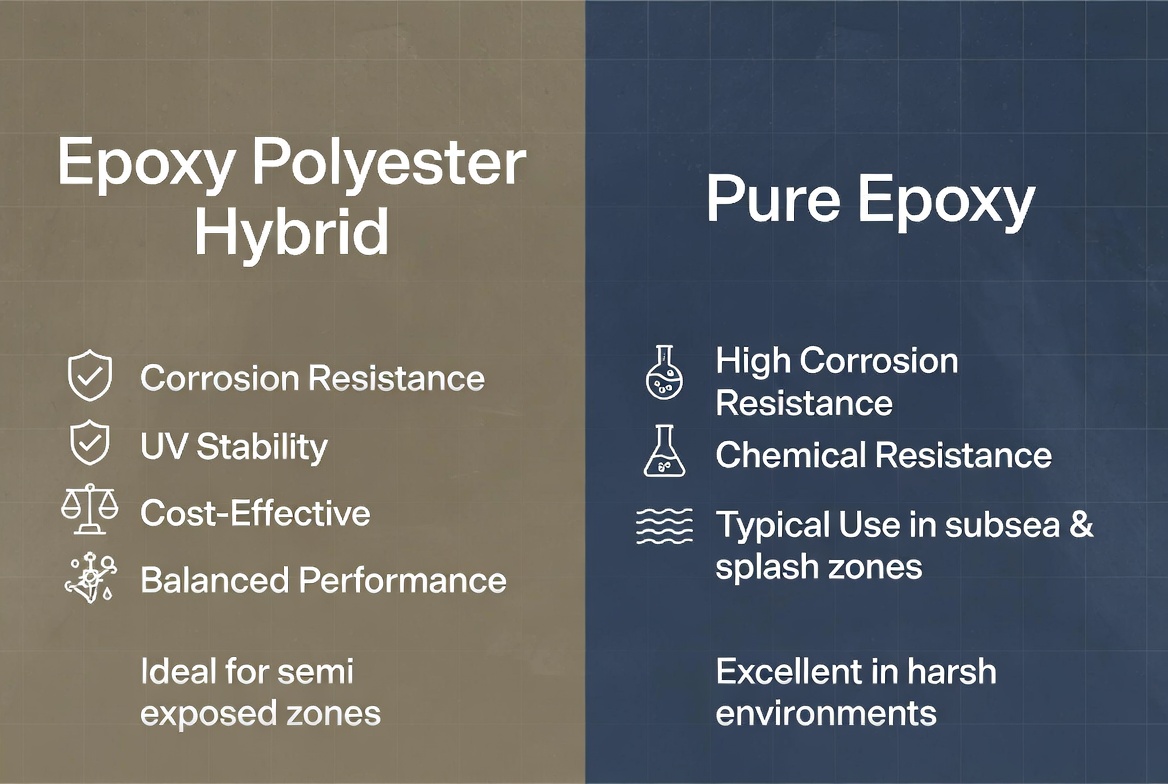
The following table summarizes core performance dimensions relevant to offshore equipment protection:
| Dimension | Epoxy‑Polyester Hybrid | Pure Epoxy Powder |
|---|---|---|
| Corrosion resistance in salt spray | Strong, but typically optimized for indoor/semi‑outdoor and industrial environments. (kgecoating) | Very high corrosion resistance, especially in immersion, splash zones, and high‑chloride environments. (marketresearchintellect) |
| UV and weathering | Better UV stability than pure epoxies; suitable for semi‑outdoor exposure, though not as durable as pure outdoor polyesters. (kgecoating) | Limited UV resistance; chalking occurs under direct sunlight, often requiring a topcoat for long‑term aesthetics. (huacaipowdercoating) |
| Mechanical toughness | Good impact and abrasion resistance; often optimized for appliances and equipment casings. (dameipc) | High adhesion and cohesive strength; excellent under mechanical load but can be more brittle in some formulations. (huacaipowdercoating) |
| Typical usage | Indoor/offshore accommodation modules, control cabinets, shelters, semi‑exposed components. (dameipc) | Subsea structures, pipelines, manifolds, risers, brackets, and high‑corrosion risk zones. (marketresearchintellect) |
| Finish and aesthetics | Wide range of colors, gloss levels, and textures; strong decorative performance. (kgecoating) | Functional appearance, often single‑color and matte/semi‑gloss; aesthetics are secondary. (huacaipowdercoating) |
| Lifecycle maintenance | Balanced; may require more frequent touch‑up in aggressive marine zones compared to specialized epoxy systems. (marketresearchintellect) | Longer corrosion‑free intervals in immersed or highly corrosive areas; often used as a base layer in multi‑coat systems. (marketresearchintellect) |
For topsides equipment—such as handrails, platforms, electrical enclosures, doors, windows, and access systems—coatings must face continuous salt‑laden air and strong UV radiation. In these scenarios, epoxy‑polyester hybrids can play a significant role when carefully engineered and paired with appropriate pretreatment. [marketresearchintellect]
Practical considerations:
- When hybrids fit: For components in semi‑sheltered positions, such as offshore accommodation modules, control rooms, or sheltered platforms, hybrids offer a good combination of durability and appearance. [dameipc]
- Aesthetic requirements: Where brand colors, gloss, and appearance matter (e.g., offshore OEM equipment delivered to energy operators), hybrid systems allow consistent visual identity with strong industrial durability. [evercoatings.en.made-in-china]
However, in continuously sun‑exposed and high‑salt spray conditions, hybrid systems may still require periodic inspection and potential recoating depending on specification, film thickness, and maintenance strategy. [marketresearchintellect]
The splash zone and subsea areas—including risers, subsea frames, clamps, manifolds, and brackets—experience constant wetting and drying, chlorides, and potential impact from debris. In these areas, pure epoxy powder systems (or fusion‑bonded epoxies and related epoxy powders) remain a leading option. [marketresearchintellect]
Key reasons pure epoxy excels here:
- Dense crosslinked structure provides robust resistance to water ingress and chloride penetration. [huacaipowdercoating]
- Proven track record in pipelines, rebar, and subsea hardware across global infrastructure projects. [marketresearchintellect]
Designers often specify pure epoxy layers with high film thickness and sometimes combine them with other topcoats in multi‑layer systems to enhance long‑term durability.
From an industrial powder coating strategist's perspective, the question is rarely just "hybrid vs. pure epoxy", but rather "single‑layer vs. system design" tailored to specific offshore risk profiles. Industry practice increasingly uses multi‑layer approaches, for example:
- Pure epoxy basecoat + polyester or hybrid topcoat, combining strong corrosion barrier with UV‑stable finishes. [huacaipowdercoating]
- Hybrid stand‑alone systems for moderate‑risk areas where maintenance access is easy and aesthetic demands are high. [kgecoating]
This mindset aligns coating selection with risk‑based inspection and lifecycle cost optimization, rather than treating coatings as commodity consumables.
Regardless of the chemistry, surface preparation is decisive for offshore performance. Poorly prepared steel or contaminated substrates will cause early failure even with the most advanced powder technology. [huacaipowdercoating]
Best‑practice process steps include:
1. Abrasive blasting or mechanical cleaning to specified cleanliness grades.
2. Chemical pretreatment (e.g., phosphating or other conversion coatings) suited to powder coating lines. [huacaipowdercoating]
3. Controlled curing parameters, ensuring full crosslinking and appropriate film thickness per technical data sheets. [evercoatings.en.made-in-china]
4. Validation by salt spray, impact, and adhesion testing under relevant international standards (for example, ISO‑related protocols cited by coating manufacturers). [evercoatings.en.made-in-china]
Ensuring these steps are consistent across multi‑site operations in China, Southeast Asia, and the Middle East helps global manufacturers maintain uniform performance and customer trust.
Both epoxy‑polyester hybrids and pure epoxy powder coatings support low‑VOC, high‑transfer efficiency processes, aligning with expanding environmental regulations targeting solvent emissions. Powder coatings help offshore OEMs and fabricators meet or exceed regional environmental standards while maintaining productivity. [evercoatings.en.made-in-china]
In markets such as Asia‑Pacific and the Middle East, energy and infrastructure operators increasingly request eco‑friendly and energy‑efficient finishing solutions, pushing manufacturers toward advanced powder systems rather than legacy solventborne technologies. This trend supports long‑term growth for high‑performance powder coating solutions in offshore supply chains. [pdf.dfcfw]
Consider a global OEM producing modular offshore equipment, with fabrication and coating facilities in China, Indonesia, and Saudi Arabia. They supply equipment for offshore wind and oil & gas projects, where equipment is exposed to varying degrees of salt spray and sunlight.
Their decision path often includes:
- Step 1 – Define exposure zones: Subsea, splash, topside, sheltered modules.
- Step 2 – Assign performance targets: Minimum years to first maintenance, aesthetic requirements, color consistency.
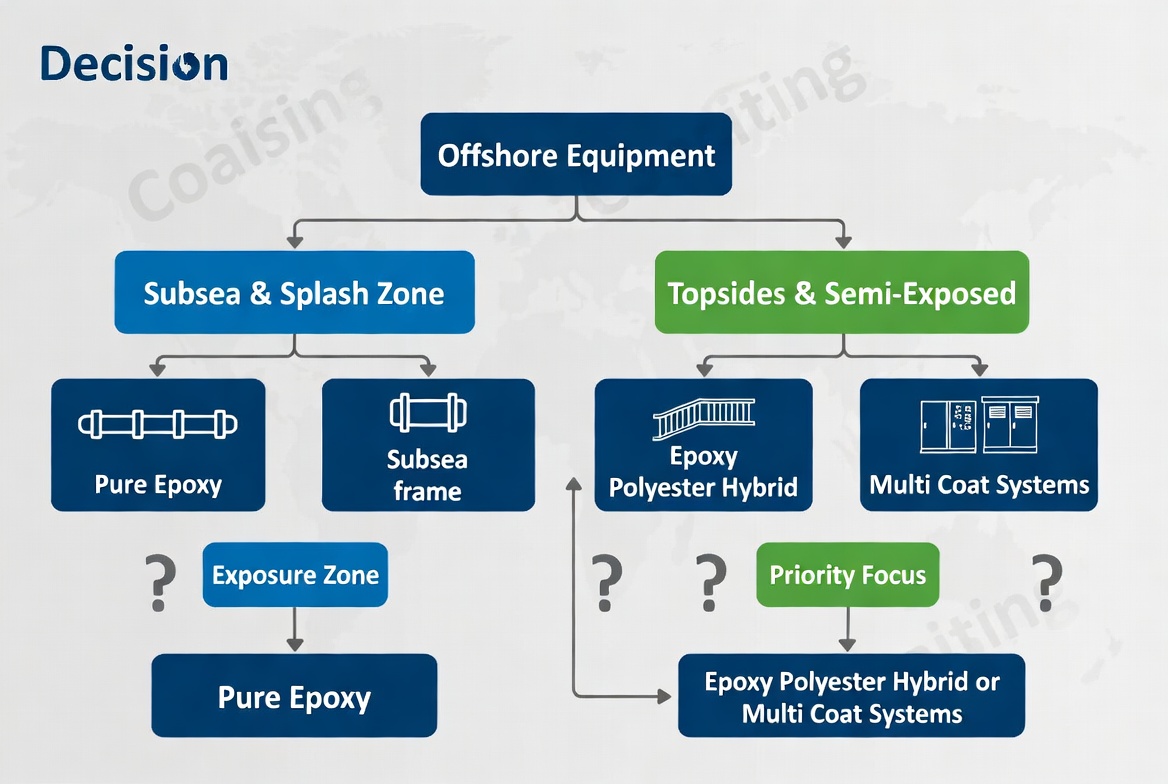
- Step 3 – Map coating options: Pure epoxy for subsea/splash areas; hybrid systems or multi‑coat structures for topside; hybrids or polyester for shelters and accommodation modules. [marketresearchintellect]
- Step 4 – Align across regions: Standardizing specifications so that coating lines in different countries deliver comparable performance and appearance.
By aligning product portfolios and technical support across regions, powder coating manufacturers can help such OEMs shorten qualification cycles, reduce rework, and ensure consistent offshore performance.
To support procurement and engineering teams, the following simple framework helps in choosing between epoxy‑polyester hybrids and pure epoxy powder coatings for offshore equipment:
- Choose pure epoxy when:
- Equipment is in subsea or continuous splash zones.
- Corrosion risk is critical, and aesthetics are secondary.
- Long maintenance intervals and structural integrity are top priorities.
- Choose epoxy‑polyester hybrid when:
- Equipment is in semi‑exposed or sheltered topside locations.
- Both appearance and durability matter.
- There is a need to balance cost, performance, and visual branding.
- Consider multi‑coat systems when:
- There is long‑term topside exposure with strong UV.
- Projects demand high gloss retention and color stability over decades.
A powder coating manufacturer specializing in R&D, environmentally friendly materials, and energy‑saving technologies across multiple regions can provide added value beyond simply supplying powder. By integrating technical consultation, localized service, and application guidance, such a manufacturer helps offshore customers reduce risk and enhance performance. [pdf.dfcfw]
Key value contributions include:
- Co‑developing custom epoxy‑polyester hybrid and pure epoxy formulas tailored to offshore exposure conditions.
- Providing on‑site technical support and process audits in different countries to stabilize coating quality.
- Offering testing data, certifications, and documentation that support project approvals and global operator standards. [pdf.dfcfw]
To translate this comparison into practical procurement and engineering decisions:
1. Map your equipment portfolio by exposure zone and risk level.
2. Review existing coating performance history, noting failure modes and maintenance intervals.
3. Consult with your powder supplier to refine hybrid and pure epoxy options based on specific offshore environments and standards. [huacaipowdercoating]
4. Standardize specifications across fabrication sites to ensure consistent offshore performance and appearance.
A structured, data‑driven approach ensures that your coating selection supports both operational reliability and sustainable, low‑emission finishing practices.
1. Is an epoxy‑polyester hybrid powder coating suitable for all offshore applications?
Epoxy‑polyester hybrids provide strong performance in semi‑exposed and sheltered offshore environments, but they may not fully replace dedicated pure epoxy systems in high‑corrosion subsea or splash zones. [kgecoating]
2. Why are pure epoxy powder coatings still widely used for subsea equipment?
Pure epoxy systems deliver excellent adhesion, barrier properties, and resistance to water and chloride ingress, which are critical for subsea and splash‑zone service life. [marketresearchintellect]
3. Can we improve UV resistance of pure epoxy powder coatings?
Pure epoxy layers are often combined with UV‑stable topcoats, such as polyester or hybrid layers, to enhance gloss and color retention while maintaining core corrosion protection. [huacaipowdercoating]
4. How do environmental regulations influence powder coating selection for offshore projects?
Tightening VOC and emission regulations encourage adoption of powder coatings, which provide high transfer efficiency and low emissions compared with solventborne systems. [evercoatings.en.made-in-china]
5. What role does surface preparation play in offshore powder coating performance?
Surface preparation is decisive; inadequate cleaning or pretreatment can lead to early coating failure regardless of whether a hybrid or pure epoxy system is used. [marketresearchintellect]
1. KGE Coating – “环氧聚酯粉末涂料:工业用途完整指南 (Epoxy‑Polyester Powder Coating: Industrial Uses Guide)”. https://www.kgecoating.com/zh-CN/epoxy-polyester-powder-use/
2. Huacai Powder Coating – “What Are the Different Types of Powder Coatings (e.g., Epoxy, Epoxy‑Polyester Hybrid)”. https://www.huacaipowdercoating.com/news/what-are-the-different-types-of-powder-coatings-e-g-epoxy-polyester-hybrid.html
3. Damei Powder Coating – “Indoor Epoxy‑Polyester Powder Coating”. https://dameipc.com/indoor-epoxy-polyester-powder-coating/
4. Ever Coatings – “High‑Performance Epoxy Polyester Powder Coating for Industrial Applications”. https://evercoatings.en.made-in-china.com/product/WTaRBkZHAIhs
5. Market Research Intellect – “The Future of Protection: Exploring Fusion Bonded Epoxy Powder Coating”. https://www.marketresearchintellect.com/zh/blog/the-future-of-protection-exploring-fusion-bonded-epoxy-powder-coating/
6. 东方财富研究报告 – “工业涂料芯技术,国产替代迈向蓝海 (Industrial Coatings Core Technologies Report)”. https://pdf.dfcfw.com/pdf/H3_AP202312111613716292_1.pdf


