Language


Views: 222 Author: Yinda Powder Coating Publish Time: 2026-06-12 Origin: Site


Content Menu
● Why Film Thickness Is Mission-Critical
● Understanding Powder Coating Film Thickness
● Measuring Powder Coating Film Thickness: Tools and Methods
● The Impact of Under‑ and Over‑Thickness
● Key Process Factors Affecting Film Thickness
● Industry Standards and Quality Control Frameworks
● New Market Dynamics: Why Thickness Control Matters Even More Today
● Step‑by‑Step: Building a Film Thickness Quality Control Routine
● Practical Example: Yinda Technology's Multi‑Region Perspective
● Advanced Section: Integrating Data and Industry 4.0 into Thickness Control
● Sustainability, VOC Regulations, and Film Thickness
● Choosing the Right Powder and Partner for Critical Film Thickness Control
● Best Practices Checklist for Powder Coating Film Thickness Quality Control
● Call to Action: Partner with a Film Thickness–Focused Powder Coating Expert
● FAQs on Powder Coating Film Thickness and Quality Control
Getting powder coating film thickness right is one of the most critical levers you can pull to improve durability, corrosion resistance, and overall finish quality in industrial applications. From my experience working with OEMs and coaters across Asia and the Middle East, the most reliable plants are those that treat film thickness as a disciplined, data-driven quality metric—not a rough visual guess. [tiger-coatings]
Film thickness is the bridge between formulation, process, and long-term performance. If you undercoat, you expose bare metal and compromise corrosion resistance; if you overcoat, you increase cost, risk orange peel, and may fail dimensional or fit requirements. [greatdanepowdercoating]
Industry practice generally targets a dry film thickness in the range of 2–3 mils (approximately 50–75 microns) for many architectural and industrial applications, balancing coverage, impact resistance, and appearance. The exact specification, however, should always follow the product data sheet (PDS) of the powder, combined with your customer or industry standards. [tiger-coatings]
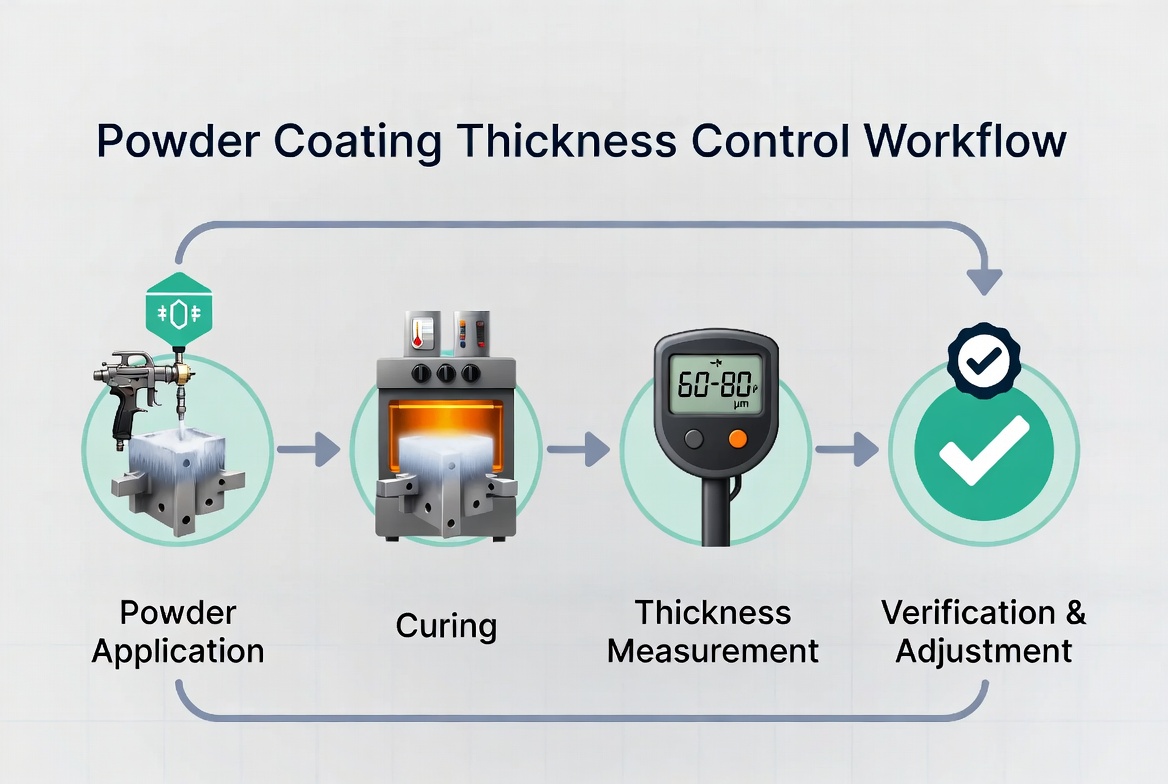
Proper film thickness is not a "nice to have"—it's an engineered parameter that directly impacts warranty claims, corrosion life, and visual consistency. [greatdanepowdercoating]
From a practical standpoint, film thickness determines:
- Corrosion resistance: Thicker films (within spec) provide a more continuous barrier, reducing pathways for moisture and salts. [tiger-coatings]
- Mechanical performance: Impact resistance, flexibility, and chip resistance are all sensitive to under- or over-thickness. [greatdanepowdercoating]
- Aesthetic quality: Gloss, texture definition, and color uniformity can shift when the film is far from the recommended range. [tiger-coatings]
Most reputable powder coating producers recommend minimum dry film thickness of 2.5–3.0 mils for standard industrial and architectural systems, but complex profiles or harsh environments may require different targets. [greatdanepowdercoating]
You cannot control what you don't measure. Reliable film thickness measurement is the foundation of quality control. [tiger-coatings]
Common measurement approaches include:
- Dry film thickness (DFT) gauges
- Magnetic or eddy current gauges for ferrous and non-ferrous substrates
- Used after curing to verify final thickness on production parts [greatdanepowdercoating]
- In-process checks using test panels
- Coated and cured alongside real parts
- Measured repeatedly to confirm that spray parameters and oven conditions are stable [premiumpowdercoating]
- Cross-section checks in lab environments
- Microscopy or destructive testing on cut sections for critical projects
- Used to validate new lines, new substrates, or new powder systems [premiumpowdercoating]
A best-practice industrial strategy is to combine routine DFT checks on parts with standardized test panels and documented acceptance ranges for each product family. [premiumpowdercoating]
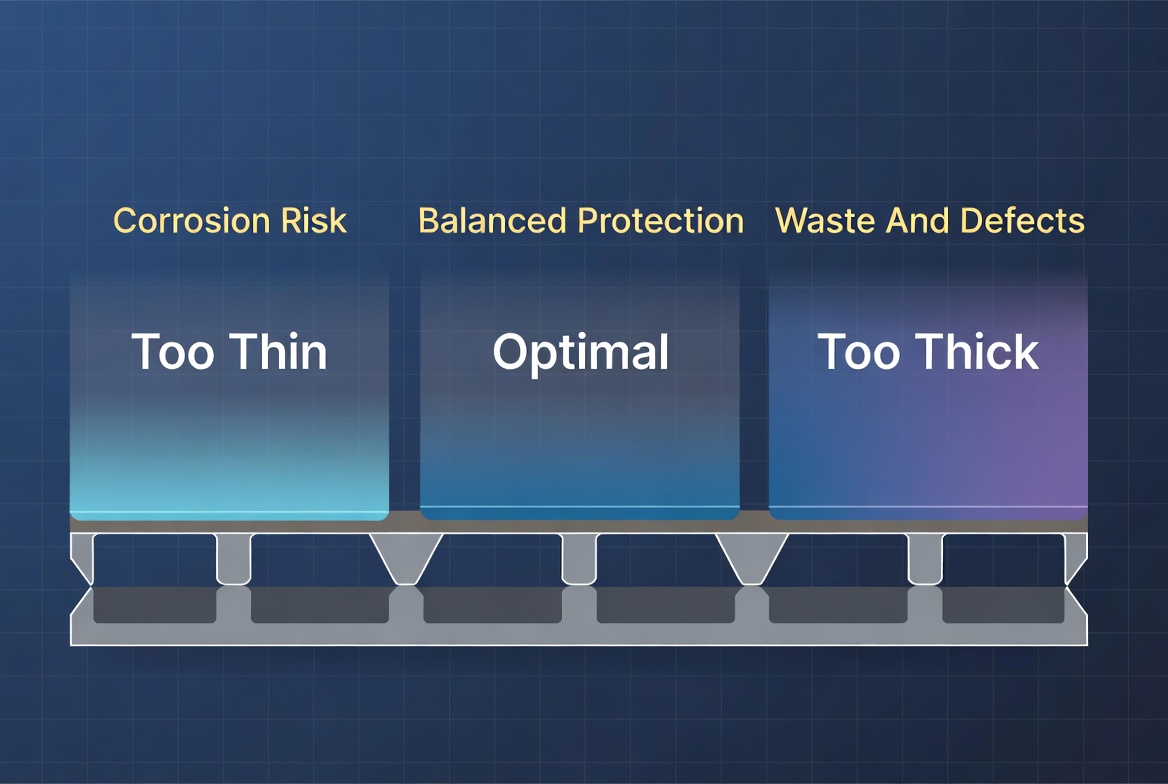
The risk profile is different at each end of the spectrum—but both are costly.
Risks of under-thickness (too thin): [tiger-coatings]
- Visible defects such as shadows, poor edge coverage, or exposed substrate
- Poor corrosion resistance and early blistering or rust, especially in outdoor or marine environments
- Reduced impact and abrasion resistance
Risks of over-thickness (too thick): [greatdanepowdercoating]
- Orange peel, poor levelling, or loss of design texture
- Increased risk of chipping or cracking, especially on edges
- Potential fit problems on tight-tolerance assemblies and higher powder consumption (direct cost impact)
This is why high-performing plants implement tight film thickness windows and link them to visual standards, adhesion test results, and corrosion performance data. [premiumpowdercoating]
Film thickness is the outcome of the entire powder coating process, not just the spray gun settings. [premiumpowdercoating]
Major drivers include:
- Powder type and formulation
Different chemistries and particle-size distributions fluidize and deposit differently, even at the same settings. [giiresearch]
- Spray gun settings
- Voltage and microamp settings control the electrostatic attraction.
- Powder flow and atomizing air influence deposition rate and film build. [premiumpowdercoating]
- Line speed and gun-to-part distance
- Faster line speed typically reduces film build; slower speed increases it.
- Incorrect gun distance can cause uneven coverage or back ionization. [premiumpowdercoating]
- Part geometry and grounding
- Deep recesses, sharp edges, and Faraday cage areas are prone to low film build.
- Poor grounding reduces transfer efficiency and creates inconsistent thickness. [premiumpowdercoating]
- Substrate pre-treatment
While pretreatment does not change nominal thickness, contamination or poor conversion coating can lead to rejects even at correct film thickness. [premiumpowdercoating]
Leading industrial coaters and OEMs rely on recognized standards to define and verify film thickness and coating performance. [premiumpowdercoating]
Common references include:
- ASTM D1186 / D7091 for non-destructive dry film thickness measurement on ferrous and non-ferrous metals
- ASTM D3359 for adhesion testing (cross-hatch) [premiumpowdercoating]
- ASTM B117 for salt spray corrosion resistance in lab testing [premiumpowdercoating]
- ISO standards for gloss, color, and appearance in architectural and automotive segments [premiumpowdercoating]
Aligning your internal quality control procedures with these standards delivers auditable, globally recognizable benchmarks—especially important when exporting to Europe, the Middle East, and Southeast Asia.
The global powder coatings market continues to grow strongly, driven by construction, automotive, appliances, and new energy applications. Market size is projected to move from around 20–22 billion USD in the mid‑2020s to well over 24–30 billion USD in the early 2030s, supported by demand for durable, low‑VOC finishes and EV-related components. [coherentmarketinsights]
At the same time:
- Sustainability pressures are pushing more customers toward solvent‑free, low‑VOC powder systems. [echemi]
- Tariffs and supply chain volatility are increasing pressure on cost efficiency and yield, making rework from thickness defects more expensive. [giiresearch]
In this environment, film thickness optimization is not just a technical topic—it's a strategic lever for cost, compliance, and brand differentiation. [coherentmarketinsights]
To translate best practice into daily operations, industrial coaters can implement a simple but robust routine:
1. Define thickness targets by product family
- Use powder supplier product data sheets as the baseline. [tiger-coatings]
- Differentiate between architectural aluminum, NEV parts, medical devices, and hardware based on environment and performance expectations.
2. Standardize measurement tools and locations
- Select appropriate DFT gauges for your substrates. [greatdanepowdercoating]
- Define measurement points on sample parts (edges, recesses, flat areas) so readings are consistent.
3. Use witness panels for every batch
- Spray and cure test panels with each load.
- Record DFT, gloss, adhesion, and visual defects as part of batch documentation. [premiumpowdercoating]
4. Control spray and oven parameters
- Calibrate electrostatic guns, check powder flow, and verify booth and hopper conditions. [premiumpowdercoating]
- Perform oven temperature mapping and use data loggers to validate cure profiles. [premiumpowdercoating]
5. Create feedback loops
- If panels or parts drift away from target thickness, adjust gun settings, line speed, or part presentation.
- Document corrective actions to build a continuous improvement database. [premiumpowdercoating]
As a powder coating manufacturer with operations in China, Indonesia, and Saudi Arabia, Yinda Technology works with customers across diverse climates and regulatory environments. [yinda-global]
For example:
- Architectural aluminum and door/window systems in hot, humid climates require consistent film build to protect against UV, temperature cycling, and atmospheric pollutants. [giiresearch]
- New energy vehicle components demand precise thickness control to ensure both corrosion resistance and tight dimensional tolerances. [coherentmarketinsights]
- Medical equipment, hardware, and electrical appliances often need a combination of smooth appearance, easy cleaning, and resistance to disinfectants—again highly sensitive to coating thickness and cure conditions. [greatdanepowdercoating]
By combining local technical support in each region with centralized R&D, a manufacturer like Yinda can help customers tailor their film thickness windows, pre-treatment systems, and QC routines to their specific application and local standards. [made-in-china]
Forward‑looking plants are no longer satisfied with manual thickness checks a few times per shift. They are moving toward connected, data‑driven quality control. [giiresearch]
Emerging practices include:
- Real‑time data logging from DFT gauges and oven sensors
- Measurements are uploaded directly to a central system, creating traceable records. [giiresearch]
- Statistical process control (SPC)
- Thickness data is charted over time to detect drift before it becomes non‑conformance. [giiresearch]
- Integration with MES/ERP systems
- Film thickness, cure data, and visual inspection results are linked to batch, customer, and product IDs for full traceability. [giiresearch]
This kind of digital backbone supports faster root‑cause analysis, better customer reporting, and easier certification audits for global OEMs.
One of the reasons powder coating is gaining share over liquid coatings is its very low volatile organic compound (VOC) emissions and high material utilization. [echemi]
However, poor thickness control can undermine these advantages:
- Excess film build directly increases powder consumption per part and overall carbon footprint. [coherentmarketinsights]
- Over‑thickness can raise rework rates, adding extra energy usage for blasting, re‑coating, and re‑curing. [premiumpowdercoating]
Conversely, well‑controlled film thickness:
- Maximizes first‑pass yield, reducing scrap and rework. [premiumpowdercoating]
- Supports green building and sustainability certifications by demonstrating consistent, efficient use of materials. [echemi]
For procurement teams sourcing powder coatings and coating services, thickness control metrics are now part of supplier audits and sustainability scorecards. [echemi]
Selecting the right powder coating supplier and technical partner is just as important as your internal process control.
Key criteria to evaluate:
- Technical data and support
- Clear, application‑specific PDS with recommended thickness ranges. [tiger-coatings]
- Access to technical engineers who can help optimize line settings and pre-treatment. [yinda-global]
- Application case history
- Proven performance in architectural, NEV, medical, hardware, and electrical appliance applications similar to yours. [yinda-global]
- Regional presence and logistics
- For multi‑country manufacturers, partners with operations and subsidiaries in key markets (e.g., China, Indonesia, Saudi Arabia) help reduce lead times and improve on-site support. [made-in-china]
- Commitment to sustainability and innovation
- Development of low‑VOC, high‑durability, and advanced metallic powder systems that maintain performance within tight film thickness windows. [coherentmarketinsights]
A manufacturer like Yinda Technology, for instance, combines global application experience with localized technical support, enabling customers to design film thickness strategies that match both performance and cost objectives. [made-in-china]

Use this as a quick internal audit tool for your plant:
- Clear thickness specifications for each product and customer
- Calibrated DFT gauges suitable for your substrates
- Defined measurement points and sampling frequency
- Test panels run and documented with each batch
- Gun settings and line speed recipes for each color and product type
- Oven temperature mapping and regular cure validation
- Routine adhesion, gloss, and visual inspection tied to thickness readings
- Documented corrective action process when thickness drifts beyond control limits
- Regular training for operators and QC technicians on film thickness impact and measurement
- Collaboration with your powder supplier for continuous improvement projects
Each of these items strengthens your E2E quality system and dramatically reduces the risk of coating failures in the field. [greatdanepowdercoating]
If your production lines serve demanding sectors such as architectural aluminum, NEVs, medical equipment, hardware, and electrical appliances, now is the right time to review your powder coating film thickness control strategy.
Yinda Technology brings:
- Expertise in powder coating R&D, manufacturing, and application support
- Multi‑region presence in China, Indonesia, and Saudi Arabia for faster local service
- Experience across architectural, automotive/NEV, medical, hardware, and appliance applications, with film thickness and quality control at the core of our technical support model [yinda-global]
To discuss how to improve your film thickness quality control, reduce rework, and extend coating life, you can reach our team through the contact details on our official site. [yinda-global]
1. What is the optimal powder coating film thickness for most industrial applications?
For many industrial and architectural applications, a dry film thickness of around 2–3 mils (50–75 microns) is common, but the exact target should always follow the product data sheet and customer requirements. [tiger-coatings]
2. How often should I check film thickness in a production line?
Best practice is to perform regular in‑process checks using DFT gauges on representative parts and test panels, at least once per batch or defined time intervals depending on line speed and risk level. [greatdanepowdercoating]
3. Can I rely only on visual inspection for thickness control?
No. While visual inspection is important for detecting defects, visual checks alone cannot reliably confirm film thickness. Non‑destructive DFT gauges and documented measurements are essential for quality control. [greatdanepowdercoating]
4. How does curing affect perceived film thickness and performance?
Incorrect cure can make a coating appear acceptable but weaker in adhesion, hardness, and chemical resistance, even if the measured film thickness is within target, so cure verification must be part of your QC routine. [greatdanepowdercoating]
5. Why is powder coating considered more sustainable than liquid paint, and how does thickness play a role?
Powder coatings are solvent‑free and low in VOCs, with high material utilization, making them more sustainable than many liquid systems; precise film thickness control further reduces waste, energy use, and rework. [echemi]
1. TIGER Coatings – "Powder Coating Film Thickness – Quality Control for Optimum Results"
<https://www.tiger-coatings.com/us-en/tiger-group/tiger-blog/powder-coating-film-thickness-quality-control-for-optimum-results> [tiger-coatings]
2. Great Dane Powder Coating – "Quality Control & Testing in Powder Coating Processes"
<https://greatdanepowdercoating.com/powder-coating-quality-control-testing/> [greatdanepowdercoating]
3. Premium Powder Coating – "Quality Control Best Practices in Industrial Powder Coating Plants"
<https://premiumpowdercoating.com/quality-control-best-practices-in-industrial-powder-coating-plants/> [premiumpowdercoating]
4. The Business Research Company – "Powder Coatings Global Market Report 2026"
<https://www.giiresearch.com/report/tbrc1927158-powder-coatings-global-market-report.html> [giiresearch]
5. Coherent Market Insights – "Powder Coatings Market Size, Trends & Forecast, 2026–2033"
<https://www.coherentmarketinsights.com/market-insight/powder-coatings-market-339> [coherentmarketinsights]
6. Echemi – "Coatings Trends & Technologies Summit 2026"
<https://www.echemi.com/cms/2996564.html> [echemi]
7. Yinda Technology – Company and Applications Information
<https://www.yinda-global.com/Applications-Case-ic3295126.html> [yinda-global]
<https://www.made-in-china.com/showroom/6f4b36fdadb3f5c8/> [made-in-china]


