Language


Views: 268 Author: Yinda Powder Coating Publish Time: 2026-07-16 Origin: Site


Content Menu
● Understanding the Two Technologies
● What Is Polyester Powder Coating?
● What Is Sublimation Wood Grain Film?
● How the Sublimation Process Works (Technical Overview)
● Application to Fire-Rated Commercial Aluminum Doors
● Durability and Weather Resistance
● Detailed Comparison for Commercial Doors
>> Performance Comparison Table
● Fire Rating and Safety Considerations
● Aesthetic and Branding Impact
● Process Control and Quality Risks
● Lifecycle Cost and Maintenance
● When to Prefer Polyester Powder Coating
● When to Prefer Sublimation Wood Grain Film
● Practical Selection Checklist for Project Teams
● Architectural Aluminum with Wood Grain Effect
● How a Global Powder Coating Manufacturer Can Support Projects
● FAQ
For modern fire-rated commercial aluminum doors, polyester powder coating remains the backbone for long-term protection and compliance, while sublimation wood grain film is best seen as a decorative system layered on top of a robust powder base. [riverscoating]

Fire-rated commercial aluminum doors in malls, hospitals, hotels, and transit hubs must balance life-safety performance, durability, and design consistency across large projects. From my experience working with façade and door system manufacturers, confusion often arises because wood grain "films" are sometimes discussed as if they are a fully independent coating system, when in practice they usually sit on top of a polyester powder basecoat. [nbprotectivefilm]
At a technical level, polyester powder coating is a thermosetting coating fused directly to properly pretreated aluminum, while sublimation wood grain film is a transfer process that uses heat and vacuum to drive decorative dyes into the surface of that powder film to mimic timber species like oak or walnut. [machine4aluminium]
Polyester powder coatings for architectural aluminum are thermosetting powders based on polyester resin and curing agents, applied electrostatically and baked to form a continuous, cross-linked film. [machine4aluminium]
For external doors and frames, architectural-grade polyester systems are engineered to deliver 7–15 years of color stability and film integrity under typical outdoor exposure when formulated and applied correctly, making them the "workhorse" finish for commercial aluminum doors. [machine4aluminium]
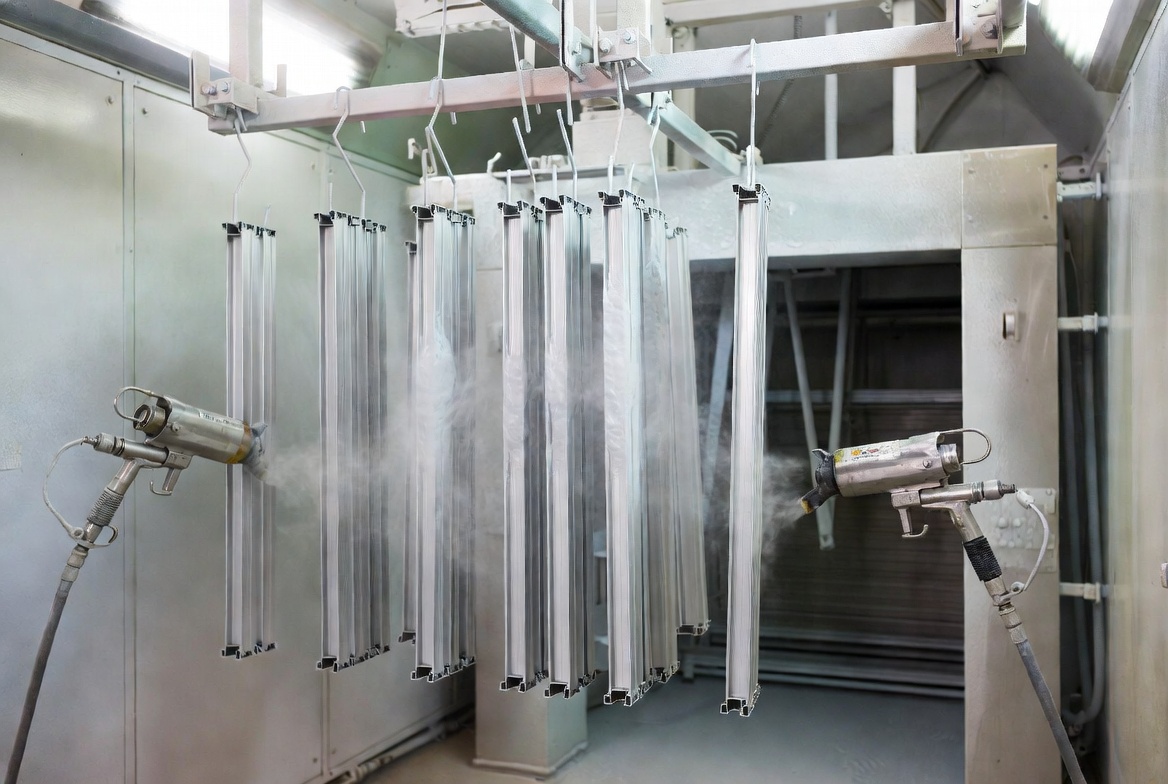
Sublimation wood grain film uses a printed transfer film and a heat–vacuum process to move dyes into a prepared powder-coated surface, generating a realistic wood pattern over the metal substrate. [nbprotectivefilm]
In architectural aluminum, this process is widely used on door profiles, window frames, louvers, and decorative components, delivering the visual warmth of wood while retaining the dimensional stability and strength of metal. [riverscoating]
From a process engineering perspective, sublimation wood grain on aluminum involves three main steps. [top-aluminium]
1. Basecoat application
A specialized transfer-printable polyester powder coating is applied at around 60–90 μm film thickness to the aluminum door profiles or panels, then fully cured. [riverscoating]
2. Wrapping with wood grain film
The printed film (showing the selected grain pattern) is wrapped tightly around the coated part, and a vacuum is applied to eliminate air gaps and achieve intimate contact. [riverscoating]
3. Heat transfer and dye penetration
Under temperatures typically around 180–200°C, the dyes in the film sublimate and diffuse into the powder coating layer, fixing the wood pattern into the coating film. [top-aluminium]
Because the pattern ends up inside the coating, rather than sitting only on the surface, the result is more durable than ordinary printing or wrapping, but the overall weathering behavior is still strongly influenced by the dyes and the basecoat formulation. [top-aluminium]
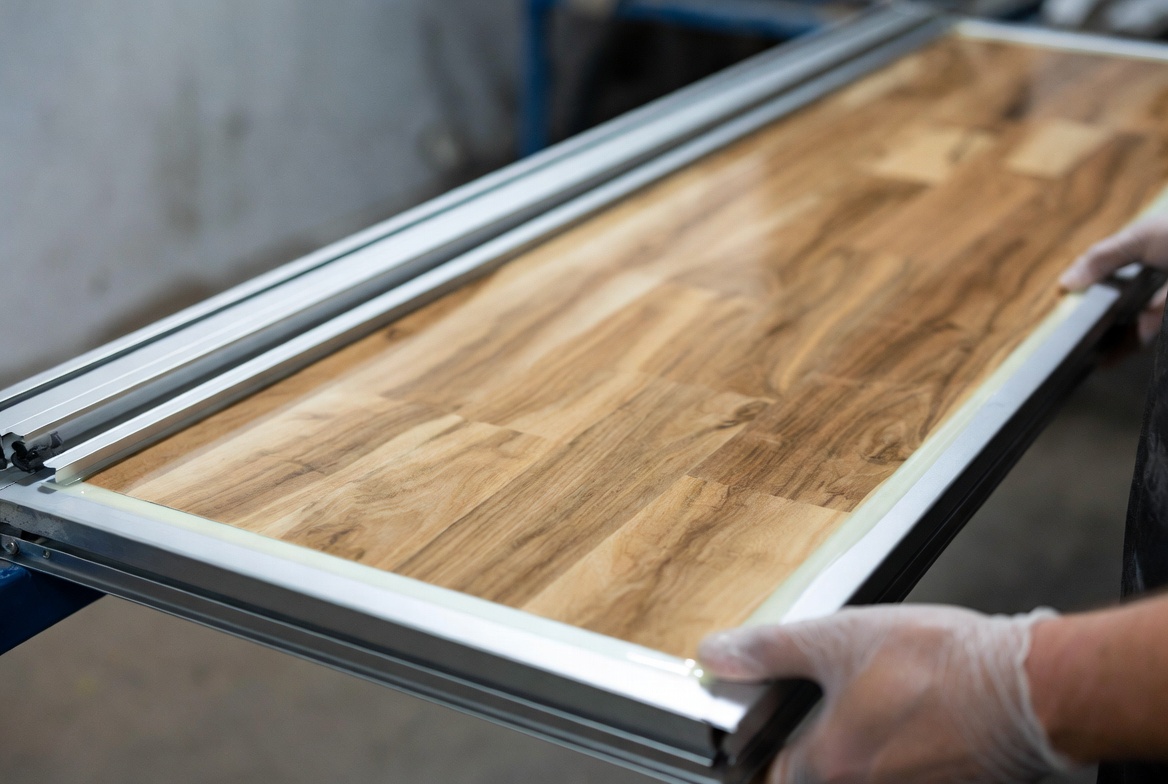
For fire-rated commercial aluminum doors, the coating system must support several performance targets at once: fire rating, door hardware integration, traffic resistance, and brand image. [machine4aluminium]
In practice, door manufacturers often specify an architectural polyester powder coating as the primary protective layer, then decide whether to add a sublimation wood grain finish based on design intent, project segment, and maintenance strategy. [nbprotectivefilm]
From a durability standpoint, polyester powder coating and sublimation wood grain film do not compete as equals; instead, the wood grain performance is heavily dependent on the underlying powder system and dye stability. [riverscoating]
Standard exterior polyester powder coatings used on building profiles can provide around 7–10 years of color stability, while super weather-resistant polyester systems can extend this to approximately 15 years for both color and film integrity when matched with suitable pigments and proper application. [machine4aluminium]
By contrast, wood grain transfer systems show more complex behavior: dye migration and fading can reduce visible pattern quality in 3–5 years if material selection and process control are not optimized, while enhanced formulations and high-grade transfer films can reach 5–10 years of outdoor appearance retention under well-controlled conditions. [machine4aluminium]
| Aspect | Polyester Powder Coating | Sublimation Wood Grain Film (on Powder Base) |
|---|---|---|
| Basic function | Primary protective and color coat on aluminum | Decorative wood/stone pattern transferred into powder basecoat |
| Typical film thickness | 60–90 μm on architectural aluminum profiles (riverscoating) | Same base thickness; additional pattern is dye within powder layer (riverscoating) |
| Outdoor color stability | Around 7–15 years depending on grade and formulation (machine4aluminium) | About 3–10 years pattern stability depending on dyes and process (machine4aluminium) |
| UV and heat sensitivity | Controlled via resin and pigment package (machine4aluminium) | More sensitive; dyes can fade or shift under UV and high temperature (machine4aluminium) |
| Maintenance needs | Periodic cleaning, minimal special care (machine4aluminium) | Similar cleaning plus more attention to early color shift (machine4aluminium) |
| Visual design options | Solid colors, metallics, textures across RAL–type palettes (riverscoating) | Simulated oak, walnut, teak, marble, and custom patterns (riverscoating) |
| Dependence on process control | Important but relatively forgiving once within spec (machine4aluminium) | Highly dependent on temperature, film quality, and vacuum quality (machine4aluminium) |
For high-traffic public entrances, this comparison often leads designers to use wood grain selectively on lobby-facing or VIP areas, while keeping heavily exposed service doors in robust single-color powder finishes. [riverscoating]
The fire rating of a commercial aluminum door assembly is governed primarily by the door core, framing system, glazing components, intumescent materials, and overall assembly design—not by the decorative coating alone. [machine4aluminium]
However, coatings still matter: they must not compromise test performance, and any organic layer contributes to the overall combustible load at the surface. Polyester powder coatings for exterior building profiles are formulated as thin, cross-linked films that have a long track record in tested assemblies, while sublimation wood grain finishes rely on the same basecoat thickness plus thin dye content. [top-aluminium]
From a practical standpoint, specifiers typically select certified door systems where the entire assembly, including coating type and color family, has been verified under regional fire test standards; within that framework, a polyester base with or without wood grain transfer can be accepted as long as it stays within the certified system parameters. [machine4aluminium]
For developers and brand owners, the visual impression of an entrance is often just as critical as performance. Polyester powder coatings offer a wide range of solid and metallic colors, matte and gloss levels, and subtle textures that align well with corporate identity standards and public-sector color schemes. [riverscoating]
Sublimation wood grain film provides an important advantage where warmth and natural material cues are needed—such as hospitality, healthcare, and high-end retail—while still allowing the project to benefit from the dimensional stability and fire-engineered design of an aluminum door system rather than solid timber. [nbprotectivefilm]
Having worked with manufacturers across China and Southeast Asia, one recurring theme is that wood grain sublimation introduces additional process complexity compared with standard polyester powder coating alone. [machine4aluminium]
Factors such as substrate pretreatment, oven calibration, film wrapping quality, vacuum uniformity, and transfer temperature/time directly affect pattern clarity, color stability, and even paper release, which can lead to inconsistent results between production batches if not tightly controlled. [top-aluminium]
Because of this, larger door and façade suppliers tend to work with standardized sublimation lines and qualified powder/film systems, often supported by long-term warranties in defined color ranges, rather than treating wood grain as a simple add-on step. [riverscoating]
When evaluating a coating system for a fire-rated commercial door project, it is helpful to view cost not only at installation but across the door's expected operational life. Polyester powder coatings are well known for predictable maintenance cycles, usually consisting of regular cleaning with neutral detergents and periodic inspection. [machine4aluminium]
Wood grain sublimation on top of the powder base does not significantly change day-to-day cleaning routines, but it does introduce aesthetic aging that may become visible earlier due to dye fade, especially in intense UV climates or on highly exposed façades, potentially leading to earlier partial replacement in strictly image-driven environments. [machine4aluminium]
For fire-rated commercial aluminum doors, a polyester powder-only system is typically favored when: [machine4aluminium]
- The project requires maximum color stability and the longest maintenance interval.
- The design language focuses on solid corporate colors, institutional tones, or metallic effects.
- Doors are located in high-UV, high-temperature, or coastal environments where wood grain dyes are more likely to shift.
In these scenarios, an architectural or super weather-resistant polyester powder coating aligned with project specifications offers a robust balance of appearance, protection, and tested performance. [machine4aluminium]
A sublimation wood grain finish on a qualified polyester powder basecoat becomes compelling when: [nbprotectivefilm]
- The project demands the look and feel of natural wood but requires the fire performance and dimensional stability of aluminum.
- Designers need to match or complement interior joinery and furniture while using metal door frames and leaves.
- The application is in semi-sheltered areas (e.g., recessed entrances, arcades, covered podiums) where UV exposure can be moderated.
The key is to treat the wood grain as part of a specified, tested system with defined durability expectations rather than as a purely decorative layer added at the last moment. [riverscoating]
For project teams comparing polyester powder coating and sublimation wood grain film on fire-rated aluminum doors, the following practical checklist can help structure decisions from a technical and design standpoint. [top-aluminium]
1. Clarify performance priorities
Decide whether long-term color stability, warm aesthetics, or rapid delivery is the top driver, and rank them clearly.
2. Map door locations and exposure
Separate highly exposed external doors from semi-sheltered or interior doors, and consider different finishes for each group.
3. Align with tested door systems
Confirm that selected coating types and color families are compatible with the fire-rated door certifications used in the project.
4. Engage coating specialists early
Work with coating providers that can supply both polyester powder and compatible wood grain systems across multiple regions, ensuring consistent application standards.
5. Plan realistic maintenance cycles
Define cleaning, inspection, and refurbishment expectations early in the specification stage, particularly for prestige entrances and branded environments.
By following this sequence, project stakeholders can choose between pure polyester powder coating and polyester-plus-sublimation systems with a clearer understanding of risk and value trade-offs. [riverscoating]
Industry case documentation on aluminum profiles with wood grain powder coating shows that wood grain systems are widely used for architectural aluminum doors, window profiles, fences, and commercial interiors, combining metal strength with decorative patterns. [afusa]
When the basecoat uses a weather-resistant polyester powder and the transfer film is optimized for outdoor exposure, suppliers can offer multi-year warranties on specific color and pattern ranges, often in the 5–10 year bracket for wood grain appearance retention under defined conditions. [riverscoating]
For fire-rated commercial doors in mixed-use projects—such as retail plus office or hospitality plus healthcare—this combination allows different zones of the same building to share a coordinated wood appearance while maintaining compliance with performance requirements for each door type. [nbprotectivefilm]
A manufacturer specialized in polyester powder coatings, eco-friendly materials, and energy-efficient technologies, with subsidiaries in China, Indonesia, and Saudi Arabia, can support door and façade manufacturers across multiple markets with: [riverscoating]
- Regionally aligned formulations tuned for local climates, ranging from high-humidity tropical environments to high-UV desert conditions.
- Integrated powder and wood grain solutions, ensuring compatibility between basecoat, transfer film, and process windows for architectural aluminum doors.
- Technical support and line optimization, helping door fabricators manage pretreatment, curing, and sublimation parameters for consistent quality.
For international construction and door brands operating across Asia and the Middle East, this combination of formulation expertise and multi-country presence helps secure visual consistency and performance alignment across large, distributed project portfolios. [riverscoating]
Q1: Can sublimation wood grain finishes be used on all fire-rated commercial aluminum doors?
A1: They can be used where the door system certification allows the selected coating family, and where the sublimation process is based on a compatible polyester powder basecoat designed for exterior use. [riverscoating]
Q2: How long does a wood grain sublimation finish usually last outdoors?
A2: Typical appearance retention ranges from around 3–5 years for standard systems to 5–10 years for enhanced formulations and carefully controlled processes, depending on climate and exposure. [machine4aluminium]
Q3: Does wood grain sublimation change the fire rating of a door?
A3: The fire rating is primarily determined by the door assembly design and core materials, but the coating must be included in the tested configuration; any change in finish should be checked against the tested system. [machine4aluminium]
Q4: Why do some projects still choose solid color polyester powder instead of wood grain?
A4: Solid color polyester powder coatings deliver highly predictable durability, simpler process control, and straightforward color management, which is especially valuable for heavily exposed or institutional applications. [riverscoating]
Q5: Can the same supplier provide both polyester powder and wood grain transfer systems?
A5: Yes, some coating manufacturers offer matched powder basecoats and transfer films as a system package for architectural aluminum doors and profiles, improving compatibility and simplifying technical support across projects. [afusa]
1. Dulux Powder Coatings – Sublicoat Sublimation Basecoat Range. https://www.duluxpowders.co.nz/products/sublicoat/
2. Yajia Aluminum – Wood Grain Finish on Aluminum. https://yajialuminum.com/wood-grain-finish-on-aluminum/
3. NB Protective Film – Guide to Wood Transfer Film for Powder-Coated Surfaces. https://www.nbprotectivefilm.com/industry-news/guide-to-wood-transfer-film-for-powder-coated-surfaces.html
4. Rivers Coating – JZ General Wood Grain & Marble Grain Heat Transfer Series. https://www.riverscoating.com/en/h-pd-269.html
5. Machine4Aluminium – Discussion on Weather Resistance of Heat Transfer Wood Grain Powder Coating. https://www.machine4aluminium.com/discussion-on-weather-resistance-of-heat-transfer-wood-grain-powder-coating/
6. Top Aluminium – Wood Grain Heat Transfer Powder Coating Formulation. https://www.top-aluminium.com/info/wood-grain-heat-transfer-powder-coating-formul-38899384.html
7. AFUSA – Wood Grain Powder Coating Services. https://www.afusa.net/applications/wood-grain-powder-coating


