Language


Views: 211 Author: Yinda Powder Coating Publish Time: 2026-07-28 Origin: Site


Content Menu
● Why Coastal Sunshades Demand Better Material Selection
● What T6 Aluminum Means in Practice
● Why 316 Stainless Steel Is Favored Near Salt
● Where Powder Coated T6 Aluminum Wins
● Where 316 Stainless Steel Wins
● The Hidden Factors That Decide Success
● FAQ
>> 1. Is powder coated T6 aluminum suitable for coastal sunshades?
>> 2. Why is 316 stainless steel preferred near saltwater?
>> 3. Which material is lighter for large sunshade structures?
>> 4. Does stainless steel need maintenance in coastal areas?
>> 5. What usually causes early failure in coastal sunshades?
>> 6. Which option is more cost-effective over time?
When coastal sunshades face salt spray, strong winds, and constant UV exposure, material selection becomes a long-term performance decision, not just a design choice. For architects, façade consultants, and project owners, the real question is not which material looks better on day one, but which one stays safer, cleaner, and more cost-effective after years of exposure.
Coastal architectural sunshades work harder than most exterior components. They are exposed to chlorides, moisture cycling, UV radiation, wind-driven debris, and frequent thermal expansion and contraction. In many marine-edge projects, corrosion risk is highest in splash and tidal influence zones, but atmospheric exposure near the shore can still accelerate degradation.
This is why powder coated T6 aluminum and 316 stainless steel are often shortlisted for premium coastal facades. Both can perform well, but they do so in different ways. Aluminum depends heavily on alloy quality, surface preparation, coating integrity, and detailing. Stainless steel depends more on its inherent resistance and the quality of its finish.
From a manufacturer's point of view, the best choice usually depends on distance from the shoreline, maintenance discipline, architectural shape, and service life target. A sunshade on a resort balcony two blocks from the sea has different demands than one facing open ocean spray year-round.

T6 aluminum refers to a heat-treated temper designed to improve strength and structural performance. In sunshade systems, this matters because engineers need a lightweight material that can span, support, and resist deformation without making the façade too heavy. Aluminum is one of the most preferred materials for sunshade systems because of its lightweight performance and durability.
However, coastal use introduces a critical distinction: aluminum must be protected properly. In harsh environments, good performance usually comes from a combination of pretreatment, primer, and high-performance coating, or an architectural anodized finish. Surface preparation is not optional. Poor pretreatment is one of the fastest ways to trigger premature coating failure.
For powder coated T6 aluminum, the finish does more than improve appearance. It acts as the primary shield against moisture ingress, UV fading, staining, and filiform corrosion under the coating. That means the final result depends on the full system, not the alloy alone.
316 stainless steel is widely specified for coastal and marine applications because it contains molybdenum, which improves resistance to chloride attack. That chemical advantage is one reason it is often treated as the preferred stainless grade for marine-facing exterior work.
For sunshades, 316 stainless steel offers a powerful combination of corrosion resistance, strength, and visual stability. It does not rely on a paint film to survive the environment, so if the finish is properly selected, it can deliver excellent long-term durability. In marine environments, the surface finish becomes especially important, and smooth or polished finishes generally perform better than rougher ones.
The tradeoff is weight, cost, and fabrication behavior. Stainless steel is heavier than aluminum, and for large sunshade assemblies that can increase structural load, installation complexity, and supporting-frame requirements. That does not make it the wrong choice. It simply means the design must justify the premium.
| Factor | Powder Coated T6 Aluminum | 316 Stainless Steel |
|---|---|---|
| Corrosion resistance | Strong when properly pretreated and coated, but coating quality is critical. | Excellent inherent resistance in coastal exposure, especially against chlorides. |
| Weight | Lightweight, easier to transport and install. | Heavier, often requiring stronger support structure. |
| Appearance | Wide color freedom through powder coating; easier branding match. | Premium metallic appearance; finish consistency matters. |
| Maintenance | Needs periodic inspection of coating edges, fasteners, and joints. | Lower routine finish maintenance, but still needs cleaning in marine air. |
| Fabrication | Easier to form and handle for complex profiles. | Strong but generally more demanding in fabrication and finishing. |
| Cost profile | Often better initial value for large projects. | Higher material cost, but often justified by lifespan and exposure level. |
| Best fit | Coastal projects needing lightweight systems and strong design flexibility. | Harsh marine sites where durability is the top priority. |
Powder coated T6 aluminum is often the smarter option when the project needs large spans, lighter substructures, more color flexibility, and easier installation. For commercial façades, hospitality projects, and residential coastal developments, that combination can be highly attractive.
It also offers a strong design advantage. Architects can match brand colors, integrate matte or textured finishes, and keep visual continuity across window frames, sunshades, and curtain wall systems. When the coating system is specified correctly, aluminum can perform well in harsh atmospheres.
In practical terms, aluminum is often the better option when:
- The sunshade is part of a larger lightweight façade system.
- Visual customization matters.
- The project team can enforce coating quality control.
- The site is coastal but not directly exposed to intense salt spray every day.
The main risk is not the alloy label itself. The main risk is assuming any coated aluminum will perform equally well. It will not. Surface preparation, coating thickness, drainage design, and isolation from dissimilar metals all matter.
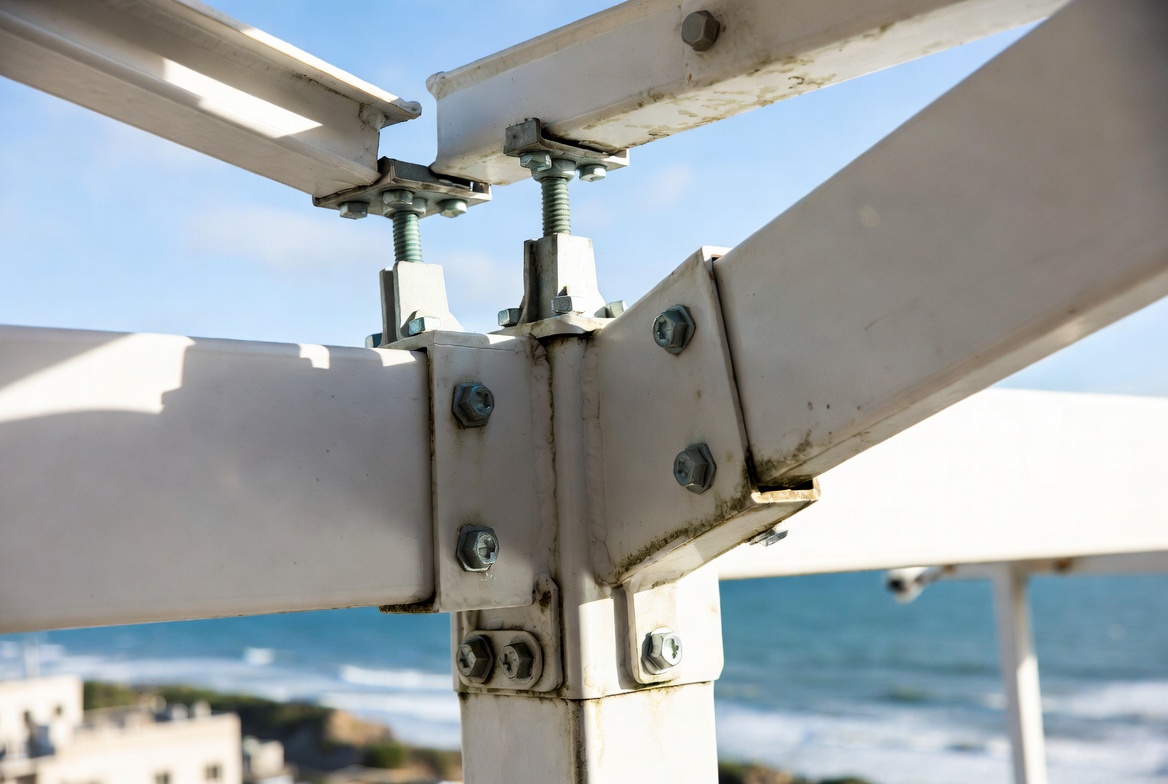
316 stainless steel becomes the stronger choice when the site is truly severe: beachfront, high-salt air, exposed elevations, frequent wetting and drying, or long service-life expectations with limited maintenance access. In these cases, the material's intrinsic resistance gives owners greater confidence.
This is especially valuable on landmark buildings, luxury resorts, hospitals, and public projects where interruption, visible staining, or frequent recoating would create operational problems. 316 stainless steel is also attractive when the sunshade details are small but highly visible, because the material can maintain a high-end appearance with less dependence on coating performance.
Another advantage is risk reduction. A damaged coating on aluminum can become a maintenance issue sooner than expected, while stainless steel often offers more forgiving long-term behavior. That said, "forgiving" does not mean maintenance-free. Marine deposits still need cleaning, and poor detailing can still create staining or crevice corrosion issues.
The final performance of coastal sunshades is often decided by details that buyers overlook. These include fasteners, isolation pads, joint design, water drainage, and finish selection. Even a strong material can fail early if it is paired with dissimilar metals or traps moisture at connection points.
Three details matter most:
1. Surface finish. Smooth finishes shed contaminants more effectively and reduce corrosion risk.
2. Drainage and washability. The design should allow rainwater to rinse surfaces instead of leaving salt deposits behind.
3. Galvanic isolation. Dissimilar metals should be separated with non-conductive barriers, sleeves, or washers.
For aluminum systems, this is even more important because coating failures often start at edges, cut points, and hardware interfaces. For stainless systems, the key risk is not coating breakdown but localized staining or corrosion in stagnant, dirty, or oxygen-starved areas.
A good material decision starts with exposure mapping. I usually look at three questions first: How close is the project to the sea? How visible is the sunshade? How much maintenance will the owner realistically perform? Those answers often tell you more than a generic material ranking.
Here is a practical rule set:
- Choose powder coated T6 aluminum when the project needs lightweight construction, broad color control, and strong value.
- Choose 316 stainless steel when the project is directly coastal, maintenance access is limited, or the client wants the most durable premium option.
- Avoid treating either material as a standalone solution. The system design, coating specification, and installation quality are just as important.
For export-oriented manufacturers, this is where credibility matters most. Clients do not buy metal. They buy long-term performance, clean appearance, and lower lifecycle risk.
From the manufacturing side, sunshades are not just products. They are systems. A powder coated aluminum system must be engineered for pretreatment quality, coating consistency, transport safety, and assembly tolerances. A stainless steel system must be engineered for corrosion-safe detailing, weld quality, and finishing control.
This is why working with a manufacturer experienced in coastal projects is essential. The right partner can help specify the correct alloy, coating standard, connection hardware, and installation method before production begins. That step can prevent expensive rework later.
For a company like Yinda Technology, this is also an opportunity to communicate technical confidence. Buyers in architecture and industrial construction respond well to clear guidance, material transparency, and evidence-based recommendations.
If the project is a moderate coastal environment and the design priorities are lightweight performance, flexible aesthetics, and cost efficiency, powder coated T6 aluminum is usually the better fit. If the project faces harsh marine exposure and the priority is long-term corrosion resistance with fewer coating concerns, 316 stainless steel is the safer premium choice.
The best answer is not universal. It depends on exposure level, maintenance access, structural requirements, and the owner's lifecycle expectations. For architectural sunshades near the coast, the winning solution is the one that balances performance, appearance, and maintainability over time.
Before finalizing your sunshade specification, request a material review that includes exposure level, coating system, fastener selection, and installation details. That single review can prevent years of corrosion problems.
Yes, if the coating system, pretreatment, and detailing are done correctly. It performs best in coastal sites with moderate exposure and disciplined maintenance.
Because it contains molybdenum, which improves resistance to chloride corrosion. That makes it a stronger option for marine and beachfront applications.
Powder coated T6 aluminum is much lighter, which makes it easier to transport, install, and support in larger façade systems.
Yes. Even 316 stainless steel benefits from routine cleaning, especially in environments with salt deposits, pollution, or stagnant moisture.
Common causes include poor surface preparation, weak coatings, dissimilar metal contact, trapped moisture, and inadequate drainage design.
It depends on exposure and service life. Aluminum can be more economical upfront, while 316 stainless steel may deliver better lifecycle value in severe marine conditions.
1. Dahlstrom Roll Form. "Salty About Coastal Construction? Use the Right Architectural Metal." [https://blog.dahlstromrollform.com/coastal-construction-correct-metal]
2. Builders Stainless. "316, 305, 304 or 410 for Coastal and Marine Construction." [https://www.buildersstainless.com/stainless-steel-grades-marine-coastal-construction]
3. BSSA. "Selection of stainless steels for building external applications." [https://www.bssa.org.uk/bssa_articles/selection-of-stainless-steels-for-building-external-applications/]
4. Linetec. "Choosing the right finish for coastal projects." [https://linetec.com/2022/09/14/choosing-the-right-finish-for-coastal-projects/]
5. Constructionspecifier. "Selecting aluminum finishes for coastal areas." [https://www.constructionspecifier.com/selecting-aluminum-finishes-for-coastal-areas/]
6. IMOA. "Case Study 09 Australian Coastal Fence." [https://www.imoa.info/download_files/stainless-steel/cs9_09.pdf]


