Language


Views: 268 Author: Yinda Powder Coating Publish Time: 2026-11-08 Origin: Site


Content Menu
● What Are Powder Coating Pinholes on Aluminum Profiles?
>> Pinholes vs. Craters, Fisheyes, and Back-Ionization Defects
● What Causes Powder Coating Pinholes on Aluminum Profiles?
>> 1. Residual Moisture After Pretreatment
>> 2. Oil, Lubricants, and Pretreatment Residues
>> 4. Moist Powder or Contaminated Compressed Air
>> 5. Excessive Film Thickness
>> 6. Inappropriate Application or Curing Conditions
● How to Diagnose Powder Coating Pinholes Systematically
>> Step 1: Contain the Affected Production
>> Step 2: Map the Defect Distribution
>> Step 3: Run a Controlled Comparison
>> Step 4: Check the Film Before and After Curing
● How to Prevent Pinholes in Powder-Coated Aluminum Profiles
>> Strengthen Cleaning, Rinsing, and Dry-Off Control
>> Protect Powder and Application Air
>> Control Film Build and Electrostatic Application
>> Validate the Actual Cure Profile
● When Should You Pre-Bake Aluminum Profiles?
● Corrective Actions for Profiles That Already Have Pinholes
>> Can You Apply Another Coat Over Pinholes?
>> Will an Outgassing-Forgiving Powder Solve the Problem?
● A Practical Trial Plan That Separates Causes
● Release Criteria: Confirm More Than Appearance
● Work With Yinda Technology on a Targeted Coating Evaluation
>> Why do pinholes appear only after curing?
>> Are extruded aluminum profiles naturally prone to outgassing?
>> Can excessive powder thickness cause pinholes?
>> Should I increase the oven temperature to remove pinholes?
>> Can sanding and recoating permanently repair pinholes?
>> Is every pinhole a corrosion failure?
Powder coating pinholes on aluminum profiles are small surface openings that can spoil an otherwise uniform finish. On window frames, architectural sections, and equipment housings, they may also interrupt the coating's protective barrier. Effective troubleshooting requires more than changing powder: manufacturers must examine substrate condition, pretreatment, compressed air, film thickness, and curing together.
At Yinda Technology, our perspective as a manufacturer of powder coatings and environmentally focused materials is straightforward: identify the defect mechanism before selecting a remedy. With subsidiaries in China, Indonesia, and Saudi Arabia, we serve applications ranging from architectural profiles and doors to new-energy vehicles, medical equipment, hardware, and appliances.
This guide explains how to distinguish pinholes from similar defects, isolate their causes, and establish corrective actions that remain effective beyond the next production batch.

Pinholes are tiny openings left when the molten coating cannot close around an escaping bubble or another local disruption before the film gels and hardens.
Their depth matters. Some defects affect only the upper coating surface; others may extend toward the substrate. Visual appearance alone cannot establish whether a particular opening exposes aluminum.
These defects can look similar, but their causes differ.
| Defect | Typical appearance | Initial investigation |
|---|---|---|
| Pinholes | Fine openings or punctures in the cured film | Moisture, volatile contamination, outgassing, film build |
| Craters or fisheyes | Depressions where coating has pulled away locally | Oil, silicone, incompatible materials |
| Back-ionization defects | Pitting, starring, or disturbed powder deposits | Charging settings, grounding, excessive deposition |
| Orange peel | Uneven, textured surface without distinct holes | Powder flow, film thickness, application, curing |
Treat this table as a starting point, not a definitive diagnosis. Inspect representative defects under magnification and establish whether they appear before or after curing.
Water retained in channels, joints, machining features, or horizontal surfaces can become vapor during curing. If it escapes after the powder has begun to gel, the opening may remain.
Check drainage and dry-off performance across the actual profile geometry. An oven setting that dries a simple test panel may not dry a complex hollow section equally well.
Extrusion-related residues, machining fluids, handling contamination, and inadequately removed cleaning chemicals can interfere with coating formation.
Some contaminants volatilize during heating. Others cause the molten coating to withdraw, producing crater-like defects rather than true pinholes.
The practical distinction is important: increasing bake time cannot compensate for an ineffective cleaning process.
Outgassing occurs when trapped gases or volatile substances escape from the substrate during heating.
However, do not treat an extruded aluminum profile as though it were a porous casting. Casting-related porosity is a recognized outgassing risk, but it should not automatically become the diagnosis for extrusion defects.
For profiles, investigate moisture, contamination, surface condition, and processing history before prescribing a dedicated degassing bake.
Compressed air contacts powder during handling and application. Moisture or oil carried through the system can therefore contaminate an otherwise acceptable material.
Potential problems include:
- An ineffective or overloaded air dryer.
- Saturated filters or malfunctioning drains.
- Condensation downstream of the compressor.
- Powder exposed to humid storage conditions.
- Cold powder opened immediately in a warmer application area.
Check air quality near the equipment, not only at the compressor outlet.
A thicker coating is not automatically a better coating. Excessive deposition can interfere with gas release and increase susceptibility to certain surface defects.
Measure thickness at multiple locations, including broad faces, corners, and areas where spray passes overlap. A single average can conceal substantial local overbuild.
Use the selected powder's technical data sheet and the project specification to establish the acceptable range.
Excessive charging, poor grounding, and unsuitable gun positioning can produce defects that resemble pinholes.
Meanwhile, an unsuitable heat-up profile can change the relationship between gas release, coating flow, and gel formation.
The essential distinction is between oven temperature and part temperature. Oven air readings alone do not establish whether every profile has received the required curing conditions.
My recommended troubleshooting sequence is to preserve evidence first, isolate variables second, and adjust the process third. Changing several settings immediately may improve appearance without revealing the cause.
Identify the last acceptable inspection and segregate potentially affected material.
Record:
- Aluminum supplier, batch, and profile geometry.
- Powder product, batch, and storage history.
- Pretreatment and dry-off conditions.
- Gun settings and reclaim proportion.
- Film-thickness readings.
- Conveyor speed and available oven-profile data.
Photograph defects with a scale reference and retain both defective and acceptable samples.
Location often provides more useful evidence than defect size alone.
| Observed pattern | Priority checks |
|---|---|
| Defects around channels or joints | Drainage, retained moisture, localized contamination |
| Defects in heavily coated areas | Film build, overlapping passes, charging conditions |
| Defects on one aluminum batch | Surface condition, supplier history, pretreatment response |
| Defects across different substrates | Powder, compressed air, shared equipment, oven conditions |
| Defects following a color change | Cleaning effectiveness and powder incompatibility |
These associations guide investigation; they do not prove causation.
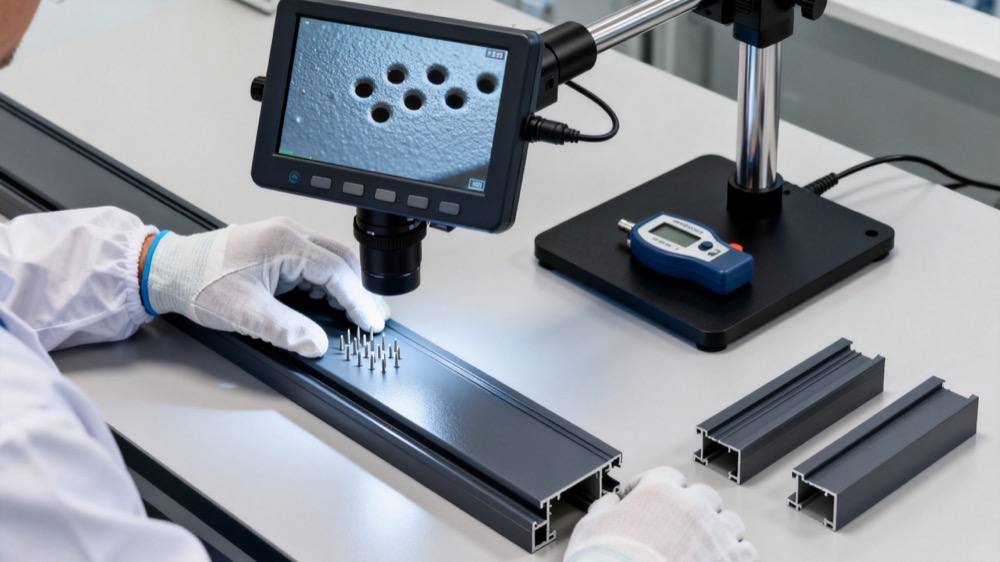
Coat a known-good aluminum panel alongside an affected production profile using the same powder and line conditions.
If both fail, investigate shared process factors. If only the profile fails, prioritize geometry, drainage, surface preparation, and substrate-related differences.
Keep film thickness comparable. Otherwise, the comparison may confuse a thickness effect with a substrate effect.
Inspect the deposited powder before it enters the oven.
Disturbance already visible in the uncured layer points toward an application issue. Defects that emerge only after heating justify closer examination of moisture, volatile contamination, and thermal behavior.
Confirm the diagnosis through repeatable trials rather than appearance alone.
Use an aluminum-compatible pretreatment system appropriate to the required performance.
Monitor the parameters specified by the chemical supplier, including bath concentration, temperature, contact time, and rinse quality.
Also verify:
- Profile orientation supports drainage.
- Recesses and joints dry adequately.
- Cleaned surfaces remain protected from handling contamination.
- Delays between pretreatment and coating remain controlled.
Do not alter conversion-coating chemistry or dry-off conditions without considering supplier instructions.
Store powder within the manufacturer's recommended conditions. Keep containers closed and allow cold powder to equilibrate before opening where condensation is possible.
Maintain dryers, separators, filters, and automatic drains. Investigate recurrent moisture at the point of use rather than repeatedly replacing contaminated powder.
Control reclaimed powder as part of the process. Record its proportion and prevent cross-contamination between incompatible products.
Adjust powder output, spray time, gun positioning, and charging together.
Clean hooks and contact points help maintain reliable grounding. Where back ionization is suspected, review voltage, current limits, gun distance, and deposition rate with the equipment supplier.
Avoid treating a lower voltage setting as a universal cure. The correct adjustment depends on the powder, profile geometry, equipment, and existing deposition conditions.
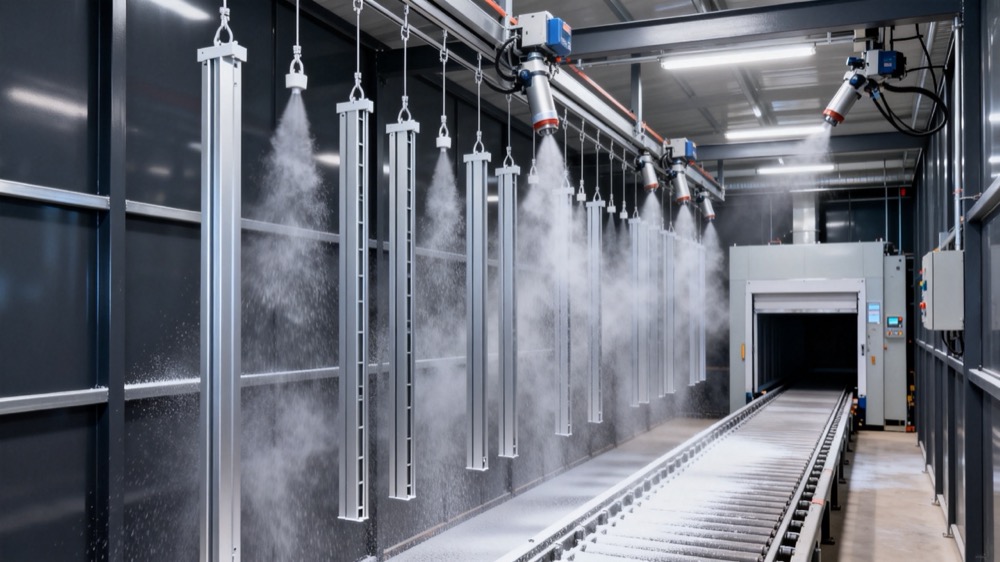
Use a suitable temperature-profiling system to measure representative parts through the oven.
Include challenging geometries and loading conditions. Compare the resulting part-temperature history with the powder supplier's curing requirements.
Do not lower curing conditions simply because the surface becomes smoother. An attractive finish can still be inadequately cured.
A dedicated degassing bake can help when trials demonstrate substrate-related gas release. It should not be the default response to every pinhole problem.
Before introducing pre-baking:
1. Confirm that cleaning and drying are effective.
2. Establish evidence that gas release remains a contributing factor.
3. Check the aluminum alloy, temper, dimensional requirements, and assembled components.
4. Agree the thermal sequence with the relevant material and pretreatment suppliers.
5. Compare finish quality and required performance after treatment.
Do not copy a casting bake schedule onto architectural extrusions. Excessive thermal exposure may create additional concerns, particularly for assembled profiles or components containing heat-sensitive materials.
Also consider where pre-baking belongs relative to pretreatment. A cycle that compromises the conversion layer can trade one defect for another.
The appropriate repair depends on defect depth, distribution, service conditions, and the customer's acceptance requirements.
| Condition | Possible corrective route | Required verification |
|---|---|---|
| Isolated, shallow surface defects | Approved local preparation and recoating | Appearance, adhesion, total thickness |
| Widespread defects with uncertain depth | Investigate, then consider stripping and recoating | Substrate condition and complete coating performance |
| Confirmed contamination | Remove the contamination through a validated process | Cleanliness and repeat-coating results |
| Persistent substrate-related outgassing | Trial an approved degassing process or suitable formulation | Finish, cure, adhesion, specified durability |
Sometimes, but not automatically.
A second coat may bridge a superficial defect. It may also reproduce the opening, trap the original problem, or exceed the permitted total film thickness.
Confirm intercoat preparation, compatibility, adhesion, and the additional thermal exposure before approving rework.
An outgassing-forgiving formulation can improve tolerance to gas release. It is not a substitute for clean aluminum, dry powder, or effective pretreatment.
Evaluate it against a known baseline. Product selection should also preserve the required exterior durability, appearance, and other application-specific properties.
The following is an illustrative investigation framework, not a reported Yinda production case.
Begin with a documented baseline, then change one factor at a time:
| Trial | Controlled change | Question being tested |
|---|---|---|
| A | Fresh, correctly stored powder | Is powder condition contributing? |
| B | Verified clean, dry air supply | Is application air contributing? |
| C | Film build within the specified range | Is local overbuild contributing? |
| D | Verified profile drainage and drying | Is retained moisture contributing? |
| E | Supplier-approved formulation or degassing trial | Is gas-release tolerance relevant? |
Use comparable profile locations for inspection. Record defect counts over a defined area rather than writing only "better" or "worse."
Repeat the successful condition on another production run. A single acceptable sample demonstrates possibility, not process stability.
Before releasing repaired or newly optimized production, verify:
- Surface appearance under agreed inspection conditions.
- Film thickness at representative locations.
- Compliance with the specified curing requirements.
- Adhesion using the applicable test method.
- Any additional performance testing required by the project.
For exterior architectural work, cosmetic improvement alone does not demonstrate long-term durability.
Track first-pass acceptance and rework frequency after implementing the change. Where energy reduction is also a goal, compare consumption against accepted output—not merely oven operating time. Repeated stripping and recoating can undermine apparent process savings.
Yinda Technology develops, manufactures, and supplies powder coatings alongside environmentally focused materials and energy-saving technology solutions.
For an aluminum-profile coating evaluation, share your profile application, defect photographs, powder specification, film-thickness readings, pretreatment sequence, and measured curing conditions.
Contact Yinda Technology to discuss a suitable powder system and a controlled evaluation plan. The objective is not simply to hide pinholes, but to identify a repeatable route to an acceptable finish.
Heating can release moisture or volatile substances while the powder melts and gels. If the film cannot flow closed afterward, openings remain.
Do not assume they behave like porous castings. On extrusions, investigate contamination, retained moisture, and application conditions before concluding that substrate porosity is responsible.
Yes. Excessive film build can contribute to pinholing and related defects. Confirm the acceptable thickness using the product data sheet and project requirements.
Not without evidence. A temperature increase may change gas release and gel behavior without solving the underlying problem. Validate part temperature and follow the specified cure schedule.
It can work for suitable superficial defects when the cause has been removed. Deeper or widespread defects may require a different approved repair process.
No. The consequence depends on defect depth, coating continuity, exposure, and the overall protective system. Inspect and test rather than assuming either harmlessness or failure.
1. IFS Coatings. "Powder Coating Troubleshooting Guide." Practical guidance covering pinholes, outgassing, moist powder, contamination, grounding, and back ionization. [ifscoatings]
2. IFS Coatings. "Powder Coating Issues and Fixes." Published October 16, 2024. Discussion of application defects, film build, grounding, humidity, and powder delivery. [ifscoatings]
3. Reliant Finishing Systems. "Resolving Powder Coating Pinhole Problems." Published September 24, 2020. Explanation of pinhole formation during gelation and compressed-air contamination control. [reliantfinishingsystems]
4. AkzoNobel Interpon. "Guidance Note 10: Application, Quality Control of Metallic and Effect Powder Coatings & Handling of Coated Parts," Version 6. Guidance on aluminum pretreatment and product-specific application controls; its metallic-finish thickness recommendations should not be generalized to every powder. [interpon]
5. AkzoNobel Interpon. "Interpon Redox Range." Manufacturer information describing specialist coating options for porous substrates susceptible to outgassing. [interpon]
6. Air Power. "Powder Coating Troubleshooting." Technical troubleshooting document addressing pinholes, moisture, trapped air, excessive film build, incompatible powders, and heat-up behavior. [airpower-usa]


