Language


Views: 217 Author: Yinda Powder Coating Publish Time: 2026-09-12 Origin: Site


Content Menu
● Why Skid Plate Finishes Matter
● Self-Healing Powder Coating Explained
>> How Self-Healing Powder Coating Works
>> Advantages of Self-Healing Powder Coating
>> Limitations of Self-Healing Powder Coating
>> Why Hard Anodizing Performs Well
>> Limitations of Hard Anodizing
● Side-by-Side Performance Comparison
● Which Finish Handles Real Off-Road Damage?
● Corrosion Protection in Mud, Salt, and Water
● Testing Before You Choose a Finish
>> Recommended Qualification Program
● FAQ
>> Is self-healing powder coating suitable for aluminum skid plates?
>> Is hard anodizing stronger than powder coating?
>> Can self-healing powder coating repair deep scratches?
>> Does hard anodizing prevent corrosion completely?
>> Which coating is best for skid plates used on salted winter roads?
>> Can hard-anodized aluminum skid plates be repainted?
>> What should manufacturers test before approving a skid plate finish?
Choosing between self-healing powder coating and hard anodizing for off-road aluminum skid plates is not simply a finish-selection exercise. It is a decision about abrasion, impact damage, salt exposure, UV stability, repairability, appearance, manufacturing flexibility, and the real operating environment of the vehicle.
For many severe off-road applications, hard anodizing remains a strong choice where maximum surface hardness and direct abrasion resistance are the priority. However, a well-engineered self-healing powder coating system can offer a more practical protective solution when the skid plate must also resist corrosion spread from stone chips, retain a consistent color, support custom branding, and allow controlled field or workshop repair.
At Yinda Technology, we work with powder coating and environmentally responsible material systems for demanding applications across construction profiles, doors and windows, new-energy vehicles, medical equipment, hardware, and electrical products. From a coating-development perspective, the best finish is not the one with the highest headline number. It is the one matched to the alloy, plate geometry, terrain, exposure conditions, service life, and maintenance reality of the skid plate.

An aluminum skid plate protects vulnerable underbody components such as the engine oil pan, transmission, transfer case, differential, battery enclosure, fuel tank, and suspension components. During off-road driving, the plate can face repeated contact with rocks, gravel, sand, mud, water, road salt, vegetation, and embedded debris.
Unlike a visible body panel, a skid plate operates in a highly abrasive environment. Its finish must perform after impacts, sliding friction, flexing, vibration, washing, and exposure to standing moisture.
The central challenge is that an aluminum skid plate needs more than surface hardness.
It needs a finish that can manage the following conditions:
- Sliding abrasion from rock contact and loose aggregate
- Point impact damage from sharp stones and trail obstacles
- Corrosion exposure from mud, saltwater, de-icing chemicals, and wet storage
- Galvanic-corrosion risk around steel fasteners, brackets, and adjacent metals
- UV exposure for exposed front, side, and rear protection panels
- Cleaning resistance when high-pressure washing and alkaline detergents are used
- Visual durability for aftermarket and premium vehicle applications
- Repairability after deep scrapes, gouges, or installation damage
A finish can be excellent in one category and weak in another. For example, a very hard surface may resist ordinary wear but may not provide the same flexibility, color range, or repair pathway as a multilayer organic coating system.
A self-healing powder coating is a protective thermoset coating designed to restore part of its protective function after minor mechanical damage. Depending on the chemistry, the healing response may involve heat activation, chain mobility, reversible bonding, shape-memory behavior, microcapsule-based repair agents, or corrosion-inhibiting components that respond when a defect exposes the metal substrate.
The phrase "self-healing" should be used carefully. It does not mean a deeply gouged skid plate will return to factory condition after a major rock strike. Rather, the technology is most relevant for micro-scratches, fine cracks, shallow abrasions, coating discontinuities, and localized barrier damage.
Research on self-healing anti-corrosion coatings describes them as intelligent materials that can restore protective performance after mechanical damage, often through a response triggered by heat, pressure, light, pH change, or other environmental stimuli.
A self-healing powder coating may rely on one or more mechanisms:
- Intrinsic healing: Polymer segments gain mobility under heat or another stimulus and reconnect across fine damage.
- Reversible chemical bonding: Certain bonds can break and reform, helping small cracks close.
- Microcapsule technology: Microscopic capsules rupture when damaged and release a repair material or corrosion inhibitor.
- Shape-memory response: A heat-responsive polymer system recovers part of its original surface shape after deformation.
- Active corrosion inhibition: An additive reacts to moisture or corrosion-related conditions near a defect, slowing underfilm corrosion.
For an off-road skid plate, the most meaningful outcome is usually not cosmetic perfection. It is the reduction of pathways that allow water, chloride, and contaminants to reach the aluminum beneath the coating.
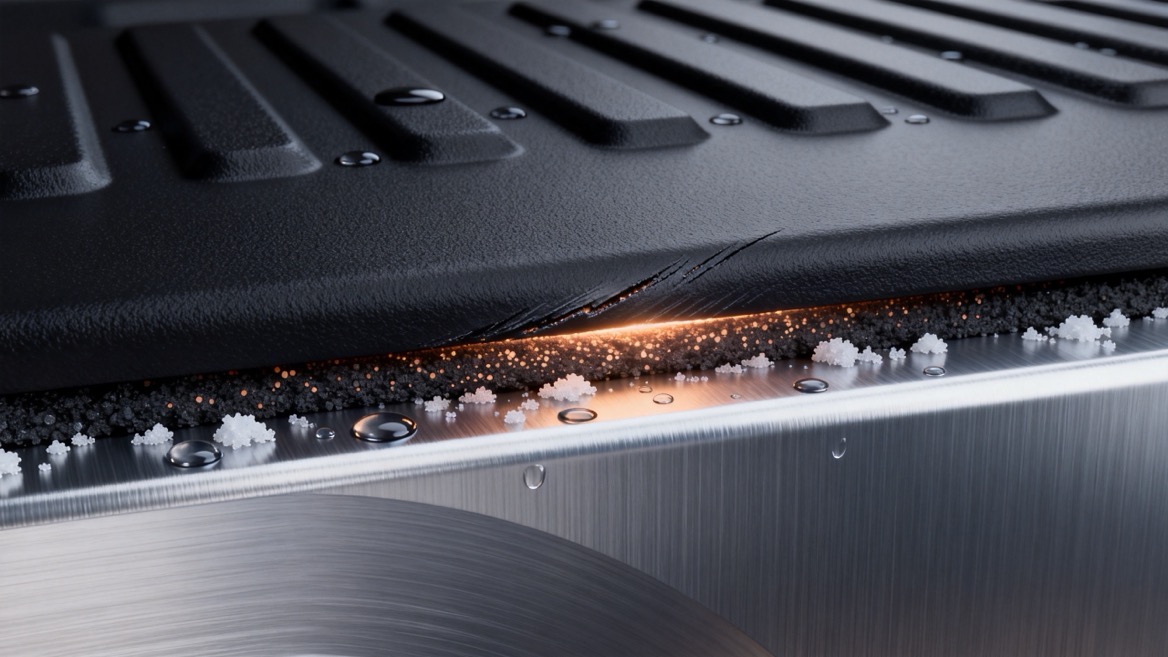
A properly specified self-healing powder coating can provide several practical advantages for aluminum skid plates.
Better corrosion-barrier continuity. Minor scratches and coating defects are common in vehicle service. If a coating can close fine damage or activate protective inhibitors, it may help reduce corrosion propagation at the damaged site.
Greater design freedom. Powder coating offers a broad range of colors, gloss levels, textures, metallic effects, and branded finishes. This matters for premium off-road accessories and vehicle-specific product lines.
Thicker protective film. Many powder systems can be applied at a substantially greater thickness than an anodic oxide layer. This can help create a more forgiving barrier on complex formed parts, provided edge coverage and pretreatment are properly controlled.
More consistent visual appearance. Hard anodized finishes are commonly dark gray, bronze, olive, or black, depending on alloy and process conditions. Powder coating gives manufacturers greater control over color matching and finish uniformity.
Environmental and operational efficiency. Powder coating is typically a low-volatile-organic-compound process because the coating is applied as a dry powder and overspray can often be recovered in controlled production systems.
Localized repair options. A deeply damaged powder-coated plate can be cleaned, feathered, spot-repaired, or recoated more easily than a hard-anodized part that needs a consistent factory anodic finish restored.
Self-healing powder coating is not a substitute for structural plate thickness, correct aluminum alloy selection, or sound skid plate design.
Key limitations include:
- Healing is limited. Deep cuts, large chips, crushed edges, and metal deformation generally exceed the capacity of the coating to recover.
- Abrasion can remove coating. Repeated rock dragging can eventually wear through any organic film.
- Activation conditions matter. Some systems require heat, light, or a specific environmental trigger to initiate recovery.
- Pretreatment remains critical. Poor cleaning, inadequate conversion coating, contamination, or poor curing can undermine even an advanced powder formulation.
- System validation is essential. A self-healing claim should be supported by realistic test data, not only a laboratory demonstration on an ideal flat panel.
Hard anodizing, often called Type III anodizing, is an electrochemical process that converts the outer surface of aluminum into a dense aluminum oxide layer. Unlike paint or powder coating, the anodic layer grows from the aluminum substrate itself.
The process generally uses controlled electrolyte temperature, current density, and time to create a thicker and harder oxide layer than conventional decorative anodizing. ASTM B580 covers porous anodic oxide coatings deposited electrolytically on aluminum and aluminum alloys where appearance, abrasion resistance, electrical properties, and corrosion protection are important.
For off-road skid plates, hard anodizing is attractive because aluminum oxide is a ceramic-like surface. It can provide excellent surface hardness and abrasion resistance, especially where the plate encounters repeated sliding contact.
Hard anodizing is commonly selected for engineered aluminum components because it creates a surface that is:
- Hard and wear resistant
- Integral to the aluminum substrate
- Thin relative to many coating systems
- Less likely to peel as a film
- Suitable for dimensional-control applications
- Available in dark technical finishes
- Useful for parts subject to rubbing, sliding, and mechanical contact
A major advantage is that the anodic layer does not behave like a conventional paint film. There is no separate organic coating layer to chip away in sheets. However, that does not mean hard anodizing is invulnerable. Strong impacts can crack, fracture, or locally damage the oxide layer, especially near sharp edges or highly stressed formed areas.
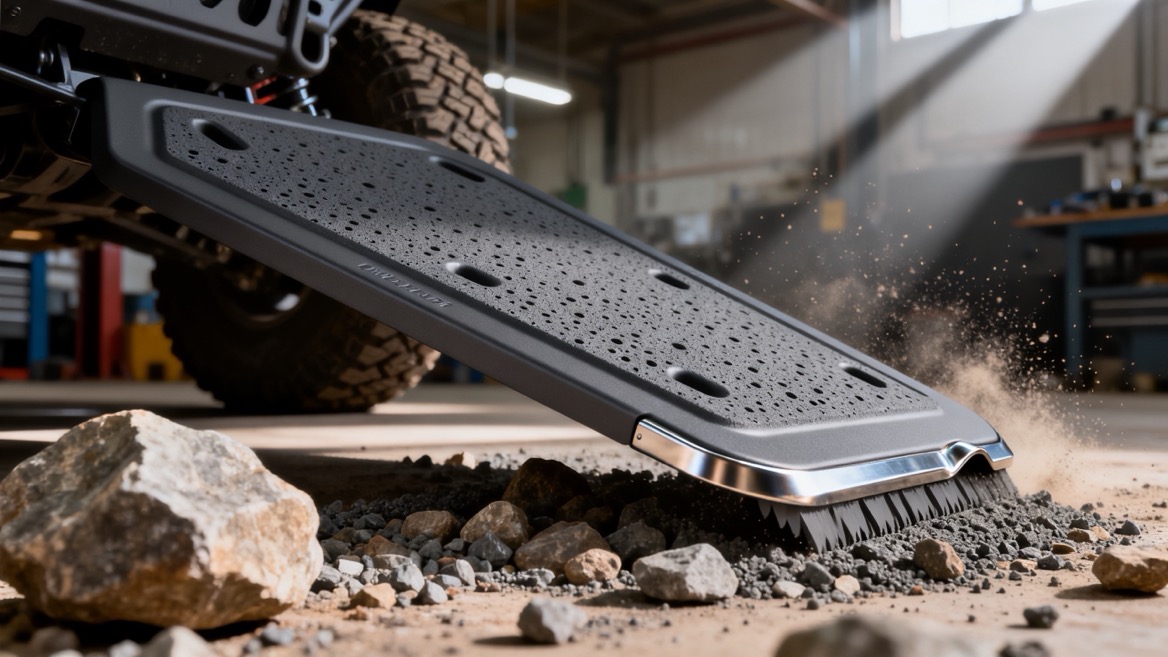
Hard anodizing is extremely capable, but it has practical limits in off-road use.
It can be brittle under severe impact. High hardness is beneficial for abrasion resistance, but ceramic-like oxide layers do not have the same flexibility as a thick polymer coating. A hard rock strike can crack the surface or damage the substrate below it.
Alloy selection affects appearance and performance. Different aluminum alloys anodize differently. Silicon-rich or copper-containing alloys may produce darker, less uniform, or more variable finishes than high-purity or suitable 5xxx and 6xxx series alloys.
Color options are restricted. Dark gray, black, bronze, and natural tones are common. Exact color matching across batches or complex assemblies can be more difficult than with powder coating.
Repair is difficult. Once a hard-anodized surface is deeply damaged, restoring a uniform Type III finish generally requires stripping and re-anodizing the part. Local touch-up coatings may protect the damaged area, but they do not reproduce the original anodic layer.
Sealing and corrosion design still matter. The anodic coating must be properly sealed where corrosion resistance is critical. Fastener selection, drainage, insulation from dissimilar metals, and avoiding moisture traps remain essential.
The correct decision depends on what the skid plate experiences most often: controlled abrasion, high-impact rock strikes, wet salted roads, desert sand, marine exposure, or appearance-sensitive aftermarket use.
| Performance Factor | Self-Healing Powder Coating | Hard Anodizing |
|---|---|---|
| Surface hardness | Moderate to high, depending on chemistry and film design | Very high, with ceramic-like oxide characteristics |
| Sliding abrasion resistance | Good to very good in optimized systems, but film can eventually wear through | Excellent for repeated rubbing and moderate sliding contact |
| Impact tolerance | Generally more flexible and forgiving than hard oxide | Can resist wear well but may crack under sharp, high-energy impacts |
| Minor scratch management | Strong potential when self-healing or active-inhibitor technology is used | No active healing mechanism |
| Corrosion protection | Excellent when pretreatment, film build, edge coverage, and curing are controlled | Good when properly anodized and sealed; design around fasteners and crevices remains important |
| Salt and wet-road exposure | Strong potential for barrier protection and inhibitor-assisted defense | Good, but damage, sealing quality, and galvanic conditions influence results |
| Color and branding options | Excellent; broad color, texture, gloss, and logo possibilities | Limited; technical and darker finishes are most common |
| Repairability | Better; spot repair or recoating is possible | Limited; full re-anodizing is usually required for consistent restoration |
| Coating thickness | Usually thicker, offering a robust barrier | Typically thinner and more dimensional-control friendly |
| Edge coverage | Must be engineered carefully, especially at sharp edges | Oxide layer follows the aluminum surface, but sharp geometry can still be challenging |
| Production flexibility | Efficient for high-volume coating lines and custom finishes | Requires specialized electrochemical processing and tight bath control |
| Best use case | Mixed corrosion, appearance, customization, and serviceability requirements | Maximum wear resistance and technical performance where appearance choices are secondary |
From my experience evaluating coating systems for industrial and vehicle-related components, the most common mistake is treating "rock resistance" as one property. It is not.
There are at least three separate damage modes:
1. Micro-abrasion: Fine sand, dust, branches, and small aggregate gradually dull or scratch the finish.
2. Sliding abrasion: The plate scrapes over rock surfaces, ledges, gravel, and compacted ground.
3. High-energy impact: A sharp rock strikes a localized area and may dent the aluminum, chip the coating, or fracture the anodic layer.
Hard anodizing is often the strongest choice for micro-abrasion and controlled sliding wear. Its hard oxide surface is highly resistant to gradual surface wear.
A self-healing powder coating can be the stronger choice for mixed exposure conditions, especially where the plate receives small chips, wet contamination, road salt, and visual damage that could become corrosion initiation points. The polymer film can also accommodate some plate flexing better than a brittle oxide layer.
For highly technical rock-crawling use, a useful strategy may be to specify hard anodizing on parts dominated by sliding contact, while using a high-performance powder coating system for brackets, guards, covers, side protection, and appearance-critical components.
Aluminum naturally forms an oxide layer, but real off-road corrosion is rarely a simple bare-aluminum problem. The risk increases when the skid plate retains wet mud, touches steel mounting hardware, traps chloride-rich water, or is exposed to road de-icing salts.
The finish must work as part of a complete corrosion-control design.
A premium coating cannot compensate for poor skid plate geometry. Consider the following design rules:
- Avoid water-trapping pockets around bends, stiffeners, and mounting locations.
- Use drainage paths so mud and water can leave the plate quickly.
- Isolate dissimilar metals where aluminum contacts carbon steel, stainless steel, or plated fasteners.
- Use compatible fasteners and washers to reduce galvanic-corrosion risk.
- Round sharp edges where possible to improve coating continuity.
- Specify edge protection because cut edges and mounting holes are common corrosion initiation areas.
- Define cleaning procedures after saltwater crossings, winter road driving, and mud exposure.
For powder-coated parts, pretreatment quality is especially important. Cleaning, surface conditioning, conversion coating, rinse control, drying, powder deposition, and full cure all affect final protection. A visually attractive coating with weak pretreatment may fail much earlier than a well-controlled industrial system.
A coating decision should not be based only on a sample coupon, a color chip, or a hardness claim. Off-road skid plates need an application-specific validation plan.
1. Confirm the aluminum alloy and temper. The selected alloy affects anodizing response, forming behavior, corrosion behavior, and finish consistency.
2. Assess geometry and contact zones. Identify leading edges, rock-contact areas, mounting holes, formed bends, weld zones, and locations where debris collects.
3. Define coating thickness targets. For powder coating, specify dry-film thickness range and minimum readings at edges and complex geometry. For anodizing, define required thickness and sealing requirements.
4. Run adhesion testing. Cross-hatch or other applicable methods can verify coating adhesion after cure and environmental exposure.
5. Run corrosion testing. Salt-spray or cyclic-corrosion testing should include scribed panels, edges, formed sections, and actual mounting interfaces—not only flat test coupons.
6. Run abrasion testing. Use a test method that reflects the service condition. Taber abrasion can be useful for comparison, but it does not fully replicate a skid plate dragging over irregular rock.
7. Run impact testing. Include stone-chip or controlled impact testing on coated formed sections. Evaluate cracking, delamination, corrosion creep, and substrate deformation.
8. Conduct field trials. Install prototype plates on vehicles operating in representative environments: desert sand, wet forest trails, winter roads, mining routes, or coastal exposure.
9. Inspect after cleaning cycles. High-pressure washing and detergents can reveal weaknesses at fasteners, edges, and damaged film areas.
10. Document the failure mode. Record whether the issue is wear-through, cracking, adhesion loss, corrosion creep, color change, or mechanical deformation. Each failure type requires a different solution.
Choose self-healing powder coating when the skid plate requires a balance of corrosion protection, color options, customized finish, flexible film behavior, and repairability. It is particularly compelling for premium aftermarket accessories, new-energy vehicle underbody protection, coated aluminum guards, and components exposed to wet roads or salt contamination.
Choose hard anodizing when the primary requirement is high surface hardness, consistent technical appearance, and strong resistance to repeated rubbing or sliding abrasion. It is often a logical option for high-contact engineered components and skid plates used in dry, abrasive environments.
Choose a hybrid design approach when no single finish can optimize every function. For example, a manufacturer may use hard anodizing on high-wear aluminum surfaces while applying advanced powder coating to brackets, guards, covers, or modules where corrosion barrier performance and visual identity are more important.
The best specification begins with the question: How will the skid plate fail in real use? If the answer is repeated rock sliding, hard anodizing may lead. If the answer is chips, salt, water, complex geometry, and customer-facing appearance, a self-healing powder coating system deserves serious consideration.
Yinda Technology develops powder coating and environmentally responsible material solutions for demanding industrial markets. With operations in China, Indonesia, and Saudi Arabia, we support customers that need practical coating expertise, stable manufacturing capability, color development, and application-focused technical communication.
For off-road aluminum skid plates, we can help evaluate substrate condition, surface preparation, coating chemistry, film thickness, corrosion requirements, appearance targets, and test plans. The goal is not to make a generic finish claim. The goal is to build a durable coating system for the actual terrain, climate, vehicle platform, and service expectations.
Contact Yinda Technology to discuss a self-healing powder coating solution for aluminum skid plates, underbody guards, battery protection systems, automotive brackets, and high-performance aluminum components.
Yes, especially when corrosion resistance, customized appearance, minor scratch management, and repairability are important. It should be selected as part of a full system that includes correct pretreatment, suitable film thickness, complete curing, and field-relevant performance testing.
Hard anodizing is generally harder at the surface and often offers better direct abrasion resistance. However, "stronger" depends on the failure mode. Powder coating can provide a thicker, more flexible protective barrier and may perform better where corrosion protection, impact tolerance, color flexibility, and repair options are important.
No. Most self-healing mechanisms are intended for minor surface damage, microcracks, shallow scratches, or localized barrier defects. Deep gouges that expose or deform the aluminum usually require conventional repair, touch-up, or recoating.
No finish prevents corrosion under every condition. Proper hard anodizing and sealing can provide strong protection, but corrosion performance also depends on alloy choice, fastener design, drainage, surface damage, chloride exposure, and galvanic contact with other metals.
A high-performance powder coating system can be highly effective because it provides a continuous barrier and can be engineered with corrosion-resistant and active-protection technologies. However, system performance depends heavily on pretreatment, edge coverage, cure quality, and regular washing to remove salt deposits.
Yes, but preparation is critical. The anodized surface must be thoroughly cleaned and appropriately prepared to achieve reliable adhesion. For heavily damaged plates, stripping and full refinishing may be more consistent than applying a local coating over an unknown or contaminated surface.
They should test adhesion, coating thickness, impact resistance, abrasion resistance, corrosion resistance, chemical resistance, edge coverage, fastener-interface behavior, and actual vehicle field performance. Flat test panels alone are not enough for a part that experiences rock contact and vibration.
1. ASTM International. [ASTM B580: Standard Specification for Anodic Oxide Coatings on Aluminum].
2. IET Research. [Self-Healing Anti-Corrosion Coatings: A Mechanism Study Using Electrochemical Techniques].
3. Springer. [Self-Healing Coatings in Anti-Corrosion Applications].
4. Springer. [Self-Healing Coatings for Active Corrosion Protection].
5. ScienceDirect. [Self-Healing Corrosion Protective Coatings Based on Micro/Nanocarriers: A Review].
6. Society of Plastics Engineers. [Self-Healing Coatings for Automotive Applications].
7. Gordon Inc. [Powder Coatings for AAMA 2604 and AAMA 2605 Applications].
8. MagnaPlates. [How to Bolster the Benefits of Anodized Aluminum Surface Treatments].


