Language


Views: 222 Author: Yinda Powder Coating Publish Time: 2026-06-09 Origin: Site


Content Menu
● What's Unique About Thermal Break Aluminum in Coastal Projects?
● Powder Coating vs. Anodizing: How the Technologies Work
>> Powder Coating on Thermal Break Aluminum Profiles
>> Anodizing on Thermal Break Aluminum Profiles
● Direct Comparison: Powder Coating vs. Anodizing for Extreme Coastal Corrosion
>> Performance Comparison for Coastal Thermal Break Profiles
● Industry Data and Case‑Level Insights for Coastal Environments
● Where Powder Coating Excels on Thermal Break Aluminum Profiles
● Where Anodizing Remains the Coastal Benchmark
● Energy Efficiency and Thermal Break Performance Considerations
● Practical Selection Framework for Coastal Thermal Break Projects
>> Key Questions to Ask Before Choosing
>> Example Recommendation Patterns
● How Yinda Technology Can Engineer Coastal Powder Coating Systems
● Step‑by‑Step: Specifying a Coastal Powder Coating System for Thermal Break Profiles
● Conclusion: How to Choose for Extreme Coastal Corrosion
● FAQs
Thermal break aluminum profiles in extreme coastal projects can perform reliably with either powder coating or anodizing, but they protect in very different ways and succeed under different design, budget, and maintenance strategies. For many façade, window, and EV applications, a marine‑grade, seaside‑specified powder coating system combined with quality thermal break profiles can match or outperform standard anodizing, while hard, well‑sealed architectural anodizing still sets the benchmark for long‑term abrasion and UV stability in the harshest marine atmospheres. [sinoextrud]

Thermal break aluminum profiles integrate an insulating barrier (typically polyamide PA66 or similar) between the inner and outer aluminum shells to reduce thermal bridging, condensation, and energy loss. In extreme coastal climates, this design has to manage three simultaneous stresses: high salt load, UV radiation, and large temperature swings between interior and exterior surfaces. [pmc.ncbi.nlm.nih]
For building envelopes, curtain walls, doors, windows, EV charging housings, and medical/industrial equipment cabinets, the outer aluminum surface is constantly exposed to salt spray and wind‑borne sand while the interior side operates at controlled temperatures. That makes the choice of surface finish—powder coating or anodizing—critical not only to corrosion resistance but also to the thermal stability of the complete system over a 10–20‑year design life. [archify]
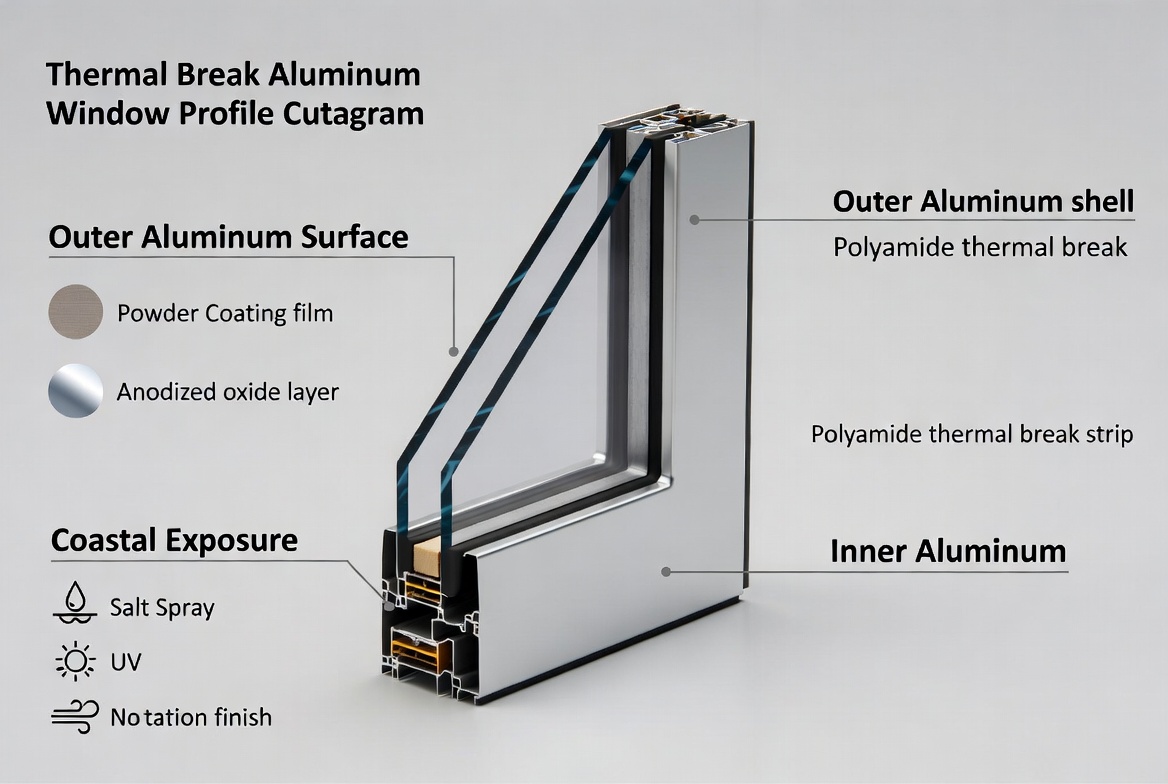
Powder coating is a dry finishing process where electrostatically charged powder is sprayed onto the aluminum profile and then cured into a continuous polymer film. The coating forms a barrier layer that isolates the metal from moisture, oxygen, and salt, significantly reducing corrosion. [alumil]
Key technical points for coastal projects:
- Marine and seaside‑grade systems use enhanced chemical pretreatment (deep etch, chromate‑free conversion, deionized rinsing) to meet or exceed QUALICOAT "Seaside" or similar specifications. [candocoatings.co]
- Typical architectural powders are polyester or superdurable polyester, which provide good UV resistance and color retention in outdoor exposure. [kimsen]
- Coating thickness in demanding coastal zones is often specified at 60–80 μm or more, which tests show gives measurably better barrier protection than conventional 40–60 μm systems. [linkedin]
For a manufacturer like Yinda Technology, the ability to tune pretreatment, resin chemistry, and film build makes powder coating highly adaptable for profiles used in windows, doors, EV components, medical equipment, and hardware in coastal markets. [yinda-global]
Anodizing is an electrochemical process that thickens the natural aluminum oxide layer, turning the surface into a dense, controlled oxide film that is integral to the metal. Instead of creating a separate "skin," anodizing converts the surface itself and then seals the pores to resist corrosion. [alignmfg]
Core characteristics:
- The anodic oxide is hard, wear‑resistant, and electrically insulating, which is valuable in façades combining aluminum and stainless steel, where bimetallic corrosion can be a risk. [linkedin]
- Hard anodizing (Type III) can reach surface hardness comparable to hardened steel, with excellent abrasion resistance in sandy, wind‑blown coastal locations. [alignmfg]
- Anodized layers are naturally UV stable, meaning color (especially in clear or lightly tinted finishes) hardly fades under decades of sunlight. [arabianextrusion]
In coastal applications, well‑specified architectural anodizing is often regarded as the most robust long‑term defense against corrosion, especially where maintenance opportunities are limited. [arabianextrusion]
Below is a practical comparison focused on thermal break aluminum used in high‑corrosivity coastal environments.
| Dimension | Powder Coating on Thermal Break Profiles | Anodizing on Thermal Break Profiles |
|---|---|---|
| Corrosion resistance in marine/coastal zones | Strong when using QUALICOAT Seaside or similar enhanced pretreatment and ≥60–80 μm marine‑grade polyester powders; performance depends heavily on film integrity (no cracks/chips). (alumil) | Excellent when using architectural or hard anodizing with proper sealing; oxide is integral so corrosion does not spread under the layer even after surface scratching. (sinoextrud) |
| UV and color stability | UV stability depends on resin chemistry; superdurable polyesters show good long‑term color and gloss retention, but low‑grade powders may chalk or fade. (alumil) | Intrinsically UV stable; finishes typically do not peel or fade even under intense sun such as Gulf or tropical coastal climates. (arabianextrusion) |
| Abrasion and sand resistance | Good but can chip under impact or heavy abrasion, exposing bare metal if not inspected and maintained. (linkedin) | Superior; hard anodized oxide has very high surface hardness and resists sand‑blasting and micro‑abrasion. (alignmfg) |
| Aesthetic flexibility | Very high—unlimited colors, gloss levels, textures (smooth, matt, metallic, fine‑texture, anti‑graffiti) to match architects' branding and façade designs. (alumil) | Moderate—limited color palette, metallic look only; excellent for premium, natural metal appearance but less flexible for branding colors. (kimsen) |
| Dimensional impact on thermal break profiles | Adds measurable thickness (typically 60–80 μm), which must be considered in tight‑tolerance sliding systems and hardware interfaces. (alumil) | Minimal dimensional change; oxide layer is thin yet dense, ideal for precision‑fit components in thermal break window and door systems. (kimsen) |
| Repair and maintenance | Localized damage can often be repaired with touch‑up systems; however, perfect color and texture matching can be challenging. (linkedin) | Deep damage usually requires re‑anodizing; field repair is limited and may create visible color variation. (linkedin) |
| Typical service life in harsh environments | Approx. 10–15+ years with correct pretreatment, marine‑grade powders, and maintenance. (archify) | Approx. 15–20+ years or more with quality anodizing and sealing, even in aggressive coastal exposures. (alignmfg) |
| Cost and total cost of ownership | Typically lower initial cost, especially for colored façades and complex color schemes; TCO depends on inspection and maintenance discipline. (linkedin) | Higher initial cost, but extended service life and reduced fading/peeling risk can lower lifetime cost for premium façades. (linkedin) |
Recent manufacturing and architectural finishing data show that surface treatments can extend aluminum component service life by 10–20+ years, depending on environment and finishing quality. Coastal environments accelerate degradation through salt deposition, humidity, and strong UV, so specifications that perform well inland often fail prematurely near the sea. [candocoatings.co]
Industry guidance from finishing bodies and major coaters highlights that standard powder coating specifications alone (e.g., generic national standards) may not guarantee long‑term performance in marine zones without upgraded pretreatment and marine‑grade powders. At the same time, real‑world façade and curtain wall projects in high‑salinity climates, such as the Gulf and Southeast Asia, demonstrate that anodized finishes can stay stable for 20+ years with minimal color or gloss change when correctly specified and maintained. [archify]
From a coastal design and procurement perspective, powder coating stands out in several scenarios:
- Projects requiring broad color palettes to match brand identities, local planning colors, or complex façade patterns. [alumil]
- EV charging stations, outdoor medical/diagnostic enclosures, and hardware where a robust, visually distinctive coating supports safety and wayfinding. [yinda-global]
- Value‑engineered coastal projects where marine‑grade powder coating with Seaside‑level pretreatment offers a strong balance of durability and budget. [alumil]
Enhanced seaside and marine specifications emphasize:
1. Deep etching pretreatments (e.g., ≥2.0 g/m² etch rates) to remove surface contamination and create a stable substrate. [candocoatings.co]
2. High‑adhesion conversion layers and multiple rinsing steps to minimize under‑film corrosion in case of coating damage. [alumil]
3. Superdurable polyester powders designed for high UV and salt exposure, often supported by extended warranties when specified correctly. [archify]
For a powder coating specialist such as Yinda Technology, these elements can be combined to build system‑level solutions tailored to thermal break profile manufacturers and fabricators serving coastal building, door and window, EV, and hardware markets. [yinda-global]
Even with advanced powder coating systems, many façade and structural applications still specify anodizing as the default finish in extreme coastal environments:
- High‑rise seaside façades where access for recoating or touch‑up is extremely difficult, and owners demand 20+ years of stable appearance. [linkedin]
- Projects that combine aluminum with stainless steel or other metals, where the insulating nature of the anodic oxide helps mitigate bimetallic corrosion. [linkedin]
- Ultra‑harsh climate zones (very high UV, sandstorms, salt‑laden winds) where the hardness and UV‑stability of anodizing provide maximum protection. [arabianextrusion]
Field experience in regions like the UAE has shown that paint and conventional powder coatings can peel, fade, or chalk under extreme UV, heat, and humidity if product and process selection are not rigorous. In contrast, high‑quality anodizing typically does not peel or blister because it is part of the substrate, and its UV stability means façades can keep a consistent appearance for decades. [alignmfg]
While both finishes primarily address corrosion and aesthetics, they also influence thermal performance and long‑term insulation stability in thermal break systems.
- Coating color and gloss affect solar heat gain: dark, high‑absorptivity powder coatings may raise outer surface temperatures, stressing thermal break strips and seals; high‑reflectance finishes can reduce this effect. [pmc.ncbi.nlm.nih]
- Anodized surfaces, especially in lighter or natural tones, often exhibit stable emissivity and reflectivity, contributing to consistent surface behavior over long service lives. [kimsen]
For window and façade engineers, it is important to:
- Match finish type and color to orientation and climate (e.g., darker coastal finishes on north‑facing elevations, lighter on direct sun‑exposed façades).
- Ensure that both powder coating bake cycles and anodizing processes are compatible with the thermal break assemblies and gaskets to avoid long‑term deformation. [pmc.ncbi.nlm.nih]
When advising a coastal client, I typically walk through these decision drivers:
1. Environmental severity
- Is this a normal coastal site or an extreme marine atmosphere with frequent salt spray and sand?
- Are there industrial pollutants adding to the corrosivity? [candocoatings.co]
2. Access and maintenance strategy
- Can the façade or equipment be easily inspected and touched up every 2–3 years? If yes, marine‑grade powder coating may be optimal. [archify]
- If access is extremely difficult, long‑life anodizing becomes more attractive. [arabianextrusion]
3. Aesthetic requirements
- Need for brand colors, textures, and effects points to powder coating. [kimsen]
- Preference for natural metallic appearance favors anodizing. [kimsen]
4. Lifetime cost vs. upfront budget
- Tight capital budgets with planned maintenance cycles often choose powder coating. [linkedin]
- Long‑term institutional owners (airports, hospitals, coastal campuses) may accept higher initial anodizing cost for reduced risk over 20+ years. [alignmfg]
- Coastal residential and mid‑rise commercial façades:
- Marine‑grade powder coating, Seaside‑level pretreatment, superdurable polyester, 60–80 μm, with defined inspection and cleaning schedules. [alumil]
- Signature coastal towers, premium public buildings:
- Architectural anodizing with robust sealing, possibly combined with powder‑coated accent elements where color is critical. [arabianextrusion]
- EV charging infrastructure, outdoor medical cabinets, hardware:
- High‑build powder coatings with anti‑graffiti or textured finishes to balance corrosion protection with impact and vandal resistance. [yinda-global]
Positioning Yinda Technology in this conversation, the key advantage is the ability to design full powder coating systems around thermal break aluminum profiles for coastal markets.
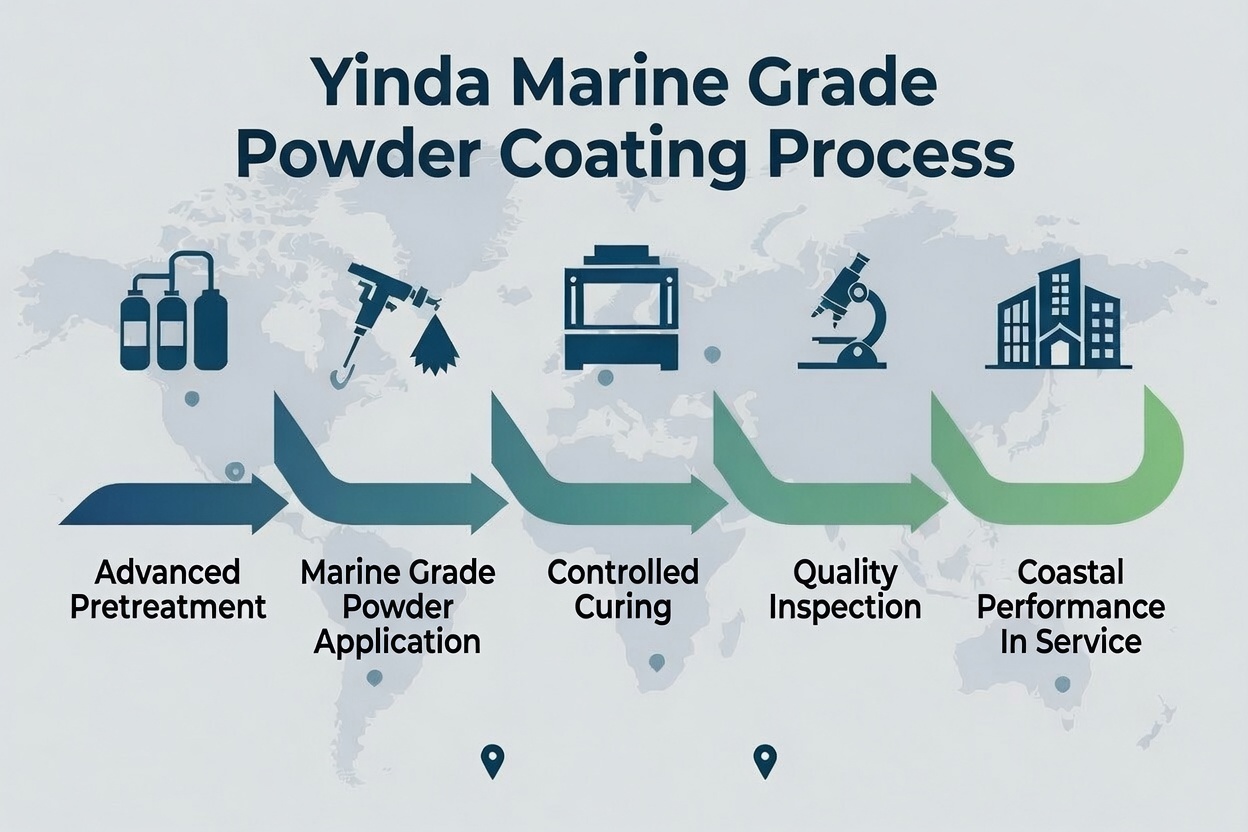
Based on published best practices and industry guidance, a Yinda‑style coastal solution would emphasize: [yinda-global]
- Advanced pretreatment lines tuned for Seaside‑class requirements, with deep etching, multi‑stage rinsing, and robust conversion coatings to control filiform corrosion.
- Marine and architectural‑grade polyester powder ranges tested for salt‑spray resistance, UV stability, and color/gloss retention relevant to coastal façades, windows, doors, and EV/medical equipment.
- Process control and quality assurance aligned with international certifications (e.g., QUALICOAT‑type processes) to give fabricators confidence when exporting to demanding markets.
- Application support for profile designers and façade engineers, including recommendations on film build, color/texture selection, and compatible cleaning/maintenance regimes.
By combining R&D in eco‑friendly, low‑VOC powder chemistries with global production footprints in China, Indonesia, and Saudi Arabia, Yinda is well positioned to support coastal projects across Asia, the Middle East, and global export markets that require high‑performance finishes on thermal break profiles. [emis]
From an engineering and procurement viewpoint, here is a simple 5‑step specification workflow you can adapt:
1. Define environment class and service life target
- Use project location to classify coastal severity and set a minimum desired lifetime (e.g., 15 years to first major maintenance for façades). [candocoatings.co]
2. Select pretreatment level
- Specify a Seaside‑equivalent pretreatment for aluminum extrusions, including enhanced etch and multi‑stage rinsing, to minimize under‑film corrosion risk. [alumil]
3. Choose powder chemistry and performance class
- For extreme coastal, select superdurable polyester powders with independent UV and salt‑spray test data suitable for building envelopes. [archify]
4. Define film thickness and color
- Set a minimum film build (typically 60–80 μm) and choose colors/finishes that balance design intent and thermal behavior (e.g., lighter colors on high‑sun façades). [linkedin]
5. Include maintenance and inspection requirements
- Add clear guidelines for cleaning, visual inspection, and touch‑up intervals in the specification and warranty documents. [archify]
This type of structured approach helps coastal owners and façade consultants compare powder coating vs. anodizing on an "apples to apples" basis while ensuring that thermal break aluminum systems achieve their targeted performance.
For extreme coastal corrosion on thermal break aluminum profiles:
- Anodizing remains the gold standard where maximum longevity, UV stability, and abrasion resistance are non‑negotiable and aesthetic flexibility is secondary. [alignmfg]
- Marine‑grade powder coating, built on enhanced pretreatment and high‑performance polyester powders, offers a compelling, cost‑effective alternative with vastly greater design flexibility when paired with disciplined inspection and maintenance. [candocoatings.co]
From a combined engineering and UX perspective, the best choice depends on site severity, lifetime expectations, access for maintenance, and architectural intent. In many real coastal projects, a hybrid strategy—anodizing for the most exposed structural elements and marine‑grade powder coating for color‑critical or user‑touch surfaces—delivers the most balanced result. [kimsen]
If you are designing a content or specification guideline around this topic, positioning Yinda as the go‑to partner for engineered coastal powder coating systems on thermal break profiles will resonate strongly with architects, façade consultants, and OEMs.
Q1: Is powder coating suitable for thermal break aluminum profiles less than 5 km from the coast?
Yes, provided you specify Seaside‑level pretreatment, marine‑grade polyester powders, and adequate film thickness, powder coating can perform reliably even in near‑shore environments with a structured maintenance plan. [alignmfg]
Q2: Does anodizing always outperform powder coating in coastal environments?
Not always. High‑quality anodizing is typically more durable in terms of UV and abrasion, but well‑engineered marine powder systems can offer comparable corrosion resistance and better color flexibility at lower initial cost. [kimsen]
Q3: Which finish is better for dark, high‑chroma façade colors facing the sea?
In most cases, superdurable polyester powder coatings are preferred for saturated colors, as anodizing has limited color options and is optimized more for metallic tones. [alumil]
Q4: How often should coastal powder‑coated façades be inspected?
Industry practice is to carry out visual inspections and basic cleaning at least once per year, with more frequent checks in very aggressive marine atmospheres. [arabianextrusion]
Q5: Can I combine anodizing and powder coating on the same coastal project?
Yes. Many projects use anodizing for primary structural/aluminum elements and marine‑grade powder coating for accent colors, doors, and hardware, provided galvanic risks and visual transitions are properly managed. [linkedin]
1. SinoExtrud – *Anodizing Vs. Powder Coating: Which Is More Durable?* (2026‑04‑20). <https://sinoextrud.com/anodizing-vs-powder-coating-which-is-more-durable/> [sinoextrud]
2. Align Manufacturing – *Anodizing vs Powder Coating: Which Finish Lasts Longer?* (2025‑12‑31). <https://alignmfg.co/anodizing-vs-powder-coating/> [alignmfg]
3. Alumil – *Powder Coating for Aluminum Extrusion*. <https://www.alumil.com/extrusion/capabilities/aluminium-finishing/powder-coating> [alumil]
4. Cando Coatings – *What Is Seaside Certification for Powder Coating* (2025‑12‑09). <https://www.candocoatings.co.uk/what-is-seaside-certification/> [candocoatings.co]
5. LinkedIn – *Anodising, Powder‑Coating and Corrosion Risk* (2025‑08‑05). <https://www.linkedin.com/pulse/coating-considerations-anodising-powder-coating-corrosion-2xzze> [linkedin]
6. Interpon / Archify – *3 Steps to Specifying Powder Coating for Coastal and Marine Environments* (2022‑11‑16). <https://www.archify.com/nz/product/interpon-nz/updates/detail/3-steps-to-specifying-powder-coating-for-coastal-and-marine-environments> [archify]
7. AREXCO / Arabian Extrusion – *Is Aluminium Anodizing Better Than Painting or Powder Coating in the UAE?* (2026‑02‑17). <https://arabianextrusion.com/is-aluminium-anodizing-better-than-painting-or-powder-coating-in-the-uae/> [arabianextrusion]
8. KIMSEN – *Anodizing vs. Powder Coat: How to Choose the Right Aluminum Finish* (2021‑08‑12). <https://kimsen.vn/anodizing-vs-powder-coat:-how-to-choose-the-right-aluminum-finish-ne88.html> [kimsen]
9. HTS Aluminium – *A Guide to Powder Coated Aluminium Windows Frame* (2025‑08‑14). <https://hts-alu.com/powder-coated-aluminium-windows-frame/> [hts-alu]
10. PMC – *Study on the Influence of Surface Treatment Process on 6061 Aluminum Alloy Profiles* (2023‑08‑31). <https://pmc.ncbi.nlm.nih.gov/articles/PMC10488388/> [pmc.ncbi.nlm.nih]
11. Yinda Technology – *Standard Architectural Powder Coatings*. <https://www.yinda-global.com/Standard-Architectural-Powder-Coatings-id48367755.html> [yinda-global]
12. Yinda Powder Coating – *Applications & Case*. <https://www.yinda-global.com/Applications-Case-ic3295126.html> [yinda-global]
13. EMIS – *Pt Yinda Powder Coating Indonesia Company Profile*. <https://www.emis.com/php/company-profile/ID/Pt_Yinda_Powder_Coating_Indonesia_en_22155438.html> [emis]


