Language


Views: 295 Author: Yinda Powder Coating Publish Time: 2026-10-27 Origin: Site


Content Menu
● Why Source Epoxy Powder Coating from China?
>> What Recent Market Reports Actually Show
● How These Suppliers Were Selected
● Understand the Product Before Comparing Manufacturers
>> Epoxy-Polyester Hybrid Powder Coating
● Top 10 Epoxy Powder Coating Manufacturers and Suppliers in China
>> 2. Fujian Wanan Industry Group
>> 3. Chengdu Hsinda Polymer Materials
>> 5. Zhejiang Huacai Advanced Material
>> 6. Zhejiang Keyco New Material Technology
>> 7. Kinte Material Technology
>> 9. TIGER Coatings — TIGER Drylac
● Supplier Comparison: Capacity, MOQ, and Certification Evidence
● Technical and Compliance Requirements Buyers Should Specify
>> Define Measurable Performance
>> Do Not Treat "CE Certified Powder" as a Universal Requirement
● Buyer's Guide: From Factory Verification to Shipment
>> Step 1: Verify the Manufacturing and Contracting Entities
>> Step 2: Start with a Written Application Brief
>> Step 3: Approve Samples in Stages
>> Step 4: Compare Cost per Accepted Coated Part
>> Step 5: Agree on Shipping and Storage Conditions
● Insider Procurement Trap: Approving the Panel but Not the Manufacturing Specification
● Conclusion: Qualify the Product and the Partnership Together
● FAQs
>> 1. How Can I Verify Whether a Supplier's ISO Certificate Has Expired?
>> 2. Does Passing a 1,000-Hour Salt-Spray Test Prove Long Service Life?
>> 3. Can "180°C for 10 Minutes" Be Used as the Oven Setting?
>> 4. How Can We Detect Undisclosed Formulation Changes?
>> 5. Can a Supplier's RoHS Report Cover Every Color and Finish?
Selecting an epoxy powder coating supplier in China requires more than comparing prices, color cards, and advertised production capacity. For procurement managers, the real challenge is finding a manufacturer that can reproduce approved performance across production batches, support application troubleshooting, and deliver the documentation required by the destination market.
A credible supplier evaluation should therefore examine factory identity, formulation expertise, quality-control procedures, sample-to-production consistency, and delivery reliability. This guide compares ten manufacturers and suppliers worth considering, while distinguishing published company information from details that buyers still need to verify.

China offers buyers a combination of domestic powder coating manufacturers, resin and additive suppliers, export-oriented factories, and multinational coating businesses with local operations.
The available supplier base also spans several manufacturing regions. Yinda operates from Foshan, Guangdong; Huacai and Keyco are based in Zhejiang; Wanan is headquartered in Zhangzhou, Fujian; and Hsinda manufactures in Chengdu, Sichuan. These locations give buyers different options for supplier visits, technical coordination, and export logistics. Huacai, for example, identifies proximity to Shanghai and Ningbo ports as part of its export offering.
For buyers serving architectural profiles, appliances, hardware, and industrial equipment, these regional networks can make it easier to coordinate coating trials with component manufacturers. However, proximity to an industrial cluster does not replace verification of the individual factory.
A powder coatings market report published in May 2026 estimates the global market at USD 16.30 billion in 2025 and projects USD 23.07 billion by 2031. These figures cover powder coatings overall—not specifically Chinese epoxy powder coating production or exports.
A separate March 2025 report estimates that Asia-Pacific accounted for more than 38% of global powder coating revenue in 2024. Meanwhile, Mordor Intelligence projects growth above 3% annually for the Asia-Pacific epoxy powder coatings market during 2025–2030. These reports support the relevance of the regional supply base, but their different market definitions should not be combined into a single China-specific statistic.
The procurement implication is straightforward: buyers have a broad supplier pool, but market growth alone says little about whether a particular formulation will work on their production line.
The shortlist prioritizes companies with identifiable powder coating operations, published product or technical information, and capabilities relevant to industrial procurement.
The following criteria should also form the basis of a buyer's own qualification process.
| Evaluation area | Evidence to request | Why it matters |
|---|---|---|
| Factory identity | Business license, manufacturing address, contracting entity, production-site details | Separates the actual manufacturer from a trading intermediary |
| Product suitability | Product-specific technical data sheet and declared resin chemistry | Prevents substitution between pure epoxy, hybrid, and polyester systems |
| Development capability | Laboratory facilities, formulation support, application-trial process | Indicates whether the supplier can solve problems beyond color matching |
| Quality control | Incoming-material checks, batch records, release criteria, retained samples | Supports repeatable production |
| Compliance | Current certificates, formulation-specific test reports, safety data sheets | Connects claims to the actual product and factory |
| Delivery reliability | Lead-time commitments, production allocation, change-control procedures | Reduces disruption after approval |
| Commercial fit | Trial quantities, production MOQ, packaging, customization terms | Determines suitability for the buyer's order profile |
For certification checks, buyers should verify certificate status rather than relying on an image supplied by a salesperson. IAF CertSearch distinguishes active, suspended, withdrawn, and expired certificates.
"Epoxy powder coating" is sometimes used loosely in commercial listings. Buyers should identify the chemistry before discussing price.
Pure epoxy powder coatings are relevant to applications requiring chemical resistance and strong physical performance. PPG's published epoxy product documentation, for example, describes formulations intended for automotive and industrial applications and specifies adhesion, impact, humidity, and salt-spray test results. Those results apply to the documented product and test conditions—not to every epoxy powder.
Hybrid systems combine epoxy and polyester chemistry and are commonly offered for interior decorative and protective applications. PPG identifies its P8 low-bake series as an epoxy-polyester system for interior parts, while TIGER describes Series 89 as a reactive epoxy-polyester hybrid used for fittings and pull-out systems.
An epoxy primer is not automatically interchangeable with a decorative epoxy topcoat. PPG's ENVIROCRON portfolio includes an epoxy anti-corrosive primer, illustrating why buyers should specify the coating's role within the complete system.
For outdoor projects, require written confirmation of weathering suitability and whether a compatible topcoat is necessary. Never infer exterior durability from an indoor epoxy or hybrid product description.
- Establishment: 2010.
- Headquarters: Foshan, Guangdong, China.
- Market coverage: China and international customers; the company describes an overseas presence in Indonesia and the Middle East.
- Procurement fit: Buyers seeking a customization-oriented manufacturing relationship rather than only a standard catalog purchase.
Yinda Technology develops, manufactures, and sells powder coatings and environmentally oriented materials, while also promoting energy-saving technologies. Its published company profile identifies a dedicated research and development center, testing facilities, production lines, and a technical team with more than 20 years of industry experience.
Its application coverage includes architectural profiles, doors and windows, new energy vehicles, medical equipment, hardware, and electrical appliances. This breadth makes it a relevant candidate for buyers managing several component categories, although each application still requires product-specific qualification.
OEM/ODM scope to discuss: Custom color and finish development, application-specific formulation, sample adjustment, and technical coordination. Yinda publicly emphasizes tailored products and responsive support; buyers should translate these commitments into an agreed sampling schedule, named technical contact, and written approval procedure.
For small and midsize brands, Yinda is worth evaluating as a potential value-oriented partner where communication and development support matter. That positioning should be confirmed through quotation comparisons and actual trial performance—not treated as proof of the lowest price.
Verification priority: Request the exact epoxy product data sheet, current factory certificates, production MOQ, available capacity, and a written response-time commitment. Its reviewed company profile does not publish a quantified annual capacity or universal MOQ.
- Establishment: 1996.
- Headquarters: Zhangzhou, Fujian, China.
- Market coverage: Chinese industrial customers, with international supply opportunities to confirm by destination.
- Procurement fit: Buyers seeking an established domestic thermosetting powder coating producer.
Wanan focuses on the research, manufacture, and sale of thermosetting powder coatings. Its official website publishes annual production capacity of 80,000 tonnes and includes an electrostatic epoxy powder coating offering for furniture and automotive-related applications.
Its principal attraction is manufacturing scale combined with a long operating history. Nevertheless, the published capacity is a company-wide figure; it does not show how much capacity is allocated to the buyer's epoxy formulation.
OEM/ODM scope to discuss: Application-specific grades, industrial color matching, finish selection, and recurring production programs. Confirm private-label rights separately from technical customization.
Verification priority: Obtain the proposed manufacturing-site details and a product-specific specification. Do not accept total factory capacity as evidence of immediate delivery availability.
- Establishment: 2015.
- Location: Chengdu, Sichuan, China.
- Market coverage: China and international industrial customers; its website includes material directed at Latin American applications.
- Procurement fit: Buyers seeking epoxy, hybrid, and functional powder options from a specialist manufacturer.
Hsinda reports eight large production lines, a bonding line, a professional laboratory, and annual output exceeding 5,000 tonnes. Its published portfolio includes epoxy and epoxy-polyester powder coatings.
The company also publishes pure epoxy product information covering particle size, film thickness, application method, and curing conditions. This provides a starting point for technical discussion, although buyers should obtain a controlled, current data sheet for the exact formulation ordered.
OEM/ODM scope: Published product information supports customized RAL and Pantone colors. Buyers can also discuss finish and application adjustments, subject to written confirmation of development limits.
Verification priority: Resolve differences between nominal capacity, actual annual output, and available production allocation. Verify any certification claim against the manufacturing entity.
- Establishment: 1993, according to the manufacturer's published history.
- China manufacturing identity: Feihong-branded operations associated with Jinhu.
- Market coverage: The company reports exports to more than 60 countries.
- Procurement fit: Export buyers seeking indoor epoxy and epoxy-polyester powder coating options.
Feihong publishes an indoor coating range covering epoxy and epoxy-polyester systems, alongside other powder coating chemistries. Its export history makes it relevant to buyers who need established international sales processes.
OEM/ODM scope to discuss: Custom colors, indoor industrial finishes, and application-specific powder supply. Private-label packaging, exclusivity, and formula ownership require separate agreement.
Verification priority: Clarify the relationship between the brand, manufacturing company, and export contracting entity. Its website refers to ISO, RoHS, REACH, and customer-related standards, but those statements do not substitute for current certificates and formulation-specific evidence.
- Establishment: 1998.
- Location: Zhejiang, China.
- Principal published export markets: Europe, America, Southeast Asia, and South America.
- Procurement fit: Buyers interested in customization supported by raw-material and laboratory capabilities.
Huacai reports annual capacity above 30,000 tonnes, 34 semi-automatic production lines, a German ZEPPELIN bonding machine, and its own raw-material production center. Its published testing equipment includes XRF, particle-size analysis, and color-measurement instruments.
These capabilities are relevant to raw-material control, particle distribution, and batch color consistency. Equipment ownership alone, however, does not establish how frequently tests are performed or what acceptance limits apply.
OEM/ODM scope: Huacai explicitly states that its research and development team can develop products according to customer requirements. Its product navigation includes polyester/epoxy hybrid coatings.
Verification priority: Ask for the proposed product's batch-release checklist and sample reports. Confirm whether an inquiry requires pure epoxy or a hybrid system before requesting a quotation.
- Establishment: The reviewed sources describe more than 20 years of powder coating experience, but do not establish a sufficiently clear legal-entity founding year.
- Location: Huzhou, Zhejiang, China.
- Market coverage: Domestic and international supply; request destination-specific references.
- Procurement fit: Buyers evaluating a broad powder coating operation with epoxy and hybrid offerings.
Keyco's website describes 25 digital automatic production lines and annual capacity exceeding 30,000 tonnes. It also contains a separate reference to 10,000 tonnes of capacity, making clarification of site and business scope particularly important.
Rather than choosing the larger figure, buyers should request a plant-by-plant capacity statement explaining which production lines would manufacture the approved product.
OEM/ODM scope to discuss: Custom industrial colors, finishes, and epoxy or hybrid formulations. Confirm the extent of formulation development and private-label services before treating them as contracted capabilities.
Verification priority: Obtain the business license, incorporation date, manufacturing address, and a consistent explanation of published capacity figures.
- Establishment: A specialist materials-industry listing identifies 1992 for Guangzhou Kinte Material Technology.
- Location: Guangzhou, Guangdong, China.
- Market coverage: Industrial coatings and materials customers; confirm current export coverage directly.
- Procurement fit: Technically demanding projects where resin and finished-coating expertise are relevant.
Kinte's official materials describe a business affiliated with China National Electric Apparatus Research Institute and engaged in powder coating research, production, and sales. Its published portfolio also includes polyester resins designed for hybrid powder coatings.
One documented resin, HH-2581, is designed for a 50/50 hybrid system cured at 180°C. This is useful evidence of chemistry-level development activity, but a resin specification is not a finished powder coating performance guarantee.
OEM/ODM scope to discuss: Application-led formulation development and industrial product qualification. Confirm the precise finished-powder offering rather than assuming every resin product is available as a ready-to-spray coating.
Verification priority: Separate the history of the parent research organization from the establishment date of the contracting manufacturing entity.
- Establishment: AkzoNobel's modern corporate form dates to the 1994 merger of Akzo and Nobel Industries.
- China presence: Documented powder coating manufacturing operations.
- Market coverage: China and multinational industrial customers.
- Procurement fit: Buyers prioritizing established product platforms and coordinated technical support.
AkzoNobel documented the opening of an EUR 11 million powder coating facility in Chengdu in 2017, intended to serve automotive, construction, furniture, and information-technology applications. That announcement establishes manufacturing history, not a current count of Chinese plants.
Interpon offers a broad powder coating range, including multiple colors and finishes. Buyers should request the exact China-available epoxy or hybrid product rather than assume every global product is manufactured locally.
OEM/ODM scope to discuss: Customer-specific color, finish, and application requirements within the available product portfolio. Technical customization should not be confused with unrestricted private-label manufacturing.
Verification priority: Confirm local availability, manufacturing origin, order quantity, and the technical documents applicable to the quoted grade.
- Establishment: 1930, at group level.
- China presence: Published group information identifies Chinese manufacturing operations and a Taicang location.
- Market coverage: China and international industrial customers.
- Procurement fit: Interior component manufacturers seeking hybrid systems and coordinated finish selection.
TIGER's general-industry information identifies Drylac Series 89 as an epoxy-polyester hybrid used for fittings and pull-out systems. The published curing example is 160°C for 10 minutes; buyers must still confirm the applicable product data sheet and substrate-temperature requirements.
Its broad finish offering can be relevant when appearance consistency is important across several component suppliers.
OEM/ODM scope to discuss: Custom finish selection, color development, and application support. Do not assume own-brand repackaging or ownership of the formulation.
Verification priority: Confirm which grades are available from the Chinese supply channel and whether the desired color requires a dedicated manufacturing batch.
- Establishment: Obtain the founding and registration details of the specific China contracting entity; the reviewed product sources do not establish that date.
- China supply route: Contact PPG's China organization to confirm product availability and manufacturing origin.
- Market coverage: Industrial, transportation, consumer-product, and construction customers.
- Procurement fit: Buyers evaluating documented epoxy primers, epoxy topcoats, and low-bake hybrid systems.
PPG's ENVIROCRON portfolio includes epoxy anti-corrosive primers, epoxy low-bake coatings, and epoxy-polyester low-bake coatings for interior parts. This makes it useful for buyers comparing different coating-system functions rather than only matching colors.
Its published epoxy data sheet provides an example of procurement-ready documentation: specified substrate, film thickness, curing window, test methods, storage conditions, and physical properties.
OEM/ODM scope: PPG's published documentation states that powders can be custom formulated across gloss levels and textures. Availability, minimum batch size, and customization terms must be confirmed for the relevant China supply channel.
Verification priority: Do not transfer North American online-store quantities or shipping commitments to a Chinese order. PPG's published small-batch e-commerce offer is explicitly directed at the United States.
"Not established" means the reviewed public information does not provide a sufficiently clear, comparable answer. It does not mean the supplier lacks the capability or certification.
| Supplier | Published annual powder capacity or output | Production MOQ | Certification or compliance evidence to verify |
|---|---|---|---|
| Yinda Technology | Not established in reviewed profile | Quote required | Current manufacturing-site certificates and product-specific reports |
| Wanan | 80,000 tonnes capacity, company-reported | Quote required | Current site certificates and proposed-grade test reports |
| Hsinda | Above 5,000 tonnes annual output, company-reported | Confirm by formulation and color | Website describes ISO-certified manufacturing; verify standard, scope, and status |
| Feihong | Not established | Quote required | Published ISO, RoHS, and REACH claims require supporting documents |
| Huacai | Above 30,000 tonnes capacity, company-reported | Quote required | Obtain current certificates; laboratory equipment is not certification |
| Keyco | Above 30,000 tonnes stated; another 10,000-tonne figure also appears | Quote required | Resolve factory scope and obtain current certificates |
| Kinte | Not established on a comparable basis | Quote required | Verify the finished-powder manufacturing entity and grade |
| AkzoNobel / Interpon | Current China epoxy-specific capacity not established | Confirm with local team | Site- and product-specific documentation |
| TIGER Drylac | Current China epoxy-specific capacity not established | Confirm with local team | Current certificate covering the supplying plant |
| PPG ENVIROCRON | Current China epoxy-specific capacity not established | Confirm with China organization | Local product documentation and applicable reports |
MOQ should be quoted separately for stocked colors, custom colors, special finishes, and dedicated formulations. A sample quantity advertised online is not necessarily the production MOQ.
A useful purchase specification should include:
- Exact resin system and product code.
- Substrate and pretreatment.
- Film-thickness range.
- Color tolerance and measurement method.
- Gloss range and measurement angle.
- Cure window at object temperature.
- Adhesion, impact, flexibility, and chemical-resistance requirements.
- Corrosion-test method and acceptance criteria.
- Storage conditions and shelf life.
- Batch-release documentation and change-control requirements.
PPG's published epoxy data sheet demonstrates why these details matter: its results identify pretreated steel panels, a recommended thickness range, defined ASTM methods, and curing conditions based on metal temperature.
CE marking applies only where specific European legislation requires it. The European Commission states that it must not be used on products outside the relevant requirements. A coating supplier's generic "CE certificate" should therefore not be accepted as universal proof of coating quality or market access.
RoHS concerns hazardous substances in electrical and electronic equipment. For a coating used on covered equipment, buyers should obtain evidence relevant to the actual coating formulation and the finished-product compliance assessment.
REACH-related declarations should identify the assessed product and the applicable substance-list version. ECHA maintains the Candidate List; an undated "REACH compliant" statement gives buyers too little information for a defensible review.
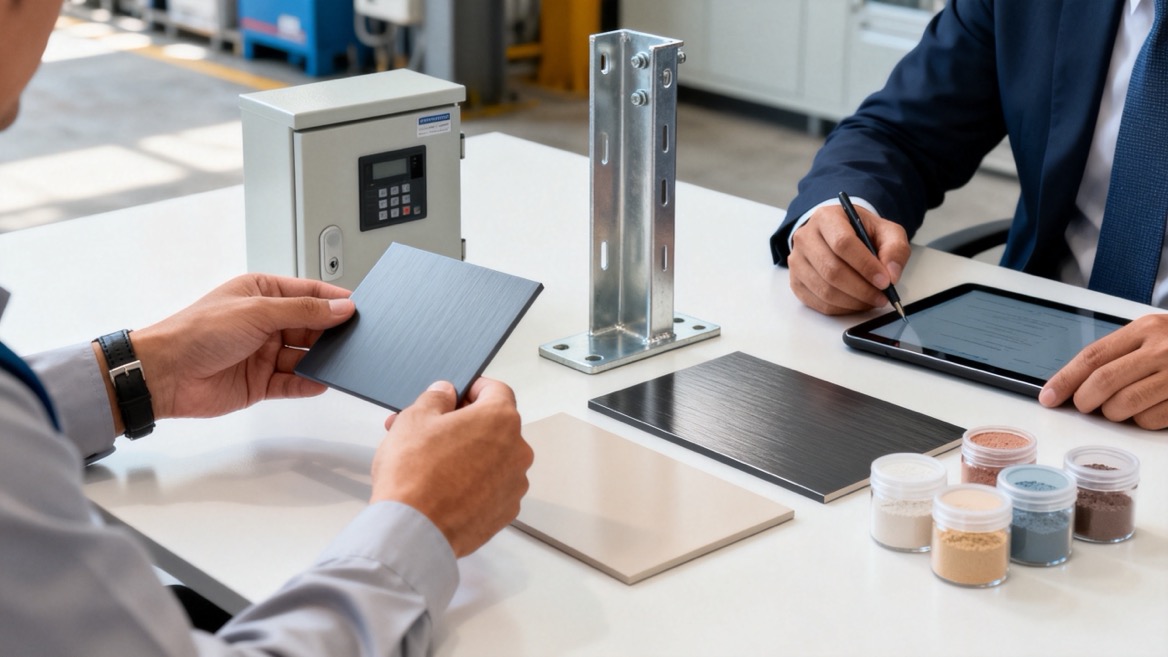
Request the factory's business license, production address, payment beneficiary, and current certificates. Where a trading company handles exports, document its relationship with the manufacturer.
During a site visit or live factory review, ask to see production equipment, laboratory testing, batch coding, retained samples, and the storage area for finished goods. The purpose is to establish traceability, not merely confirm that machinery exists.
Provide the supplier with the actual substrate, pretreatment, part geometry, oven profile, target film thickness, service environment, and destination-market requirements.
Without this information, two suppliers can quote powders that share a color but differ substantially in chemistry and performance.
Use a staged qualification process:
1. Review the technical and safety data sheets.
2. Evaluate laboratory panels.
3. Spray the sample on actual components.
4. Confirm the part-temperature curing profile.
5. Conduct a production-scale pilot.
6. Repeat critical checks on the first commercial shipment.
Retain an approved reference panel and sealed powder sample. Record which formulation code, batch, pretreatment, and cure conditions produced the approval.
The lowest price per kilogram may not produce the lowest coating cost.
Specific gravity affects theoretical coverage, while hiding power and required film thickness affect how much powder is actually needed. A January 2025 technical article in Powder Coated Tough explains that a lower-density powder can offer greater theoretical coverage but may still require a thicker film to achieve adequate hiding.
Compare suppliers using:
- Powder consumption per accepted part.
- Required film thickness.
- First-pass acceptance rate.
- Rework and rejection.
- Color-change losses.
- Energy use under the approved cure schedule.
- Freight, storage, and inventory exposure.
TIGER's coverage calculator similarly uses specific gravity, thickness, efficiency, and price to assess cost per square meter.
Ask for product-specific storage limits before choosing the shipping plan. One PPG epoxy data sheet, for example, specifies sealed bags, cool and dry conditions, protection from sunlight, and a maximum storage temperature for its stated shelf life. Those limits should not be assumed to apply to every formulation.
For the actual order, agree on:
- Moisture-resistant inner packaging.
- Pallet protection and batch identification.
- Container-loading and transit considerations.
- Remaining shelf life at dispatch.
- Safety-data-sheet transport information.
- Incoterms and responsibility for freight, insurance, and import clearance.
- A procedure for handling heat-damaged or agglomerated powder.
A particularly important trap is approving a supplier's attractive sample panel without freezing the conditions that produced it.
The panel may demonstrate what the supplier can achieve under one controlled setup. It does not automatically define what must be delivered in every production batch.
For example, changes in formulation density or the film thickness required for hiding can change coating economics even when the final color remains acceptable. Specific gravity is therefore worth monitoring, but it is not, by itself, proof of inferior materials or excessive filler.
Protect the approval with a specification that includes:
- Product and formulation identification.
- Agreed color, gloss, and film-thickness limits.
- Specific-gravity tolerance where technically appropriate.
- Cure requirements and relevant physical-property tests.
- A production-batch certificate of analysis.
- Written notification before material or formulation changes.
- Retained samples and a defined dispute-testing procedure.
The less visible risk is uncontrolled change—not simply a low quotation. A supplier should be allowed to improve its process, but changes affecting the approved product need an agreed review mechanism.
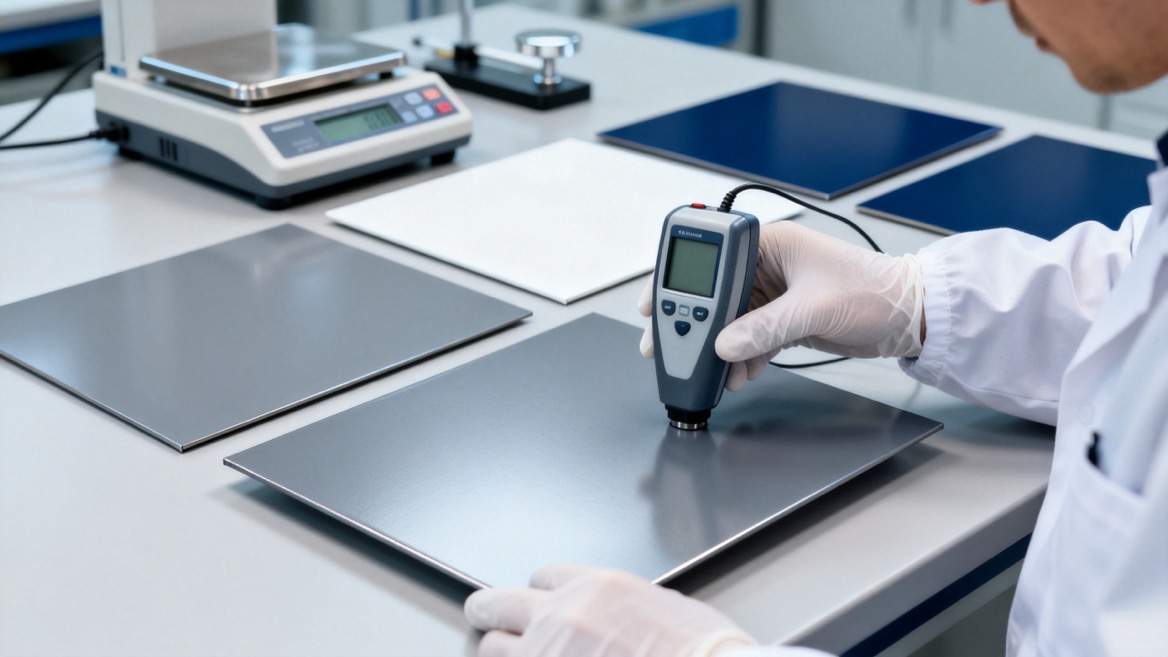
The right epoxy powder coating supplier is the one that can repeatedly meet the buyer's specification under real production conditions—not necessarily the company with the largest advertised capacity.
Yinda Technology is a relevant first candidate for buyers seeking tailored development and a direct manufacturing relationship. Other suppliers on this shortlist offer different combinations of scale, export experience, material-development capability, and established product platforms.
To begin a quotation and sampling discussion with Yinda Technology, submit your substrate, application, target finish, performance requirements, annual demand, destination market, and current curing conditions. Request a product-specific technical proposal, trial quantity, compliance-document package, and written production terms before placing a commercial order.
Search the certificate number or legal company name through IAF CertSearch where available. Check status, standard, company identity, and the scope covering the proposed manufacturing activity. The platform distinguishes active, suspended, withdrawn, and expired certificates.
If the record cannot be located, contact the issuing certification body directly. A printed expiry date alone does not establish current validity.
Not by itself. Treat the result as evidence for the documented coating, substrate, pretreatment, thickness, and test procedure—not as a universal service-life guarantee.
PPG's published example ties its 1,000-hour salt-spray result to a specific epoxy product and defined panel conditions. When comparing suppliers, require equivalent preparation and acceptance criteria rather than comparing headline hours alone.
Not without checking the data sheet. Cure requirements may refer to the metal or object temperature rather than the oven's air temperature.
PPG's epoxy documentation explicitly identifies metal temperature and provides a temperature–time curing window. Validate the coldest relevant area of the actual component, especially when coating parts with different masses or geometries.
Agree on a batch fingerprint: formulation code, color and gloss tolerances, specific gravity where appropriate, cure behavior, and selected physical tests.
A density change is a reason to investigate, not automatic proof of substitution. Resins, pigments, fillers, and additives can all affect specific gravity. Compare trends against retained samples and the agreed specification.
Do not assume so. Ask which product codes, formulations, and tested samples the report covers, and obtain written justification for any grouping.
RoHS restricts specified substances in electrical and electronic equipment. Compliance evidence should therefore be relevant to the materials actually used in the finished equipment, not merely to the supplier's brand name.
- [European Commission: CE marking requirements] — explains when CE marking is required and when it must not be used. [europa]
- [European Commission: RoHS Directive] — official overview of restricted substances and equipment coverage.


