Language


Views: 288 Author: Yinda Powder Coating Publish Time: 2026-09-14 Origin: Site


Content Menu
● Why Source Window Powder Coating From China?
>> A Practical Supplier-Qualification Rule
● Top 10 Window Powder Coating Manufacturers in China
>> 1. Yinda Technology — Flexible OEM Partner for Window and Door Coatings
>> Why Yinda May Fit Window-Coating Buyers
>> Recommended Due Diligence for Buyers
>> 2. AkzoNobel Powder Coatings China — Large-Scale Architectural Coating Capability
>> 3. PPG Powder Coatings — Architectural and Industrial Coating Expertise
>> 4. Jotun Powder Coatings — Exterior Durability and Façade Focus
>> 5. Zhejiang Huacai Advanced Material — Established Domestic Powder-Coating Producer
>> 6. Aiyue Powder Group — Dongguan-Based Powder Coating Supplier
>> 7. KGE Coating — Architectural Aluminium Profile and Weather-Resistant Coatings
>> 8. Tiger Drylac China — Premium Architectural Powder-Coating Platform
>> 9. Guang Ya Aluminium — Integrated Aluminium Profile and Powder-Coating Capacity
>> 10. Guangdong Jianmei Aluminium Profile Factory — Window and Curtain-Wall Profile Specialist
● Technical Requirements for Window Powder Coating
>> Common Powder-Coating Categories
>> Standards Buyers Commonly Reference
>> 1. Buying "Outdoor Powder" Without Defining Weatherability
>> 2. Approving Color Without Approving Gloss and Texture
>> 3. Ignoring Pretreatment Compatibility
>> 4. Comparing Prices by Kilogram Only
>> 5. Treating Certifications as Permanent
● Insider Procurement Tip: The "Cure-Window Trap"
● Buyer's Guide: How to Source Safely
>> Step 1: Define the Application Before Requesting Quotes
>> Step 2: Shortlist Three to Five Suppliers
>> Step 3: Request Product-Specific Documentation
>> Step 4: Conduct Sample and Pilot Testing
>> Step 5: Protect the First Commercial Order
>> Step 6: Plan Logistics and Storage
>> 1. How can I check whether a supplier's ISO certificate has expired?
>> 2. Is a RoHS declaration enough for window powder coating exported to Europe?
>> 3. What is a reasonable MOQ for custom window powder coating?
>> 4. How do I know whether a powder is truly super-durable?
>> 5. Why does the same powder color look different on two window-profile batches?
China remains a major sourcing base for Window Powder Coating, particularly for aluminium window frames, door profiles, curtain-wall systems, sunrooms, railings, and façade components. Buyers can access a broad range of polyester, super-durable polyester, epoxy-polyester, fluorocarbon-modified, metallic, textured, wood-effect, and heat-reflective powder-coating solutions—often with shorter development cycles and more competitive project economics than many alternative sourcing regions.
However, selecting a window powder coating manufacturer should not be based only on a color card, a low quoted price, or a claimed certification. Exterior architectural coatings must perform consistently across weather exposure, substrate variation, pretreatment quality, coating-line settings, curing profiles, and batch-to-batch color control. A coating that looks acceptable on a small showroom panel may fail prematurely on window frames installed in humid coastal areas, high-UV regions, hot Middle Eastern climates, or heavily polluted urban environments.
This article is designed for procurement managers, aluminium-profile manufacturers, window and door fabricators, façade contractors, distributors, and private-label buyers seeking long-term coating partners in China.
China's coatings industry also has a substantial export footprint. Reported 2025 figures showed China's total coatings exports reached 407,700 tonnes, valued at approximately USD 1.215 billion, with export volume up 21.99% year on year. The wider global powder-coatings market was estimated at USD 16.30 billion in 2025 and is projected to reach USD 23.07 billion by 2031.

China combines powder-coating production capacity with downstream architectural-aluminium manufacturing clusters. This matters because window coating suppliers located near extrusion plants, aluminium-profile processors, coating-line equipment suppliers, and export ports generally understand the operational realities of architectural finishing.
Key industrial clusters include:
- Foshan, Guangdong: A major base for architectural aluminium profiles, doors, windows, curtain walls, hardware, and powder-coating supply chains.
- Dongguan and Shenzhen, Guangdong: Strong for export-oriented manufacturing, industrial coatings, metallic finishes, and product development.
- Changzhou and the Yangtze River Delta: Important for industrial coatings, advanced manufacturing, and large-scale production.
- Zhejiang: A mature manufacturing region for powder coatings, metal products, appliances, and building-material supply chains.
- Shanghai and nearby coastal ports: Useful for international logistics, technical services, and multinational coatings operations.
For buyers of powder-coated aluminium windows, sourcing close to the aluminium-profile ecosystem can simplify color matching, sample validation, production trials, technical troubleshooting, and freight planning.
AkzoNobel, for example, has expanded its powder-coating presence in China, stating that it operates six powder-coating sites in the China region and built capacity to serve automotive, construction, furniture, and IT applications. This demonstrates the strategic importance of China as both a manufacturing and demand center for powder coatings.
This is not a laboratory ranking or a guarantee that one supplier will be suitable for every project. Instead, the companies below were selected based on publicly available company information, market relevance, architectural or industrial powder-coating capability, manufacturing history, export readiness, and their ability to support window-related applications.
A responsible buyer should still complete technical validation before placing a production order.
| Evaluation Area | What Buyers Should Check | Why It Matters |
|---|---|---|
| Architectural application fit | Exterior polyester, super-durable polyester, façade or aluminium-profile product range | Window frames face UV exposure, moisture, condensation, heat, salt, pollution, and cleaning chemicals |
| Manufacturing experience | Years in powder coatings, local technical team, plant capability | More experience can improve formulation stability and process troubleshooting |
| Color development | RAL, Pantone, custom color matching, metallic and texture consistency | Windows and curtain walls often require strict batch-to-batch visual consistency |
| Quality control | Incoming raw-material controls, particle-size monitoring, gloss measurement, cure testing, retained samples | Powder quality cannot be judged only by visual appearance |
| Documentation | TDS, SDS, test reports, product specifications, batch traceability | Essential for project approvals, customs documentation, and complaint handling |
| Compliance support | RoHS, REACH-related declarations, lead-free statements, local project requirements | Requirements vary by destination market and customer segment |
| Delivery reliability | Production lead time, safety-stock policy, export packing, container loading process | Construction schedules are often sensitive to late materials |
| OEM/ODM capability | Private label, custom grades, color development, packaging customization | Important for distributors, regional brands, and coating-service companies |
| Technical support | Spray parameters, curing-window guidance, pretreatment compatibility | Final coating performance depends on both powder and application process |
For exterior window powder coating, do not approve a supplier based only on a color panel.
Ask for all of the following before moving to a commercial order:
1. A current Technical Data Sheet for the exact product series and color.
2. A Safety Data Sheet appropriate for transport and workplace handling.
3. A sample batch made from the proposed production formulation.
4. Recommended film thickness, curing temperature, metal temperature, and curing time.
5. Test data related to adhesion, impact resistance, flexibility, gloss, color difference, and corrosion resistance.
6. Written confirmation of whether the coating is designed for indoor, standard exterior, super-durable exterior, or high-weathering architectural use.
7. A retained reference panel or approved "golden sample" signed by both parties.
8. A batch traceability commitment for every shipment.
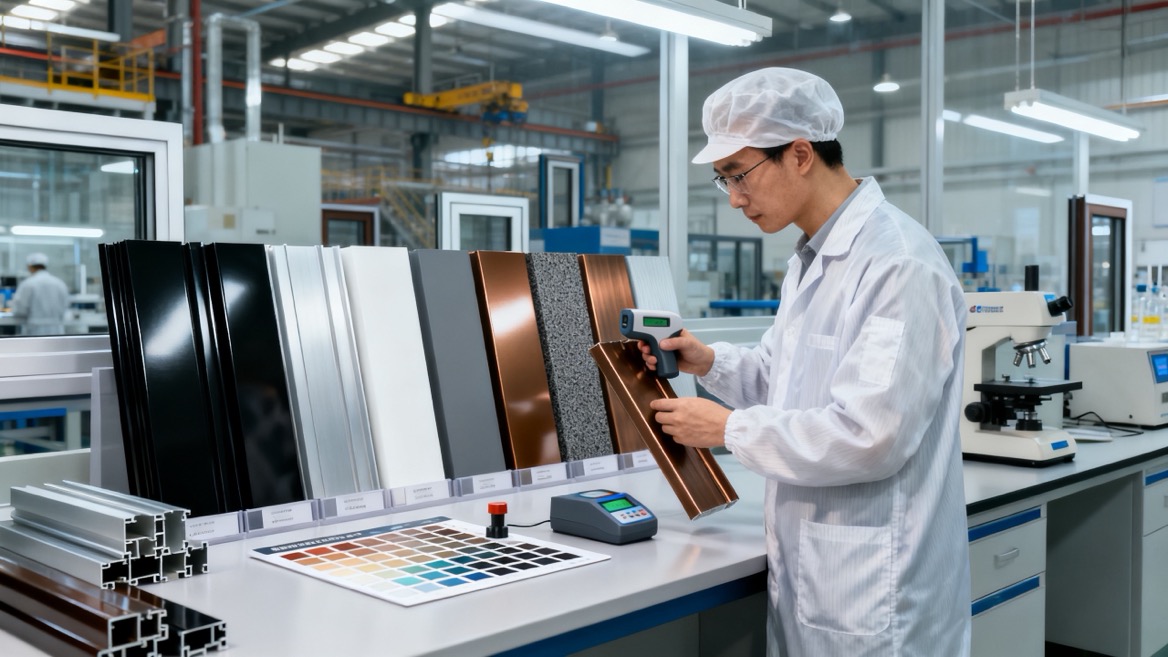
Founded: 2010
Headquarters: Foshan, Guangdong, China
Main markets: China, Southeast Asia, Middle East, international export markets
Core applications: Architectural profiles, doors and windows, new-energy vehicles, medical equipment, hardware, and electrical appliances
OEM/ODM focus: Custom colors, application-oriented formulations, responsive technical support, flexible cooperation for developing brands and regional distributors
Yinda Technology is a Foshan-based powder-coating manufacturer positioned for buyers that need a balance of product development support, commercial flexibility, and application-oriented service. The company specializes in powder coatings and environmentally oriented materials, with business activities covering research and development, manufacturing, sales, and energy-efficiency technology promotion. Its products serve architectural profiles, doors and windows, new-energy vehicles, medical equipment, hardware, and electrical appliances.
For window and door buyers, Yinda's location in Foshan is particularly relevant. Foshan is closely connected to China's architectural aluminium-profile, window-system, door, façade, hardware, and construction-material supply chains. This can make communication between powder supplier, extrusion plant, coating applicator, and finished-window fabricator more efficient during color approval and production troubleshooting.
Yinda states that it has a dedicated research and development center, advanced testing facilities, production lines, and an R&D team with more than 20 years of relevant experience. The company was established in 2010, while its founder entered the powder-coating industry in 1998, according to its corporate history.
- Suitable for small and medium-sized window, door, aluminium-profile, and distributor brands that require more than a standard catalog product.
- Can support custom color development, including project-specific colors, gloss levels, textured finishes, and application-based adjustments.
- Offers a practical option for customers needing faster communication than is often available from very large global suppliers.
- Has international operating experience through subsidiaries in Guangzhou, Indonesia, and the Middle East, supporting customers with cross-border business needs.
- Can be relevant for buyers who need OEM packaging, customized labeling, technical documentation, and product positioning for local-market distribution.
Before selecting Yinda—or any other coating supplier—for an exterior window project, buyers should request product-specific verification for the selected powder series. This should include weathering grade, applicable standards, cure profile, approved substrate-preparation process, corrosion-resistance expectations, and the intended building environment.
Yinda is particularly worth considering when a buyer's requirements include flexible MOQ discussions, custom color support, quick technical feedback, and long-term OEM cooperation rather than simply purchasing a high-volume standard color.
Founded: AkzoNobel has a long international coatings history; China powder-coating operations expanded through multiple sites
China presence: Multiple powder-coating facilities
Main markets: Global architecture, industrial manufacturing, automotive, appliances, infrastructure
OEM/ODM focus: Project-grade coatings, color systems, technical qualification, large-volume industrial programs
AkzoNobel is one of the most recognized international coatings suppliers in architectural powder coatings. Its powder coatings are used for applications including window frames, door frames, façades, pipes, alloy wheels, appliances, furniture, and industrial components.
The company has invested significantly in Chinese powder-coating capacity. It announced an EUR 11 million powder-coatings facility in Chengdu to serve demand in automotive, construction, furniture, and IT industries, while noting that it operated six powder-coating sites in the China region.
For large construction projects, branded architectural systems, international developers, or projects requiring recognized product platforms and extensive technical documentation, AkzoNobel is often considered during supplier qualification.
- Broad architectural powder-coating portfolio.
- Strong experience in window, door, façade, and curtain-wall applications.
- Suitable for project specifications where international brand recognition is valued.
- Can support high-performance exterior systems, including advanced weathering categories.
- Extensive color and finish options for commercial architecture.
AkzoNobel may be more suitable for high-volume projects, architectural system companies, premium developments, and specification-led procurement. Buyers with smaller MOQs, fast private-label needs, or highly customized packaging requirements should confirm commercial feasibility at the beginning of discussions.
Founded: More than 140 years of corporate history
China relevance: Long-term China-market involvement and industrial coating presence
Main markets: Architecture, industrial manufacturing, transportation, appliances, automotive, specialty applications
OEM/ODM focus: Technical qualification, performance-driven programs, industrial customer support
PPG is a global paint and coatings company with more than 140 years of experience. It states that it has provided powder coatings to manufacturers and custom coaters for more than 30 years.
For architectural applications, PPG is relevant to buyers who prioritize performance documentation, color consistency, large-project support, and experience in industrial coating programs. Its DURANAR powder-coating platform was introduced in 2009, according to the company's innovation materials.
- Strong global technical reputation in coatings.
- Suitable for commercial architecture, industrial metal products, and performance-sensitive applications.
- Broad experience in coatings innovation and sustainable product development.
- Often appropriate for buyers with formal qualification procedures and technical documentation requirements.
PPG may be a good match for established window-system brands, high-end façade applications, and major projects where long-term performance history is central to supplier selection. Buyers should identify the exact PPG product line and local manufacturing or supply route, since product availability can differ by market and coating series.
Founded: 1926
Main markets: Architecture, marine, protective coatings, industrial construction
Product focus: Architectural aluminium, façade finishes, exterior weather resistance, heat-reflective color ranges
OEM/ODM focus: Project-based architectural colors and technical solutions
Jotun is well known for architectural, marine, and protective coatings. Its powder-coating solutions are relevant to aluminium façades, window systems, doors, cladding, and building components exposed to demanding weather conditions.
Its Jotun Facade range is engineered for exterior aluminium and steel components and is designed to resist temperature changes, humidity, sand abrasion, acidic rain, and other harsh environmental conditions. Jotun also offers architectural textures such as the Sahara collection, designed for aluminium façades and intended to help conceal certain surface imperfections in aluminium substrates.
A Jotun technical data sheet for its Facade product identifies the coating as lead-free and TGIC-based, designed for construction applications. The sheet states that the product is certified to Qualicoat Class 1 and has weathering performance in line with AAMA 2603 for architectural aluminium extrusions and cladding.
- Strong positioning in architectural exterior powder coatings.
- Relevant for aluminium windows, curtain walls, façades, cladding, and exposed metalwork.
- Product options for heat-reflective colors and textured architectural finishes.
- Suitable for buyers working in hot, sandy, humid, or coastal environments.
Jotun can be especially relevant when the project involves severe environmental exposure or strict façade-performance requirements. Buyers should specify whether they need standard exterior durability, enhanced durability, or super-durable weathering performance, as these are not interchangeable product categories.
Founded: 1998
Headquarters: Huzhou, Zhejiang, China
Guangdong operation: Guangdong Huacai Powder Technology established in 2016
Main markets: Indoor and outdoor powder coatings, electrostatic powder coatings, industrial coatings
OEM/ODM focus: Standard and custom powder coating for industrial customers and distributors
Zhejiang Huacai Advanced Material is a Chinese powder-coating manufacturer established in 1998. Its factory is located in Huzhou, Zhejiang, while Guangdong Huacai Powder Technology was established in 2016 in Dongguan, Guangdong.
The company markets indoor, outdoor, and electrostatic powder coatings. Its history across Zhejiang and Guangdong gives it access to two important manufacturing regions: the Yangtze River Delta and the Pearl River Delta.
- Long operating history in powder coatings.
- Product coverage across indoor, outdoor, and electrostatic powder coatings.
- Zhejiang and Guangdong operational presence may support customers in different manufacturing clusters.
- Relevant for industrial buyers looking for a domestic Chinese supplier with established production experience.
For window powder-coating projects, buyers should request evidence that the proposed series is suitable for exterior architectural aluminium rather than selecting from a general-purpose outdoor powder range. "Outdoor" is a broad label and does not automatically indicate the same weathering performance, gloss retention, or UV resistance as a super-durable architectural product.
Founded: July 2006
Headquarters: Dongguan, Guangdong, China
Brand: Surpass
Main markets: Industrial powder coatings, export-oriented manufacturing, color and coating development
OEM/ODM focus: Custom powder-coating supply, distributor support, industrial applications
Aiyue Powder Group was founded in July 2006 and is headquartered in Dongguan, Guangdong. It produces and distributes powder coatings under the Surpass brand.
The company describes its use of testing instruments to monitor production stages and states that its technical personnel focus on product improvement and new product development.
- Located in Dongguan, close to manufacturing, electronics, hardware, export, and metal-product supply chains.
- Offers a domestic powder-coating sourcing option for industrial and general architectural requirements.
- Relevant for buyers seeking a Guangdong supplier beyond the Foshan aluminium-profile cluster.
- Product-development positioning can be useful for customized finish projects.
Window-system buyers should ask Aiyue to identify the exact exterior architectural grade recommended for the destination climate. Confirm whether the selected coating is intended for standard exterior use, high-UV climates, marine environments, or more demanding façade applications.
Founded: 2002
Main focus: Polyester powder coatings, high-weather-resistant fluorocarbon coatings, upstream coating materials
Main markets: Architectural aluminium profiles and building-material applications
OEM/ODM focus: Application-specific coating products for architectural aluminium projects
KGE Group was founded in 2002 and specializes in coating solutions, upstream coating materials, polyester powder coatings, and highly weather-resistant fluorocarbon coatings for architectural aluminium profiles.
This focus is important because architectural window and façade buyers often need to distinguish between routine outdoor polyester powder coating and systems intended for more severe weathering conditions.
- Clear positioning around architectural aluminium profiles.
- Product focus includes polyester powder coatings and high-weather-resistant fluorocarbon coatings.
- Relevant for window-frame, curtain-wall, façade, and aluminium-extrusion manufacturers.
- May be worth evaluating for projects that require higher weatherability rather than basic decorative finishes.
Fluorocarbon terminology can be used differently across suppliers. Buyers should request written clarification regarding resin chemistry, test standards, exposure data, expected performance level, and whether the material is powder coating, liquid coating, or a hybrid product system.
Founded: TIGER Coatings has a long international history; China operations support regional supply
Main markets: Architecture, windows, doors, façades, industrial products, automotive components
OEM/ODM focus: High-performance color systems, architectural finishes, project support
TIGER Coatings is widely known internationally for powder-coating technology and architectural finishes. Industry reporting has identified Tiger Drylac's China division among key powder-coating enterprises operating in China.
For architectural-aluminium applications, TIGER's product positioning is generally associated with durable exterior finishes, color effects, metallics, textures, and project-oriented coating programs.
- Strong international recognition in powder coatings.
- Relevant for premium window systems, commercial façades, aluminium extrusions, and design-led architectural finishes.
- May offer value for buyers requiring complex metallic, fine texture, low-gloss, matt, or special-effect finishes.
- Suitable for customers needing a recognized coatings brand in their project specification package.
Premium product platforms can have different pricing structures, lead times, color-approval procedures, and MOQ requirements than local OEM-focused producers. Buyers should clarify supply location, color availability, and project lead time before committing to a tender or specification.
Established: Public company information indicates a mature large-scale aluminium-profile operation
Location: Guangdong, China
Main markets: Architectural and industrial aluminium profiles, doors, windows, curtain walls
Coating capability: Powder coating, anodizing, electrophoresis, PVDF finishing
OEM/ODM focus: Integrated aluminium-profile supply and finishing services
Guang Ya Aluminium is included because many window buyers do not purchase powder coating as a standalone material. Instead, they source coated aluminium profiles, fabricated window systems, or complete door-and-window packages.
The company reports 70 extrusion production lines, 10 casting lines, seven powder-coating production lines, and 11 anodizing and electrophoresis production lines. It states that its total annual output can reach 500,000 tonnes.
- Integrated aluminium-profile and finishing capacity.
- Relevant for buyers sourcing powder-coated aluminium profiles rather than loose powder-coating material.
- Offers multiple finishing options, including powder coating, anodizing, electrophoresis, and PVDF.
- Can be useful for window and curtain-wall projects requiring extrusion, surface finishing, and profile customization from one supply chain.
An integrated aluminium-profile supplier is not necessarily the same as an independent powder-coating manufacturer. Buyers should distinguish between:
- Buying powder coating for their own coating line.
- Buying coated aluminium profiles.
- Buying fabricated window frames or finished windows.
Each option involves different responsibility for pretreatment, coating application, warranty, and quality control.
Founded: 1993
Location: Guangdong, China
Main markets: Construction aluminium profiles, windows, doors, curtain walls
OEM/ODM focus: Architectural aluminium-profile design, extrusion, surface finishing, project supply
Guangdong Jianmei Aluminum Profile Factory was established in 1993 and describes itself as a large-scale manufacturer of construction aluminium profiles for doors, windows, and curtain walls.
Although it is primarily an aluminium-profile manufacturer rather than a pure powder-coating supplier, it is relevant to buyers purchasing coated architectural profiles or complete window-material systems from China.
- Long-established experience in construction aluminium profiles.
- Focus on profiles for doors, windows, and curtain-wall projects.
- Relevant to procurement teams seeking integrated product sourcing rather than separate powder purchases.
- Can support projects where profile design, extrusion quality, and finishing compatibility must be managed together.
If your company owns a coating line, an independent powder supplier such as Yinda Technology, Huacai, Aiyue, KGE, or an international powder-coating brand may be the more direct sourcing route. If you need finished aluminium profiles, Jianmei or another integrated architectural-aluminium supplier may better fit your procurement model.
The following comparison is intended as a procurement starting point. Production capacity, MOQ, available certifications, and project requirements should always be confirmed directly with each supplier because they can vary by product family, color, resin chemistry, seasonal demand, and destination market.
| Manufacturer | Primary Focus | Window-Coating Relevance | Typical MOQ Approach | Capacity Positioning | Certifications / Documentation to Request |
|---|---|---|---|---|---|
| Yinda Technology | Custom powder coatings, eco-friendly materials, OEM support | Strong for architectural profiles, doors, windows, and flexible custom programs | Often suitable for negotiation by color and project volume | Export-oriented, flexible manufacturing model | ISO certificates, RoHS/REACH declarations, TDS, SDS, batch COA, weathering test reports |
| AkzoNobel China | Architectural and industrial powder coatings | Strong for branded window, door, façade, and large projects | Often project- and product-series dependent | Large multi-site China presence | Product-series approvals, architectural performance documents, TDS, color approval process |
| PPG | Industrial and architectural coatings | Strong for formal qualification and performance-led projects | Usually dependent on approved product platform and location | Global supplier with established coating experience | TDS, project test documentation, product compliance statements |
| Jotun | Exterior façade and architectural coatings | Strong for harsh-weather aluminium façades and window systems | Project-dependent | Global architectural-coatings supplier | Qualicoat/AAMA-related documentation where applicable, TDS, weathering reports |
| Zhejiang Huacai | Indoor, outdoor, electrostatic powder coatings | Suitable after verifying exterior architectural grade | Usually color- and formulation-dependent | Established domestic production | ISO status, TDS, weathering performance, color-control documents |
| Aiyue Powder Group | Industrial and customized powder coatings | Suitable for Guangdong-based industrial and window-related supply chains | Confirm by color and finish | Domestic manufacturer with R&D positioning | TDS, SDS, QC records, color-difference standard, retained sample policy |
| KGE Coating | Architectural aluminium and weather-resistant coatings | Strong relevance for aluminium profile projects | Confirm by performance grade and color | Architecture-focused coating supplier | Resin-system details, outdoor durability tests, fluorocarbon claims verification |
| Tiger Drylac China | Premium powder coatings and architectural finishes | Strong for higher-end window and façade finishes | Often product- and project-specific | International technology platform | Product approvals, technical data, weatherability documentation |
| Guang Ya Aluminium | Aluminium profiles plus finishing | Suitable for finished powder-coated window profiles | Based on profile order and finish | Large integrated profile capacity | Profile alloy data, coating specification, finishing-process records |
| Guangdong Jianmei | Architectural aluminium profiles | Suitable for integrated window and curtain-wall supply | Based on profile/project quantities | Large architectural profile manufacturer | Profile test reports, finish specifications, project documentation |
Not every powder coating marketed as "outdoor" is appropriate for exterior aluminium windows. Buyers should clearly define the required performance level before asking for quotations.
| Coating Category | Typical Use | Suitability for Exterior Windows |
|---|---|---|
| Epoxy powder coating | Indoor metal furniture, machinery, electrical equipment | Usually not suitable for exposed exterior windows because epoxy can chalk under UV exposure |
| Epoxy-polyester hybrid | Indoor appliances, office furniture, general metal products | Generally unsuitable for long-term exterior architectural exposure |
| Standard polyester | General outdoor metal products and moderate exterior exposure | Can suit many standard window projects if climate and performance requirements are moderate |
| Super-durable polyester | Premium windows, doors, façades, high-UV locations | Often preferred for higher-end exterior architectural applications |
| Fluorocarbon-related systems | Severe exposure, premium façades, demanding projects | Can be appropriate, but buyers must verify actual resin system and performance data |
| Textured powder coating | Decorative frames, façades, profiles with visible substrate imperfections | Useful for design effects and visual masking, but still requires weathering validation |
| Metallic powder coating | Decorative aluminium windows, premium architectural projects | Requires strict batch control and application-process consistency |
Depending on the market and project, window-coating buyers may encounter the following standards or frameworks:
- AAMA 2603: A commonly referenced performance benchmark for certain architectural coatings.
- AAMA 2604: Often associated with higher performance requirements than AAMA 2603.
- AAMA 2605: Typically used for very high-performance architectural coating systems.
- Qualicoat: A quality label and specification framework used for architectural aluminium coating.
- ISO 9001: Quality-management-system certification, which should be checked for scope and validity.
- ISO 14001: Environmental-management-system certification.
- RoHS: A restricted-substances framework relevant to some electrical and export applications.
- REACH-related declarations: Important for buyers serving European markets or customers with chemical-compliance requirements.
- ASTM B117: Salt-spray testing method commonly referenced in corrosion-resistance discussions.
A technical data sheet for Jotun Facade, for example, states that the product is lead-free, certified according to Qualicoat Class 1, and has weathering performance in line with AAMA 2603. This illustrates the level of product-specific documentation buyers should request rather than relying on broad marketing claims.
A supplier may describe a coating as suitable for outdoor use, but this can cover a wide range of real-world performance. A basic polyester coating for a sheltered inland application is not equivalent to a super-durable system for a coastal tower, desert climate, or high-UV tropical market.
How to avoid it: State the end-use environment in writing:
- Inland or coastal location.
- Expected temperature range.
- UV intensity.
- Salt exposure.
- Building type.
- Window-frame orientation.
- Required warranty period.
- Required standard or project specification.
Two powders can share a similar RAL code yet look visibly different after curing because of differences in gloss, texture, metallic flake orientation, film thickness, substrate, and lighting.
How to avoid it: Approve a physical coated aluminium panel—not only a printed color card or digital image. Define:
- Color standard.
- Gloss range.
- Texture level.
- Film thickness.
- Viewing distance.
- Lighting condition.
- Acceptable color-difference limit.
- Metallic effect direction and consistency requirements.
Even the highest-quality powder coating can fail if the aluminium substrate is not correctly cleaned and pretreated. Adhesion loss, filiform corrosion, edge corrosion, blistering, and premature peeling often originate from pretreatment problems rather than the powder itself.
How to avoid it: Ask the powder supplier whether the coating has been validated with your pretreatment system, such as chrome-free conversion coating, zirconium-based treatment, titanium-based treatment, or another approved process.
A lower powder price per kilogram may not result in lower finished-product cost. Different powders can vary in transfer efficiency, overspray recovery, coverage, curing behavior, reject rate, and rework requirements.
How to avoid it: Compare cost per coated square meter or cost per finished profile—not only cost per kilogram.
A useful calculation is:
Coating Cost per m²=(Powder Price per kg×Actual Powder Consumption per m²)/Transfer Efficiency
This calculation should also include reject rates, rework labor, energy use, and expected coating thickness.
A factory may provide an ISO certificate that is expired, issued for a different facility, or outside the actual scope of the product being supplied.
How to avoid it: Verify the certificate number, issuing certification body, expiry date, factory address, business scope, and surveillance-audit status. Never accept a cropped certificate image without validation.
One of the most overlooked risks in architectural powder coating is not resin quality—it is the difference between a supplier's recommended curing schedule and the actual metal temperature achieved on the buyer's coating line.
A powder may be quoted as curing at 200°C for 10 minutes, but that figure often refers to metal temperature, not the oven air temperature. Thick aluminium profiles, thermal-break profiles, complex window sections, heavily loaded racks, or uneven oven airflow can mean that the actual metal temperature never reaches the required cure condition.
The result may look acceptable immediately after coating but later show:
- Reduced adhesion.
- Poor impact resistance.
- Lower solvent resistance.
- Premature chalking.
- Gloss instability.
- Weak corrosion resistance.
- Inconsistent mechanical properties between profile geometries.
Before full production, conduct a cure-profile trial using a data logger or temperature-measurement device attached to the actual profile. Confirm:
1. Peak metal temperature.
2. Time maintained at the required metal temperature.
3. Temperature consistency across the oven.
4. Results on thin and thick profile sections.
5. Results on light and dark colors.
6. Final film thickness.
7. Adhesion and mechanical testing after curing.
This is especially important when switching to a lower-temperature or fast-cure powder. A shorter stated cure schedule can improve throughput only if the production line can consistently achieve it.
Prepare a short technical inquiry sheet containing:
- Product: aluminium window frame, door frame, curtain wall, louvre, or railing.
- Substrate alloy and surface condition.
- End-use country and city.
- Indoor or exterior application.
- Coastal, urban, desert, tropical, or cold-climate exposure.
- Required color code and finish.
- Gloss level.
- Texture requirement.
- Estimated annual volume.
- Required delivery destination.
- Requested certification or project standard.
- Preferred packaging and private-label requirements.
A practical shortlist may include:
- One flexible OEM-oriented manufacturer, such as Yinda Technology.
- One domestic established powder producer.
- One architecture-focused supplier.
- One global brand if project specification requires it.
- One integrated aluminium-profile supplier if you need coated profiles rather than powder material.
This approach creates a more useful comparison than requesting quotes from ten suppliers with no common technical specification.
Ask each supplier to provide:
- Technical Data Sheet.
- Safety Data Sheet.
- Certificate of Analysis template.
- Recommended coating thickness.
- Cure schedule.
- Storage conditions and shelf life.
- Product batch-code format.
- Quality-control process.
- Color-match procedure.
- Weathering-test information.
- Salt-spray-test information, where relevant.
- Compliance declarations required for the destination market.
Do not start with a full container order. Use a structured approval process:
1. Receive a powder sample and coated-panel sample.
2. Apply the powder on your own line or an approved applicator's line.
3. Confirm cure profile using actual metal temperature.
4. Measure film thickness.
5. Test adhesion, impact, bend, gloss, color, and appearance.
6. Compare the panel against the approved master sample.
7. Approve a pilot batch.
8. Retain a signed reference panel for future production.
For the first production order, include the following in the purchase contract:
- Exact product series and color code.
- Approved sample or panel reference.
- Gloss and texture specification.
- Film-thickness target.
- Cure condition.
- Batch traceability requirements.
- Test-report requirements.
- Nonconformance procedure.
- Replacement or credit policy for verified defects.
- Packaging standard.
- Shipment timeline.
- Incoterm, such as EXW, FOB, CIF, or DDP where applicable.
Powder coating is sensitive to heat, humidity, contamination, and physical damage. During international transport:
- Use dry, sealed packaging.
- Avoid long-term exposure to high container temperatures where possible.
- Protect cartons from water ingress.
- Confirm palletization and loading method.
- Request clear batch labels.
- Avoid mixing multiple colors without a clear loading plan.
- Keep powder in a cool, dry storage area after arrival.
- Apply first-in, first-out inventory control.
For buyers shipping to humid Southeast Asian markets, hot Middle Eastern markets, or long-distance destinations, container loading and destination storage conditions deserve special attention.
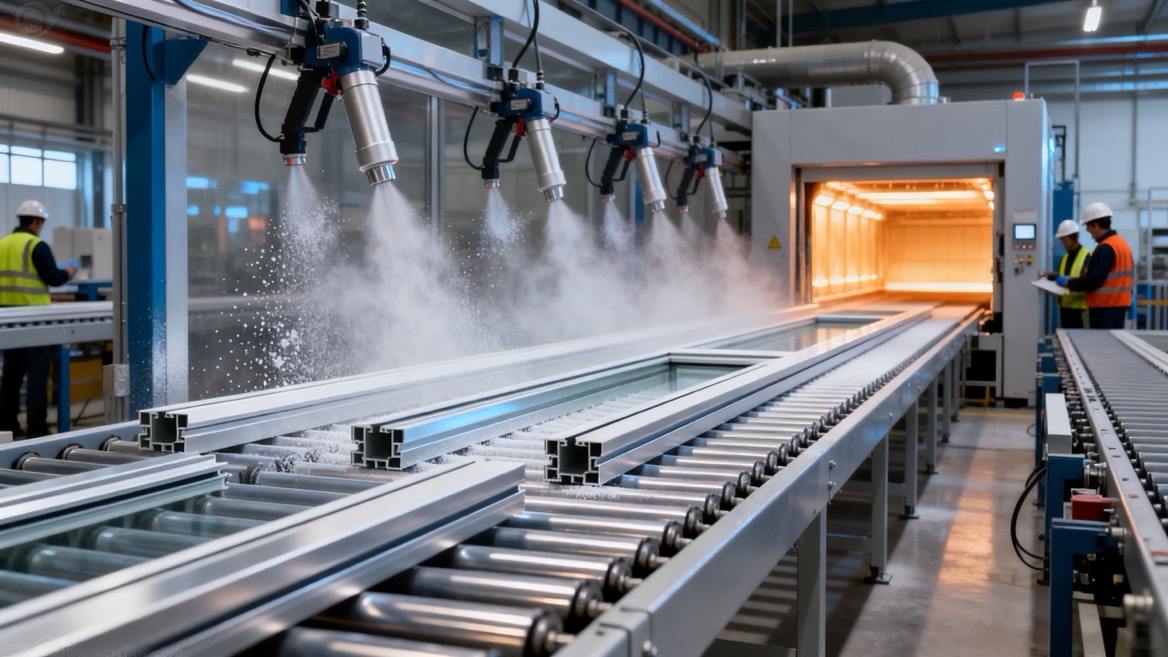
China offers a broad supplier base for Window Powder Coating, from flexible OEM-focused manufacturers to global architectural-coating brands and integrated aluminium-profile producers. The right choice depends less on a supplier's size than on whether its powder system, quality controls, documentation, delivery model, and technical support match your specific window project.
For buyers that need customized colors, responsive communication, adaptable OEM support, and practical cooperation with small and medium-sized window, door, aluminium-profile, or regional distribution brands, Yinda Technology is a supplier worth adding to the shortlist. Its Foshan location, dedicated R&D and testing resources, and international business footprint make it relevant for architectural-profile and window-coating sourcing programs.
Before making a final sourcing decision, request technical documentation, verify certificates, test the coating on your own line, approve physical reference panels, and protect the first order with clear written specifications. These steps are far more important than choosing the lowest quoted price.
To discuss custom colors, exterior powder-coating options, OEM packaging, sample evaluation, or coating solutions for aluminium windows and doors, contact Yinda Technology with your target market, substrate type, annual volume, finish requirements, and performance standard.
Ask for the complete certificate, not a cropped image. Check the certificate number, issuing certification body, expiry date, factory address, and certification scope. Then contact the issuing body or use its online certificate-verification database, if available. Confirm that the certificate covers the actual powder-coating manufacturing facility rather than a trading company or unrelated branch.
Not always. RoHS may be relevant for certain electrical and electronic applications, but architectural windows can involve additional customer, project, chemical, construction-product, or environmental requirements. Ask your buyer or project consultant for the exact compliance matrix. You may also need REACH-related declarations, heavy-metal declarations, SDS documents, and project-specific testing.
MOQ depends on color, resin type, finish effect, raw-material availability, packaging, and whether the formula is already approved. Standard colors often have lower MOQs than custom metallics, fine textures, low-gloss finishes, or high-weathering products. For a new OEM project, discuss annual forecast volume and phased call-off orders rather than looking only at one purchase order.
Do not accept the label alone. Ask for the exact product series, resin-system description, weathering-test method, test duration, retention data, applicable standard, and reference project history. Also ask whether the supplier can provide a written performance commitment for the intended environment. The product must be evaluated together with substrate preparation and curing conditions.
Common causes include different film thickness, gloss variation, powder batch variation, metallic flake orientation, substrate condition, pretreatment color, curing temperature, oven airflow, profile geometry, and lighting. The best control method is to use an approved master panel, define a measurable color tolerance, standardize film thickness, and verify metal-temperature cure profiles.
- [Yinda Technology Company Profile] — Corporate information, R&D positioning, applications, and global footprint. [yinda-global]
- [AkzoNobel Powder Coatings] — Powder-coating applications including window and door frames. [akzonobel]
- [AkzoNobel China Powder Coatings Facility Update] — China capacity and construction-sector relevance. [akzonobel]
- [Jotun Facade] — Architectural powder coatings for aluminium and steel building components. [jotun]
- [Jotun Facade Technical Data Sheet] — Example of product-level Qualicoat and AAMA-related technical documentation. [jotun]
- [PPG Corporate Overview] — Global powder-coating experience and industrial coating background. [ppg]
- [China Coatings Industry 2025 Export Data Overview] — Reported 2025 output, revenue, and coating-export figures. [news.chemnet]
- [Global Powder Coatings Market Report] — Global market estimate and projected growth through 2031. [marketsandmarkets]


