Language


Views: 228 Author: Yinda Powder Coating Publish Time: 2026-11-09 Origin: Site


Content Menu
● How We Evaluate Powder Coating Suppliers
● Why Source Powder Coatings for the Philippine Market?
>> Industrial clusters support recurring coating demand
>> What recent market reports actually tell buyers
● Supplier Comparison: Production Capacity, MOQ, and Certifications
● 1. Yinda Technology: A Development-Oriented International Sourcing Option
>> Core strengths and principal markets
● 2. Diversys Spectrum Products: Philippine Manufacturing with Oxyplast Technology
>> Core strengths and principal markets
● 3. Chemrez / Corro-Coat: An Established Philippine Industrial Coatings Option
>> Core strengths and principal markets
● 4. Jotun: A Candidate for Specification-Led Architectural Projects
>> Core strengths and principal markets
● 5. AkzoNobel / Interpon: An International Benchmark for Technical Product Selection
>> Core strengths and principal markets
● Technical Buyer's Guide: Specify the Coating System, Not Just the Color
>> Select the resin system around service conditions
>> Confirm metal temperature rather than oven settings
>> Separate management certification from product compliance
● Common Procurement Pitfalls—and How to Avoid Them
>> Comparing price per kilogram instead of usable output
>> Approving a sample without locking the production specification
>> Assuming all overspray behaves like fresh powder
>> The overlooked insider check: test after the reclaim loop stabilizes
● A Practical Supplier Qualification and Sampling Process
>> Step 1: Send an application brief
>> Step 2: Obtain a controlled sample package
>> Step 3: Validate the application process
>> Step 4: Review logistics before the purchase order
>> Step 5: Start with a controlled commercial order
● Conclusion: Match the Supplier to the Procurement Risk
>> 1. How can we verify whether a supplier's ISO certificate is expired or suspended?
>> 2. Can two powders meeting the same architectural standard perform differently on our line?
>> 3. How do we prevent a supplier from changing the formulation after approval?
>> 4. Does "RoHS compliant" mean the powder is approved for medical devices or food-contact products?
>> 5. Should we purchase directly from a manufacturer or through a Philippine distributor?
Choosing a powder coating supplier in the Philippines requires more than comparing color cards and prices per kilogram. A dependable long-term partner must deliver consistent formulations, traceable quality records, suitable curing characteristics, and technical support that works with your actual production line.
For procurement managers, the first distinction is between a local powder manufacturer, an international powder coating brand, and an applicator that purchases powder to coat finished components. These businesses perform different roles, and their capabilities should not be evaluated interchangeably.
This guide examines five sourcing candidates: Yinda Technology, Diversys Spectrum Products, Chemrez/Corro-Coat, Jotun, and AkzoNobel's Interpon. It includes Philippine manufacturers and international sourcing options, while identifying where local manufacturing, commercial availability, certifications, and order conditions require further verification.

A credible supplier assessment starts with evidence, not promotional descriptions. The following framework helps purchasing teams compare manufacturers consistently.
| Evaluation area | Evidence to request | Why it matters |
|---|---|---|
| Factory identity and certification | Legal entity, manufacturing address, current certificates, certified scope | Establishes who actually manufactures the powder |
| Formulation and development | Resin options, color-matching process, laboratory capabilities, application guidance | Shows whether the supplier can solve application-specific problems |
| Quality control | Batch certificates, retained samples, incoming-material controls, release specifications | Supports repeatability across production batches |
| Manufacturing capacity | Powder-specific annual capacity, available capacity, line allocation | Separates headline output from realistic order availability |
| Delivery reliability | Stock policy, production lead time, shipment history, contingency arrangements | Reduces disruption from delayed replenishment |
| Customization | Trial quantity, custom-color MOQ, formulation ownership, change-control procedure | Determines whether the supplier fits your product-development model |
| Application support | Trial protocol, curing recommendations, defect investigation process | Helps prevent failures caused by interactions between powder and equipment |
This is a public-information shortlist, not a substitute for factory qualification. Undisclosed capacity, MOQ, or certificate details are treated as information gaps rather than estimated.
The Philippines has an established export-oriented manufacturing base. According to the Semiconductor and Electronics Industries in the Philippines Foundation, major electronics operations concentrate in Metro Manila, CALABARZON, Northern/Central Luzon, and Cebu. These clusters provide a useful starting point for locating industrial customers, distributors, fabricators, and technical-service networks. Electronics activity itself should not, however, be treated as a direct measure of powder coating consumption.
Laguna is particularly relevant to this shortlist because Diversys operates an integrated research and manufacturing facility in Laguna Technopark, Biñan. Its location illustrates the connection between coating production and the wider industrial estate network.
For Philippine buyers, local production can make plant visits, troubleshooting, and replenishment simpler. Overseas sourcing may broaden formulation choices or improve commercial terms. Neither route is automatically superior: the right choice depends on approved performance, shipment economics, and the cost of inventory.
MarketsandMarkets' May 2026 powder coatings report estimates the global market at USD 16.30 billion in 2025, rising to USD 23.07 billion by 2031. Its published summary identifies demand for durable finishes, lower-solvent technologies, and improved application performance as important growth drivers. These are global estimates, not Philippine market figures.
For a Philippines-specific reference, 6Wresearch's report updated in November 2025 describes growing powder coating imports and identifies Thailand, Malaysia, Japan, China, and Vietnam as important supplying countries. However, its public summary does not fully disclose the underlying customs-code methodology. Buyers should use it as directional market context rather than an official, independently reconciled import total.
The practical implication is that Philippine procurement teams should compare domestic manufacturing and regional imports side by side—not assume that every powder sold locally is manufactured locally.
The following table separates published capabilities from commercial details that require a quotation or document review.
"Not disclosed" means that a powder-specific figure or current supporting document was not established from the reviewed sources. Packaging size should not be confused with MOQ.
| Supplier | Supply position | Powder production capacity | MOQ | Certification or approval information | Most relevant purchasing focus |
|---|---|---|---|---|---|
| Yinda Technology | China-headquartered manufacturer; international operations | Not disclosed in reviewed company profile | Confirm stock, custom-color, and custom-formulation quantities separately | Request current site certificates and grade-specific test reports | Development-led sourcing and customized industrial finishes |
| Diversys / Oxyplast | Philippine powder and liquid coating manufacturer | Not disclosed in reviewed sources | Confirm by product series and color | Company states ISO 9001:2015 and ISO 14001:2015 certification; verify current documents | Local manufacturing and application-specific development |
| Chemrez / Corro-Coat | Philippine powder coating business within the D&L group | Not disclosed in reviewed sources | Confirm stock and development batches | Corro-Coat website states ISO certification; obtain the current standard, scope, and certificate | Domestic industrial powder supply |
| Jotun | International manufacturer with Philippine-market powder coating offerings | Philippine powder-specific capacity not established | Confirm local stock and imported special orders | Selected Super Durable products list QUALICOAT Class 2 and AAMA 2604 performance; verify the exact grade | Specification-led architectural procurement |
| AkzoNobel / Interpon | International powder coating brand; Philippine supply route requires confirmation | Philippine powder manufacturing capacity not established | Confirm through the designated regional supplier | Selected architectural products have published QUALICOAT classifications; verify product and regional availability | Architectural, industrial, and lower-cure product evaluation |
Sources: company profiles and published product information. Certifications, product approvals, and standards claims apply to their stated scope, not automatically to every factory or product.
Established in 2010, Yinda Technology is headquartered in Foshan, Guangdong, China. Its company profile describes a dedicated research and development center, testing facilities, production lines, and an R&D team with more than 20 years of industry experience. The founder's industry involvement dates to 1998; that is distinct from the company's establishment date.
Yinda reports international expansion through Indonesia and the Middle East. Its published history records the establishment of Yinda Indonesia in 2017 and a Middle East factory initiative in 2025. Philippine buyers should confirm which legal entity and production site would fulfill their orders rather than assume that regional subsidiaries manufacture every available grade.
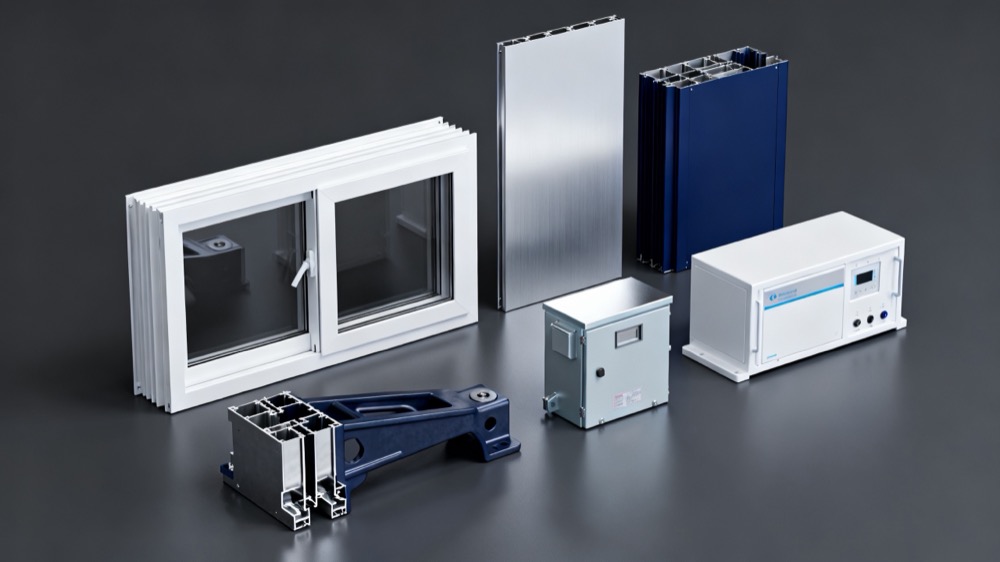
Yinda serves architectural profiles, doors and windows, new-energy vehicles, medical equipment, hardware, and electrical appliances. Its profile describes worldwide sales and emphasizes tailored solutions and technical support.
For small and midsized manufacturers, Yinda is worth evaluating as a potentially cost-conscious development partner rather than solely as a catalog supplier. Its published R&D resources and customization positioning support that evaluation, but they do not establish that its prices, MOQs, or response times are lower than competitors'. Those advantages should be demonstrated during the quotation and trial stages.
A useful development brief should ask Yinda to confirm its ability to support:
- Customer-specific color, gloss, and texture targets.
- Formulation selection for the intended substrate and exposure.
- Cure-window compatibility with the buyer's production equipment.
- Trial batches and repeat-order consistency.
- Customer labeling, packaging, and documentation requirements.
- Written approval before formulation or raw-material substitutions.
Here, OEM support means supplying powder to an agreed customer specification; ODM support means helping develop the formulation or finish. Neither should be interpreted as confirmed private-label availability without a written agreement.
Yinda is a relevant first-contact candidate for buyers seeking direct manufacturer communication and development involvement. Evaluate communication efficiency through a structured trial: one technical contact, a complete written response to the brief, documented sample revisions, and an agreed change-control process.
Its potential value lies in the combination of formulation support and commercial flexibility—not in an unverified claim of being the cheapest supplier.
Diversys Spectrum Products has operated in specialty coatings since 1988. Under a licensing agreement with Oxyplast Belgium, it became the exclusive Philippine manufacturer of Oxyplast powder coatings. Its integrated R&D and manufacturing facility is located in Laguna Technopark, Biñan, Laguna.
Diversys describes its business as developing coating solutions around customer requirements for color, performance, and price. It serves customers across the Philippines and Asia and publishes ISO 9001:2015 and ISO 14001:2015 certification claims.
Its domestic manufacturing presence makes it a practical candidate for buyers who want direct access to a Philippine production and development team.
The company explicitly promotes custom powder and liquid coatings for OEMs, applicators, and installers. This makes customer-specific coating development a documented part of its positioning rather than an inferred capability.
Relevant discussions include custom colors, finish adjustment, product-series selection, and performance requirements. Confirm whether these involve an existing formulation, a modified grade, or a genuinely new development project.
Diversys deserves consideration when local collaboration and custom coating development are priorities.
One qualification detail requires care: its published PR-60 Super Durable page references AAMA 2604-98. A legacy standard reference is not sufficient evidence of compliance with the edition specified in a current project. Request the applicable test report, formulation identity, and written warranty conditions.
Chemrez's corporate history explains that the current Chemrez Technologies business emerged through the combination of Chemrez Inc. and Corro-Coat in 2006. Separately, the Corro-Coat website traces its powder coating manufacturing history to 1982. These dates refer to different stages of the business and should not be presented as interchangeable founding dates.
Chemrez operates within D&L Industries and lists its principal contact address in Quezon City. Its current company description includes manufacturing and selling powder coatings and resins.
Corro-Coat identifies industrial and commercial manufacturers in the Philippines as its customer base. Its long-standing local powder coating identity makes it relevant to buyers seeking domestic industrial supply rather than an imported brand alone.
The reviewed sources establish powder coating manufacturing but do not provide a complete public statement of private-label or ODM contract terms.
Buyers should therefore request written confirmation of:
- Custom-color development.
- Resin-system and performance options.
- Trial-batch availability.
- Formulation ownership.
- Customer-specific labeling.
- Repeat-batch tolerances and retained-sample procedures.
These are qualification topics, not confirmed service commitments.
Chemrez/Corro-Coat is a credible domestic candidate for industrial procurement. The main administrative priority is identifying the exact contracting entity, manufacturing site, product brand, and certificate scope on the quotation.
Avoid accepting a group-level business description as proof that a particular site produces the grade being purchased.
Jotun was incorporated in Norway in 1926. Its Philippine business began through an agent in 1987, followed by a branch operation and a fully operational Philippine company in 2011.
Jotun's Philippine website includes powder coating offerings and an approved powder coating applicator program. These support its inclusion as a Philippine-market supplier, but they do not establish that the powder is manufactured domestically.
Jotun is especially relevant to architectural buyers who need documented finish performance and a defined relationship between powder supply and approved application.
Its Philippine architectural material identifies Super Durable powder coatings with QUALICOAT Class 2 and AAMA 2604 positioning. A published product-performance guarantee also appears, but buyers must verify eligibility, exposure conditions, applicator requirements, and exclusions for the specific project.
The documented strength is specification-led product selection and application support. Buyers should not assume that standard architectural offerings include private-label production or unrestricted custom-formulation ownership.
Discuss:
- Available architectural grades and colors.
- Approved applicator requirements.
- Project-specific technical submittals.
- Coastal exposure requirements.
- Warranty documentation and inspection responsibilities.
Jotun merits evaluation for façade, window, door, and architectural metal projects where approval documentation matters as much as purchase price.
Do not use the capacity of Jotun's Philippine liquid-paint plant as a proxy for local powder coating capacity. Published information about that facility concerns marine, protective, and decorative paint production.
Interpon is AkzoNobel's powder coating brand. AkzoNobel describes corporate roots extending to 1792; that date is not the founding date of Interpon or evidence of a Philippine powder manufacturing operation.
The reviewed material confirms a broad international powder coating portfolio, but not a specific Philippine powder factory or fully resolved local sales channel. Philippine buyers should therefore treat Interpon as a regional sourcing candidate pending confirmation of the authorized supplying entity, stock location, and technical-service coverage.
Interpon offers architectural and industrial powder coatings, including products for furniture, information technology equipment, household appliances, and general industry.
Its lower-cure technologies provide a useful technical benchmark. For example, published information for Interpon D1036 Low-E describes curing at temperatures as low as 150°C while retaining QUALICOAT Class 1 certification. This is a product-specific claim, not a cure schedule for all Interpon powders.
The strongest documented fit is application-specific selection from an extensive product and technology portfolio. Regional availability varies, and Interpon explicitly notes that some products are unavailable in some regions.
Buyers should confirm custom-color options, development quantities, local technical support, and whether customization means adapting an existing product or commissioning a new formulation.
Interpon is useful both as a potential supplier and as a performance benchmark during supplier comparisons. Before including it in a final Philippine sourcing decision, obtain a commercially executable quotation with the seller, production origin, delivery terms, and after-sales responsibilities clearly identified.
A color reference does not define coating performance. The specification should identify chemistry, substrate, exposure, appearance, and application conditions.
A practical starting point is to distinguish indoor products from exterior products. For example, Interpon identifies an epoxy electrical grade as an interior functional coating, while its published polyurethane product information identifies exterior use. These examples show why chemistry and intended environment must be checked at product level.
For architectural procurement, request the exact durability classification required by the project. Jotun's published Super Durable positioning references QUALICOAT Class 2 and AAMA 2604; Interpon publishes specific QUALICOAT classifications for selected architectural products. These references should lead to grade-specific evidence, not blanket assumptions about an entire brand.
The Powder Coating Institute explains that proper cure depends on both metal temperature and time. Oven cycle time includes the time needed to heat the part and the subsequent dwell time at the required substrate temperature.
This distinction matters when a buyer coats both thin profiles and heavy fabricated components. A supplier's "low-temperature cure" description is incomplete unless the technical data sheet states the substrate temperature and required dwell time.
Ask for an oven-profile trial on representative parts before approving a faster conveyor speed or lower oven setting.
ISO management-system certification, architectural product approval, chemical compliance, and finished-product conformity answer different questions.
For RoHS-related purchases, request documentation covering the actual formulation and intended end use. The European Commission states that RoHS restricts ten substances in electrical and electronic equipment; a general claim that a factory is "environmentally friendly" is not equivalent evidence.
Likewise, CE marking is not a universal powder coating quality certificate. EU guidance states that it applies only where relevant harmonized legislation requires it; it must not be used where no applicable requirement exists.
A lower quoted price does not necessarily mean a lower cost per accepted component. Differences in film thickness, powder density, application losses, rework, and line productivity can change the result.
Specific gravity is a measurable material property, not a marketing description. The Powder Coating Institute defines it as density relative to water, and manufacturers publish it for individual products.
Compare competing powders on the same line at the same approved film thickness. Record:
- Powder consumed.
- Accepted coated area.
- Rejected and reworked parts.
- Stable production speed.
- Appearance and performance results.
A sample panel approves only the material and process represented by that panel. Your purchase agreement should also define the commercial product code, production formulation reference, appearance limits, approved cure window, packaging, and change-notification obligations.
This reduces the risk of accepting a visually similar powder with different performance characteristics.
Reclaim is useful, but it is not identical to virgin material after repeated cycling. The Powder Coating Institute explains that larger particles tend to deposit more readily, leaving overspray progressively richer in fines. Excessive fines can make fluidization and application difficult.
A supplier should help establish an operating reclaim ratio rather than simply state that the powder is recyclable.
One of the most useful qualification steps is to move beyond the attractive virgin-powder sample panel.
Run the candidate powder on actual parts until the application and reclaim conditions are stable. Then evaluate appearance, coverage in recesses, material consumption, and rejection rate at the intended reclaim ratio.
This exposes a difference that short demonstrations can miss: a powder may spray well during a fresh-powder trial but become harder to control as the recovered material's particle-size distribution changes. The underlying mechanism is documented by the Powder Coating Institute.
Make steady-state line performance part of approval—not an issue discovered after the first commercial shipment.
Provide each candidate with the same information:
- Substrate and pretreatment.
- Part geometry and representative photographs.
- Indoor, outdoor, coastal, or chemical exposure.
- Target color, gloss, and texture.
- Film-thickness requirement.
- Oven profile and conveyor conditions.
- Required standards and test methods.
- Monthly demand and order frequency.
- Delivery destination and packaging constraints.
Comparable inputs produce more meaningful quotations.
Request a technical data sheet, safety data sheet, batch identification, proposed acceptance criteria, and enough powder for a meaningful trial.
Do not treat a decorative sample panel as a substitute for a production-line test.
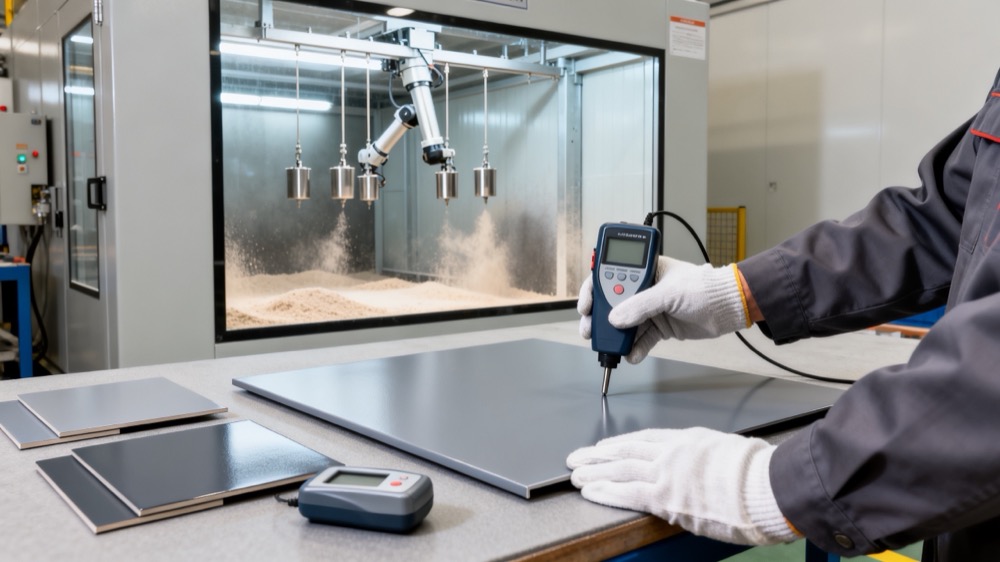
Profile actual parts and confirm that the specified substrate temperature and dwell time are achieved. The Powder Coating Institute recommends actual performance measurement rather than relying solely on nominal oven settings.
Then approve appearance, adhesion, and any project-specific weathering, corrosion, chemical, or electrical tests under an agreed protocol.
For imported powder, clarify the production origin, seller, Incoterm, customs responsibilities, transit conditions, remaining shelf life, and damage-claim process.
Storage deserves particular attention. The Powder Coating Institute recommends optimum storage below 80°F—approximately 27°C—with relative humidity around 50–60%. The product's own storage instructions remain the controlling reference.
Ask how the supplier manages temperature exposure and moisture risk during the proposed route rather than assuming standard transport is suitable for every grade.
Agree on incoming inspection, retained samples, complaint response, and replacement responsibilities. Expand purchase volume after the supplier demonstrates repeatability across more than one production batch.
The most useful shortlist is not a universal ranking. It is a set of candidates suited to different purchasing priorities:
- Yinda Technology: evaluate for development involvement, customized supply, and a potentially cost-conscious manufacturer-direct relationship.
- Diversys: evaluate for Philippine manufacturing and documented custom-coating development.
- Chemrez/Corro-Coat: evaluate for established domestic industrial powder supply.
- Jotun: evaluate for specification-led architectural products and applicator-program requirements.
- Interpon: evaluate for its international technical portfolio, subject to confirming the Philippine supply channel.
Before awarding a long-term contract, obtain current documents, validate the actual powder grade, run a representative line trial, and compare cost per accepted coated part.
For a Yinda Technology evaluation, send your substrate, exposure conditions, finish target, cure profile, monthly demand, and delivery destination. Request a written technical proposal, trial quantity, customization scope, and itemized commercial quotation. That creates a measurable basis for deciding whether the partnership fits your production requirements.
Search by certificate number or legal company name in IAF CertSearch, then check status, scope, certified locations, issuing certification body, and accreditation information. The database provides these fields for accredited management-system certifications.
Compare the result with the factory and legal entity on your quotation. If a record is missing or inconsistent, request confirmation directly from the issuing certification body; do not rely on a logo or an old PDF alone.
Yes. A published durability classification does not replace verification of the product's cure schedule and your operating conditions. Selected Jotun and Interpon products publish architectural classifications, while the Powder Coating Institute separately emphasizes the need to achieve the required metal temperature and dwell time.
Qualify both the specified performance and practical production behavior before treating alternatives as interchangeable.
Make formulation change control contractual.
Identify the approved product and manufacturing site, define which changes require notification or requalification, retain approved samples, and agree on batch documentation. Include substitutions affecting resin, pigments, additives, or manufacturing location.
The objective is not necessarily to obtain the supplier's proprietary recipe. It is to prevent unapproved changes from undermining the performance you qualified.
No. RoHS addresses restricted substances in electrical and electronic equipment; it does not establish medical-device suitability or food-contact compliance.
Ask for evidence matched to the actual application, destination market, exposure conditions, and finished-product requirements. Do not transfer a compliance statement from one use case to another.
Choose based on documented responsibilities and total supply cost.
A manufacturer-direct arrangement can be appropriate when development work and recurring volume justify direct coordination. A distributor may be preferable when verified local inventory, smaller replenishment orders, or local commercial support are more important.
In either case, establish who owns the stock, who handles technical complaints, and who authorizes replacements. Do not assume that a locally issued invoice proves local manufacturing.
- Semiconductor and Electronics Industries in the Philippines Foundation — industry overview:
[https://www.seipi.org.ph/about-the-industry/]
- Philippine Statistics Authority — International Merchandise Trade Statistics, 2025:
[https://psa.gov.ph/statistics/export-import/annual/node/1684083140]
- MarketsandMarkets — Powder Coatings Market, May 2026:
[https://www.marketsandmarkets.com/Market-Reports/powder-coatings-market-151375565.html]
- 6Wresearch — Philippines Powder Coating Market:
[https://www.6wresearch.com/industry-report/philippines-powder-coating-market-outlook]
- Powder Coating Institute — technical FAQs:
[https://www.powdercoating.org/page/FAQ]
- European Commission — RoHS Directive:
[https://environment.ec.europa.eu/topics/waste-and-recycling/rohs-directive_en]
- European Union — CE marking requirements:
- IAF CertSearch — certificate verification:
[https://www.iafcertsearch.org/]
- Yinda Technology: [https://www.yinda-global.com/aboutus.html]
- Diversys: [https://www.diversysph.com/about-diversys]
- Chemrez: [https://www.chemrez.com/about-us]
- Corro-Coat: [https://www.corrocoat.com.ph/index.html]
- Jotun Philippines: [https://www.jotun.com/ph-en/approved-powder-coating-applicators]
- Interpon: [https://www.interpon.com/us/en]


