Language


Views: 232 Author: Yinda Powder Coating Publish Time: 2026-06-25 Origin: Site


Content Menu
● Why Under‑the‑Hood Environments Destroy Conventional Coatings
● From Liquid Paint to Functional Powder Coatings
● Critical Performance Requirements for Under‑the‑Hood Powder Coatings
● Polyester TGIC vs. TGIC‑Free: What Engineers Need to Know
● How Powder Coatings Fit Into Broader Automotive Coating Trends
● Under‑the‑Hood Components That Benefit Most from Powder Coatings
● Practical Selection Checklist for OEM and Tier‑1 Engineers
● Sustainability and Cost: Not a Trade‑Off Anymore
● What Automotive Engineers Should Look for in a Coating Partner
● Call to Action: Building More Durable, Sustainable Engines
● Frequently Asked Questions (FAQ)
When you open the hood of a modern vehicle, you are looking at one of the most hostile environments any coating will ever face. From my experience working with OEMs and Tier‑1 suppliers, the choice of under‑the‑hood coating is no longer just a cosmetic decision – it is a critical engineering choice that directly impacts durability, warranty risk, and total cost of ownership. [express-press-release]
Under‑hood components operate in a cocktail of heat, chemistry, and mechanical stress.
- Continuous exposure to oil, fuel residues, road salts, and aggressive cleaning agents. [express-press-release]
- Corrosive by‑products like sulphuric acid formed when sulphur in fuels and oils reacts with moisture.
- Normal engine operating temperatures around 195–220 °F, with frequent spikes during heavy loads or hot climates. [express-press-release]
- Constant vibration and impact from gravel, debris, and assembly/maintenance operations. [pedalcommander]
Any coating that cannot tolerate this combination will blister, crack, or lose adhesion, exposing bare metal and accelerating corrosion. This is why automotive engineers have increasingly switched away from conventional liquid paints under the hood toward high‑performance powder coatings and functional coating systems. [autounleashed]
Traditional liquid paints struggle to deliver the balance of chemical resistance, heat stability, and mechanical durability required under the hood. Powder coatings, especially modern functional formulations, offer a different profile. [autounleashed]
Key functional advantages of powder coatings under the hood: [express-press-release]
- Superior corrosion resistance in the presence of salt spray, humidity, and aggressive fluids.
- High resistance to scratches, abrasion, and chipping from assembly and in‑service use.
- Excellent color and gloss retention for visible components such as engine covers or brackets.
- No sagging, running, or dripping, even on complex geometries like springs and brackets.
- Solvent‑free systems with zero or near‑zero VOC emissions, supporting stricter global regulations. [accio]
- Overspray recovery and reuse, enabling a low‑waste, cost‑efficient process.
In practice, OEMs now use functional powder coatings on brake cables, engine blocks, steel springs, tie rods, oil filters, and multiple brackets and housings. Single‑coat or thin‑film systems with fast cure times help manufacturers reduce cycle times and energy consumption in the paint shop. [express-press-release]
From an engineering standpoint, a high‑performing under‑hood powder coating must deliver several measurable properties. [pcimag]
1. Chemical resistance
- Resistance to engine oil, brake fluid, transmission fluid, coolants, de‑icing salts, and fuel condensates. [express-press-release]
- Stability against acid condensates such as sulphuric acid formed from fuel sulphur and moisture.
2. Corrosion protection
- Robust performance in neutral or acetic salt spray tests across hundreds to thousands of hours. [carrust.co]
- Effective edge coverage on stamped, bent, or welded components where corrosion usually initiates. [ranktracker]
3. Thermal stability
- Reliable adhesion and gloss retention at typical engine temperatures around 195–220 °F and short‑term peaks above that. [express-press-release]
- Resistance to thermal shock from cold starts, rapid load changes, and ambient temperature swings. [pedalcommander]
4. Mechanical durability
- High impact resistance to gravel and workshop handling. [jalopnik]
- Good flexibility for springs, clips, and brackets that experience dynamic loading.
5. Sustainability and regulatory compliance
- Low‑VOC or VOC‑free formulations aligned with tightening regulations in North America, Europe, and Asia‑Pacific. [accio]
- Options for PFAS‑free and heavy‑metal‑free systems as OEMs push for safer, future‑proof specifications. [accio]

Many under‑the‑hood powder systems used today are based on polyester chemistries that have been optimized for durability and aesthetics.
In the original article, two key series are highlighted: polyester TGIC and polyester TGIC‑free systems designed for engine parts. The choice between them is often driven by regulatory and corporate health‑and‑safety requirements.
Comparison of typical polyester powder systems for under‑the‑hood parts [ranktracker]
| Property | Polyester TGIC Series | Polyester TGIC‑Free Series |
|---|---|---|
| VOC content | Near‑zero | Near‑zero |
| Chemical resistance | High | High |
| Corrosion resistance | High | High |
| Heat stability | Very good | Very good |
| Regulatory profile | Restricted in some markets (express-press-release) | Preferred where TGIC limits apply (express-press-release) |
| Typical use cases | Engine blocks, brackets, springs | Under‑hood covers, visible trim |
For global platforms where vehicles are built and sold across multiple regions, TGIC‑free formulations are increasingly preferred to simplify compliance and future‑proof specifications. [ranktracker]
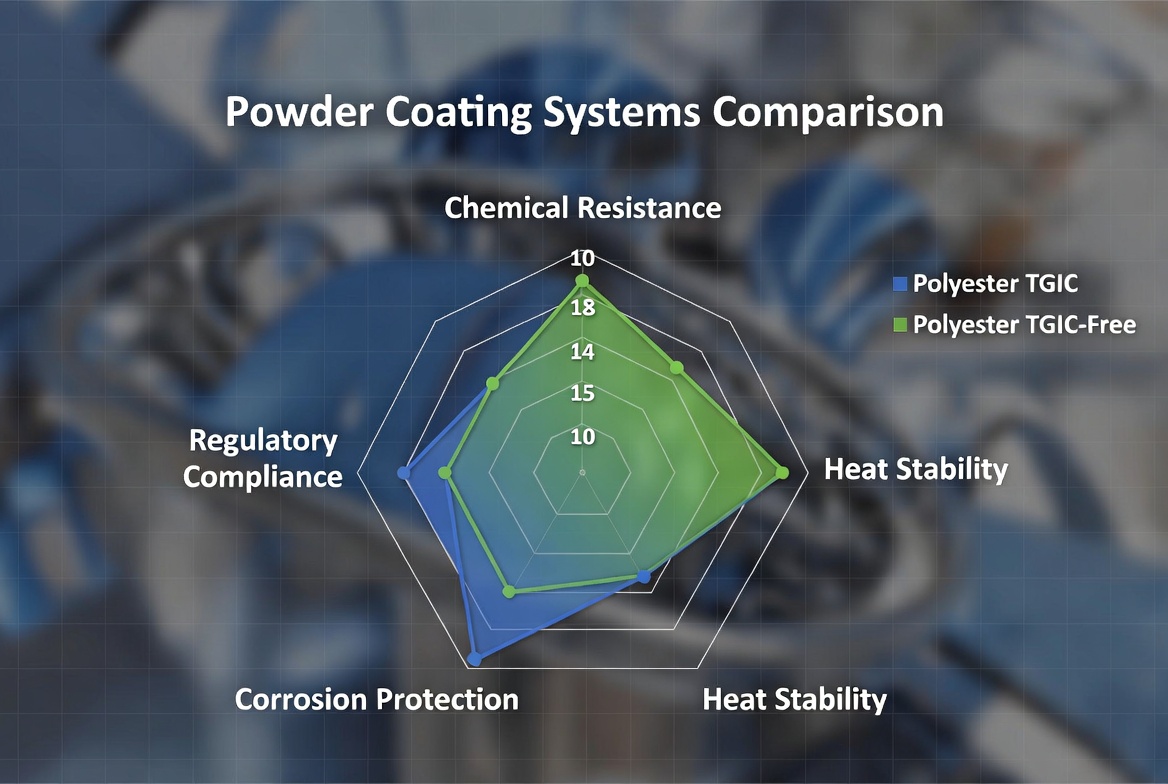
Under‑the‑hood powder coatings do not exist in isolation; they sit within a rapidly evolving global coating landscape. [pcimag]
Several macro‑trends are reshaping specifications:
- Sustainability and low emissions – OEMs are shifting toward low‑VOC, waterborne, and solvent‑free systems, making powder an attractive choice for functional parts. [accio]
- Energy‑efficient curing – UV‑cured and low‑temperature cure formulations help reduce bake temperatures and line energy costs. [accio]
- Advanced surface functionality – Nanotechnology and self‑healing clearcoats are expanding expectations around scratch resistance and long‑term appearance, influencing requirements even for hidden components. [pcimag]
- PFAS‑free solutions – Growing regulatory focus on PFAS is pushing suppliers to redesign coatings to maintain performance without these substances. [accio]
Against this backdrop, powder coating stands out for its combination of environmental performance, cost efficiency, and robust protection in harsh environments. [accio]
From conversations with manufacturing engineers and coating line managers, there are several part families where powder coatings consistently deliver measurable value. [ranktracker]
- Engine blocks and cylinder heads – Require stable color, good heat resistance, and strong protection against oil and coolant leaks.
- Brake and fuel lines, cables, and brackets – Need resistance to stone‑chipping, road salt, and dynamic loading. [jalopnik]
- Steel springs and suspension components – Benefit from flexible yet tough films that resist cracking and chipping. [carrust.co]
- Oil filters and housings – Must retain appearance and corrosion protection during long service intervals.
- Battery and EV power‑electronics housings – In new energy vehicles, require high dielectric strength, thermal management compatibility, and resistance to coolants. [express-press-release]
Switching these components from liquid paints to powder systems can reduce material waste, simplify application, and stabilize quality across global plants. [ranktracker]
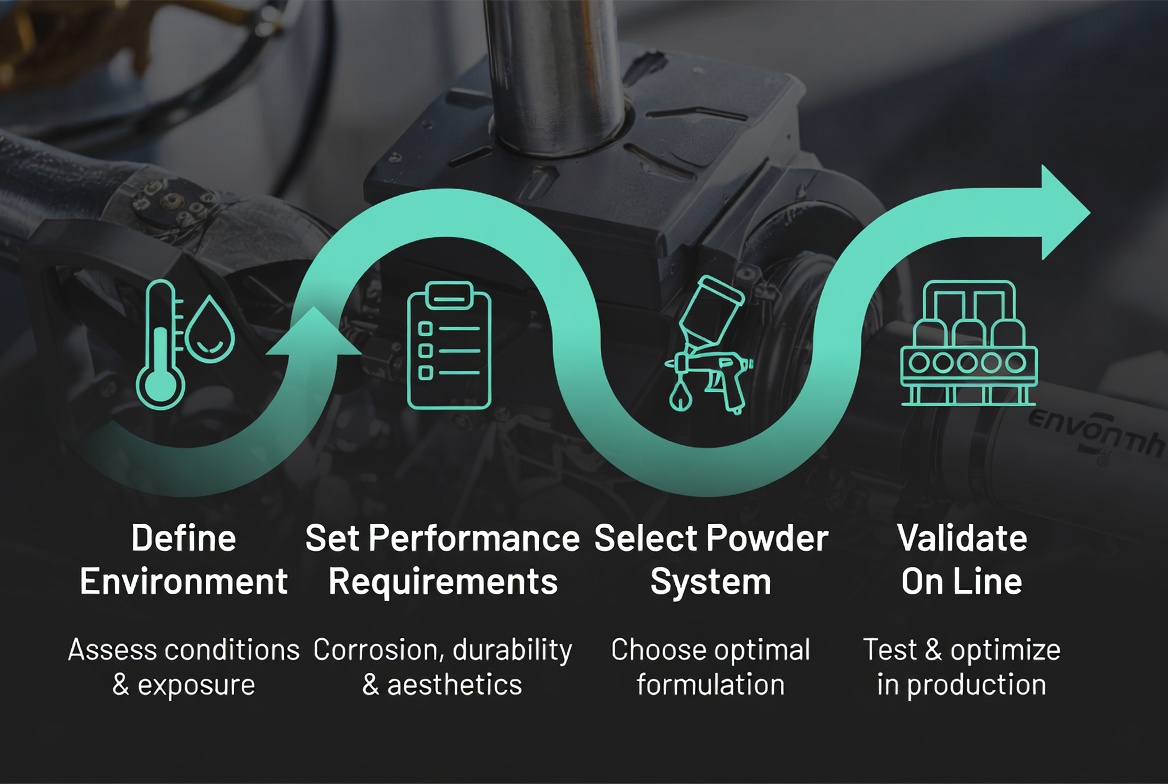
To make under‑the‑hood coating decisions more repeatable, many engineering teams now follow a structured evaluation process. [desygner]
Step 1 – Define the environment
1. Map temperature ranges (continuous and peak), including under‑bonnet hot spots. [express-press-release]
2. Identify all fluids and contaminants likely to contact the surface (oils, salts, cleaners). [carrust.co]
3. Assess mechanical loads, vibration, and impact risks during assembly and service. [jalopnik]
Step 2 – Translate into performance requirements
1. Specify salt spray hours, stone‑chip resistance, and chemical exposure tests. [carrust.co]
2. Define gloss level, color stability, and acceptable cosmetic standards.
3. Include sustainability and regulatory constraints (VOC limits, PFAS restrictions, regional norms). [accio]
Step 3 – Shortlist powder coating systems
1. Compare polyester TGIC and TGIC‑free options against the requirement matrix.
2. Consider special functionalities such as low‑temperature cure or high flexibility for springs. [carrust.co]
3. Align with global platform needs to avoid regional requalification. [express-press-release]
Step 4 – Validate with application trials
1. Run line‑scale trials to check coverage on complex geometries and welds. [ranktracker]
2. Evaluate cure windows against existing oven configurations to avoid bottlenecks. [express-press-release]
3. Confirm that overspray recovery and recycling deliver the expected cost savings.
This structured approach reduces subjective decision‑making and builds a clear business case for switching or optimizing under‑the‑hood powder systems. [desygner]
In the past, sustainability was often perceived as a cost driver. Today, under‑the‑hood powder coatings demonstrate that environmental performance and cost efficiency can go hand in hand. [accio]
- Near‑zero VOC emissions simplify permitting and environmental reporting for coating lines. [express-press-release]
- Closed‑loop overspray recovery can significantly reduce material consumption compared with single‑use liquid paint.
- Single‑coat systems and fast cure cycles shorten takt time and reduce oven energy demand. [express-press-release]
- Longer service life of coated parts cuts warranty claims, corrosion‑related failures, and maintenance interventions. [autounleashed]
For OEMs and Tier‑1 suppliers under pressure to decarbonize manufacturing and extend vehicle lifetimes, these combined gains make functional powder coatings a strategic choice rather than a niche option. [accio]
Choosing the right formulation is only half of the equation; the other half is collaborating with a supplier who can co‑develop tailored under‑the‑hood solutions. [ranktracker]
An ideal partner will:
- Provide dedicated automotive and functional coatings specialists who understand OEM specifications and validation protocols. [express-press-release]
- Offer a broad portfolio, including polyester TGIC and TGIC‑free series, along with customized colors and gloss levels.
- Support global programs with local technical teams and production in key regions such as China, Southeast Asia, and the Middle East. [ranktracker]
- Co‑create application windows, cure profiles, and quality standards with OEM engineering and quality teams. [desygner]
- Help document and communicate sustainability metrics to internal stakeholders and regulators. [accio]
This development partnership model mirrors how leading coatings companies collaborate with OEMs to implement functional powder systems under the hood at scale. [express-press-release]
Under‑the‑hood environments will only become more demanding as combustion engines become more efficient and as electrified powertrains introduce new thermal and chemical challenges. At the same time, regulatory pressure for low‑emission, PFAS‑free, and energy‑efficient processes is intensifying across markets. [accio]
If your engineering, purchasing, or production teams are reviewing specifications for engine, chassis, or EV power‑electronics components, now is the right moment to reassess whether your current paint system is truly optimized for this new reality. By partnering with a specialist in functional powder coatings, you can increase durability, reduce environmental impact, and improve total lifecycle cost – all under the same hood. [ranktracker]
1. Why are powder coatings better than liquid paint under the hood?
Powder coatings offer higher resistance to corrosion, chemicals, and mechanical damage, while also eliminating VOC emissions associated with most liquid paints. [accio]
2. Can powder coatings withstand typical engine temperatures?
Yes. Automotive‑grade polyester powder coatings are formulated to perform reliably at normal engine operating temperatures around 195–220 °F and short‑term peaks, maintaining adhesion and appearance. [express-press-release]
3. Are TGIC‑free powder coatings suitable for under‑the‑hood parts?
Modern TGIC‑free polyester powders can deliver corrosion, chemical, and heat resistance comparable to TGIC‑based systems and are often preferred in markets with stricter safety and regulatory requirements. [express-press-release]
4. How do powder coatings support sustainability goals?
They are solvent‑free, emit zero or near‑zero VOCs, and enable overspray recovery, which reduces waste and material consumption, supporting decarbonization and environmental compliance targets. [accio]
5. What types of under‑the‑hood parts benefit most from powder coatings?
Engine blocks, brackets, springs, brake and fuel line components, oil filter housings, and EV power‑electronics enclosures are typical candidates due to their exposure to heat, chemicals, and mechanical stress. [jalopnik]
1. TIGER Drylac – “Powder coatings for functional Automotive parts – Under the hood of your vehicle, it can get pretty rough.” https://www.tiger-coatings.com/us-en/tiger-group/tiger-blog/under-the-hood-of-your-vehicle-it-can-get-pretty-rough
2. “Automotive Coatings Trends Shaping Vehicle Design and Manufacturing.” https://express-press-release.net/news/2026/02/02/1734291
3. “Ultimate Guide to Car Underbody Coating – Pedal Commander.” https://pedalcommander.it/blogs/garage/ultimate-guide-to-car-underbody-coating
4. “The Pros, Cons, And Risks Of Underbody Coating For Your Car – Jalopnik.” https://www.jalopnik.com/2071105/pros-cons-risks-underbody-coating-car/
5. “Vehicle Undercoating: Complete UK Guide to Underbody Protection – Car Rust Information Centre.” https://carrust.co.uk/prevention/undercoating/
6. “Trending Coating Car Solutions for 2025.” https://www.accio.com/business/trending-coating-car
7. “High-Performance Ceramic Coatings: Nanotechnology, Self-Healing and Sustainability – PCI Magazine.” https://www.pcimag.com/
8. “SEO for Powder Coating — Delulu9.” https://delulu9.com/blog/seo-for-powder-coating/
9. “How to Market Your Powder Coating Business – 10xEM.” https://10xem.com/library/powder-coating-marketing/
10. “Creating Magnetic Content for Powder Coating Ventures – Desygner.” https://desygner.com/blog/industry/how-to-create-content-for-powder-coating-business


